

Ships within 24 hours Free delivery for orders over 350 EURO Wide selection of high-quality laboratory products Ships within 24 hours Free delivery for orders over 350 EURO Wide selection of high-quality laboratory products Ships within 24 hours Free delivery for orders over 350 EURO Wide selection of high-quality laboratory products Ships within 24 hours Free delivery for orders over 350 EURO Wide selection of high-quality laboratory products Ships within 24 hours Free delivery for orders over 350 EURO Wide selection of high-quality laboratory products Ships within 24 hours Free delivery for orders over 350 EURO Wide selection of high-quality laboratory products Ships within 24 hours Free delivery for orders over 350 EURO

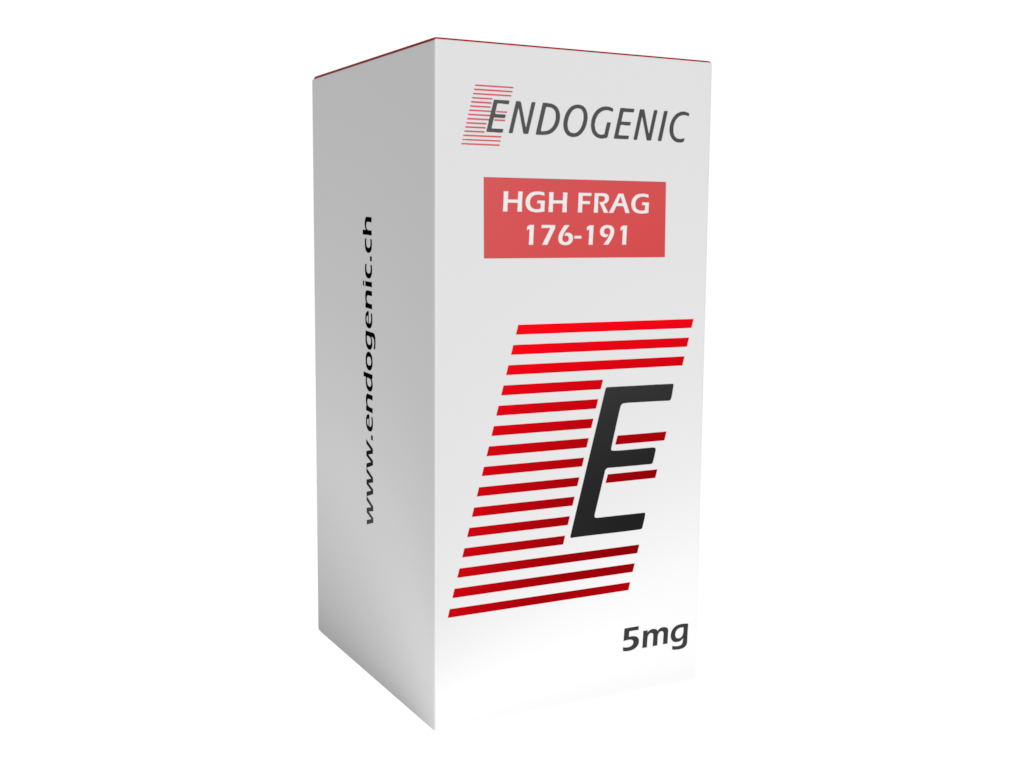
HGH Fragment 176-191 5mg

Sale!


 31.00

HGH Fragment 176-191

HGH Fragment 176-191 is a synthetic, C-terminal analogue of human growth hormone, used as a specialized reagent in biochemical and molecular biology research. Its precisely defined sequence of 16 amino acids, including a stabilizing disulfide bridge, makes it a valuable tool for exploring protein-receptor interactions and as an analytical standard. Check also AOD-9604

In the field of bioorganic chemistry and biochemistry, synthetic peptides serve as fundamental tools that enable scientists to delve into complex biological processes at the molecular level. HGH Fragment 176-191, a synthetic, C-terminal analogue of human growth hormone, is an example of such a specialized reagent. Its precisely defined amino acid sequence allows it to be used as an analytical standard or a tool in research on protein-receptor interactions under controlled laboratory conditions. This description is intended to present only the chemical and physical properties of this substance and its potential applications as a research reagent.
Reviews

There are no reviews yet.

Be the first to review “HGH Fragment 176-191 5mg”

Your email address will not be published. Required fields are marked *

HGH Fragment 176-191 INTENDED FOR RESEARCH PURPOSES ONLY!

All the properties mentioned above are observed during laboratory research, not conducted on humans, and are purely informational. All information contained in the descriptions has not been approved by the GIS, GIF, or EFSA. The substance is not a medicinal product, a food product, or a dietary supplement; consequently, it is not suitable for human consumption. The product is classified as a chemical reagent / reference material approved for marketing within the EU. It may be used exclusively for scientific research. Other information about the agent is contained in the chemical safety data sheet, which we provide for inspection. The products are available only to institutions or private individuals associated with research or laboratory activity.

What is HGH Fragment?

From a chemical perspective, HGH Fragment 176-191 is a linear, unesterified peptide consisting of 16 amino acids, whose sequence corresponds to the fragment of the human growth hormone (somatotropin) chain from position 176 to 191. The full hGH molecule is a 22 kDa polypeptide, composed of 191 amino acid residues. Fragment 176-191 was isolated and synthesized to enable scientists to study specific structural regions of the larger parent protein without the necessity of working with the entire, significantly more complex molecule. As a chemical reagent, it is supplied in the form of a lyophilized powder, which ensures its stability during transport and storage.

HGH Fragment 176-191 properties

Precise chemical characterization is key to the reproducibility and reliability of scientific experiments.

  • Systematic Name (IUPAC): L-Tyrosyl-L-leucyl-L-arginyl-L-isoleucyl-L-valyl-L-glutaminyl-L-cysteinyl-L-arginyl-L-seryl-L-valyl-L-glutamyl-L-glycyl-L-seryl-L-cysteinyl-L-glycyl-L-phenylalanine
  • Single-letter Sequence: YLRIVQCRSVEGSCGF
  • CAS Number: 66004-57-7
  • Molecular Formula: $C_{78}H_{125}N_{23}O_{23}S_{2}$
  • Molar Mass: $1817.12 \ g/mol$
  • Structure: The molecule contains a disulfide bridge between two cysteine residues (at positions 7 and 14 of the fragment sequence), which stabilizes its spatial conformation. This structural feature is significant in research concerning protein folding and peptide stability.
  • Appearance: White, lyophilized powder.
  • Solubility: Soluble in sterile water, bacteriostatic water, and dilute acetic acid solutions.

Purity and Analysis – Guarantee of Quality in Research

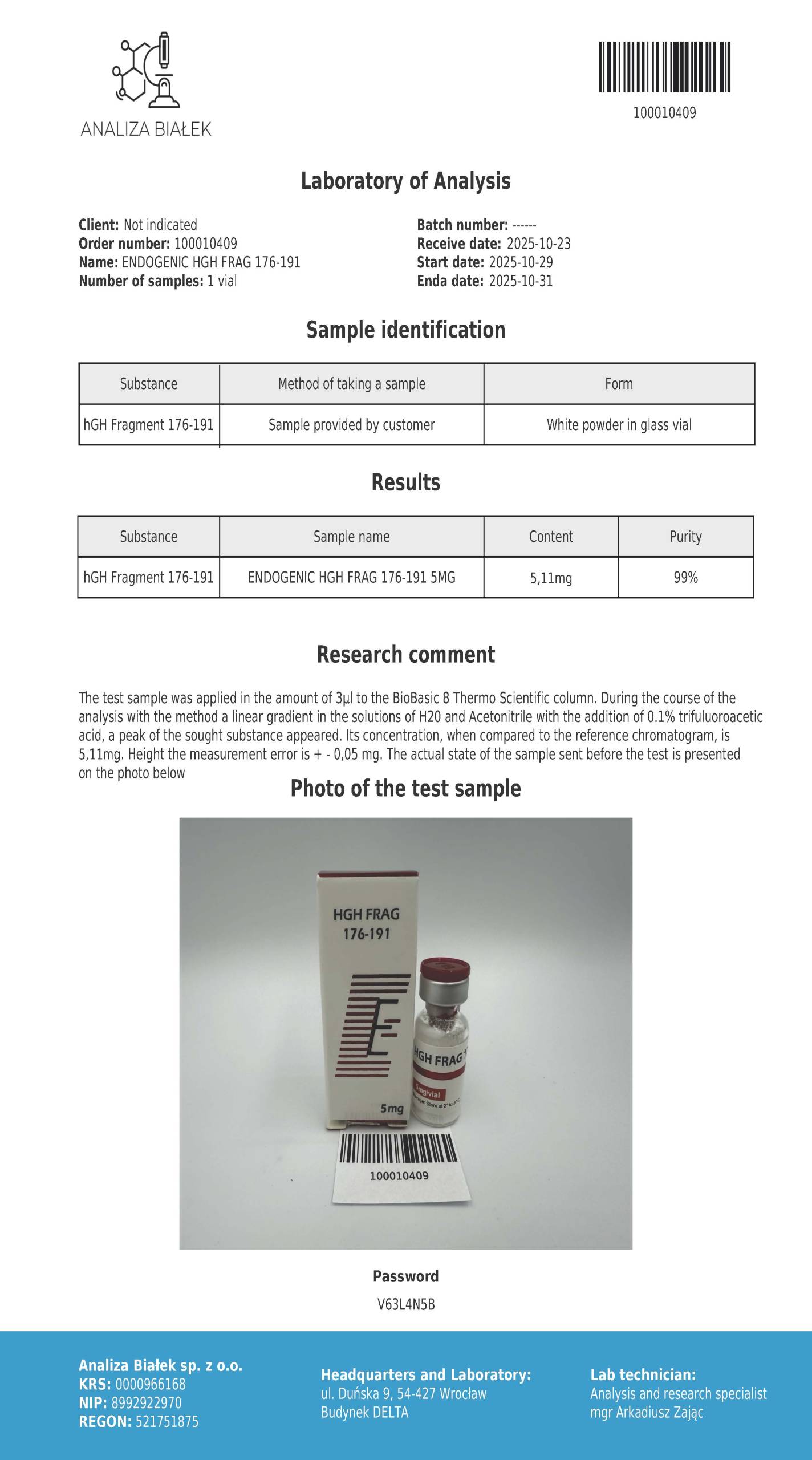
The reliability of scientific research results is directly dependent on the purity of the reagents used. Every batch of the offered HGH Fragment 176-191 peptide undergoes rigorous quality control, and the results are documented with a certificate of analysis.

  • Analytical Method: Peptide purity is verified using High-Performance Liquid Chromatography (HPLC). This is the “gold standard” in peptide analysis, allowing for the precise separation of the target molecule from any impurities, such as truncated peptides or residues from the synthesis process.
  • Purity Criterion: We guarantee a substance purity level of ≥98%. This grade of purity is required for precise biochemical and analytical experiments.
  • Identity Verification: The molecule’s identity and the correctness of its molar mass are confirmed using Mass Spectrometry (MS), which assures the researcher that they are working with the proper, precisely defined chemical structure.

Storage and Handling of the Reagent

Proper handling of peptides is crucial for maintaining their structural integrity and reactivity.

  • Powder Storage: Lyophilized HGH Fragment 176-191 is stable at room temperature for a short period (transport). For long-term storage, a temperature of 2°C to 8°C (refrigerator) is recommended, and for multi-month storage, -20°C (freezer).
  • Reconstitution: Before use in an experiment, the lyophilized powder must be dissolved (reconstituted) in an appropriate, sterile solvent (e.g., water for analytical purposes). The solvent should be added slowly, down the side of the vial, to avoid foaming. The vial should be gently swirled until the powder is completely dissolved. Do not shake vigorously.

Solution Storage: After reconstitution, the peptide solution must be stored at a temperature of 2°C to 8°C. The stability of the solution is limited over time and depends on the solvent used. Repeated freezing and thawing of the solution should be avoided, as this may lead to peptide degradation.

HGH Fragment action

Scientific research on HGH Fragment 176-191 focuses on its biophysical and biochemical properties under in vitro conditions. The subject of researchers’ interest is how this specific amino acid sequence interacts with other biomolecules. Examples of research directions include the analysis of the affinity and binding kinetics of this peptide to isolated membrane receptors in ELISA assays or using Surface Plasmon Resonance (SPR) technology. The sole purpose of such experiments is to understand the basic mechanisms of molecular interactions, which forms the foundation for further studies in the field of structural biology.

HGH Fragment Application

Applications in Scientific Research

HGH Fragment 176-191, as a chemically defined molecule with confirmed purity, is used in a wide spectrum of laboratory procedures:

  • Analytical Standard: It can serve as a reference standard in the development and validation of chromatographic methods (HPLC, LC-MS) used for the detection and quantification of peptides in complex biological matrices.
  • Receptor Studies: In experiments on isolated cells or cell membrane preparations, this peptide can be used as a ligand to study the properties and distribution of specific receptor types.
  • Structural Biology: It serves as a model in studies on peptide conformation, the stability of disulfide bridges, and the effect of sequence modifications on tertiary structure.
  • Development of Immunochemical Assays: It can be used as an antigen for antibody production or as a standard in enzyme-linked immunosorbent assays (ELISA).

What is worth remembering?

HGH Fragment 176-191 is a highly specialized chemical reagent, a valuable tool in the hands of scientists and laboratory personnel. Its value lies in its precisely defined structure and high purity, which allows for reliable and reproducible scientific research in vitro. We emphasize once again that this substance is intended solely for research use by authorized entities and is under no circumstances intended for human use. The responsible and lawful use of chemical reagents is the basis of scientific progress and public safety.

Referenced Citations


Scientific sources:

  1. Strasser, B., Spreitzer, A., & Haber, P. (2007). Fat loss depends on energy deficit only, independently of the method for weight loss. Annals of Nutrition and Metabolism, 51(5), 428–432.
  2. Hursel, R., Viechtbauer, W., & Westerterp-Plantenga, M. S. (2009). The effects of green tea on weight loss and weight maintenance: a meta-analysis. International Journal of Obesity, 33(9), 956–961.
  3. Paoli, A., Grimaldi, K., D’Agostino, D., Cenci, L., Moro, T., Bianco, A., & Palma, A. (2012). Ketogenic diet in neuromuscular and neurodegenerative diseases.BioMed Research International, 2012, 474296. (This source, although it concerns the ketogenic diet, extensively discusses the metabolic processes related to the use of fat for energy, which is relevant to the topic of weight loss.)
  4. The Effects of HGH Fragment 176-191 on Fat Burning.