

SNAP-8 is the trade name of an octapeptide with the INCI name Acetyl Glutamyl Octapeptide-3 (synonymously Acetyl Octapeptide-3). The name refers directly to the SNAP-25 protein, whose N-end the peptide imitates, and to the chain length. The core sequence is written as Ac-EEMQRR. SNAP-8 is an extended analogue of the older hexapeptide Argireline and belongs to the class of neuromuscular peptides studied for the reduction of facial wrinkles. In the Pro-Body catalog it remains a RUO reagent/raw material for formulation research, not a finished cosmetic.
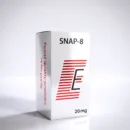
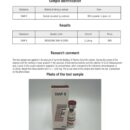
Snap-8
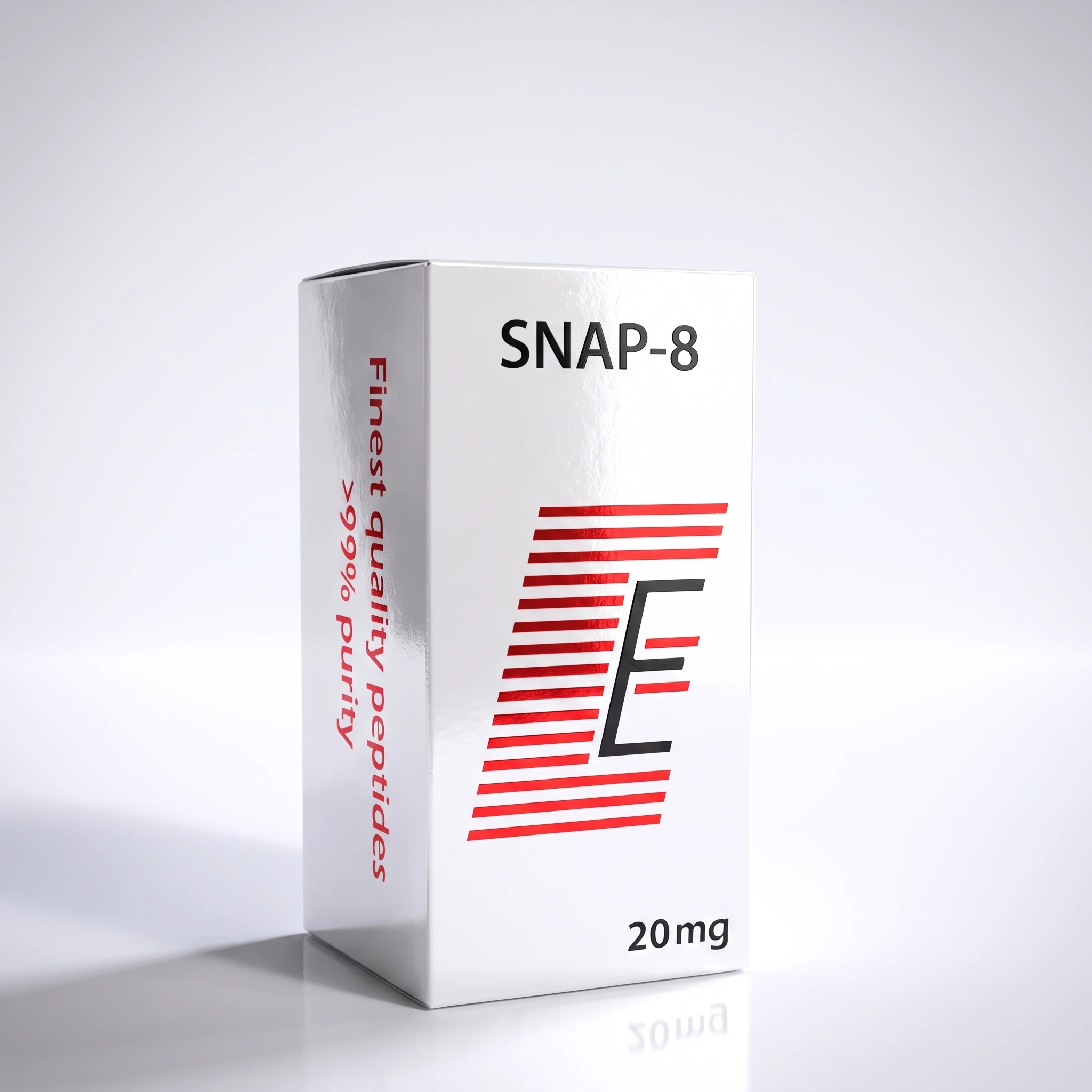
SNAP-8 (Acetyl Octapeptide-3, lyophilisate 20 mg, Endogenic line) — cosmetic neuromuscular octapeptide, biomimetic fragment of the N-terminus of the SNAP-25 protein, for research on topical formulation. Described in the literature as a SNARE-competitive peptide: it competes for a place in the SNARE complex, weakens the release of neurotransmitter on the neuromuscular plate (“Botox-like”, topical and reversible mechanism) and is associated with the reduction of facial wrinkles in skin models. RUO reagent
28,99 €
Fast shipping
Delivery options
Free delivery from 350 €
Returns policy
SNAP-8 20 mg - cosmetic neuromuscular peptide - RUO research reagent
- SNAP-8 (Acetyl Octapeptide-3, lyophilisate 20 mg, Endogenic line) — cosmetic neuromuscular octapeptide, biomimetic fragment of the N-terminus of the SNAP-25 protein, for research on topical formulation.
- Described in the literature as a SNARE-competitive peptide: it competes for a place in the SNARE complex, weakens the release of neurotransmitter on the neuromuscular plate ("Botox-like", topical and reversible mechanism) and is associated with the reduction of facial wrinkles in skin models.
Product status information
Chemical reagent intended exclusively for laboratory tests (Research Use Only). Reference material/raw material for formulation research – it is not a finished cosmetic, medicinal product, dietary supplement or food. It is not intended for consumption. Sales only to registered research units, R&D laboratories and cosmetic formulation development departments.
Regulatory framework – WADA status and substance category
SNAP-8 (Acetyl Octapeptide-3) is a topical neuromuscular peptide with a cosmetic profile, described in the literature as an active ingredient for research on facial expressions and the visibility of wrinkles. As a biomimetic fragment of the SNAP-25 protein used topically is not a substance listed by name on the WADA Prohibited List and is not a doping compound. In the Pro-Body catalog, SNAP-8 appears only as an RUO research reagent and a raw material for research on topical formulations – not as an adjuvant or a ready-made preparation for human application.
SNAP-8 from the line Endogenous this neuromuscular octapeptide with a biomimetic sequence – a fragment imitating the N-end of the SNAP-25 protein, one of the three pillars of the neurotransmitter release apparatus in the synapse. Unlike regenerative or metabolic peptides, SNAP-8 is not designed for tissue reconstruction or metabolism modulation, but for one, well-defined direction of cosmetic research: silencing the contraction of facial muscles responsible for the formation of facial wrinkles.
This makes it an unusual molecule in the catalog of reagents – short, synthetic and molecularly precise, operating at the interface of neurobiology and dermatopharmacology. The whole story of SNAP-8 begins with a question that has been occupying cosmetology researchers for years: is it possible to alleviate the repetitive spasm of facial muscles using a topical, reversible method and without injection – differently than using botulinum toxin?
The answer turned out to be class biomimetic peptides competing with SNARE complex proteins for a place in the synaptic vesicle exocytosis apparatus. SNAP-8, that is Acetyl Octapeptide-3 (Acetyl Glutamyl Octapeptide-3), is an extended analogue of the older hexapeptide Argireline (acetyl hexapeptide-8) – developed with the postulated higher affinity for the SNARE complex in mind.
This distinction has practical implications for the design of formulation experiments. SNAP-8 has been explored in the literature in skin models and in research on reducing the depth of facial wrinkles, where competitive mimicry of the N-terminus of SNAP-25 plays a central role. The role and mechanism of such ingredients in care is discussed in more detail in the article about what they are peptides in cosmetics.
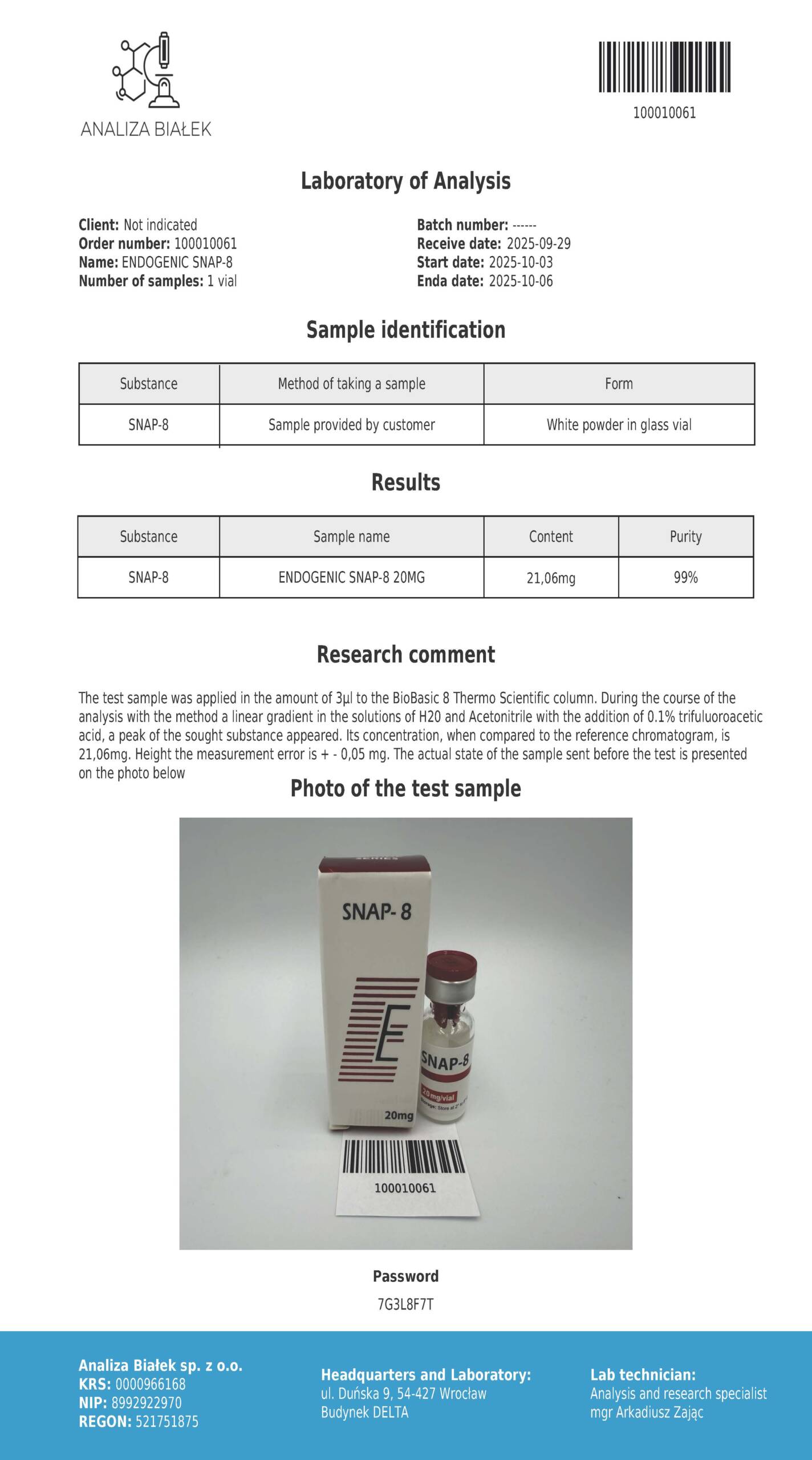
This format is provided as lyophilisate 20 mg — dry peptide for self-preparation of a working solution or introduction to a cream base in laboratory conditions, giving the researcher full freedom to select the working concentration for a specific experimental system. Purity verified by HPLC ≥98%, identity confirmed by mass spectrometry, COA available for each batch.
SNARE complex, exocytosis and neuromuscular endplate
To understand the SNAP-8 profile, you need to go back to the mechanics of the synapse itself. The contraction of a muscle – including the facial muscle under the skin of the face – begins with the release of a neurotransmitter acetylcholine at the neuromuscular junction (neuromuscular endplate). Acetylcholine does not flow freely from the nerve ending; it is stored in tiny synaptic vesicles that must be transported to the membrane and integrated with it.
This process of fusion of the vesicle with the membrane is called exocytosis. It builds the exocytosis machinery SNARE complex — a set of three cooperating proteins: SNAP-25, syntaxins and VAMP (synaptobrevins). These proteins intertwine into a four-helical structure that physically pulls the vesicle to the membrane and allows the neurotransmitter to be released into the synaptic cleft.
SNAP-25 serves as a scaffold in this complex – without its functional N-terminus, the complex does not assemble properly and the release of acetylcholine is weakened. This is where the logic of biomimetic peptides comes in. SNAP-8 mimics the N-terminus of SNAP-25 and – according to the described mechanism – competes for a place in the SNARE complex.
The more effectively the peptide occupies this place, the less efficiently the native exocytosis apparatus will assemble, and thus the release of the neurotransmitter at the neuromuscular plate will weaken. In models this translates to reduction of facial muscle contraction — the mechanism is sometimes described in the literature as “Botox-like”, with one major difference: it is topical and reversible, not injectable and irreversible.
The Endogenic SNAP-8 line is part of the peptide family cosmetics for research on topical formulation – in addition to matrikine peptides (like Matrixyl 3000) and copper peptides (like GHK-Cu 20mg). However, each of these classes operates a different mechanism – and this distinction is one of the most important in this description.
What is SNAP-8 - Acetyl Octapeptide-3 (Ac-EEMQRR)
SNAP-8 is octapeptide with a biomimetic acetylated sequence corresponding to the N-terminal fragment of the SNAP-25 protein. The trade name “SNAP-8” refers directly to this parent protein – SNAP-25 — and to the chain length. In the INCI nomenclature it functions as Acetyl Glutamyl Octapeptide-3 (synonymously Acetyl Octapeptide-3). The core sequence is written as Ac-EEMQRR (with N-terminal acetylation and C-terminal amidation in a cosmetic form), which corresponds to the glutamate-glutamate-methionine-glutamine-arginine-arginine motif extending the older Argireline hexapeptide with additional residues.
It is this extension of the Argireline sequence that is the basis for the postulate of a higher affinity of SNAP-8 for the SNARE complex – a thesis explored in the literature on cosmetic formulations. The short, synthetic structure has practical consequences for working with the reagent. The peptide is a relatively small and polar molecule, supplied in the form of a 20 mg lyophilisate to be dissolved in an aqueous medium or incorporated into a cream base.
The presence of two arginine residues gives the molecule a basic character, which affects its solubility and interactions in the formulation.
Chemical characteristics
| Parameter | Value |
|---|---|
| Name | SNAP-8 (Acetyl Octapeptide-3) |
| Synonyms / INCI | Acetyl Glutamyl Octapeptide-3, Acetyl Octapeptide-3 |
| Line | Endogenous |
| Class | Neuromuscular octapeptide (cosmetic), biomimetic fragment of SNAP-25 |
| Sequence (record) | Ac-Glu-Glu-Met-Gln-Arg-Arg-NH₂ – Ac-EEMQRR motif [to be verified in the party’s COA] |
| Number of residues (core) | octapeptide [sequence record for verification in the batch COA] |
| Origin of the sequence | biomimetic of the N-terminus of the SNAP-25 protein |
| CAS number | 868844-74-0 [to be verified in the party’s COA] |
| Molar mass | ~1075 g/mol [to be verified in the party’s COA] |
| Physical form | lyophilisate / powder (20 mg) for working solution or cream base |
| HPLC purity | ≥98% |
| Identity confirmation | mass spectrometry (MS) |
Mechanism of action at the molecular level
In the literature on cosmetic formulation, SNAP-8 is described as a biomimetic peptide with a consistent, unidirectional profile: competitive weakening of the exocytosis apparatus at the neuromuscular junction. The literature points to four related subsections of the mechanism observed in the models. Below, each with the name of the process and its translation into experimental observations.
Competitive mimicry of the SNAP-25 N-terminus
The main axis of the profile. SNAP-8 was designed as biomimetic of the N-terminus of the SNAP-25 protein — one of the three proteins of the SNARE complex (SNAP-25, syntaxin, VAMP), which is responsible for merging synaptic vesicles with the membrane in the process of exocytosis. According to the described mechanism, peptide competes for a place in the SNARE complex, occupying the position that under native conditions is occupied by the N-terminus of SNAP-25.
The more effective this competition, the less efficiently the four-helical exocytosis apparatus is assembled. This is the molecular core of the SNAP-8 profile observed in the models.
Weakened neurotransmitter release at the neuromuscular endplate
The second axis explains the consequence of the first. A less efficient SNARE complex means less efficient release acetylcholine and catecholamines at the neuromuscular junction. In models examining transmission at the neuromuscular endplate, attenuation of this release has been associated with reducing the contraction of facial muscles — those tiny muscles under the facial skin whose repeated contraction leads to the formation of facial wrinkles. The mechanism is sometimes described as “Botox-like”, but – importantly – in a variant topical and reversible, without the permanent enzymatic cleavage of the SNAP-25 protein characteristic of botulinum toxin.
Reduction of the depth of facial wrinkles in skin models
The third axis is the tissue translation of the previous two. In skin models and in topical formulation studies, decreased contraction of facial muscles has been associated with reducing the visibility and depth of facial wrinkles in a research context. This is an effect observed at the model level as a result of a neuromuscular mechanism, not a separate pathway – and, as the RUO framework emphasizes, a reference observation from the literature, not a promise of a cosmetic effect in a specific individual.
Extended sequence towards Argireline – postulated affinity
The fourth axis concerns the position of SNAP-8 in the class of SNARE-competitive peptides. SNAP-8 (octapeptide) is an extended hexapeptide analogue Argireline (acetyl hexapeptide-8), with which it shares the mechanism of action of the SNARE complex. The extra residues in the sequence are the basis for the o postulate higher affinity of SNAP-8 for the exocytosis apparatus relative to a shorter precursor – a thesis explored in the formulation literature.
This is a comparative context within a class, not a declaration of the superiority of a human effect. Reference data mainly comes from work on the mechanism of SNARE complex inhibition by biomimetic peptides (Blanes-Mira et al. 2002, for acetyl hexapeptide) and from reviews of cosmetic and anti-aging peptides on acetyl octapeptide.
Important distinction - SNAP-8 vs. Argireline, matrikines and botulinum toxin
IMPORTANT DISTINCTION
The affiliation of SNAP-8 to cosmetic peptides can be a source of confusion, because under one umbrella of “wrinkle peptides” there are molecules with completely different mechanisms. The party’s identity is always confirmed peptide sequence and mass spectrometry mass recorded in COA — not the trade name itself or the association with the category.
SNAP-8 (octapeptide) vs. Argireline / acetyl hexapeptide-8 (hexapeptide). Both peptides act by the same mechanism – competitive mimicry of the N-terminus of SNAP-25 and attenuation of SNARE complex assembly. They differ in chain length: SNAP-8 is an octapeptide, Argireline is a hexapeptide. The extension of the sequence in SNAP-8 is the basis for the postulate of higher affinity for the exocytosis apparatus. This is a difference within the same SNARE-competitive class, not a difference of mechanism.
Neuromuscular peptide (mimic) versus matrikine peptide (collagen). This is a fundamental class difference. SNAP-8 works on neurotransmitter release and muscle contraction — its attachment point is the synapse, not the skin matrix. Matrikine peptides operate in a completely different way: they signal fibroblasts to synthesize collagen and repair the extracellular matrix. One addresses facial wrinkles (caused by muscle movement), the other – wrinkles related to the structure and firmness of the skin. The mechanisms are separate and in formulation research they are sometimes considered complementary, not interchangeable.
The melting mechanism is reversible towards botulinum toxin (injection, irreversible cutting). This distinction is critical. Botulinum toxin is an enzymatic protein administered by injection, which permanently cleaves (proteolyzes) the SNAP-25 protein, blocking exocytosis for the duration of the apparatus regeneration (weeks to months). SNAP-8 works differently: as a top peptide competes for a place in the SNARE complex in a way reversible, without enzymatic cutting of any protein.
The term “Botox-like” refers only to the common point of attachment (SNARE/SNAP-25 apparatus) – not to the identity of the mechanism, route of administration, or scale of effect. SNAP-8 reagent is not and does not replace botulinum toxin.
RUO reagent for finished cosmetics and medicines. SNAP-8 is available in the Pro-Body catalog reference material and raw material for formulation research — not a finished cream, serum or medicinal product. The 20 mg lyophilized form does not constitute a suggestion for preparing the preparation for use in humans; is the starting point for laboratory work on the solubility, stability and compatibility of the peptide in cosmetic bases.
Applications in scientific research
SNAP-8 as an RUO reagent is used in several areas of research focused on neuromuscular peptides and topical formulations. The 20 mg lyophilized form is particularly useful where researchers need complete freedom in selecting the working concentration and carrier for a specific experimental system.
Studies on the SNARE complex and exocytosis. Models and preparations examining the assembly of the SNARE complex (SNAP-25/syntaxin/VAMP) and neurotransmitter release at the neuromuscular junction. Endpoints: efficiency of complex assembly, level of released acetylcholine/catecholamines, competitiveness of the peptide towards the native N-terminus of SNAP-25. This is the mechanistic core of the SNAP-8 exploration.
Skin models and reduction of facial wrinkles. Reconstructed models of the epidermis, cell cultures and research on the visibility of facial wrinkles in the context of formulation. Endpoints: contraction parameters of the facial muscle in the model, wrinkle depth, skin surface topography profile. Historically, the most explored area of SNARE-competitive peptides in cosmetology.
Comparative studies of SNAP-8 versus Argireline. SNAP-8 as a reference compound when comparing the affinity and effect of SNARE-competitive peptides of different chain lengths – octapeptide versus hexapeptide (acetyl hexapeptide-8). Endpoints: affinity for the SNARE complex, kinetics, stability profile in the formulation.
Topical formulation and delivery research. Work on the solubility, stability and penetration of the peptide in cosmetic bases, compatibility with other active ingredients (matrikins, copper peptides) and on carriers increasing the availability of the peptide in the skin layers. SNAP-8 as a raw material for designing research recipes.
REGULATORY STATUS
SNAP-8 (Acetyl Octapeptide-3) it is not registered as a medicine in the EU or the USA. The EMA and FDA have not issued any therapeutic authorization for this substance. As Acetyl Glutamyl Octapeptide-3 the peptide is listed in the INCI nomenclature as a cosmetic ingredient approved for use in finished cosmetic products under the Cosmetics Regulation (EC 1223/2009) – however in the Pro-Body catalog it is sold as a reagent/RUO raw material, not as a finished cosmetic.
SNAP-8 is not a substance on the WADA Prohibited List by name. Communication of the product as a ready-made anti-wrinkle cream, “Botox cream” for direct application or a medicinal product is contrary to the Research Use Only framework.
Summary
SNAP-8 (Acetyl Octapeptide-3, lyophilisate 20 mg, Endogenic line) is cosmetic neuromuscular octapeptide — biomimetic fragment mimicking the N-end of the SNAP-25 protein, with the core sequence Ac-EEMQRR (CAS 868844-74-0; mass ~1075 g/mol – values to be confirmed in COA). Four related subsections of the mechanism have been described in the formulation literature: competitive mimicry of the SNAP-25 N-terminus and attenuation of SNARE complex assembly (SNAP-25/syntaxin/VAMP), attenuation of acetylcholine and catecholamine release at the neuromuscular endplate (a “Botox-like”, topical and reversible mechanism), reduction of the depth of facial wrinkles in skin models, and extended sequence vs. Argireline as the basis for the postulate of higher affinity for the exocytosis apparatus.
What makes SNAP-8 an unusual molecule is its position at the intersection of neurobiology and dermatopharmacology – the peptide acts on the synapse, not the skin matrix, which distinguishes it fundamentally from matrikine (Matrixyl) and copper (GHK-Cu) peptides. It shares the mechanism with Argireline, but differs in chain length; it shares the attachment point (SNARE apparatus) with botulinum toxin, but differs in the route of administration and reversibility – the peptide competes, the toxin permanently cuts SNAP-25.
The regulatory profile remains clear: SNAP-8 is listed in the INCI as a cosmetic ingredient (EC 1223/2009), but in the Pro-Body catalog it is sold only as a Research Use Only reagent/raw material – with HPLC purity ≥98%, MS and COA confirmation for each batch. It is not a ready-made cosmetic, medicine or substitute for a medical procedure.
Related cosmetic peptides and materials
In research on peptides that modulate the appearance of the skin, SNAP-8 is sometimes combined with other ingredients used topically in skin care. In the context of anti-aging, a ready-made duo is being investigated at the interface of the telomere pathway and the copper matrix modulator Epithalon + GHK-Cu, and the combination of the three most frequently discussed ingredients in cosmetology is described in the review GHK-Cu, Snap-8 and Matrixyl. All of these materials are related to the cosmetic framework (fusible application) and are separate from this RUO reagent.
Bibliography
- Blanes-Mira C, Clemente J, Jodas G, Gil A, Fernández-Ballester G, Ponsati B, et al. (2002). A synthetic hexapeptide (Argireline) with antiwrinkle activity. PubMed
- Wang Y, Wang M, Xiao S, Pan P, Li P, Huo J (2013). The anti-wrinkle efficacy of argireline, a synthetic hexapeptide, in Chinese subjects. PubMed
- Lim SH, Sun Y, Thiruvallur Madanagopal T, Rosa V, Kang L (2018). Enhanced skin permeation of anti-wrinkle peptides via molecular modification. PubMed
- Reddy B, Jow T, Hantash BM (2012). Bioactive oligopeptides in dermatology: Part I. PubMed
Chemical reagent Research Use Only. SNAP-8 (Acetyl Octapeptide-3, lyophilisate 20 mg, Endogenic line) in the Pro-Body catalog is not a ready-made cosmetic, medicinal product, dietary supplement or food. It is not intended for direct application to humans outside of a controlled formulation research environment; The 20 mg lyophilized form does not constitute a suggestion for the preparation of a finished cosmetic.
SNAP-8 does not have therapeutic authorization EMA or FDA and is not a substance on the WADA Prohibited List by name. As Acetyl Glutamyl Octapeptide-3, it is listed in the INCI as an approved cosmetic ingredient (EC 1223/2009), but introduction into the finished product requires a separate safety assessment on the part of the formulator.
The information in the description is educational and scientific in nature and refers to the results reported in the literature – it does not constitute medical or cosmetic advice or application instructions.
FAQ
The SNARE complex is a set of three proteins (SNAP-25, syntaxin, VAMP) that integrates synaptic vesicles with the membrane and enables the release of the neurotransmitter in the process of exocytosis. SNAP-8 mimics the N-end of the SNAP-25 protein and – according to the described mechanism – competes for a place in the assembled complex.
Effective competition means less efficient assembly of the exocytosis apparatus, and thus weakening the release of acetylcholine and catecholamines on the neuromuscular plate. In the models, this was associated with a reduction in the contraction of facial muscles. These are observations from research models, not an effect confirmed as a finished product in humans.
Both peptides act by the same mechanism – competitive mimicry of the N-terminus of SNAP-25 and attenuation of SNARE complex assembly. They differ in chain length: SNAP-8 is an octapeptide, and Argireline (acetyl hexapeptide-8) is a hexapeptide. The extension of the sequence in SNAP-8 is the basis for the postulate of higher affinity for the exocytosis apparatus relative to the shorter precursor – a thesis explored in the formulation literature. This is a difference within the same SNARE-competitive class, not a difference of mechanism.
NO. The only common attachment point is the SNARE apparatus and the SNAP-25 protein. Botulinum toxin is an enzymatic protein administered by injection that permanently cuts (proteolyzes) SNAP-25 and blocks exocytosis while the apparatus regenerates. SNAP-8 is a top peptide that only competes for a place in the SNARE complex in a reversible manner, without enzymatic cleavage of any protein. The term “Botox-like” refers only to the common point of entry, not to the identity of the mechanism, route of administration, or scale of effect. SNAP-8 is not and does not replace botulinum toxin.
In research on melt formulation, the SNAP-8 working solution is sometimes introduced into the cream base as a carrier in the aqueous phase, in accordance with the recipe protocol. The basic nature of the peptide (two arginine residues) affects solubility and pH selection, and the methionine residue is sensitive to oxidation – therefore, compatibility with other ingredients and stability of the formulation are verified by a test.
This is a laboratory procedure on a research formulation, not an instruction on how to prepare a ready-made cosmetic for use on humans; the finished product requires a separate safety assessment according to EC 1223/2009.
In the Pro-Body catalog, SNAP-8 is supplied as a 20 mg lyophilized product – a reference material and raw material for formulation research, not a ready-made cream or serum. Although Acetyl Glutamyl Octapeptide-3 is listed in the INCI as an approved cosmetic ingredient (EC 1223/2009), the substance itself in the form of raw material is not a product for direct application. The introduction of the peptide into the finished cosmetic, its safety assessment (CPSR) and distribution are the responsibility of the formulator. The powder form does not constitute a suggestion for preparing the preparation for use in humans.
0.0
0 reviews
This product has no reviews yet.
Related products
SEMA G 8mg PEN
SEMA G 8mg PEN
166,99 €

GHRP-2 10mg
GHRP-2 10mg
19,99 €