Skip to content

Free delivery on orders over €400. Fast delivery.

Search

What are you looking for?

Type at least 2 characters to see suggestions.

Melanotan-2 10mg
Melanotan-2 10mg

Melanotan-2 10mg

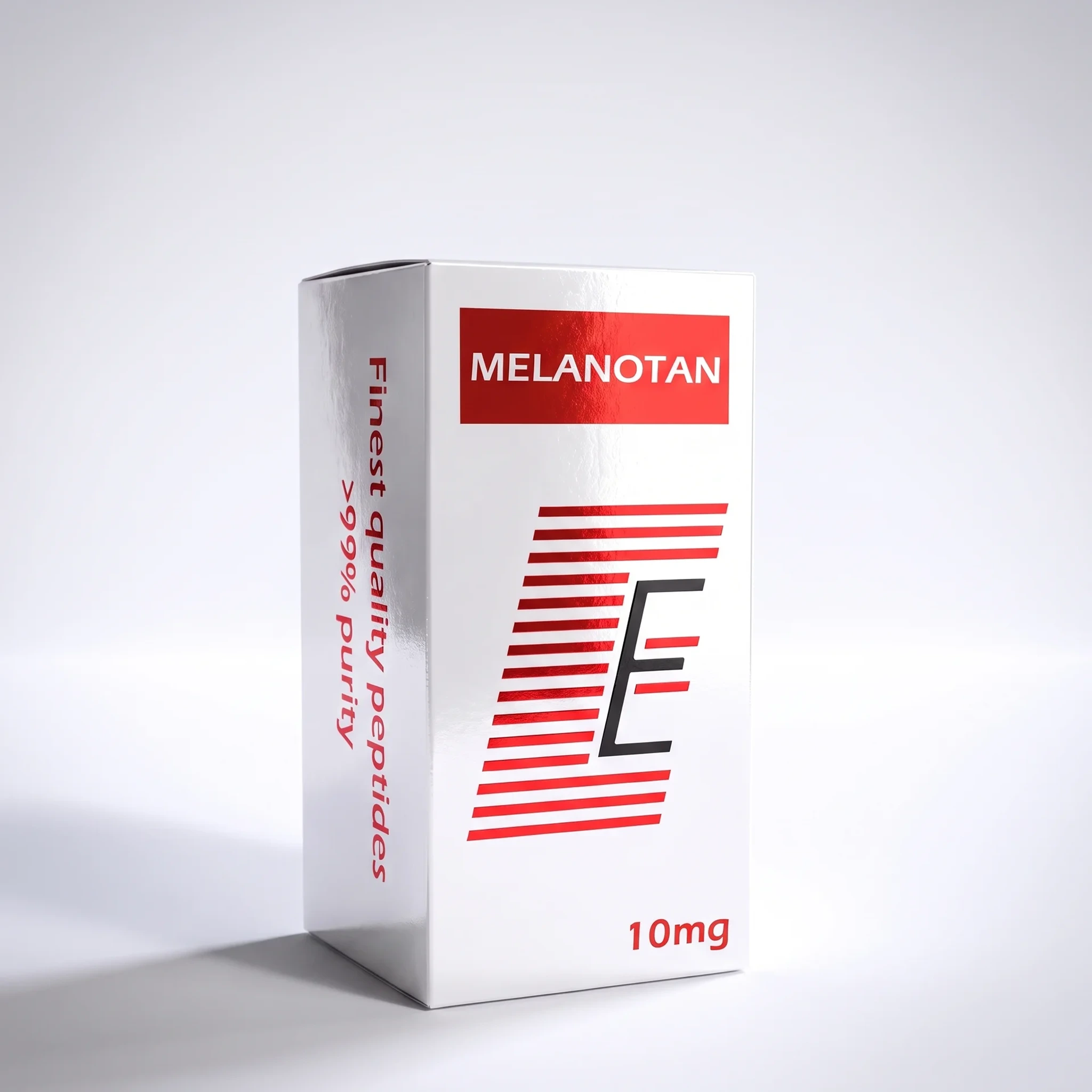
Melanotan 2 (MT-II) 10 mg — cyclic α-MSH analogue from the photoprotection program of the University of Arizona (Hadley, Hruby), a full pan-agonist of MC1R–MC5R melanocortin receptors. Lyophilisate in a vial (Endogenic line) for self-reconstitution, with the freedom to select the working concentration. Research Use Only

25,99 €
Buy more, pay less
Fast shipping
Delivery options
Returns policy

Melanotan 2 (MT-II) 10 mg - research reagent in a vial

  • Melanotan 2 (MT-II) 10 mg — cyclic α-MSH analogue from the photoprotection program of the University of Arizona (Hadley, Hruby), a full pan-agonist of MC1R–MC5R melanocortin receptors.
  • Lyophilisate in a vial (Endogenic line) for self-reconstitution, with the freedom to select the working concentration.

Product status information

Chemical reagent intended exclusively for laboratory tests (Research Use Only). It is not a medicinal product, dietary supplement or food. It is not intended for use on humans or animals. Sales only to registered research units and laboratories.

Melanotan II (MT-II) comes from a photoprotection program, not from a peptide laboratory looking for a “natural tan”. The team of Mac Hadley and Victor Hruby at the University of Arizona designed this molecule in the 1980s with a specific research goal – to increase endogenous skin pigmentation so as to reduce the dose of UV radiation needed to protect against skin cancer.

Cyclization and replacement of two amino acid residues in the α-MSH sequence gave an analogue that was metabolically stable and many times more potent than the parent hormone. Thirty years later, MT-II is still not registered as a drug – the only registered derivative is PT-141 (Bremelanotide, Vyleesi®), a later modification with greater selectivity for the MC4R receptor.

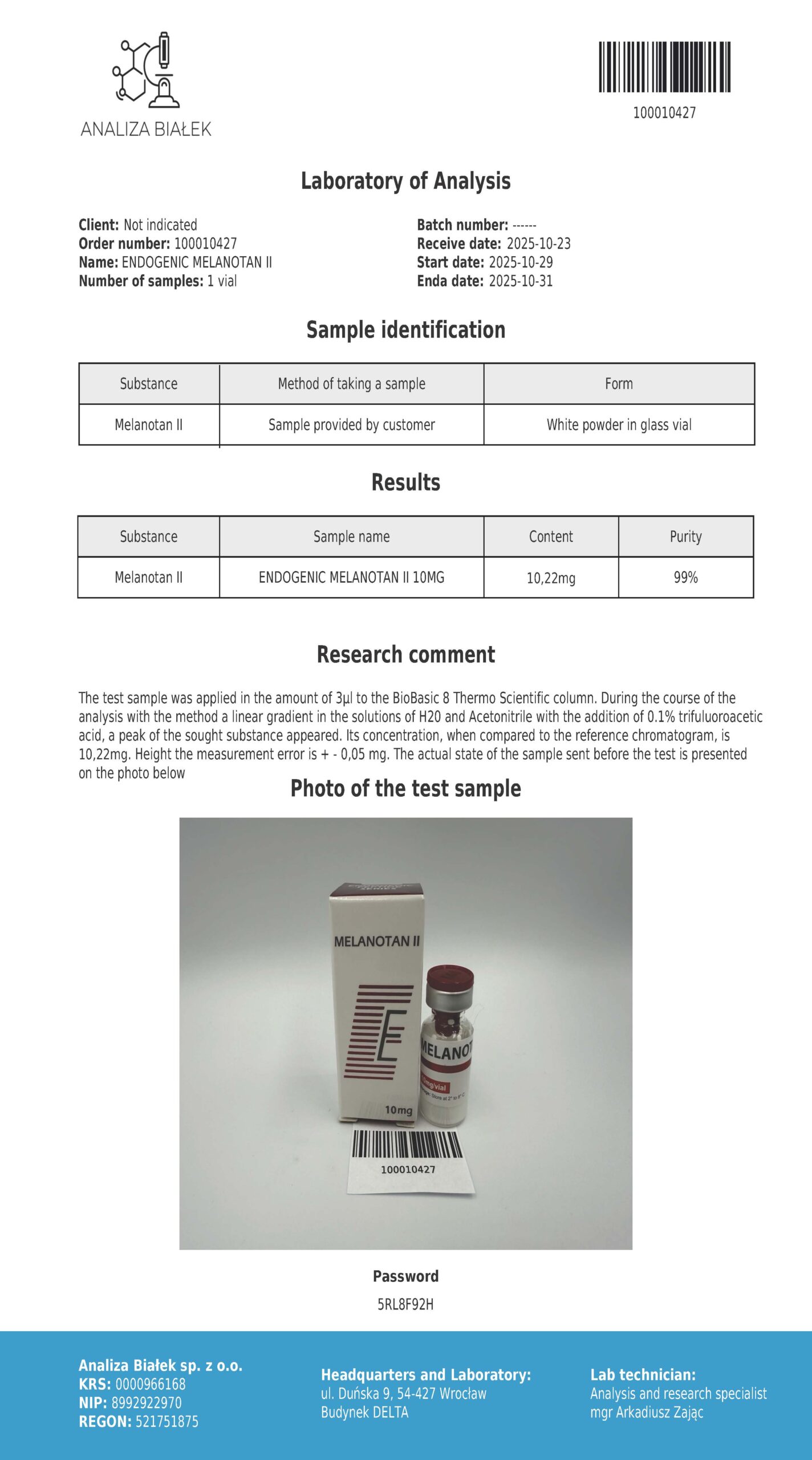
Melanotan II itself belongs to the group research peptides most often described in the context of melanocortin signaling and melanogenesis. This reagent belongs to the line Endogenous and is delivered in the format lyophilized vials, 10 mg MT-II, for independent reconstitution in the laboratory. This form is different from the ready-made applicator or liquid form – the lyophilisate gives researchers complete freedom in selecting the working concentration: the solvent, buffer volume and final peptide concentration are selected according to the methodology of a specific experiment, not the ready-to-use applicator format. Purity verified by HPLC ≥98%, identity confirmed by mass spectrometry, COA available for each batch.

Regulatory status

Melanotan II is not registered as a medicine in the EU, USA or anywhere in the world. University of Arizona clinical development program abandoned; the only registered derivative of the melanocortin pathway remains PT-141 (Bremelanotide). The FDA issued Warning Letters to sellers of MT-II in 2007, and the UK MHRA issued a warning in 2008. Marketing the product as a “tan peptide”, “libido enhancer” or “erection aid” is inconsistent with the Research Use Only framework.

Melanotan and the melanocortin system

The melanocortin system is one of the most widely branched signaling pathways in mammals – one family of peptides (melanocortins) and five receptors (MC1R–MC5R) that control processes as diverse as skin pigmentation, appetite, inflammation, libido, and sebaceous gland secretion. The common denominator is their origin: all melanocortins (α-MSH, β-MSH, γ-MSH and ACTH) are formed from one protein precursor – proopiomelanocortin (POMC) — through enzymatic post-translational cleavage. α-MSH (melanocyte stimulating hormone) is the best characterized melanocortin.

It is a thirteen-amino-acid peptide that binds to melanocortin receptors and triggers a G-protein-dependent signaling cascade – mainly the cAMP/PKA pathway. However, the research problem with native α-MSH is prosaic: the molecule exists quickly degraded in the body (half-life measured in minutes), which makes it useless as a tool for studying long-term modulation of the melanocortin pathway.

This is where the MT-II comes into play. The Arizona team solved the stability problem by two modifications of the α-MSH sequence and cyclization of the peptide chain:

  • Met⁴ → Nle⁴ replacement (norleucine) – removes the oxidation-sensitive sulfur atom of methionine, increasing chemical stability
  • L-Phe⁷ → D-Phe⁷ replacement — inversion of the spatial configuration of the phenylalanine residue increases resistance to proteolysis and receptor affinity
  • Cyclization via a lactam bridge (Asp–Lys) — stiffens the structure and stabilizes the active conformation

Effect: an analogue many times stronger than α-MSH, resistant to enzymatic degradation, with an extended period of activity. This makes MT-II a model ligand for studying pharmacology everyone melanocortin receptors – its non-selectivity, problematic from a therapeutic perspective, is an advantage in mechanistic studies of the MCR family as a whole. The world of pharmacology is watching MT-II for three reasons.

First, as a research tool on melanogenesis and photoprotection (original Arizona context). Secondly, as a model pan-agonist for comparative studies of receptor selectivity – a reference point against selective MC4R (PT-141) and MC1R ligands. Third, as a compound illustrating the risk of MC1R activation in melanocytes – a topic of dermatological and oncological importance.

What is Melanotan II?

Chemically, MT-II is a cyclic heptapeptide, an α-MSH analogue with a modified and stiffened core sequence.

Parameter Value
Common name Melanotan II, MT-II, MT2
Synonyms Melanotan 2, melanotan ii
Chemical name [Nle⁴,D-Phe⁷]-α-MSH(4-10) analog, cyclic via lactam bridge
CAS number 121062-08-6
Sequence Ac-Nle-cyclo[Asp-His-D-Phe-Arg-Trp-Lys]-NH₂
Summary formula C₅₀H₆₉N₁₅O₉
Molar mass 1024.18 g/mol
Chemical grade cyclic heptapeptide, melanocortin analogue; pan-agonist of MC1R–MC5R receptors
Figure delivered lyophilisate in a vial, 10 mg of active substance; pharmaceutical grade ≥98% HPLC; Endogenic line

Structural difference MT-II vs PT-141: MT-II and PT-141 (Bremelanotide) share an almost identical cyclic core. The main difference lies in the C-terminus of the peptide chain:

  • MT-II — C-terminus closed with an amide group (–NH₂); full MC1R–MC5R agonist
  • PT-141 — C-terminus with a free carboxyl group (–COOH); formally formed as a metabolite/modification of MT-II with greater selectivity towards MC4R

In pharmacological practice, this means that PT-141 was intentionally designed as a narrower tool – modulating primarily the central MC4R receptor (libido context), with less impact on MC1R-dependent pigmentation. MT-II remains a “broad spectrum” tool – it activates the entire melanocortin system at once. The comparative selective reagent is described under item PT-141 10mg. Origin: MT-II was synthesized in the 1980s at the University of Arizona by the team of Mac E.

Hadley and Victor J. Hruby as part of a research program on photoprotection and skin cancer prevention. The research hypothesis was that pharmacologically increasing endogenous pigmentation (eumelanin) would reduce UV-induced DNA damage and reduce the risk of skin cancer. The molecule entered early Phase I studies (Dorr et al. 1996; Hadley et al. 1993), where its melanogenic activity in humans was confirmed, but also had two unexpected effects: induced erections and nausea.

PT-141 (Bremelanotide) was then developed as a selective derivative of MC4R and ultimately approved by the FDA (2019, Vyleesi®). However, the MT-II program has not been registered.

Mechanism of action at the molecular level

MT-II works as full agonist of all five melanocortin receptors. MCR receptors are a class A of G protein-coupled receptors (GPCRs) – their activation increases intracellular cAMP concentration through adenylate cyclase and triggers the PKA pathway. Where a given receptor is located determines the observed phenotype. It is this broad, nonselective activation that distinguishes MT-II from selective ligands and explains its complex profile observed in the literature. Per receptor profile (observed in research models and early clinical literature):

  1. MC1R (skin melanocytes) → melanogenesis. Activation of MC1R on melanocytes triggers the cAMP/PKA/MITF pathway, which increases the expression of tyrosinase – an enzyme that limits the rate of melanin synthesis. Net effect: shifting synthesis towards eumelanins (dark, photoprotective pigment) and increase in skin pigmentation. This was the original design goal of the MT-II (Dorr et al. 2000).
  2. MC4R (central nervous system) → appetite, erection, libido. MC4R in the hypothalamus and other CNS regions participates in the regulation of energy balance (appetite suppression) and in the central modulation of sexual functions. MC4R activation is associated with induced erections independent of the vascular stimulus (Wessells et al. 2000) and with a central effect on libido – it was this pathway that became the basis for the development of the selective PT-141.
  3. MC3R (CNS, peripheral tissues) → energy balance. MC3R interacts with MC4R in the regulation of energy homeostasis and energy expenditure; its role is complementary to MC4R, although less thoroughly characterized.
  4. MC2R (adrenal cortex) → ACTH pathway. MC2R is a receptor specific for ACTH (adrenal steroidogenesis). MT-II binds to MC2R weaker than to other receptors, but in the context of pan-agonism this pathway remains the subject of selectivity analysis.
  5. MC5R (exocrine glands) → sebaceous and exocrine secretion. MC5R participates in the regulation of sebaceous and other exocrine glands; in animal models, its activation affects the production of sebum and pheromones.

Pharmacokinetic profile (based on early literature and models):

  • Metabolic stability much higher than native α-MSH (effect of cyclization and Nle⁴/D-Phe⁷ substitutions)
  • Plasma half-life in humans: on the order of several hours (partial data from Phase I studies; Dorr et al. 2000)
  • Absorption after parenteral administration is good; oral bioavailability is negligible (the peptide is digested in the gastrointestinal tract)
  • Metabolism: proteolytic; elimination mainly renal

Applications in scientific research

MT-II is used in research as a model pan-agonist of melanocortin receptors – a tool for studying the entire MCR system and a reference point in comparative studies of ligand selectivity. Receptor affinity, cAMP activation kinetics and functional selectivity are examined in in vitro models (human and mouse melanocyte lines, recombinant MC1R–MC5R receptor expression systems, HEK293 cell cultures transfected with MCR).

In in vivo models (rodents, historical lizard model Anolis for the melanogenesis test), the pigmentation and metabolic response is assessed. The lyophilized form in a vial is particularly useful in protocols where researchers need to independently select the working concentration for a specific question – from in vitro dose-response curves to series of dilutions in a buffer with a fixed composition. Specific research directions include:

  • Pharmacology of melanogenesis and photoprotection — MC1R/cAMP/MITF/tyrosinase pathway; evaluation of eumelanin synthesis as a model for the prevention of UV damage (original context from Arizona)
  • Comparative studies of receptor selectivity — MT-II (pan-agonist) vs PT-141 (selective MC4R) vs selective MC1R ligands; mapping of functional profiles
  • MC4R central modulation — energy balance, appetite suppression, central pathways of sexual function in rodent models
  • Melanocortin signaling in exocrine glands — role of MC5R in the regulation of sebaceous glands (animal models)
  • Melanocytic risk studies — the impact of chronic MC1R activation on the proliferation and phenotype of melanocytes (dermatopharmacological and oncological context)

Summary

Melanotan II (MT-II) is a cyclic heptapeptide, an α-MSH analogue designed in the 1980s at the University of Arizona (Hadley, Hruby) in the photoprotection research program. Thanks to cyclization and Nle⁴ and D-Phe⁷ replacements, it is metabolically stable and acts as full pan-agonist of MC1R–MC5R receptors — which distinguishes it from PT-141 (Bremelanotide), a selective derivative of MC4R differing in the C-terminus (amide instead of carboxyl).

In models and early Phase I literature, MT-II demonstrated melanogenic activity (MC1R), induced erections and central effects on libido (MC4R), and nausea; Rare cases of changes in atypical moles and eruptive moles have also been described – a real safety signal. Regulatory Status – Research Use Only; no registration in any jurisdiction; WADA status: not listed (as of 2024).

Bibliography

  1. Dorr RT, Lines R, Levine N, Brooks C, Xiang L, et al. (1996). Evaluation of melanotan-II, a superpotent cyclic melanotropic peptide in a pilot phase-I clinical study. PubMed
  2. Hadley ME, Sharma SD, Hruby VJ, Levine N, Dorr RT (1993). Melanotropic peptides for therapeutic and cosmetic tanning of the skin. PubMed
  3. Wessells H, Gralnek D, Dorr R, Hruby VJ, Hadley ME, Levine N (2000). Effect of an alpha-melanocyte stimulating hormone analog on penile erection and sexual desire in men with organic erectile dysfunction. PubMed
  4. Dorr RT, Dvorakova K, Brooks C, Lines R, Levine N, et al. (2000). Increased eumelanin expression and tanning is induced by a superpotent melanotropin [Nle4-D-Phe7]-alpha-MSH in humans. PubMed
  5. Cardones AR, Grichnik JM (2009). alpha-Melanocyte-stimulating hormone-induced eruptive nevi. PubMed