

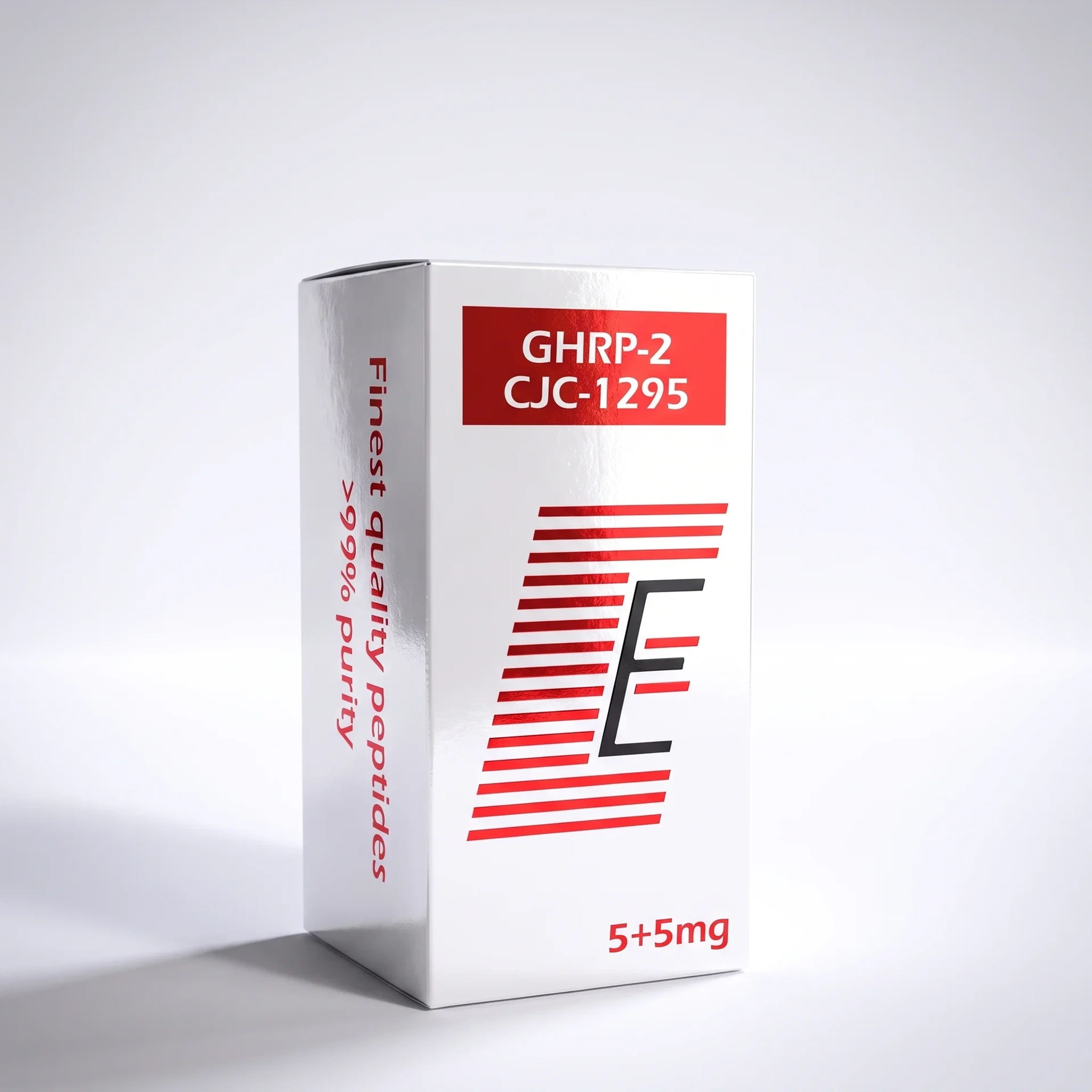
This is a research reagent that combines two growth hormone secretagogues in one vial of lyophilisate in a mass ratio of 1:1 – 5 mg of GHRP-2 (pralmorelin, a ghrelin mimetic acting on the GHS-R receptor) and 5 mg of CJC-1295 (a GHRH analogue acting on the GHRH receptor), a total of 10 mg of peptides. Two different molecules from two mechanistic classes co-occur in one package, allowing the somatotropic axis to be studied from two inputs simultaneously. It is not one compound with two actions, but a mixture of two peptides. RUO reagent, for laboratory tests only.
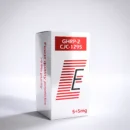
GHRP-2 + CJC-1295 5+5mg
GHRP-2 + CJC-1295 5 mg + 5 mg — a blend of two growth hormone secretagogues (ghrelin mimetic GHRP-2 + GHRH analogue CJC-1295, Endogenic line) in one vial of lyophilisate for laboratory tests. RUO reagent
35,99 €
Fast shipping
Delivery options
Returns policy
GHRP-2 + CJC-1295 5 mg + 5 mg - blend of GH secretagogues (ghrelin mimetic + GHRH analogue)
- GHRP-2 + CJC-1295: two peptides, nominally 5 mg + 5 mg in one vial.
- Lyophilisate for reconstitution; the CJC-1295 variant requires confirmation in the batch COA.
- Research Use Only reagent, not a medicinal product.
Product status information
Chemical reagent intended exclusively for laboratory tests (Research Use Only). It is not a medicinal product, dietary supplement or food. It is not intended for use on humans or animals. Sales only to registered research units and laboratories.
Regulatory frameworkwork – WADA S2 status
Growth hormone secretagogues (GHRP-2 as a ghrelin mimetic) and growth hormone releasing factors (CJC-1295 as a GHRH analogue) are located on WADA prohibited list – class S2 (peptide hormones, growth factors, related substances and mimetics) and are prohibited substances constantly – during and outside the competition. Blend GHRP-2 + CJC-1295 combines two compounds from the same WADA class. Registered athletes (ADAMS) must check the current list of prohibited substances before making any decision.
Introduction
The somatotropic axis – the hypothalamic-pituitary pathway regulating the secretion of growth hormone (GH) – has remained for decades one of the best described and at the same time most difficult to precisely modulate endocrine systems. The pituitary gland releases GH not continuously, but pulsating: in short, high waves, regulated by two opposing signals from the hypothalamus – the stimulating GHRH (growth hormone releasing hormone) and the inhibiting somatostatin.
It is the fidelity of this pulsatility that distinguishes research on secretagogues from the administration of exogenous, recombinant growth hormone (rhGH), which floods the body with a constant, non-physiological concentration of GH. Blend GHRP-2 + CJC-1295 from the line Endogenic is a tool for examining the somatotropic axis from two sides at the same time.
In the Pro-Body catalog, the Endogenic line groups peptides that represent endogenous molecules or their analogues – signals that the body produces on its own and which researchers recreate synthetically as molecular tools. GHRP-2 (pralmorelin) reproduces the effect of ghrelin on the GHS-R receptor, CJC-1295 is an analogue of natural GHRH. Two different inputs to the same system, tested in one reagent.
Blend belongs to a group growth hormone-increasing peptides, in which the Pro-Body catalog collects secretagogues operating on the somatotropic axis. This reagent is supplied in a vials with lyophilisate with a nominal content of 5 mg GHRP-2 + 5 mg CJC-1295 (total 10 mg of peptides in one vial). The lyophilized form – a dry, sublimated powder – is the classic format of the peptide reagent with the highest stability in stock: the peptide without water remains stable for many months, and the researcher independently determines the working concentration at the reconstitution stage.
General description
Blend GHRP-2 + CJC-1295 is stack of two growth hormone secretagogues acting through distinct but complementary molecular pathways of the somatotropic axis. This distinguishes it from a single peptide: instead of one input to the system, the researcher has two signals at once, which in the literature on secretagogues has been described as a system with an intense GH response to each of the components separately.
GHRP-2 (pralmorelin) is a ghrelin mimetic – a synthetic hexapeptide acting as an agonist of the GHS-R receptor (growth hormone secretion receptor, i.e. ghrelin receptor). It belongs to the GHRP (growth hormone releasing peptides) family, next to GHRP-6 and ipamorelin. In the literature, GHRP-2 was described as a strong stimulator of pulsatile GH release, with an accompanying stimulation of appetite (ghrelin effect) more pronounced than in the case of selective ipamorelin.
CJC-1295 is a GHRH analogue corresponding to fragment 1-29 of the natural hormone (the smallest fully active GHRH fragment). It acts through the GHRH receptor on the somatotropic cells of the pituitary gland, increasing the amplitude of the GH pulse. As an analogue, GHRH belongs to a different mechanistic class than GHRP – and it is this distinctiveness that forms the basis of the synergy studied in the blend.
In the Pro-Body catalog blend belongs to Pillar II – body composition peptides and the GH axis. The format of the lyophilized vial is both technical and strategic. Dry powder is the most stable form of peptide storage – without water, there are no hydrolysis or aggregation reactions in the solution, so the material endures long periods of storage much better than a ready-made solution.
The researcher reconstitutes the entire vial to a volume matched to the planned molarity of the working concentration – and in the blend, both peptides dissolve simultaneously in one volume of solvent, in a fixed ratio of 1:1 (5 mg + 5 mg). Anyone who wants to test the milder ghrelin system reaches for the blend Ipamorelin + CJC-1295; who works on the ghrelin arm itself – after GHRP-2 in the solo variant 10 mg.
What is the GHRP-2 + CJC-1295 blend - two peptides, two pathways
Blend combines two peptides from two different mechanistic classes. It is not one compound with two actions, but two separate molecules co-existing in one vial in a 1:1 mass ratio. GHRP-2 (pralmorelin) is a synthetic hexapeptide sequence His-D-2-Nal-Ala-Trp-D-Phe-Lys-NH₂ (modified amide C-terminus). The presence of D-amino acid residues (D-2-Nal, D-Phe) stiffens the molecule and increases its resistance to proteolysis compared to a peptide composed only of natural L-amino acids.
GHRP-2 binds to the GHS-R1a receptor – the same receptor that endogenous ghrelin activates – and is therefore described as a ghrelin mimetic. Number CAS 158861-67-7. CJC-1295 is an analogue of GHRH based on the sequence 1-29 of the natural hormone, with amino acid substitutions increasing stability against enzymatic degradation (including against DPP-4). The central distinction concerns the presence of technology DAC (Drug Affinity Complex) — a chemical linker (maleimide residue) that covalently binds the peptide to plasma albumin after administration, significantly extending the time of the molecule’s presence in the bloodstream.
Variant with DAC has a half-life measured in days; variant without DAC (Mod-GRF 1-29) – in minutes. These are two molecules with different masses and different pharmacokinetic profiles, although both act on the same GHRH receptor.
Chemical characterization of both peptides
| Parameter | GHRP-2 (pralmorelin) | CJC-1295 (GHRH analogue 1-29) |
|---|---|---|
| Line | Endogenic | Endogenic |
| Class | Ghrelin mimetic (hexapeptide, GHRP) | GHRH analog (fragment 1-29) |
| Mechanism | GHS-R1a receptor agonist (ghrelin receptor) | GHRH receptor agonist (somatotropic cells) |
| Sequence | His-D-2-Nal-Ala-Trp-D-Phe-Lys-NH₂ | Analog GHRH(1-29), variant with or without DAC (to be verified in COA) |
| Number of amino acids | 6 | 29 (active core) |
| CAS number | 158861-67-7 | depending on the variant (with DAC vs. without DAC); for verification at COA |
| Half-life | short (minutes–several dozen minutes) | with DAC: days · without DAC (Mod-GRF): minutes |
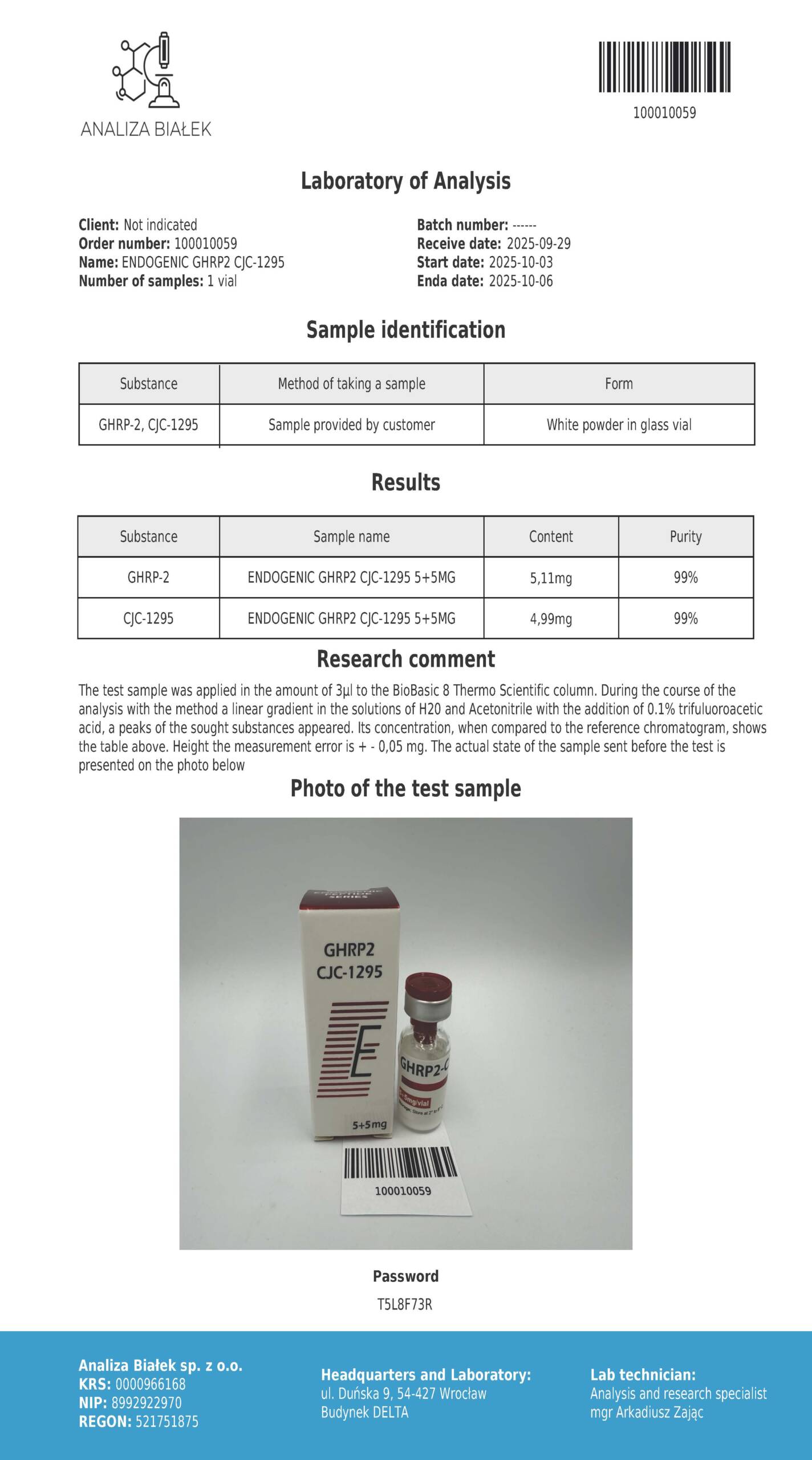
| Nominal content | 5 mg/vial (blend) | 5 mg/vial (blend) |
| Total content of the blend | 10 mg (5 mg + 5 mg) in one vial | |
| Physical form | Lyophilisate (sublimated powder), common vial | Lyophilisate (sublimated powder), common vial |
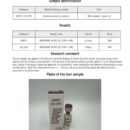
| HPLC purity | ≥98% | ≥98% |
| Identity confirmation | Q-TOF mass spectrometry | Q-TOF mass spectrometry (decided by DAC variant) |
Synergy mechanism - GHRP + GHRH on the somatotropic axis
The synergy in this blend results from the fact that GHRP-2 and CJC-1295 enter the somatotropic axis two independent paths, which have been described as mutually reinforcing in the literature on secretagogues.
Ghrelin arm – GHRP-2 (GHS-R pathway). GHRP-2 binds the GHS-R1a receptor on somatotropic cells of the pituitary and hypothalamus. Activation of this receptor stimulates GH release and – what is important for the synergy mechanism – suppresses the action of somatostatin, a physiological inhibitor of GH secretion. GHRP has been reported in models to amplify the hormone pulse itself: it does not so much raise the baseline as increase the height of the ejection wave.
This is accompanied by a ghrelin effect – stimulation of appetite, stronger in the case of GHRP-2 than with selective ipamorelin, and an effect on the secretion of cortisol and prolactin described in the literature.
GHRH arm – CJC-1295 (GHRH receptor pathway). CJC-1295 acts on the GHRH receptor, a natural pathway that stimulates somatotropic cells. It increases the amplitude of the GH pulse by directly stimulating the same cells affected by endogenous GHRH. Unlike GHRP, it does not disturb somatostatin – it works by “accelerator pedal”, not by releasing the “brake”.
Synergy of both arms. The combination of GHRH (stimulation of secretion) with GHRP (amplification of the pulse and inhibition of somatostatin) is a classic system studied in the literature on secretagogues – two complementary signals trigger a GH response more pronounced than the sum of the effects of each of the components separately. What is important for research on axis physiology: both mechanisms are preserved pulsatility secretion – the pituitary gland continues to release GH in waves regulated by its own feedback, unlike exogenous rhGH, which imposes a constant concentration of the hormone independent of regulatory loops.
An important distinction - three axes that need to be separated
Working with this blend requires conceptual discipline on three separate dimensions. Confusing them leads to incorrect interpretation of the results.
First axis – CJC-1295 with DAC vs without DAC. This distinction is resolved in the batch COA. Variant with DAC (Drug Affinity Complex) contains a maleimide residue, which binds the peptide to plasma albumin after administration, extending the half-life to days – in the clinical literature (Teichman et al. 2006) a prolonged increase in GH and IGF-1 after a single administration has been described.
Variant without DAC, known as Mod-GRF 1-29, does not have this modification and is rapidly cleared (half-life in minutes). These are two different molecules with different masses. Which one a given blend contains decides sequence and mass confirmed by mass spectrometry in COA — this is the only binding identity signal. Compare solo variants: CJC-1295 with DAC and CJC-1295 without DAC (Mod-GRF).
Second axis – secretagogue blend vs exogenous rhGH. Blend GHRP-2 + CJC-1295 is not a growth hormone. Secretagogues stimulate own somatotropic pituitary cells to secrete endogenous GH, maintaining pulsatility and feedback. Exogenous recombinant growth hormone (rhGH, somatropin) is a ready-made GH molecule administered externally, imposing a constant concentration independent of pituitary regulation. This is a fundamental difference in the mechanism studied in the models.
Third axis – GHRP-2 vs ipamorelin. Both are ghrelin mimetics acting on GHS-R1a, but have different profiles. GHRP-2 was described as a stronger appetite stimulator and a compound with a more pronounced effect on the secretion of cortisol and prolactin. Ipamorelin it is more selective – it stimulates GH with minimal effect on cortisol and prolactin, which makes it a “gentler” ghrelin arm. Hence the existence of two analogous blends: GHRP-2 + CJC-1295 (stronger ghrelin effect) and a milder blend Ipamorelin + CJC-1295.
Applications in scientific research
Blend GHRP-2 + CJC-1295 as an RUO reagent is used in research directions on the somatotropic axis. The lyophilized vial format is particularly useful when the researcher needs to independently define the starting concentration of the stock solution of both peptides at once – reconstitution to a selected volume allows the molarity to be adjusted to a specific test.
Physiology of GH secretion and pulsatility. Cellular models of pituitary somatotropes and animal models of the hypothalamic-pituitary axis. Endpoints: amplitude and frequency of GH pulses, secretion profile over time, IGF-1 response. Blend allows you to study the synergy of two inputs to the system – ghrelin and GHRH – in one arm of the experiment.
Mechanism of GHRP + GHRH synergy. Comparative studies of the GH response for each peptide separately and in combination, analysis of the contribution of somatostatin to the enhancement effect, study of the role of GHS-R and GHRH receptors. This is the direction for which blend is a dedicated tool – the ready-made 1:1 ratio simplifies test design.
Ghrelin receptor (GHS-R) modulation. Research on the ghrelin arm: the effect of GHRP-2 on GHS-R1a signaling, models of appetite and metabolic regulation, analysis of differences from ipamorelin in terms of cortisol and prolactin. The lyophilisate allows you to prepare a stock solution with a concentration selected for serial dilutions.
Pharmacokinetics of the CJC-1295 variant. Comparative time profile studies for a variant with and without DAC – the difference in half-life (days vs minutes) is the primary variable here, and the identity of the variant is determined by the batch COA.
SCIENTIFIC PERSPECTIVE
All mentioned research directions apply cellular and animal models and selected studies on healthy volunteers of single components. The profile of the blend itself in a fixed 1:1 ratio has not been the subject of widely published clinical trials as a finished product. Endpoints (GH pulse amplitude, IGF-1 response, pharmacokinetic parameters) are measured under experimental conditions. The reagent is intended for laboratory use only.
REGULATORY STATUS
GHRP-2 (ghrelin mimetic) and CJC-1295 (GHRH analogue) are not registered as medicines in the EU or the USA. The EMA, FDA and EFSA have not authorized these substances as medicinal products. Both compounds are on the WADA prohibited list – class S2 (peptide hormones, growth factors, related substances and mimetics) – as permanently prohibited substances (in- and out-of-competition). Blend combines two compounds from the same WADA class. Registered Athletes (ADAMS) must check the current list before making any decision.
Summary
Blend GHRP-2 + CJC-1295 (5 mg + 5 mg) from the Endogenic line is a tool for examining the somatotropic axis from both sides at the same time. GHRP-2 (pralmorelin, a ghrelin mimetic) enters through the GHS-R receptor and amplifies the GH pulse, suppressing somatostatin; CJC-1295 (GHRH analogue 1-29) works through the GHRH receptor, increasing the pulse amplitude.
The combination of two complementary pathways is the classic GHRP + GHRH synergy system described in the literature on secretagogues – while maintaining the pulsatile nature of secretion, unlike exogenous rhGH, which imposes a constant concentration of the hormone. Working with this reagent requires the separation of three axes: the CJC-1295 variant (with DAC, T½ in days, vs without DAC/Mod-GRF, T½ in minutes – determined by batch COA), the difference between secretagogue and exogenous rhGH, and the difference between GHRP-2 and the milder ipamorelin.
The lyophilized vial format provides the highest shelf life and the freedom to select the working concentration of both peptides at once. Both compounds are on the WADA prohibited list in class S2.
Bibliography
- Bowers, C. Y. (2001). Unnatural growth hormone-releasing peptide increases natural ghrelin. PubMed
- Teichman SL, Neale A, Lawrence B, Gagnon C, Castaigne JP, Frohman LA (2006). Prolonged stimulation of growth hormone (GH) and insulin-like growth factor I secretion by CJC-1295, a long-acting analogue of GH-releasing hormone, in healthy adults. PubMed
- Sinha DK, Balasubramanian A, Tatem AJ, Rivera-Mirabal J, Yu J, Kovac J, et al. (2020). Beyond the androgen receptor: the role of growth hormone secretagogues in the modern management of body composition in hypogonadal males. PubMed
- Raun K, Hansen BS, Johansen NL, Thøgersen H, Madsen K, Ankersen M, et al. (1998). Ipamorelin, the first selective growth hormone secretagogue. PubMed
- Ionescu M, Frohman LA (2006). Pulsatile secretion of growth hormone (GH) persists during continuous stimulation by CJC-1295, a long-acting GH-releasing hormone analog. PubMed
FAQ
GHRP-2 and CJC-1295 enter the somatotropic axis through two independent pathways. GHRP-2 (ghrelin arm) binds the GHS-R receptor, amplifies the GH pulse itself and suppresses somatostatin – the physiological inhibitor of secretion. CJC-1295 (the GHRH arm) acts through the GHRH receptor to increase pulse amplitude by direct stimulation of somatotropic cells. The combination of the “gas pedal” (GHRH) with pulse amplification and “brake” release (GHRP) in the secretagogue literature produces a GH response stronger than the sum of the components individually – while maintaining the pulsatility of secretion. This is a research observation, not a declaration of effect in humans.
The product page doesn’t clearly disclose this – it decides sequence and mass confirmed by mass spectrometry in the batch COA. Variant with DAC (Drug Affinity Complex) binds the peptide to plasma albumin after administration, extending the half-life to days. Variant without DAC, known as Mod-GRF 1-29, does not have this modification and is rapidly cleared (half-life in minutes). These are two different molecules with different masses, so verification in COA is the first step before planning to work with the reagent. Compare solo variants: CJC-1295 with DAC and CJC-1295 without DAC / Mod-GRF.
Secretagogues (GHRP-2, CJC-1295) stimulate own somatotropic pituitary cells to secrete endogenous GH – maintaining pulsatility and physiological feedback. Exogenous recombinant growth hormone (rhGH, somatropin) is a ready-made GH molecule administered externally, imposing a constant concentration independent of pituitary regulation. This is a fundamental difference in the mechanism studied in the models: one system stimulates natural secretion, the other replaces it. Blend falls into the first category – secretagogues. The oral equivalent of the secretagogue being studied in the context of GH is MK-677 (growth hormone tablets), which also stimulates the ghrelin receptor.
Yes, both. Ghrelin mimetics (GHRP-2) and GH releasing agents/GHRH analogues (CJC-1295) are on the WADA prohibited list in class S2 (peptide hormones, growth factors, related substances and mimetics) as permanently prohibited substances – during and outside competition. Blend combines two compounds from the same S2 class. Registered Athletes (ADAMS) must check the current list before making any decision.
In short: bring the vial to room temperature, adjust the volume of bacteriostatic water to the target concentration of the stock solution (e.g. 2 ml per vial of 5 mg + 5 mg gives 2.5 mg/ml of each peptide), direct the solvent stream at the wall of the vial (not on the precipitate), dissolve with gentle swirling without shaking, check the clarity of the solution, and then prepare working concentrations by serial dilutions.
Both peptides dissolve simultaneously in one volume. After reconstitution, store the solution at 2–8°C or aliquot and freeze at −20°C. For a complete six-step description, please refer to the “Lyophilisate Reconstitution Protocol” section. This is a laboratory procedure, not instructions for administration to humans. The broader context of the selection of anabolic compounds and the GH axis in sports is discussed in the review peptides in bodybuilding.
0.0
0 reviews
This product has no reviews yet.
Related products