The CJC-1295 without DAC works through a single, well-defined mechanism: GHRH receptor agonism on somatotroph cells of the pituitary gland. What distinguishes this reagent from the DAC variant is not the receptor mechanism itself, but the… pharmacokinetics — including how long the molecule stays in circulation and how long it stimulates the receptor.
GHRH receptor agonism – pulse amplitude. Activation of the GHRH receptor (coupled to Gs protein) increases intracellular cAMP and triggers the PKA kinase-dependent pathway. The effect is increasing pulse amplitude — a single release of growth hormone becomes higher. In a working analogy: The CJC-1295 adjusts the “volume” of a single GH signal.
The receptor mechanism is identical for both variants of the molecule; the difference is in how long this signal lasts.
No DAC – short half-life, physiological pulse. This is the essence of the variant without DAC. In the DAC variant, a maleimide linker is attached to the core, binding to serum albumin, which acts as a reservoir for the molecule and extends the half-life to many days. Variant without DAC it does not have this reservoir – the half-life is about 30 minutes. The consequence is fundamental: instead of prolonged, multi-day exposure of the GHRH receptor, the molecule generates short, sharp pulse arousal that mimics the physiological release of endogenous GHRH.
This makes Mod-GRF 1-29 a tool for examining GH release in conditions similar to natural pulsatile rhythm.
Tetrasubstitution – protection against DPP-4. Four amino acid substitutions (Asp³, Ala⁸, Arg²⁹, Leu²⁷) were introduced at positions critical for the degradation of native GHRH(1-29). Substitution at position 8 (Ala) blocks cleavage by dipeptidyl peptidase-4, the main pathway for inactivating the native peptide. The remaining substitutions limit the oxidation and isomerization of sensitive residues. The result is a peptide that is significantly more stable than native GHRH(1-29) (whose half-life is several minutes), although it is still short-acting compared to the DAC variant.
Synergy with GHRP – amplitude plus frequency. In research protocols on the somatotropic axis, the GHRH analogue is often combined with a GHRP class peptide, such as Ipamorelin or GHRP-2. The rationale is mechanistic: GHRH provides a strong Gs/cAMP increasing signal amplitude pulse, while GHRP stimulates the ghrelin receptor (Gq cascade/phospholipase C), affects frequency and pulsatility and suppresses somatostatin — inhibitory hormone.
Because both peptides act through different receptors and different cascades, and the ghrelin arm additionally abolishes somatostatin inhibition, simultaneous stimulation of both pathways produces an effect in the models. greater than the sum of each individual’s actions.
The short half-life of Mod-GRF 1-29 allows it to deliver a sharp, time-aligned amplitude pulse in such study pairs.
Pulse profile preferred in research protocols. The short half-life of the non-DAC variant is sometimes treated in the literature as a methodological advantage where the goal is to imitate physiological, short pulse GHRH – as opposed to prolonged, continuous exposure of the DAC variant. A pulsatile stimulation pattern adapted to the natural rhythm is the subject of research on the architecture of GH secretion and its differences from constant, non-physiological stimulation.
IMPORTANT DISTINCTION
CJC-1295 without DAC vs. CJC-1295 with DAC are two structural variants of the same core molecule (tetrasubstituted GHRH(1-29)), which must not be confused — they differ in pharmacokinetics, not in the receptor mechanism.
- Without DAC (Mod-GRF 1-29): short half-life order minutes (~30 min); generates short, physiological pulse stimulation of the GHRH receptor, similar to the natural GHRH release.
- With DAC: the attached albumin affinity complex (maleimide linker) extends the half-life to an order of magnitude days; generates prolonged, multi-day exposure GHRH receptor and maintained GH/IGF-1 stimulation (Teichman et al. 2006).
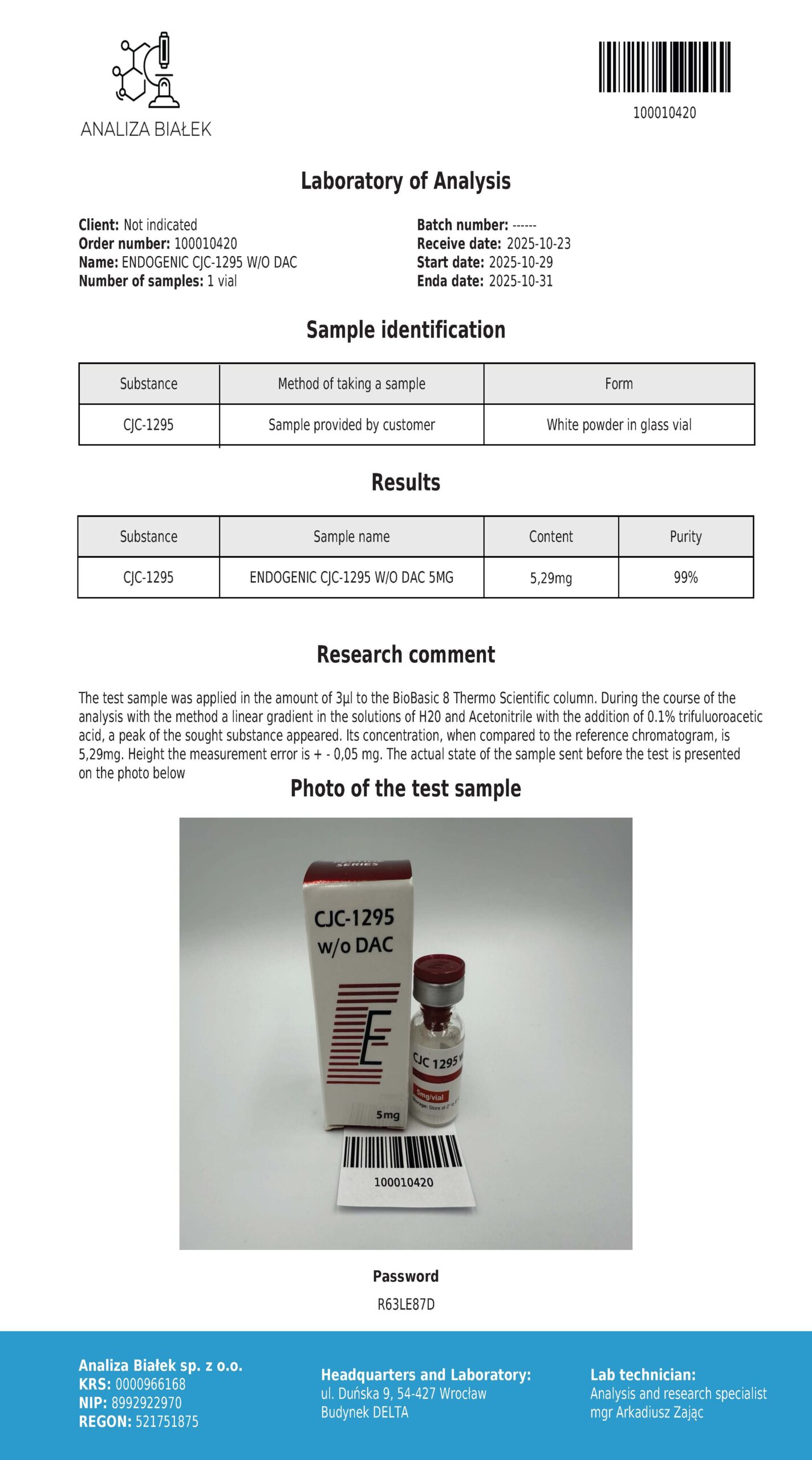
The presence or absence of a DAC group is decisive COA of the party — this is a specification that the researcher must verify before planning the experiment, because the time profile of GH stimulation of both variants is fundamentally different. “Pulsatile, short” (without DAC) and “prolonged, continuous” (with DAC) are two different pharmacokinetic models. Any references to GH release in this description refer to mechanisms reported in the literature on GHRH molecules – they do not imply a guarantee of effect for anyone working with the RUO reagent.