The operation of the CJC-1295 with DAC is based on the combination of two elements: classic GHRH receptor agonism and extended albumin retention technology (DAC). This distinction is important – the receptor mechanism is the same as endogenous GHRH, but the pharmacokinetics are fundamentally different.
GHRH receptor agonism – pulse amplitude. Activation of the GHRH receptor (Gs-coupled protein) on the somatotropic cell increases intracellular cAMP and triggers the PKA kinase-dependent pathway. The effect is increasing pulse amplitude — a single release of growth hormone becomes higher. In a working analogy: The CJC-1295 regulates the “volume” of the GH signal.
The core of the molecule is a fragment of GHRH(1-29), so at the receptor level the analogue mimics the endogenous hormone – the difference is not in What does with the receptor, but How long is able to do this.
DAC technology – irreversible binding of albumin. The heart of the molecule is a reactive maleimide-propionic linker. After reconstitution and introduction into an albumin-containing medium, the maleimide group reacts with the free cysteine-34 thiol group of serum albumin, forming permanent, covalent thioether bond. The resulting bioconjugate circulates bound to albumin, a protein with its own multi-day half-life.
Albumin acts as a reservoir: it protects the GHRH analog from glomerular filtration in the kidneys and from proteolytic degradation, while keeping it in circulation and slowly releasing the active form. It is DAC technology that translates the half-life from minutes to 6–8 days (Jetté et al. 2005).
Stabilizing modifications – protection against proteases. Independent of DAC, the peptide core itself contains substitutions (Asp³, Ala⁸, Arg²⁹, Leu²⁷) that protect the analogue from cleavage by dipeptidyl peptidase-4 (DPP-4) and other plasma proteases. Endogenous GHRH(1-29) is rapidly inactivated at the Tyr¹-Ala² bond, and substitution at position 8 (and the others) removes this sensitive site.
These modifications increase the stability of the peptide before albumin retention will still come into play.
Multi-day GH stimulation and secondary increase in IGF-1. The combination of the above elements gives a profile unique among GHRH analogues: sustained, multi-day stimulation of the GHRH receptor. In a phase I study (Teichman et al. 2006), a single exposure to CJC-1295 with DAC elevated GH concentrations for many days and led to sustained secondary increase in IGF-1 — a marker reflecting the hepatic response to prolonged GH signaling.
Importantly, despite the constant, increased concentration of the analogue, GH secretion remained pulsating (Ionescu, Frohman 2006) – prolonged exposure to GHRH maintains a higher basal level rather than abolishing the physiological rhythm of pulses.
Synergy with GHRP class peptides. In research protocols, a GHRH analogue is often combined with a ghrelin mimetic (Ipamorelin, GHRP-2) – because both arms act through different receptors and different intracellular cascades. GHRH (CJC-1295) provides the Gs/cAMP signal and increases the amplitude; GHRP stimulates the Gq ghrelin receptor, increases the frequency and suppresses somatostatin.
Because the ghrelin arm abolishes somatostatin inhibition and enhances the response to GHRH, simultaneous stimulation of both pathways produces an effect in the models. greater than the sum of individual actions — this is a classic research pair of GHRH + GHRP on the physiology of the somatotropic axis, also available as a ready-made stack Ipamorelin + CJC-1295.
IMPORTANT DISTINCTION – DAC vs. non-DAC variant
CJC-1295 is in the research market in… two structural variants with fundamentally different pharmacokinetics, which must not be confused:
- CJC-1295 with DAC (this reagent, DAC:GRF) – GHRH(1-29) core with an attached albumin affinity complex (maleimide-propionic linker). Binds irreversibly to plasma albumin → half-life days (~6–8 days) → maintained, multi-day GH/IGF-1 stimulation.
- CJC-1295 without DAC (also known as Mod-GRF 1-29 or modified GRF 1-29) – the same stabilized GHRH(1-29) core, but without albumin complex. Half-life in the order of minutes (~30 min) → short, pulsed stimulation similar to the physiological GHRH signal.
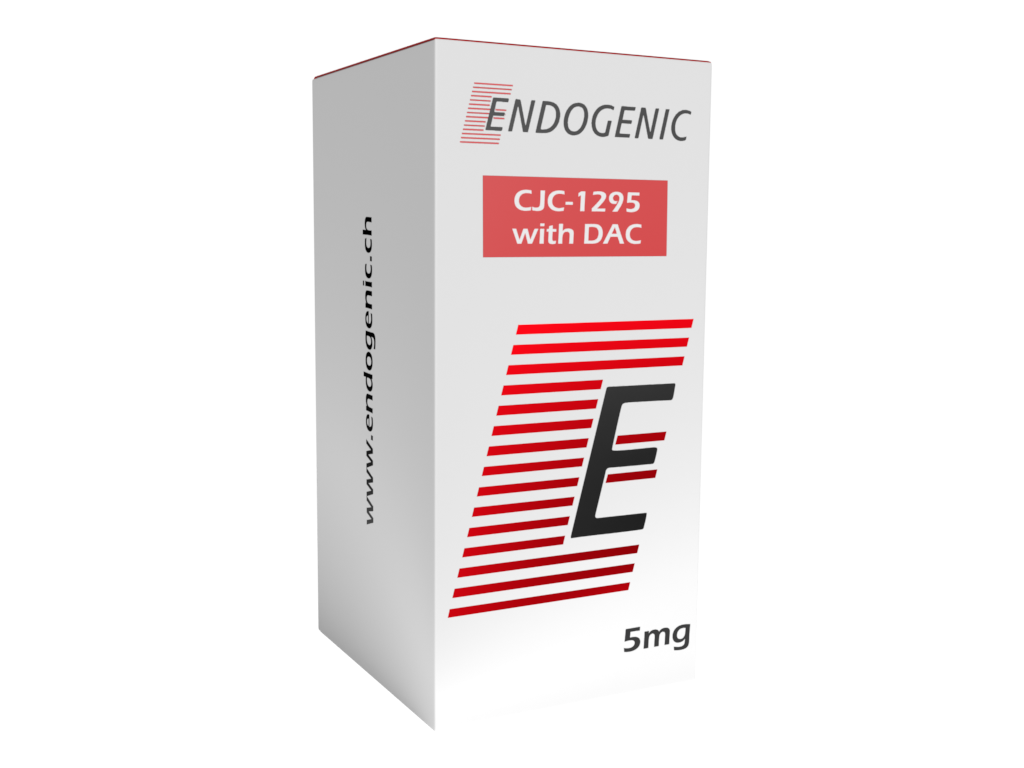
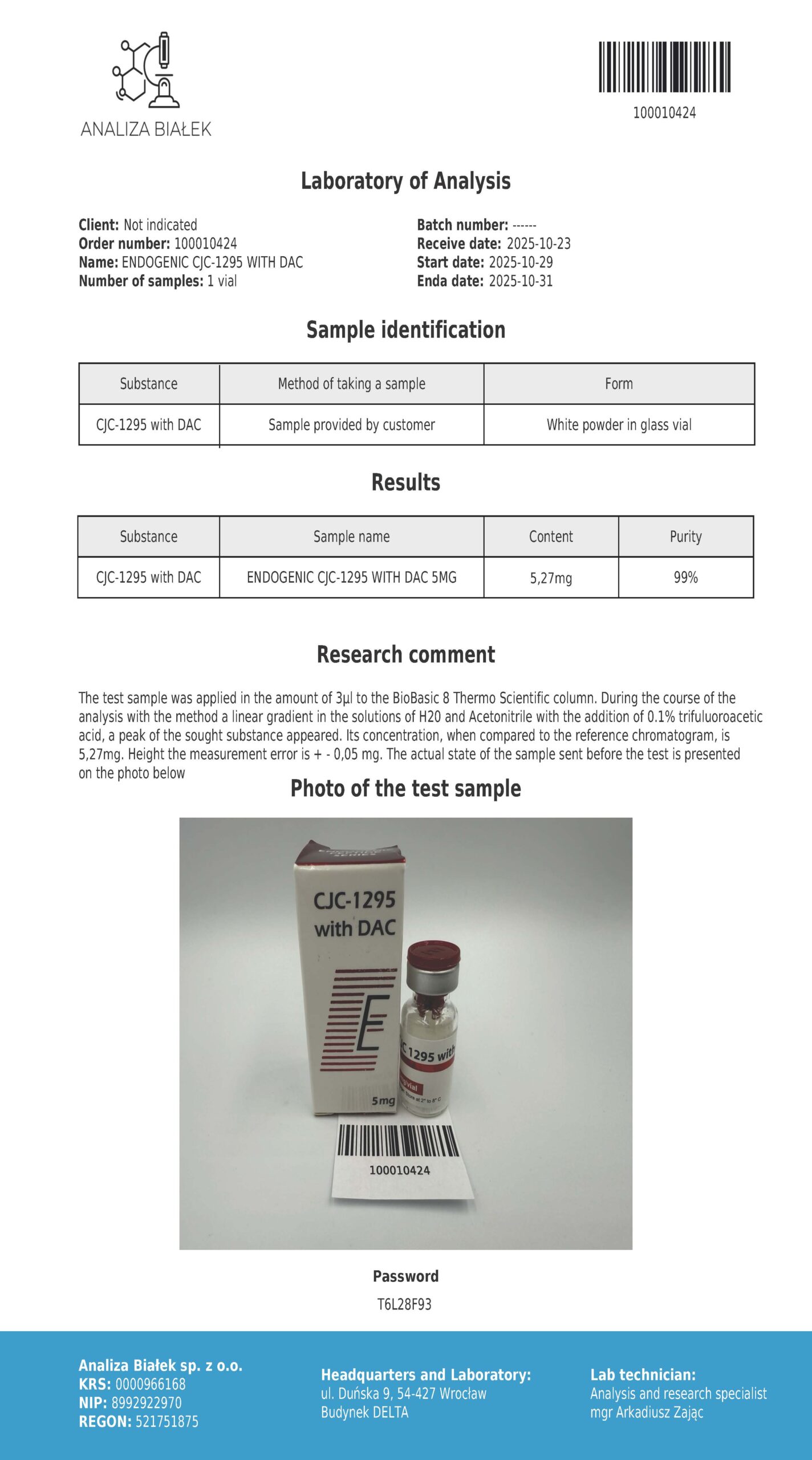
The difference is fundamental for the design of the experiment: the time profile of GH stimulation of the DAC variant (long, sustained, multi-day) and without DAC (short, pulsed) are two different pharmacokinetic models. The presence of DAC in a given batch must be confirmed in the COA — is the specification that the researcher verifies before planning the protocol.
The only binding signal of variant identity is the molecular weight confirmed by mass spectrometry (variant with DAC ~3647 g/mol vs. ~3367 g/mol variant without DAC) – the trade name is not sufficient. This distinction refers to the profile of the molecule in the literature and does not imply application to humans.