

The core sequence is identical (TKPRPGP), but N-Acetyl Selank Amidate has two terminal modifications: acetylation of the N-terminal α-amino group and amidation of the C-terminal α-carboxyl group (Ac-TKPRPGP-NH₂). Both changes block the attack sites of exopeptidases — enzymes degrading the free terminal groups of the peptide — which in research models translates into a longer half-life. The pharmacophore core remains the same, so the mechanistic profile is likely similar to that of Selank, although it requires separate validation for the modified molecule.
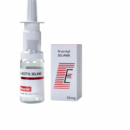
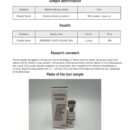
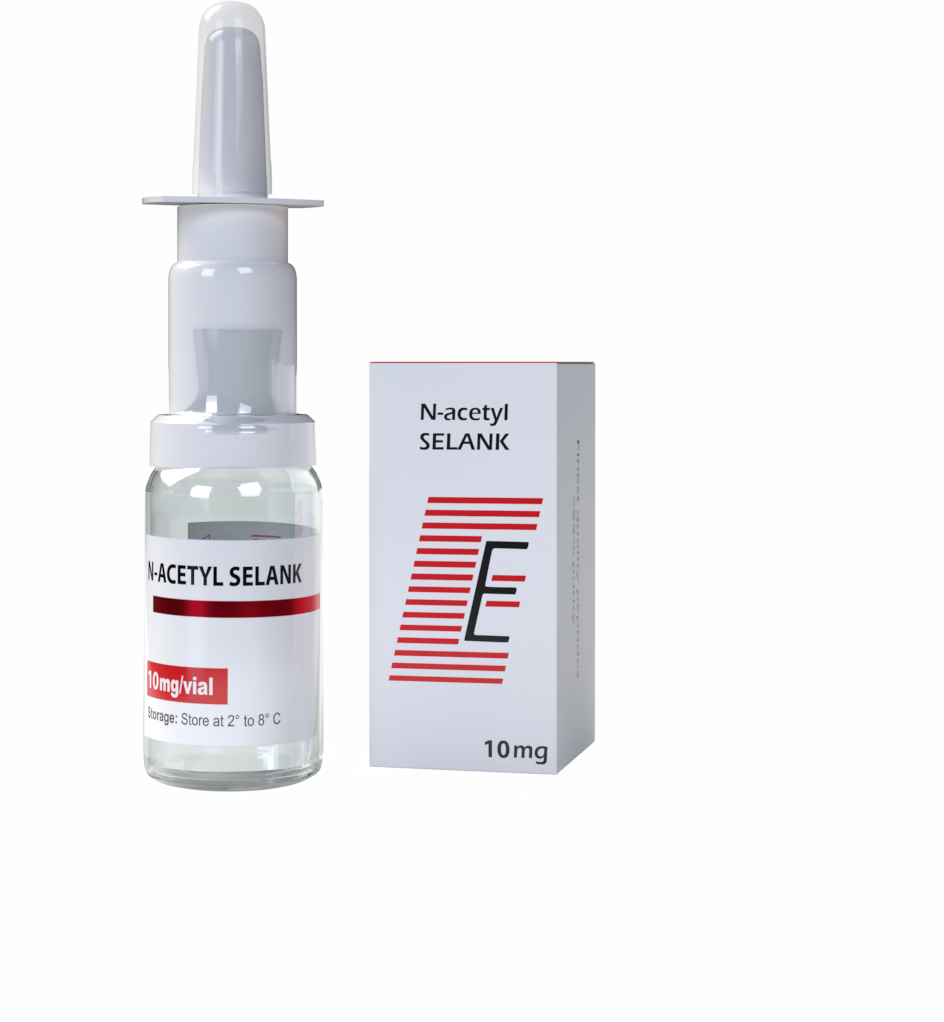
N-acetyl SELANK spray 10 mg
N-Acetyl Selank Spray 10 mg is an N-acetylated and C-amidated derivative of Selank (Ac-TKPRPGP-NH₂) in a kit containing lyophilisate, water and an atomizer—the same compound as Adalank, in a format requiring solution preparation. The Selank family profile includes non-classical GABA-A modulation and BDNF induction in rodent models. Research Use Only reagent.
33,99 €
Product unavailable
N-Acetyl Selank Spray 10 mg — N-Acetyl Selank Amidate nasal spray, research reagent
- N-Acetyl Selank spray: nominally 10 mg of peptide.
- Kit: lyophilisate, water and an atomizer; requires solution preparation.
- Research Use Only reagent, not a medicinal product.
N-Acetyl Selank spray – Chemical reagent intended exclusively for laboratory research (Research Use Only). It is not a medicinal product, dietary supplement, or food product. It is not intended for use in humans or animals. Sold exclusively to registered research entities and laboratories.
Native Selank degrades in serum within a few hours — the heptapeptide with the sequence Thr-Lys-Pro-Arg-Pro-Gly-Pro is more stable than the tuftsin from which it derives, but still susceptible to aminopeptidases. N-Acetyl Selank Amidate is peptide chemistry’s answer to this limitation: the same core sequence as Selank, but with two terminal modifications — N-terminal acetylation and C-terminal amidation (Ac-TKPRPGP-NH₂).
Both changes block the attack sites of exopeptidases, which in research models translates into a longer half-life of the peptide in solution and tissue. This reagent is the same compound as Adalank — N-Acetyl Selank in a vial, supplied as a kit containing lyophilisate, water and an atomizer. This format reflects the dominant route of administration in the literature on the Selank family — native Selank is registered in the Russian Federation as a nasal solution, and intranasal administration of regulatory peptides is the standard in preclinical protocols investigating nose-to-brain transport.
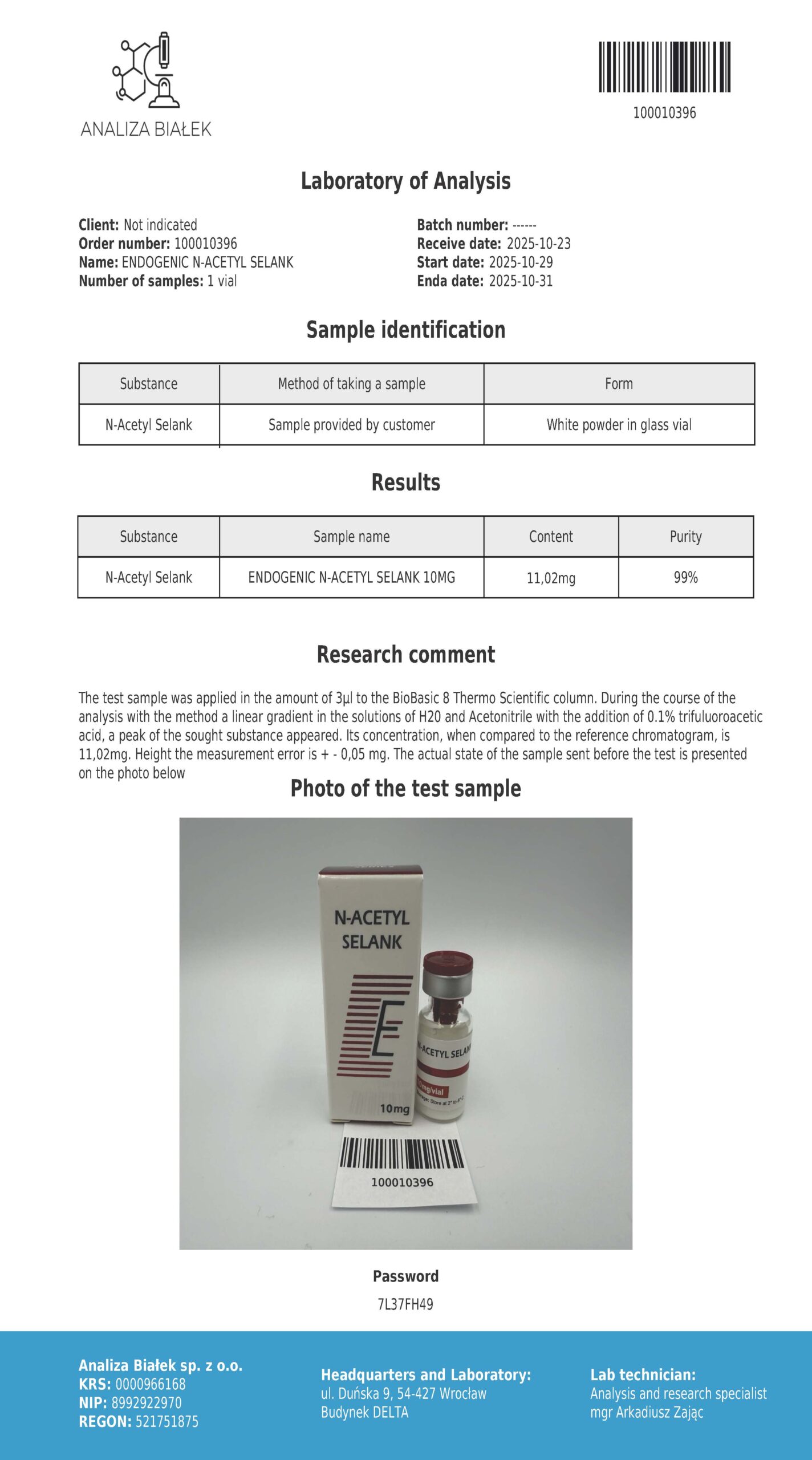
Within the catalog, this format sits among the peptides in spray intended for intranasal administration. In terms of pharmacological profile, N-Acetyl Selank inherits the mechanisms of Selank: nonclassical modulation of the GABA-A receptor via subunit expression, BDNF induction, an effect on monoaminergic transmission, tuftsin-like immunomodulatory activity, and inhibition of enkephalinases. This profile places the compound in the group of nootropic peptides with an anxiolytic component. Purity verified by HPLC ≥98%, identity confirmed by mass spectrometry, COA available for each batch.
REGULATORY STATUS
N-Acetyl Selank Amidate is not registered as a medicine in the EU or USA. Native Selank is registered as a medicinal product exclusively in the Russian Federation — the modified N-acetylated analogue does not hold such registration in any jurisdiction. Communicating the product as an “over-the-counter anxiolytic”, a “stress preparation”, or an “anxiety spray” is inconsistent with the Research Use Only framework.
What is N-Acetyl Selank Amidate?
N-Acetyl Selank Amidate is a synthetic heptapeptide — an N-acetylated and C-amidated derivative of Selank.
- Common name: N-Acetyl Selank, N-Acetyl Selank Amidate, NA-Selank Amidate
- Sequence: Ac-Thr-Lys-Pro-Arg-Pro-Gly-Pro-NH₂ (single-letter: Ac-TKPRPGP-NH₂)
- Modifications relative to Selank: acetylation of the N-terminal α-amino group (threonine) + amidation of the C-terminal α-carboxyl group (proline)
- Chemical class: modified regulatory heptapeptide; tuftsin derivative (the first four residues TKPR correspond to tuftsin)
- Molar mass: ~792.9 Da (Selank core 751.9 Da + acetyl group +42 Da, amidation −1 Da; exact value — to be verified in the batch COA)
- Molecular formula: C₃₅H₅₈N₁₄O₉ (indicative for the acetylated-amidated form; MS confirmation in the COA)
- Isoelectric pH: strongly basic (presence of lysine and arginine; C-terminal amidation additionally reduces the negative charge)
- Supplied form: kit containing lyophilisate, water and an atomizer for solution preparation, 10 mg of peptide per package; pharmaceutical grade ≥98% HPLC
Origin and rationale for the modification: The core sequence derives from tuftsin — a natural tetrapeptide Thr-Lys-Pro-Arg, a fragment of the CH2 domain of immunoglobulin G, described in 1970 by Victor Najjar. Nina Myasoedov’s team at the Institute of Molecular Genetics in Moscow added the C-terminal tripeptide Pro-Gly-Pro to tuftsin, creating Selank and revealing its anxiolytic profile.
N-Acetyl Selank Amidate is the next step in the same design strategy: capping both ends of the peptide (N-acetylation + C-amidation) blocks the exopeptidases that degrade free terminal groups. In the chemistry of regulatory peptides, this is a standard method of extending proteolytic stability without altering the pharmacophore core.
Mechanism of action at the molecular level
N-Acetyl Selank — as a derivative of Selank — likely acts through several parallel neurobiological pathways. The mechanisms below have been documented for native Selank in preclinical models; their transfer to the acetylated analogue remains the subject of research. Pharmacological profile described for the Selank family in research models:
- Nonclassical modulation of the GABA-A receptor — the best-described mechanism. In rat models, Selank increases the mRNA and protein expression of selected GABA-A receptor subunits (mainly α1, α2, γ2) in the frontal cortex and hippocampus (Vyunova et al. 2018; Volkova et al. 2016). This mechanism is fundamentally different from that of benzodiazepines: benzodiazepines bind allosterically to the benzodiazepine site of an existing receptor, whereas Selank increases the expression of the receptor itself through transcriptional modulation. Consequence in the models: enhancement of inhibitory signaling without the sedation, ataxia, and tolerance typical of benzodiazepines
- BDNF induction (brain-derived neurotrophic factor) — Selank increases BDNF expression in the hippocampus and cortex; the effect is weaker than in the case of Semax, but consistent across animal models. This is one of the likely mechanisms behind its effect on cognitive function and resistance to chronic stress
- Inhibition of enkephalinases — Selank inhibits the activity of enzymes degrading enkephalins in serum and brain tissue (Kost et al. 2001), which raises the concentration of endogenous Met- and Leu-enkephalins in synapses. The opioid activity of endogenous peptides makes a likely contribution to the anxiolytic and mood-stabilizing effect
- Modulation of monoaminergic transmission — some works indicate an increase in serotonin (5-HT) concentration in the cortex and hippocampus after administration of Selank, probably through inhibition of monoamine-degrading enzymes or modulation of their release
- Modulation of the HPA axis (hypothalamic–pituitary–adrenal) — in chronic stress models, Selank reduces the excessive corticosterone response without suppressing the basal activity of the axis — a profile distinguishing it from drugs that lower the systemic cortisol level
- Tuftsin-like immunomodulatory activity — as a tuftsin analogue, Selank modulates macrophage function and cytokine profile; in some animal models, antiviral activity against influenza viruses was observed. A peripheral effect relative to the main anxiolytic profile, but of interest for hypotheses regarding disorders with an inflammatory component
Nose-to-brain mechanism — peptide transport via intranasal administration
The nasal spray format reflects the dominant route of administration in the literature on the Selank family. The molecular rationale is well described in peptide neuropharmacology. Most regulatory peptides poorly cross the blood-brain barrier (BBB) after peripheral administration — they are too large and too polar. Intranasal administration offers an alternative route for delivery to the central nervous system (CNS), partly bypassing the BBB. In research models, two parallel nose-to-brain transport pathways have been described:
- Olfactory pathway — a peptide applied to the olfactory epithelium in the upper part of the nasal cavity can be transported along the olfactory nerves directly to the olfactory bulb and further to forebrain structures, bypassing the systemic circulation
- Trigeminal nerve pathway — the trigeminal nerve endings innervating the nasal mucosa constitute a second route of transport to the brainstem and further CNS structures
In research models, intranasal administration of regulatory peptides demonstrates nose-to-brain transport, achieving higher concentrations in brain structures with smaller total doses than systemic administration. For the Selank family, the intranasal route is preferred in preclinical protocols precisely for this reason.
Applications in scientific research
N-Acetyl Selank Amidate in nasal spray format finds application in research directions analogous to those of native Selank, with additional emphasis on characterizing the profile of the modified molecule:
- Experimental anxiety models — classic behavioral tests in rodents (open field, elevated plus maze, light-dark box, Vogel conflict test); comparison of the effect size of the acetylated analogue relative to native Selank and benzodiazepines
- Chronic stress resistance models — physical (immobilization, cold stress) and psychosocial (defeat model); assessment of the effect on the development of depressive behaviors and the HPA axis response
- Neuropsychiatric models — experimental models of PTSD and adjustment disorders; modulation of synaptic plasticity in the amygdala and hippocampus
- Nose-to-brain transport studies — comparative pharmacokinetics of intranasal versus systemic administration; characterization of the effect of terminal modifications (acetylation, amidation) on transport across the olfactory epithelium
- GABA-A subunit and BDNF expression — transcriptional studies in the cortex and hippocampus; comparison of modulation kinetics for the acetylated analogue
- Cognitive models — memory and learning tests (Morris water maze, passive avoidance), particularly under conditions of cognitive impairment induced by stress
REGULATORY STATUS
The WADA status of Selank-family peptides requires verification against the current list — Selank and its analogues are not currently listed as separately named prohibited substances; however, peptides with neuromodulatory activity are sometimes covered by general clauses. Registered athletes (ADAMS) must check the current list of prohibited substances before any decision. Native Selank is registered as a medicine exclusively in the Russian Federation; the N-acetylated analogue is not registered as a medicine in any jurisdiction.
Summary
N-Acetyl Selank Spray 10 mg is an N-acetylated and C-amidated derivative of Selank (Ac-TKPRPGP-NH₂) — the same compound as Adalank, supplied as a kit containing lyophilisate, water and an atomizer, requiring solution preparation. The terminal modifications block exopeptidases, extending the stability of the peptide in solution. The pharmacological profile inherited from Selank includes nonclassical modulation of the GABA-A receptor via subunit expression, BDNF induction, inhibition of enkephalinases, modulation of monoamines and the HPA axis, and tuftsin-like immunomodulatory activity — all documented for native Selank in rodent and in vitro models, with the need for separate validation for the acetylated analogue.
The spray format reflects the intranasal route dominant in the literature on the Selank family and the nose-to-brain transport mechanism. Regulatory status — Research Use Only. A complementary analogue for the Selank family is native Selank 10mg in injectable form — the reference, unmodified peptide against which the profile of the acetylated analogue is compared.
In cognitive research, Selank is sometimes paired with an activating nootropic of dopaminergic-serotonergic profile, namely Semax spray — the anxiolytic + nootropic pair is often treated as complementary. The broader context of the classification and mechanisms of nootropic compounds is discussed in the review nootropic substances — what are they and when to use them.
Bibliography
- Vyunova TV, Andreeva LA, Shevchenko KV, Myasoedov NF (2018). Peptide-based anxiolytics: the molecular aspects of heptapeptide Selank biological activity. PubMed
- Kost NV, Sokolov OY, Gabaeva MV, Grivennikov IA, Andreeva LA, Myasoedov NF, Zozulya AA (2001). Semax and selank inhibit the enkephalin-degrading enzymes from human serum. PubMed
- Zozulya AA, Neznamov GG, Siuniakov TS, Kost NV, Gabaeva MV, Sokolov OY, et al. (2008). Efficacy and possible mechanisms of action of a new peptide anxiolytic selank in the therapy of generalized anxiety disorders and neurasthenia. PubMed
- Volkova A, Shadrina M, Kolomin T, Andreeva L, Limborska S, Myasoedov N, Slominsky P (2016). Selank administration affects the expression of some genes involved in GABAergic neurotransmission. PubMed
- Najjar VA, Nishioka K (1970). “Tuftsin”: a natural phagocytosis stimulating peptide. PubMed
FAQ
Both formats require solution preparation before laboratory work. The vial contains lyophilisate, whereas the spray kit additionally contains water and an atomizer. Preparation parameters, working concentration and storage conditions must follow the specific batch documentation and research protocol. Peptide identity and terminal modifications must be confirmed in the COA; the trade name or packaging alone does not establish them.
The intranasal route is the dominant route of administration in the literature on the Selank family — native Selank is registered in the Russian Federation as a nasal solution. In research models, intranasal administration of regulatory peptides demonstrates nose-to-brain transport: the peptide is transported to the CNS along the olfactory nerve and the trigeminal nerve, partly bypassing the blood-brain barrier. This allows higher concentrations to be achieved in brain structures with smaller total doses than systemic administration.
Only partially and cautiously. Most of the documented data — the GABA-A mechanism, BDNF induction, anxiolytic profile, precedent of intranasal administration in humans — comes from the literature on native Selank (TKPRPGP). Acetylation and amidation alter the pharmacokinetics (stability, lipophilicity, nasal transport kinetics), and potentially also the affinity for molecular targets. The profile of the N-acetylated analogue (Ac-TKPRPGP-NH₂) requires separate characterization — extrapolation from native Selank is a working hypothesis, not a documented fact.
The kit contains separate lyophilisate, water and an atomizer. Storage conditions for each component and stability of the prepared solution must be checked in the specific batch documentation. Without these data, do not state a universal temperature, preservative content or solution shelf life. Material preparation should follow the approved laboratory protocol.
Selank and its analogues are not currently listed as separately named prohibited substances; however, peptides with neuromodulatory activity are sometimes covered by the general clauses of the WADA list. Registered athletes (ADAMS) must check the current list of prohibited substances before any decision — the status of the compound may change in subsequent updates.
Both peptides originate from the Russian school of regulatory peptides and use a similar stabilization strategy, but they have different profiles. Semax acts mainly through the dopaminergic-serotonergic system and has a nootropic profile (learning, memory, neuroprotection). Selank and its derivatives act mainly through the GABAergic system and have an anxiolytic profile. In research practice, they are often treated as a complementary pair — an activating nootropic and a calming anxiolytic.
0.0
0 reviews
This product has no reviews yet.
Related products