

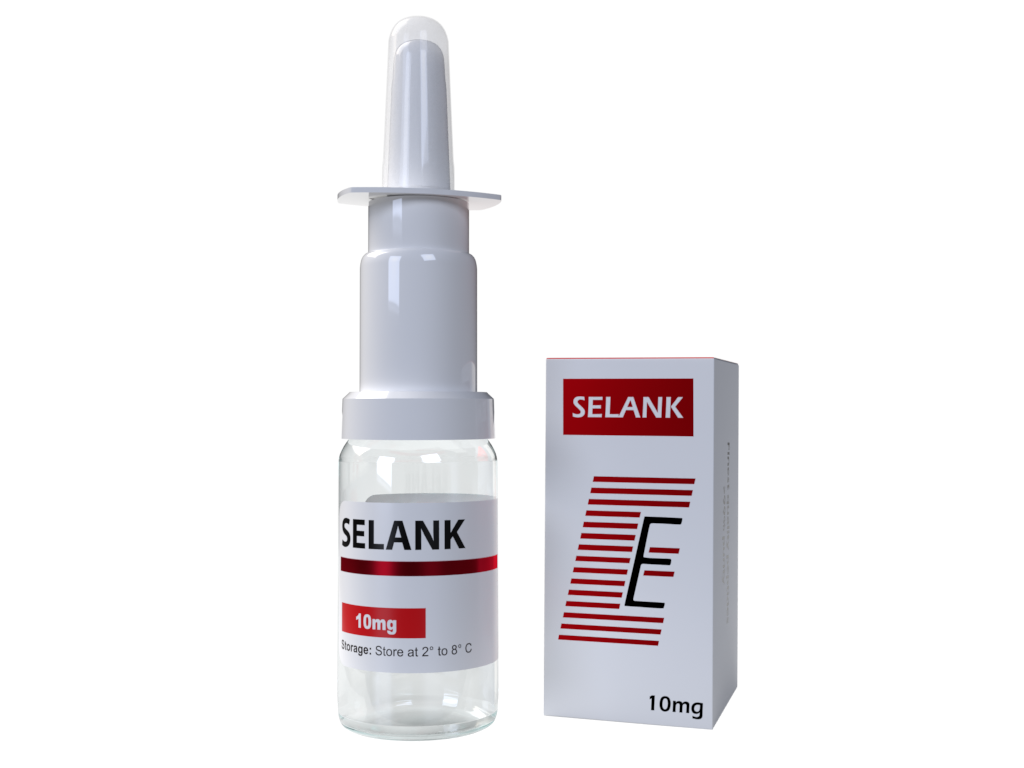
NO. This is a self-preparation kit. It consists of three elements: a vial with Selank lyophilisate (powder), bacteriostatic water for reconstitution and an empty glass atomizer with a dosing pump. The researcher first reconstitutes the lyophilisate with the included water, then transfers the solution to the atomizer. The concentration of the solution is not factory set – it results from the peptide content in the vial (given in the COA) and the volume of water used for reconstitution. This format reflects the nasal route dominant in the Selank literature.
Selank spray
Selank nasal spray is a native anxiolytic heptapeptide TKPRPGP (both ends free) – a synthetic analogue of tuftsin developed at the Institute of Molecular Genetics of the Russian Academy of Sciences, supplied as a kit for self-preparation of a nasal spray. Research Use Only reagent
34,99 €
Product unavailable
Selank nasal spray preparation kit, research reagent (RUO)
- Selank: native TKPRPGP heptapeptide, tuftsin analogue.
- Spray preparation kit: lyophilisate, water and glass atomizer; not a ready-to-use solution.
- Research Use Only reagent, not a medicinal product.
Product status information
Chemical reagent intended exclusively for laboratory tests (Research Use Only). It is not a medicinal product, dietary supplement or food. It is not intended for use on humans or animals. Sales only to registered research units and laboratories.
Introduction
In the family of regulatory peptides derived from tuftsin Native Selank is the starting molecule, a heptapeptide with the sequence Thr-Lys-Pro-Arg-Pro-Gly-Pro (TKPRPGP), on which most of the mechanistic work attributed to the entire group has been performed. Selank belongs to the lineage Endogenic — reagents mapping molecules of endogenous origin or directly derived from them, provided for research on the neuropharmacology of regulatory peptides. In the Pro-Body catalog it is adjacent to others peptides to improve well-being used as reference compounds in experimental anxiety models.
This reagent delivers native Selank in a format targeting the route of administration predominant in the literature for this molecule – as kit for self-preparation of nasal spray: vial with Selank lyophilisate, bacteriostatic water for reconstitution and a glass atomizer with a dosing pump. This is not a ready-to-use solution: the researcher first reconstitutes the lyophilized product with the included water and then fills the atomizer, preparing the solution for intranasal administration.
The format logic here is remarkably consistent with the compound’s history – native Selank is registered in the Russian Federation as an anxiolytic in the form of a nasal solution, and intranasal administration of regulatory peptides is standard in preclinical protocols examining nose-to-brain transport. Where for most peptides the intranasal route is a logistical choice, for Selank it is the route on which its therapeutic registration is based – in the catalog it corresponds to a wider group peptides spray prepared for intranasal administration.
Native Selank has variants and related formats in the Pro-Body catalog that should not be confused with it: only a vial with lyophilisate, without water and atomizer (Selank 5 mg – lyophilized vial) and acetylated derivatives — N-Acetyl Selank Spray – acetylated form and Adalank – N-Acetyl Selank Amidate. Unlike them, native Selank has both ends free, which is why it has the shortest half-life in the family.
The pharmacological profile includes non-classical modulation of the GABA-A receptor by the NPY system, induction of BDNF and NGF, influence on monoaminergic transmission, tuftsin-like immunomodulatory activity and inhibition of enkephalinases. Purity verified by HPLC ≥98%, identity confirmed by mass spectrometry, COA available for each batch.
Regulatory status
Native Selank is registered as a medicinal product only in the Russian Federation — since 2009 as an anxiolytic in the form of a nasal solution. It is not registered as a medicine in the EU and USA. The Pro-Body nasal spray preparation kit is a research reagent reflecting the route of administration from the literature, not a registered drug – communication of the product as an “over the counter anxiolytic”, “stress spray” or “anxiety peptide for biohackers” is contrary to the Research Use Only framework.
Tuftsin, Selank and the Russian school of regulatory peptides
To understand Selank, you have to go back to tuftsyna. It is a natural tetrapeptide Thr-Lys-Pro-Arg – a fragment of the CH2 domain of immunoglobulin G, described in 1970 by Victor Najjar as a peptide stimulating phagocytosis. Tuftsin was one of the first molecules on which the strategy of designing synthetic analogues of endogenous peptides was based: take an active fragment of a natural protein, stabilize it and check what physiological functions it brings.
In the 1990s, Nina Myasoedow’s group at the Institute of Molecular Genetics of the Russian Academy of Sciences (RAN) in Moscow added the C-terminal tripeptide Pro-Gly-Pro to tuftsin, creating the heptapeptide Selank.
The addition of proline tripeptide changed the profile of the molecule: in addition to tuftsin-like immunomodulatory activity, a clear anxiolytic and nootropic profile was revealed in behavioral models in rodents. The first four Selank residues (TKPR) are still the tuftsin sequence – this is why the peptide inherits the immunomodulatory activity; added Pro-Gly-Pro gives it a neuroactive profile. Selank was included in clinical trials for anxiety disorders, and in 2009 it was registered in the Russian Federation as an anxiolytic in the form of a nasal solution.
This makes it one of the few peptide molecules from this group that has passed the registration route as a medicine – although only in one jurisdiction, and in a form administered through the nose. Selank remains a peptide with limited proteolytic stability: both ends are free and susceptible to exopeptidases. This limitation has spawned a whole generation of stabilized derivatives – N-Acetyl Selank and Adalank – that block the enzymatic attack points without disturbing the core activity.
Native Selank, however, remains the reference molecule: most of the mechanistic work referenced in the descriptions of its derivatives has been carried out on it, and it is the one that has Russian registration in its intranasal form.
What is Selank?
Selank is a synthetic heptapeptide with two free ends – a tuftsin analogue extended with a C-terminal proline tripeptide. In this kit, it is supplied as a lyophilized product in a vial along with bacteriostatic water and a glass atomizer, from which the researcher prepares a solution for intranasal administration after reconstitution.
- Common name: Selank, native Selank
- Sequence: Thr-Lys-Pro-Arg-Pro-Gly-Pro (single letter: TKPRPGP); both ends free – free α-amino group at the N-terminus (threonine) and free α-carboxyl group at the C-terminus (proline)
- Structural origin: synthetic analogue of tuftsin (Thr-Lys-Pro-Arg) extended with the tripeptide Pro-Gly-Pro
- Chemical class: regulatory heptapeptide; tuftsin derivative (the first four residues of TKPR correspond to tuftsin)
- Supplied form: set – vial with Selank lyophilisate + bacteriostatic water for reconstitution + glass nasal atomizer (for self-preparation of the solution); pharmaceutical grade ≥98% HPLC
Table of physicochemical characteristics
| Parameter | Value | Notes |
|---|---|---|
| Sequence | TKPRPGP (both ends free) | heptapeptide, tuftsin analogue |
| CAS number | 129954-34-3 | for the native form of Selank |
| Molecular formula | C₃₃H₅₇N₁₁O₉ | form with free ends |
| Molar mass | 751.87 g/mol | monoisotopic mass for verification in the batch COA |
| Isoelectric point | strongly alkaline | the presence of lysine and arginine; free ends maintain full charge profile |
| Supplied form | set: lyophilisate vial + water + glass atomizer | for reconstitution and preparation of the nasal solution by the investigator |
| Purity | ≥98% HPLC | UV detection, per batch verification |
| Half-life (model) | ~7–15 min (shortest in the family) | both free ends susceptible to exopeptidases |
Mechanism of action at the molecular level
Native Selank likely operates through several parallel neurobiological pathways. The following mechanisms have been documented for Selank in preclinical models – these are the reference data referenced in the descriptions of the stabilized derivatives. Pharmacological profile described for Selank in research models:
- Non-classical modulation of the GABA-A receptor by the NPY system — best described mechanism. In rodent models, Selank does not bind to the benzodiazepine site of the receptor, but acts indirectly – including through the neuropeptide Y (NPY) system – and modulates the expression of GABA-A receptor subunits in the frontal cortex and hippocampus. This is a fundamentally different mechanism from benzodiazepines: benzodiazepines bind allosterically to the benzodiazepine site of an existing receptor, whereas Selank affects the level of GABAergic signaling itself by modulating expression and transmission. Consistency in models: enhancement of inhibitory signaling without the sedation, ataxia and tolerance typical of benzodiazepines
- Modulation of BDNF and NGF expression in the hippocampus — Selank increases the expression of brain neurotrophic factor (BDNF) and affects nerve growth factor (NGF) in the hippocampus and cortex (Inozemtseva et al. 2008); a weaker effect than with Semax, but consistent in animal models. This is one of the probable mechanisms of influence on cognitive functions and resistance to chronic stress. Importantly, Inozemtseva’s work was done on a model intranasal administration — which makes it directly relevant to this format
- Modulation of dopaminergic and serotonergic transmission — some studies indicate the effect of Selank and tuftsin on the concentration of monoamines (dopamine, serotonin) and their metabolites in brain structures, which in rodent models correlates with the anxiolytic and nootropic profile (Semenova et al. 2006). The mechanism likely involves modulation of monoamine release or degradation
- Tuftsin-like immunomodulatory activity — as a tuftsin analogue, Selank modulates macrophage function and cytokine profile, including interferons (IFN-α/β) and interleukins (IL-6) (Uchakina et al. 2008). In some models and clinical observations, it was associated with an anxiolytic-asthenic profile with an immunological component. Effect peripheral to the main anxiolytic profile, but interesting for hypotheses on disorders with an inflammatory component
- Inhibition of enkephalinases — Selank inhibits the activity of enkephalin-degrading enzymes in serum and brain tissue, which increases the concentration of endogenous Met- and Leu-enkephalins in synapses and prolongs enkephalinergic signaling. The opioid activity of endogenous peptides likely contributes to the anxiolytic and mood-stabilizing effects
Nose-to-brain mechanism - peptide transport by intranasal administration
The intranasal administration format for which this kit is prepared reflects the predominant route of administration in the literature on Selank and, in the case of this particular molecule, also the route on which the Russian medicinal registration was based. The molecular logic of transport is well described in peptide neuropharmacology. Most regulatory peptides do not cross the blood-brain barrier (BBB) well when administered peripherally – they are too large and too polar.
Intranasal administration offers an alternative delivery route to the central nervous system (CNS), partially bypassing the BBB. Two parallel nose-to-brain transport pathways have been described in research models:
- Olfactory pathway (olfactory) — a peptide applied to the olfactory epithelium in the upper part of the nasal cavity can be transported along the olfactory nerves directly to the olfactory bulb and further to the structures of the forebrain, bypassing the systemic circulation
- Trigeminal nerve pathway — the endings of the trigeminal nerve innervating the nasal mucosa constitute a second route of transport to the brain stem and further structures of the CNS
For native Selank, the nasal route is particularly important for two reasons. Firstly, the shortest half-life in the family (7–15 minutes) means that peripheral administration provides a narrow window of exposure; the intranasal route, partially bypassing first-pass metabolism and the blood-brain barrier, allows the peptide to be delivered closer to central targets. Secondly, the central work on BDNF induction in the rat hippocampus (Inozemtseva et al. 2008) was performed using an intranasal administration model, which makes this format directly consistent with the mechanistic literature.
SCIENTIFIC PERSPECTIVE
Native Selank has strong precedent for intranasal administration in humans — it is registered in the Russian Federation as a nasal solution, and clinical trials on this form have been conducted in generalized and adaptive anxiety disorders (Zozulia et al. 2008). This is a rare situation in the regulatory peptide family: the route of administration corresponding to the format of this reagent has a documented clinical pathway for the same molecule, not just a logical nose-to-brain analogy.
A fair caveat remains, however: this precedent concerns a registered Russian medicinal product, a RUO Pro-Body form is a research reagent — not a registered drug and not its substitute. Clinical precedent describes the potential of the route of administration in research and does not authorize the use of the reagent in humans.
Important Distinction - Native Selank vs N-Acetyl Selank (and RUO Reagent vs Russian Drug)
The format prepared for intranasal administration is available in the Pro-Body catalog in two chemical variants, which must not be confused. Both are intended for the intranasal route, but they differ in modifications of the peptide ends, and therefore in proteolytic stability and clinical precedent status.
| Parameter | Nasal Selank (this product) | N-Acetyl Selank Spray |
|---|---|---|
| Sequence | TKPRPGP (both ends free) | Ac-TKPRPGP-NH₂ (N-acetylation + C-amidation) |
| Approximate weight | 751.87 Da | ~792–793 Da |
| Half-life (model) | ~7–15 min (shortest) | longer (both ends blocked) |
| Human intranasal precedent | direct — native Selank registered in Russia as a nasal solution | only partially portable from native Selank |
| Status of mechanistic data | reference molecule, direct data | inherited from Selank, require separate validation |
Applications in scientific research
The native Selank in this kit is the reference molecule for the entire TKPRPGP family, supplied with a kit for preparing the solution for the route of administration, on which most of the major work and the Russian registration are based. It is used in research areas:
- Experimental anxiety models — classic behavioral tests in rodents (open field, elevated plus maze, light-dark box, Vogel conflict test); Selank as a reference compound when assessing the scale of the effect of acetylated analogues in relation to the native form and benzodiazepines
- Nose-to-brain transport studies — comparative pharmacokinetics of intranasal versus systemic administration for the native form; characterization of the transport kinetics of a peptide with two free ends across the olfactory epithelium
- Models of resistance to chronic stress — physical (immobilization, cold stress) and psychosocial (defeat model); assessment of the impact on the development of depressive behaviors and the response of the HPA axis
- Neuropsychiatric models — experimental models of PTSD and adjustment disorders; modulation of synaptic plasticity in the amygdala and hippocampus
- Expression of BDNF, NGF and GABA-A subunits — transcription and protein studies in the cortex and hippocampus after intranasal administration, in reference to Inozemtseva’s model; Selank as a standard for modulation kinetics in relation to stabilized analogues
- Cognitive models — memory and learning tests (Morris water maze, passive avoidance), especially in conditions of cognitive impairment due to stress
- Immunomodulation studies — assessment of tuftsin-like activity on macrophage function and cytokine profile (IFN, IL-6) in in vitro and in vivo models
In research on nootropic and anxiolytic peptides, native Selank is sometimes combined with related molecules of the Russian school of regulatory peptides prepared for intranasal administration – the reference point for the nootropic peptide is, for example, Semax spray, for which the BDNF induction effect is more pronounced than for Selank.
Summary
Nasal selank is a native heptapeptide with the sequence TKPRPGP (both ends free) – a synthetic analogue of tuftsin extended with the C-terminal tripeptide Pro-Gly-Pro, developed in the 1990s at the RAN Institute of Molecular Genetics in Moscow and supplied as a kit for self-preparation of a nasal spray: a vial with lyophilisate, bacteriostatic water for reconstitution and a glass atomizer.
It is the reference molecule of the entire family: most of the mechanistic work referred to in the descriptions of the stabilized derivatives – N-Acetyl Selank Spray and Adalank – has been carried out on it. Native Selank has the shortest half-life in the family (7–15 minutes) because both of its free ends are susceptible to exopeptidases.
The pharmacological profile includes non-classical modulation of the GABA-A receptor by the NPY system, BDNF/NGF modulation in the hippocampus, effects on dopaminergic and serotonergic transmission, tuftsin-like immunomodulatory activity (IFN, IL-6) and enkephalinase inhibition – documented in rodent models, in vitro and in clinical trials conducted in the Russian Federation. The intranasal format refers directly to the route on which the registration was based: native Selank is the only molecule of the family registered as a drug in the form administered through the nose – nasal drops/solution, exclusively in Russia since 2009, which sets a strong human intranasal precedent. HPLC purity ≥98%, MS confirmation (Q-TOF), COA for each batch.
Regulatory status outside Russia – Research Use Only. The broader context of the classification and uses of compounds that support cognitive functions and stress resistance is discussed in the guide on what they are nootropic substances and when they are the subject of research.
Bibliography
- Inozemtseva LS, Karpenko EA, Dolotov OV, Levitskaya NG, Kamensky AA, Andreeva LA, Grivennikov IA (2008). Intranasal administration of the Selank peptide regulates BDNF expression in the rat hippocampus in vivo. PubMed
- Uchakina ON, Uchakin PN, Miasoedov NF, Andreeva LA, Shcherbenko VE, Mezentseva MV, et al. (2008). Immunomodulatory effects of Selank in patients with anxiety-asthenic disorders. PubMed
- Zozulia AA, Neznamov GG, Siuniakov TS, Kost NV, Gabaeva MV, Sokolov OIu, et al. (2008). Efficacy and possible mechanisms of action of a new peptide anxiolytic selank in the therapy of generalized anxiety disorders and neurasthenia. PubMed
- Semenova TP, Kozlovskaia MM, Zuĭkov AV, Kozlovskiĭ II, Zakharova NM, Andreeva LA (2006). Selank-induced normalizing effects on the integrative brain activity and biogenic amine level disorders due to antenatal hypoxia. PubMed
FAQ
Content – in both cases, the peptide is a lyophilisate that requires reconstitution. This product is vial with lyophilisate + bacteriostatic water + glass atomizer, i.e. a set for preparing a solution for intranasal administration. Selank 5 mg it is just a lyophilisate without water and an applicator – the researcher selects the solvent volume and working concentration for any route of administration in the protocol, and the vial ensures longer shelf life. The identity of the material in both formats is determined by the sequence and mass of the MS in the batch COA.
The core sequence is common (TKPRPGP), but these are two separate molecules. This product is Native Selank with two free ends (TKPRPGP, 751.87 Da) – the shortest half-life in the family (7–15 minutes), but with direct clinical precedent and direct mechanistic data. N-Acetyl Selank Spray is an acetylated and amidated form (Ac-TKPRPGP-NH₂, ~792–793 Da) – end modifications block exopeptidases and extend proteolytic stability, but change lipophilicity and nasal transport kinetics, and most of the data for it is inherited from native Selank.
The identity is determined by the sequence and MS mass in the COA of the batch – native Selank is distinguished by a mass difference of −42 Da (no acetyl group).
The intranasal route is the dominant route of administration in the literature on Selank and at the same time the route on which its Russian medicinal registration was based. In research models, intranasal administration of regulatory peptides demonstrates nose-to-brain transport: the peptide is transported to the CNS along the olfactory nerve and trigeminal nerve, partially bypassing the blood-brain barrier.
For native Selank, this has a double justification – the shortest half-life limits the exposure window after peripheral administration, and the central work on BDNF induction in the rat hippocampus (Inozemtseva et al. 2008) was performed in an intranasal model. In this kit, the solution for intranasal administration is prepared by the researcher himself after reconstitution of the lyophilisate.
Yes, and it is a strong precedent. Native Selank has been registered in the Russian Federation as an anxiolytic in the form of a nasal solution since 2009, and clinical trials on this form have been conducted in generalized and adaptive anxiety disorders (Zozulia et al. 2008). This is a rare situation in the regulatory peptide family: the route of administration corresponding to the format of this reagent has a documented clinical pathway for the same molecule.
However, the caveat remains – the precedent concerns a registered Russian drug, and the Pro-Body form is a Research Use Only reagent, an unregistered drug and not a substitute.
Benzodiazepines bind allosterically to a specific benzodiazepine site on the existing GABA-A receptor and directly enhance its response – hence their sedation, ataxia and development of tolerance. Selank works differently: it does not occupy the benzodiazepine site, but affects GABAergic signaling indirectly – including through the neuropeptide Y (NPY) system – and modulates the expression of receptor subunits. In rodent models, this translates into an enhancement of inhibitory signaling without the typical sedative profile of benzodiazepines. This is a mechanism described in preclinical models.
Yes, but only in one jurisdiction. Native Selank was registered in the Russian Federation in 2009 as an anxiolytic in the form of a nasal solution – the result of the work of the RAN Institute of Molecular Genetics team and early clinical trials conducted in Russia. Outside the Russian Federation, Selank is not registered as a medicine (no EMA, FDA, EFSA authorization) and remains a Research Use Only reagent. Acetylated derivatives (N-Acetyl Selank, Adalank) have no medicinal registration in any jurisdiction.
Selank and its analogues are not currently listed as separately listed prohibited substances, however, peptides with neuromodulatory activity are sometimes included in the general clauses of the WADA list. Registered athletes (ADAMS) must check the current list of prohibited substances before making any decision – compound status may change in subsequent updates.
0.0
0 reviews
This product has no reviews yet.