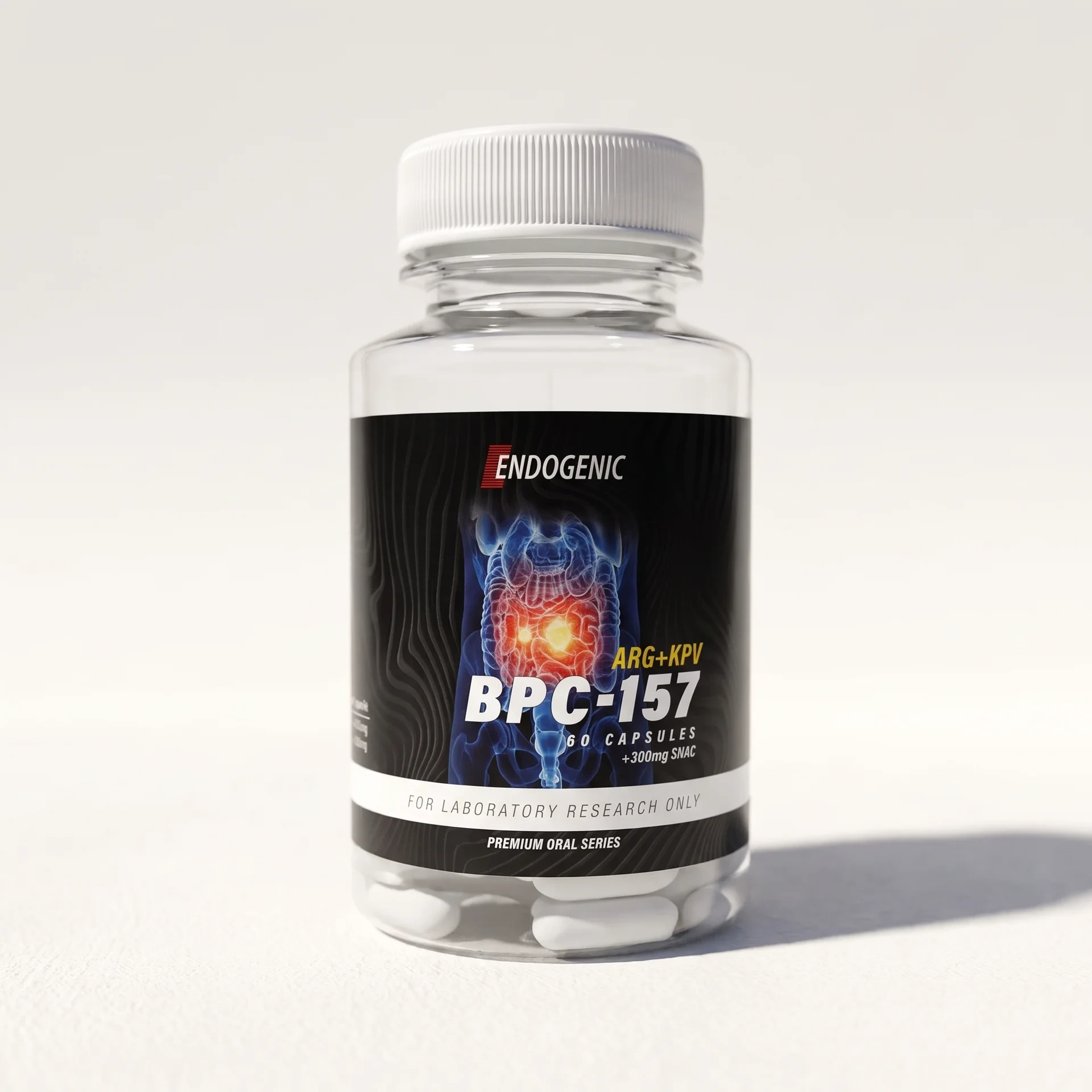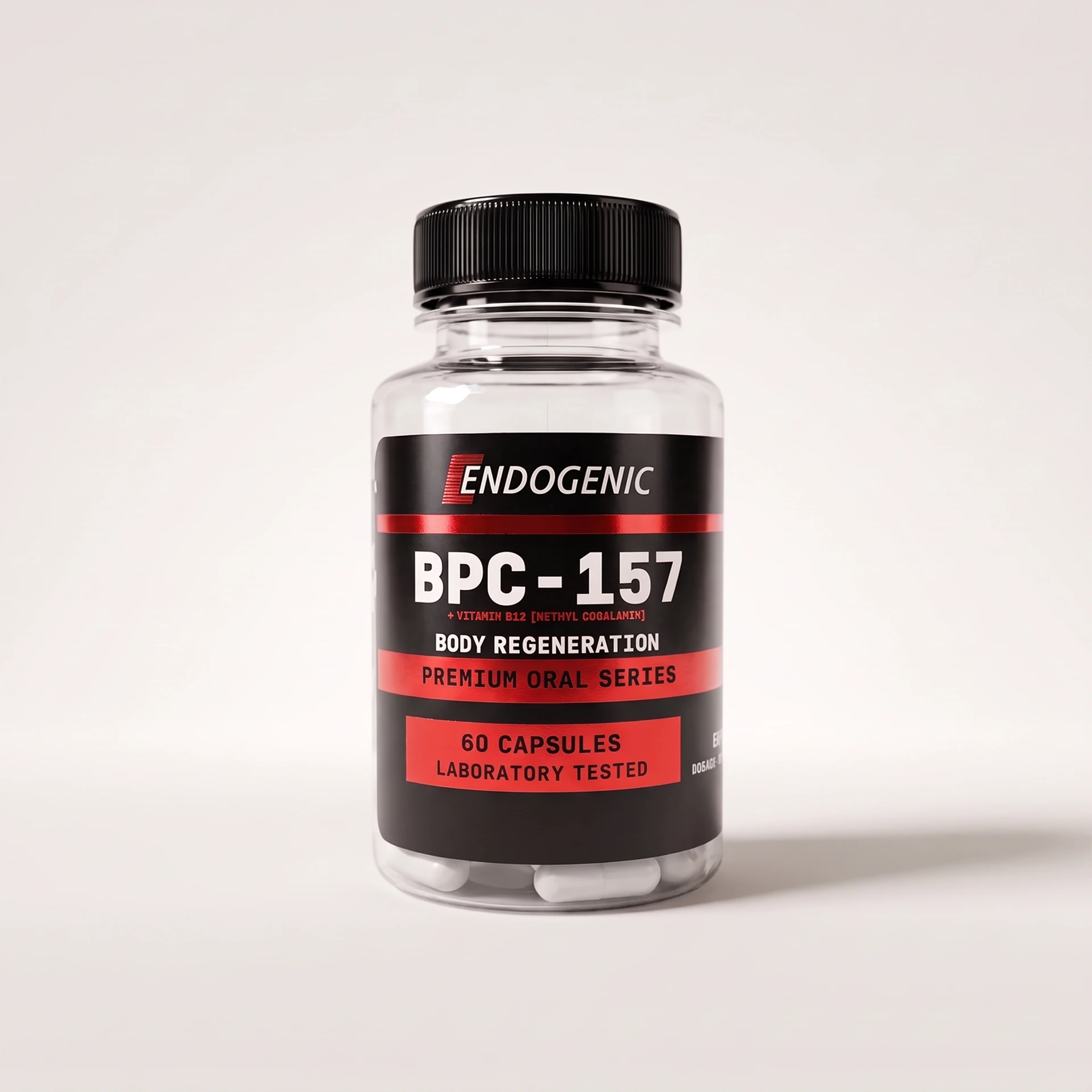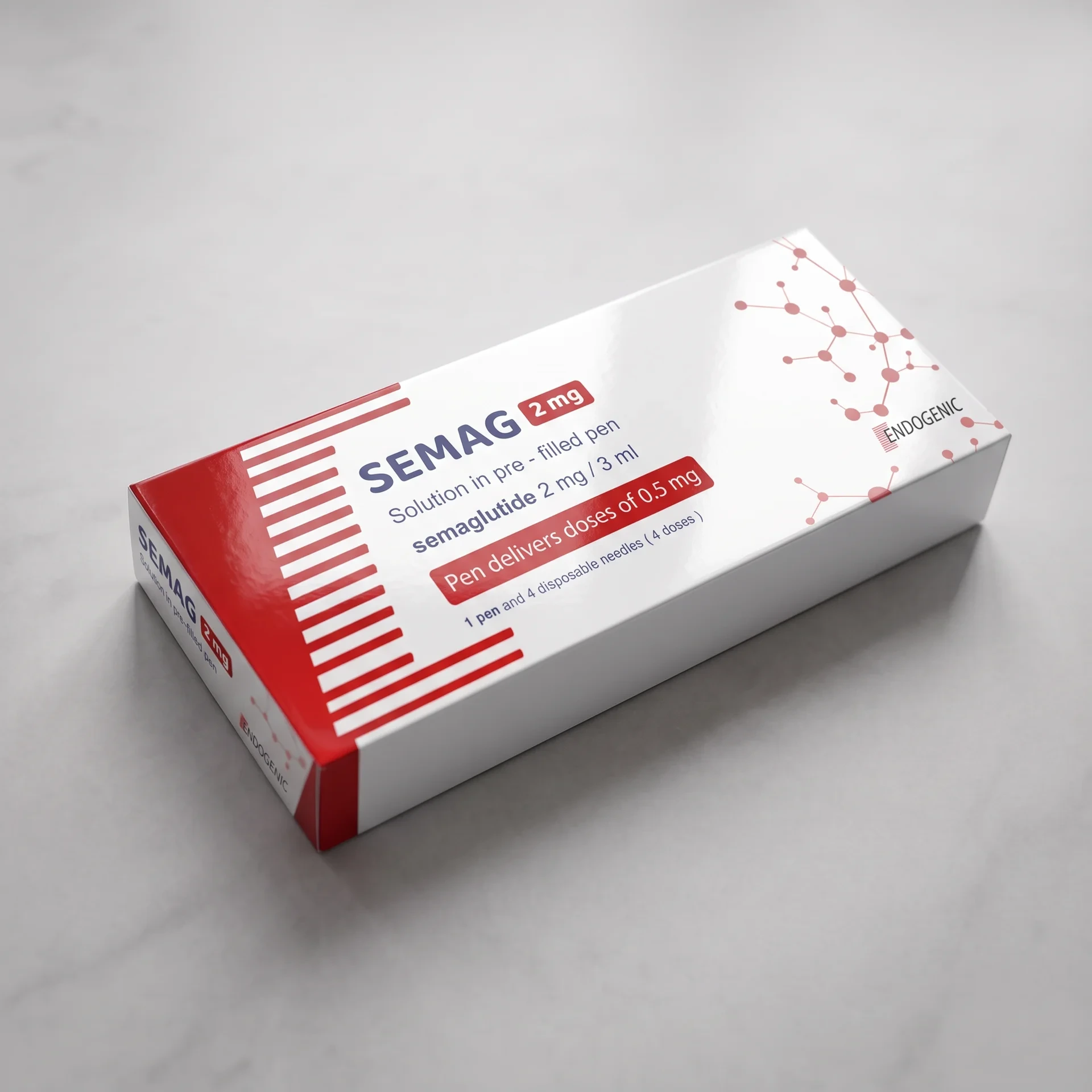


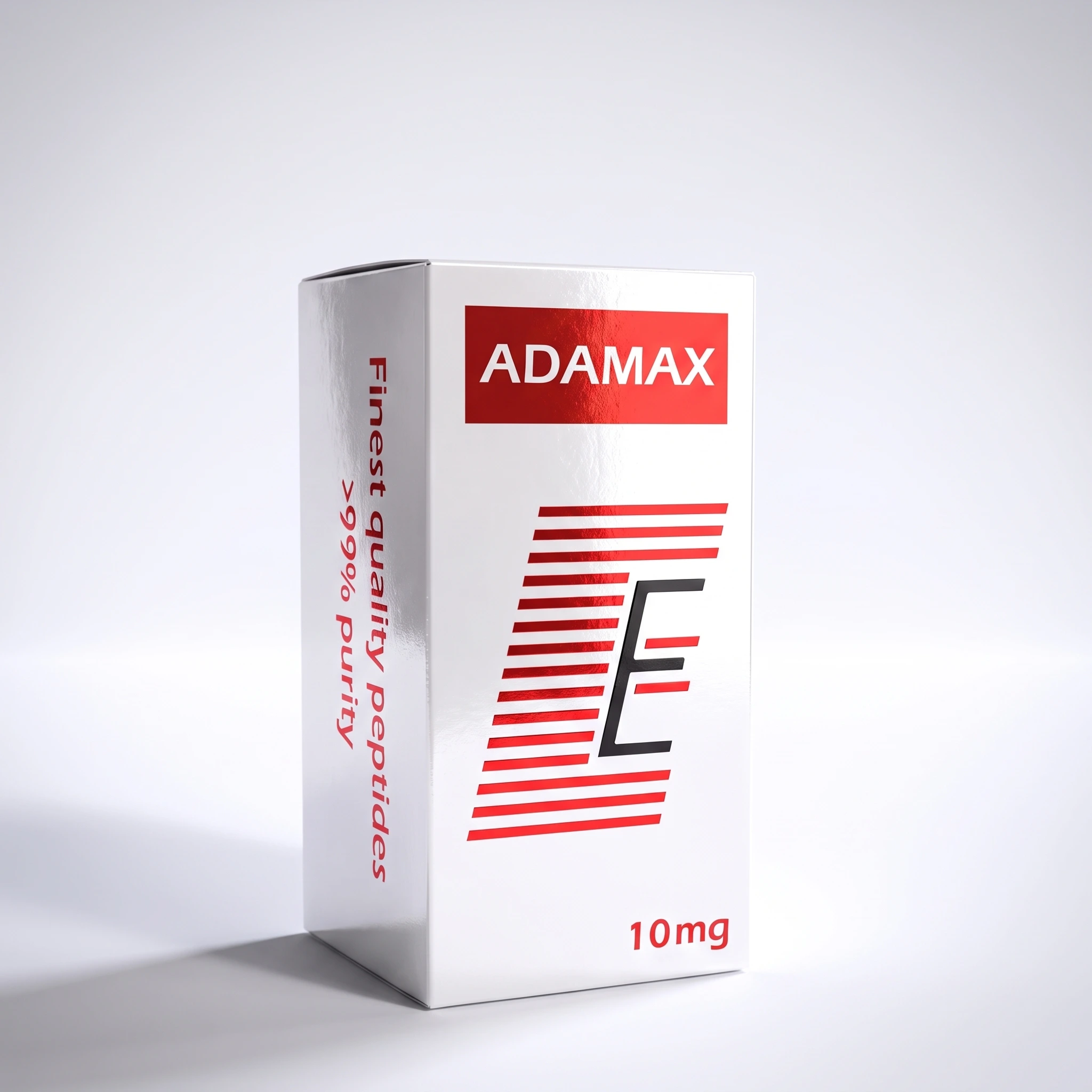
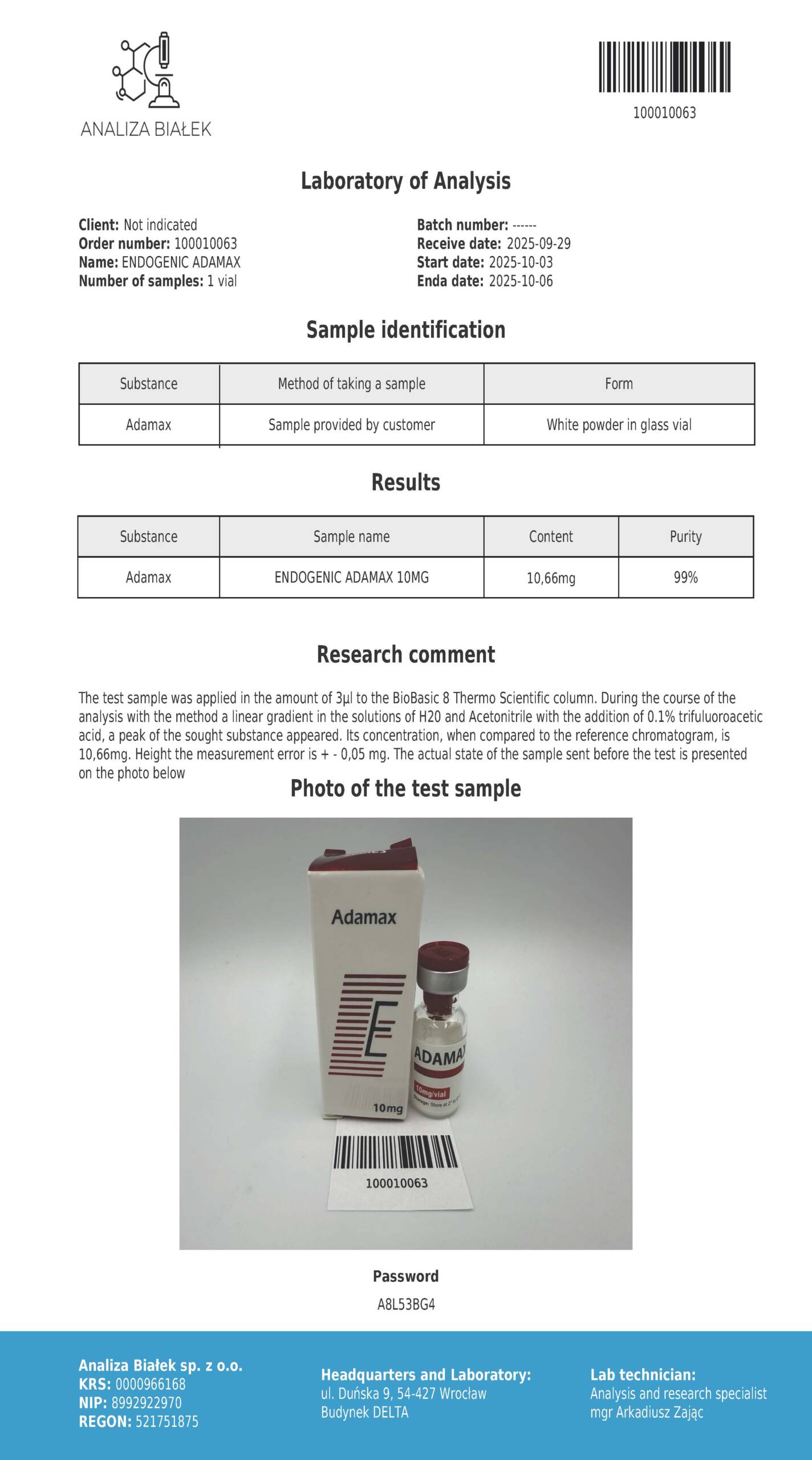
As vial with lyophilisate containing 10 mg of peptide – dry, lyophilized form requiring reconstitution before work. The packaging does not contain a solvent or applicator: the solvent and its volume are selected by the researcher, and the working concentration results from the peptide content in the vial (confirmed in the COA) and the volume used for reconstitution. This format does not determine the route of administration – it allows you to prepare a solution for any variant planned in the protocol methodology, and at the same time provides the longest shelf life among peptide forms.
Adamax 10mg
Adamax 10 mg is a modified, stabilized analogue of Semax from the Endogenic line in the form of a vial with lyophilisate, for independent reconstitution. The manufacturer describes it as an “improved version of Semax” with greater proteolytic resistance. The Semax family profile includes strong BDNF/NGF induction and neuroprotection. Research Use Only reagent
52,99 €
Product unavailable
Adamax 10 mg - modified Semax analogue, research reagent
- Adamax: modified, stabilized Semax analogue.
- 10 mg lyophilisate in a vial, Endogenic line.
- Research Use Only reagent, not a medicinal product.
Product status information
Chemical reagent intended exclusively for laboratory tests (Research Use Only). It is not a medicinal product, dietary supplement or food. It is not intended for use on humans or animals. Sales only to registered research units and laboratories.
Native Semax degrades in serum within minutes – the heptapeptide with the sequence Met-Glu-His-Phe-Pro-Gly-Pro (MEHFPGP) is one of the best described neuropharmacological tools of the Russian school of regulatory peptides, but its short half-life limits the window of observation in many research protocols. Adamax is the trade name under which Pro-Body delivers the peptide chemistry answer to this limitation – the neuropeptide of the line Endogenic, described by the manufacturer as a modified, stabilized analogue of Semax (“improved version of Semax”).
Adamax inherits the pharmacophore core of Semax, but carries a terminal modification that increases proteolytic resistance – which in research models translates into longer durability of the peptide in solution and tissue. Adamax is delivered as vial with lyophilisate, 10 mg of peptide — dry, lyophilized form for independent reconstitution by the researcher. The vial format does not determine the route of administration or working concentration: the researcher selects the solvent and its volume according to the parameters of the planned experiment, and the lyophilisate retains the longest storage stability among the peptide forms.
In the literature on the Semax family, the intranasal route remains the dominant route of administration – native Semax is registered in the Russian Federation as nasal drops and spray, and intranasal administration of regulatory peptides is standard in preclinical protocols examining nose-to-brain transport; this context is described below as literature background, not as a format for this reagent. The relationship of Adamax to Semax is analogous to the relationship ADALANK to Selank: in both cases we have a stabilized modification of the native peptide of the Russian school family, redesigned for longer proteolytic stability.
In terms of its pharmacological profile, Adamax – as an analogue of Semax – refers to the mechanisms of the native base compound: strong induction of BDNF and NGF in the hippocampus and cortex, an ACTH(4-7) analogue profile devoid of corticotropic activity, modulation of dopaminergic and serotonergic transmission, inhibition of enkephalinases and neuroprotective activity in ischemia models. Within a category peptides for brain function it is located on the side of the nootropic-neuroprotective axis. Purity verified by HPLC ≥98%, identity confirmed by mass spectrometry, COA available for each batch.
Regulatory status
Adamax is not registered as a medicine in the EU or USA. Native Semax is registered as a medicinal product only in the Russian Federation – the modified analogue Adamax does not have such registration in any jurisdiction. Communication of the product as an “over-the-counter nootropic”, “concentration peptide” or “memory booster” is contrary to the Research Use Only framework.
Semax and the family of ACTH analogues(4-7)
Semax was born from a simple observation: the ACTH(4-10) fragment – a seven-amino-acid fragment of the adrenocorticotropic hormone – has an effect on memory and learning in animal models, but is devoid of hormonal activity (does not stimulate the secretion of corticosteroids). The problem was instability: the ACTH fragment was rapidly proteolytically degraded. The team at the Institute of Molecular Genetics in Moscow rebuilt this molecule, shortening it to the ACTH(4-7) fragment — Met-Glu-His-Phe — and adding the C-terminal tripeptide Pro-Gly-Pro.
Semax (MEHFPGP) was created: a peptide that retains the neurotropic profile of the ACTH fragment, but is clearly more stable due to the presence of proline residues that hinder the action of peptidases.
Pro-Gly-Pro serves as a chemical stabilizer here – peptide bonds involving proline are resistant to most endopeptidases. This is the same design logic used in the related Selank (also finished with Pro-Gly-Pro). Adamax goes a step further in the same strategy: it adds a terminal modification (capping) to proline stabilization, closing another gate for peptidases attacking free end groups. This is the standard method of regulatory peptide chemistry – extending the shelf life without changing the core responsible for binding to molecular targets.
What is Adamax (modified Semax analogue)?
Adamax is a synthetic neuropeptide from the Endogenic line – a stabilized, modified derivative of Semax, an analogue of the ACTH(4-7) fragment extended with Pro-Gly-Pro. It is supplied as a lyophilized vial, requiring reconstitution before use.
- Trade name: Adamax (Pro-Body, Endogenic line)
- Manufacturer’s description: modified/stabilized Semax analogue (“improved version of Semax”)
- Base Core: Semax (Met-Glu-His-Phe-Pro-Gly-Pro, MEHFPGP) — ACTH(4-7) analogue with the attached tripeptide Pro-Gly-Pro
- Nature of modification: terminal modification increasing proteolytic resistance and extending half-life (probably N-terminal acetylation or other terminal capping); the manufacturer does not reveal the full sequence
- Chemical class: modified regulatory neuropeptide; a synthetic analogue of the ACTH(4-7) fragment with the Pro-Gly-Pro tripeptide attached
- Supplied form: vial with lyophilisate (lyophilized powder), 10 mg of peptide; for independent reconstitution; pharmaceutical grade ≥98% HPLC
Table of physicochemical characteristics
| Parameter | Value | Notes |
|---|---|---|
| Sequence | for verification in the batch COA | MEHFPGP core with terminal modification; the manufacturer does not reveal the full sequence |
| Base core | Met-Glu-His-Phe-Pro-Gly-Pro (MEHFPGP) | native Semax sequence, ACTH(4-7) analogue |
| CAS number | for verification in the batch COA | native Semax: 80714-61-0; the modified form requires confirmation in a certificate |
| Molar mass | for verification in the batch COA | Semax core ~813 Da + terminal modification mass; confirmation of MS in the COA of the batch |
| Chemical nature | the presence of histidine and glutamic acid | the histidine residue buffers within the physiological range; modification of the N-terminus reduces the positive charge |
| Form | freeze-dried powder in a vial | requires reconstitution; the solvent and concentration are selected by the researcher |
| Peptide content in the vial | 10 mg | declared on the batch label and in the COA |
| Purity | ≥98% HPLC | UV detection, per batch verification |
Mechanism of action at the molecular level
Adamax – as an analogue of Semax – probably works through several parallel neurobiological pathways. The following mechanisms have been documented for native Semax in preclinical models; transferring them to a modified analogue remains the subject of research. Pharmacological profile described for the Semax family in research models:
- Strong induction of BDNF and NGF (neurotrophic factors) — the best described and most characteristic mechanism. Semax in rat models increases the expression of BDNF (brain neurotrophic factor) and NGF (nerve growth factor) in the hippocampus and cortex, along with the activation of their TrkA and TrkB receptors (Dolotov et al. 2006). This is a probable basis for the influence on synaptic plasticity, neurogenesis and neuronal survival. The neurotrophic profile of Semax is clearly stronger than that of the related Selank – this is the difference that distinguishes the nootropic-neuroprotective axis from the anxiolytic axis
- ACTH(4-7) analogue without corticotropic activity — Met-Glu-His-Phe core comes from melanocortin, but Semax does not stimulate the secretion of cortisol or corticosterone. The neurotropic activity of the ACTH fragment has been separated from its hormonal function – the peptide acts at the level of the central nervous system, not at the level of the hypothalamic-pituitary-adrenal axis. This is an important feature of profile security in research models
- Modulation of dopaminergic and serotonergic transmission — Semax in animal models affects the dopamine system (including in the structures of the striatum and prefrontal cortex) and the serotonergic system, which is related to the observed pro-cognitive profile and the impact on motivation and mood in behavioral tests. Modulation of monoamines is a probable co-mechanism of nootropic action
- Inhibition of enkephalinases — Semax inhibits the activity of enkephalin-degrading enzymes in serum and brain tissue (Kost et al. 2001), which increases the concentration of endogenous Met- and Leu-enkephalins in synapses. Prolonged activity of endogenous opioid peptides likely contributes to neuroprotective and mood-stabilizing effects
- Neuroprotection in ischemia models — in models of cerebral ischemia (experimental stroke, hypoxia), Semax reduces the area of damage and affects neuronal survival markers and the inflammatory response (Medvedeva et al. 2014). This is the basis for the most widely researched direction of applications of native Semax in Russian experimental neurology
Nose-to-brain mechanism - intranasal route in the literature of the Semax family
The intranasal route dominates the Semax family in the literature and is the most frequently chosen variant of administration in preclinical protocols for this group of peptides. The vial format does not determine the route of administration – the researcher selects it in the experimental methodology – but the following context explains why the intranasal route is so important in this family.
Reagents supplied directly in a form prepared for this route are collected in the catalog as spray peptides. Most regulatory peptides do not cross the blood-brain barrier (BBB) well when administered peripherally – they are too large and too polar. Intranasal administration offers an alternative delivery route to the central nervous system (CNS), partially bypassing the BBB. Two parallel nose-to-brain transport pathways have been described in research models:
- Olfactory pathway (olfactory) — a peptide applied to the olfactory epithelium in the upper part of the nasal cavity can be transported along the olfactory nerves directly to the olfactory bulb and further to the structures of the forebrain, bypassing the systemic circulation
- Trigeminal nerve pathway — the endings of the trigeminal nerve innervating the nasal mucosa constitute a second route of transport to the brain stem and further structures of the CNS
In research models, intranasal administration of regulatory peptides demonstrates nose-to-brain transport, achieving higher concentrations in brain structures at lower total doses than systemic administration. For the Semax family, the intranasal route is preferred in preclinical protocols for this very reason – the short half-life of the peptide in the blood makes direct transport to the CNS, bypassing the systemic circulation, particularly important.
SCIENTIFIC PERSPECTIVE
Native Semax has a precedent for intranasal administration in humans – it is registered in the Russian Federation as a nasal solution (drops/spray), and research on the neuropeptide has been conducted in experimental neurology, among others. in ischemic conditions and reduced hypoxia tolerance (Kaplan et al.
1992). Fair distinction: this precedent is for native Semax (MEHFPGP), not a modified Adamax analogue. Data from native Semax in the form of nasal drops are not fully portable on a modified molecule – the terminal modification changes the lipophilicity, charge and kinetics of transport through the nasal epithelium. The nose-to-brain profile for Adamax requires separate characterization.
Important distinction - Adamax vs. native Semax
The separation of these two molecules is the most important substantive caveat of this description. Adamax (modified analogue) and native Semax (MEHFPGP) share a pharmacophore core but differ in their terminal modification, which has practical consequences:
- Proteolytic stability — the end modification blocks peptidases, so the analogue is designed to be more stable in solution and tissue than native Semax. This is the main intention of the modification and the point by which the manufacturer justifies the term “improved version of Semax”
- Pharmacokinetics of nasal transport — changing the charge and lipophilicity of the peptide end affects the kinetics of penetration through the olfactory epithelium. The nose-to-brain profile of native Semax does not translate 1:1 to the modified analogue
- Data portability — almost all documented literature (BDNF/NGF, neuroprotection, clinical precedent for intranasal administration) concerns native Semax. The Adamax profile is a working hypothesis derived from core similarity, not a set of independently confirmed observations
- Structural identity — the manufacturer does not disclose the full sequence or exact structure of the modification. Peptide sequence and mass confirmation by MS remain the only binding signals of identity – the label and trade name alone do not determine what terminal modification is in the package
The starting form for this family is the unmodified peptide available as Semax 50mg (MEHFPGP core, nootropic-neuroprotective axis) – the durability and kinetics of the modified analogue are compared to it. An analogous caution applies to the related Selank and its stabilized analogue Adalank: the precedent of intranasal administration of native Semax and native Selank (both registered in the Russian Federation as nasal formulations) is a strong argument for the logic of the intranasal route for the entire family, but is not evidence for modified forms. The Semax base data is a reference point, not a documented Adamax profile.
Applications in scientific research
Adamax in the format of a lyophilized vial is used in research directions analogous to native Semax, with additional emphasis on characterizing the profile of the modified molecule. The lyophilized form allows you to select the solvent, working concentration and route of administration according to the methodology of a specific protocol:
- Neuroprotection models — experimental models of cerebral ischemia, hypoxia and neuronal damage; assessment of the effect of the analogue on the area of damage, markers of neuronal survival and inflammatory response
- Research on neurotrophic factors — expression of BDNF and NGF and activation of Trk receptors in the hippocampus and cortex; comparison of the kinetics and induction strength of the modified analogue compared to native Semax
- Cognitive models — memory and learning tests (Morris water maze, passive avoidance, radial arm maze), especially in conditions of cognitive impairment caused by stress, ischemia or neurotoxins
- Nose-to-brain transport studies — comparative pharmacokinetics of intranasal versus systemic administration; characterization of the effect of terminal modification on transport through the olfactory epithelium and achieved concentrations in brain structures
- Models of monoaminergic transmission — influence on the dopamine and serotonergic systems in the structures of the striatum, prefrontal cortex and hippocampus; research on the basis of the procognitive profile
- Pharmacokinetic characterization of modifications — comparative assessment of the proteolytic stability and distribution profile of the modified form compared to native Semax; confirmation of structural identity by MS
Summary
Adamax is the trade name under which Pro-Body supplies a modified, stabilized analogue of Semax from the Endogenic line – a neuropeptide described by the manufacturer as an “improved version of Semax”, delivered as a lyophilized vial containing 10 mg of the peptide, for independent reconstitution by the researcher. Adamax inherits the core pharmacophore of Semax (MEHFPGP, an ACTH(4-7) analogue from Pro-Gly-Pro), but carries a terminal modification that increases proteolytic resistance and extends half-life – analogous to the relationship of Adalank to Selank.
The pharmacological profile derived from Semax includes strong induction of BDNF and NGF, a neurotrophic profile of the ACTH fragment without corticotropic activity, modulation of dopaminergic and serotonergic transmission, inhibition of enkephalinases, and neuroprotection in ischemia models – all documented for native Semax in rodent and in vitro models, with the need for separate validation for the modified analogue.
The intranasal route dominates in the literature of the Semax family and is associated with the nose-to-brain transport mechanism, but the vial format does not determine the route of administration – the solvent, working concentration and administration variant are selected by the researcher.
The exact sequence and structure of the modifications are not disclosed by the manufacturer – they are decided by the batch COA (sequence plus MS mass). HPLC purity ≥98%, MS confirmation (Q-TOF), COA for each batch. Regulatory status – Research Use Only. The broader background to this class of compounds is described in the guide nootropic substances — their classification and mechanisms of action.
Bibliography
- Dolotov OV, Karpenko EA, Inozemtseva LS, Seredenina TS, Levitskaya NG, Rozyczka J, et al. (2006). Semax, an analogue of ACTH(4-10) with cognitive effects, regulates BDNF and trkB expression in the rat hippocampus. PubMed
- Medvedeva EV, Dmitrieva VG, Povarova OV, Limborska SA, Skvortsova VI, Myasoedov NF, Dergunova LV (2014). The peptide semax affects the expression of genes related to the immune and vascular systems in rat brain focal ischemia: genome-wide transcriptional analysis. PubMed
- Shadrina M, Kolomin T, Agapova T, Agniullin Y, Shram S, Slominsky P, et al. (2010). Comparison of the temporary dynamics of NGF and BDNF gene expression in rat hippocampus, frontal cortex, and retina under Semax action. PubMed
- Ashmarin IP, Nezavibatko VN, Myasoedov NF, Kamensky AA, Grivennikov IA, Ponomareva-Stepnaya MA, et al. (1997). A nootropic adrenocorticotropin analog 4-10-Semax (15 years of experience in its design and study). PubMed
- Kaplan AYa, Koshelev VB, Nezavibatko VN, Ashmarin IP (1992). Increased resistance to hypoxia effected by the neuropeptide preparation Semax. PubMed
- Kost NV, Sokolov OY, Gabaeva MV, Grivennikov IA, Andreeva LA, Myasoedov NF, Zozulya AA (2001). Semax and selank inhibit the enkephalin-degrading enzymes from human serum. PubMed
FAQ
The vial must first be equilibrated to ambient temperature to avoid moisture condensation on the lyophilisate. Then, working under aseptic conditions, a measured volume of solvent is introduced in a slow stream along the wall of the vial – never directly onto the lyophilized cake. The solution is left to dissolve spontaneously, optionally by gently turning the vial in your hands; shaking is a mistake, because it foams the solution and denatures the peptide.
Finally, the clarity is checked (no turbidity or sediment), the vial is marked with the reconstitution date and concentration and transferred to the refrigerator. The volume of the solvent is previously converted to the target working concentration resulting from the experiment methodology.
Adamax shares the pharmacophore core with Semax – the MEHFPGP sequence of the ACTH(4-7) analogue with the attached tripeptide Pro-Gly-Pro – but carries an additional terminal modification (capping) that blocks peptidases that degrade free end groups of the peptide. The manufacturer describes Adamax as a stabilized, “improved version of Semax” with greater proteolytic resistance and a longer half-life.
The core responsible for binding to molecular targets remains the same, so the mechanistic profile is likely similar to Semax, although it requires separate validation for the modified molecule. The relationship of Adamax to Semax is analogous to the relationship ADALANK peptide 10mg to Selank – in both cases it is a stabilized modification of the native peptide of the Russian school family.
The manufacturer does not disclose the full sequence or exact structure of the terminal modification of Adamax. The most likely nature of the change is N-terminal acetylation or other terminal capping that increases proteolytic resistance – a standard method of regulatory peptide chemistry. In the face of an undisclosed sequence, the only binding identity signal remains the batch COA: sequence and mass confirmation by mass spectrometry (MS).
The mass difference compared to native Semax (~813 Da) indicates the nature of the terminal modification. We recommend verifying these parameters on the certificate of a specific batch before its characterization in the protocol.
In rat models, native Semax increases the expression of BDNF (brain neurotrophic factor) and NGF (nerve growth factor) in the hippocampus and cortex, along with activation of their TrkA and TrkB receptors (Dolotov et al. 2006). Neurotrophic factors support synaptic plasticity, neurogenesis and neuronal survival – this is the likely basis for the procognitive and neuroprotective profile observed in behavioral tests.
This signaling is described for animal models and in vitro over native Semax; does not constitute a guarantee of effect in humans and does not constitute a suggestion for the use of RUO reagent. For the modified Adamax analogue, the profile requires separate confirmation.
The intranasal route dominates the Semax family in the literature – native Semax is registered in the Russian Federation as a nasal solution. In research models, intranasal administration of regulatory peptides demonstrates nose-to-brain transport: the peptide is transported to the CNS along the olfactory nerve and trigeminal nerve, partially bypassing the blood-brain barrier. For Semax, which has a short half-life in the blood, direct transport to the CNS, bypassing the systemic circulation, is particularly important.
However, it is worth remembering that the vial format does not determine the route of administration – it is the literature context of the family, and the administration variant and working concentration are selected by the researcher in the protocol methodology.
Only partially and carefully. Almost all documented data – BDNF/NGF induction, ACTH(4-7) profile without corticotropic activity, neuroprotection in ischemia, precedent for intranasal administration in humans – comes from the literature on native Semax (MEHFPGP). The terminal modification changes the pharmacokinetics (stability, lipophilicity, nasal transport kinetics) and potentially also the affinity for molecular targets. The Adamax profile requires separate characterization – the base Semax data is a reference point, not a documented fact for the modified molecule.
Semax and its analogues are not currently listed as separately listed prohibited substances, however, peptides with neuromodulatory and neurotrophic activity are sometimes included in the general clauses of the WADA list. Registered Athletes (ADAMS) must check the current Prohibited Substances List before making any decision – the status of the compound may change in subsequent updates.
0.0
0 reviews
This product has no reviews yet.
Related products