

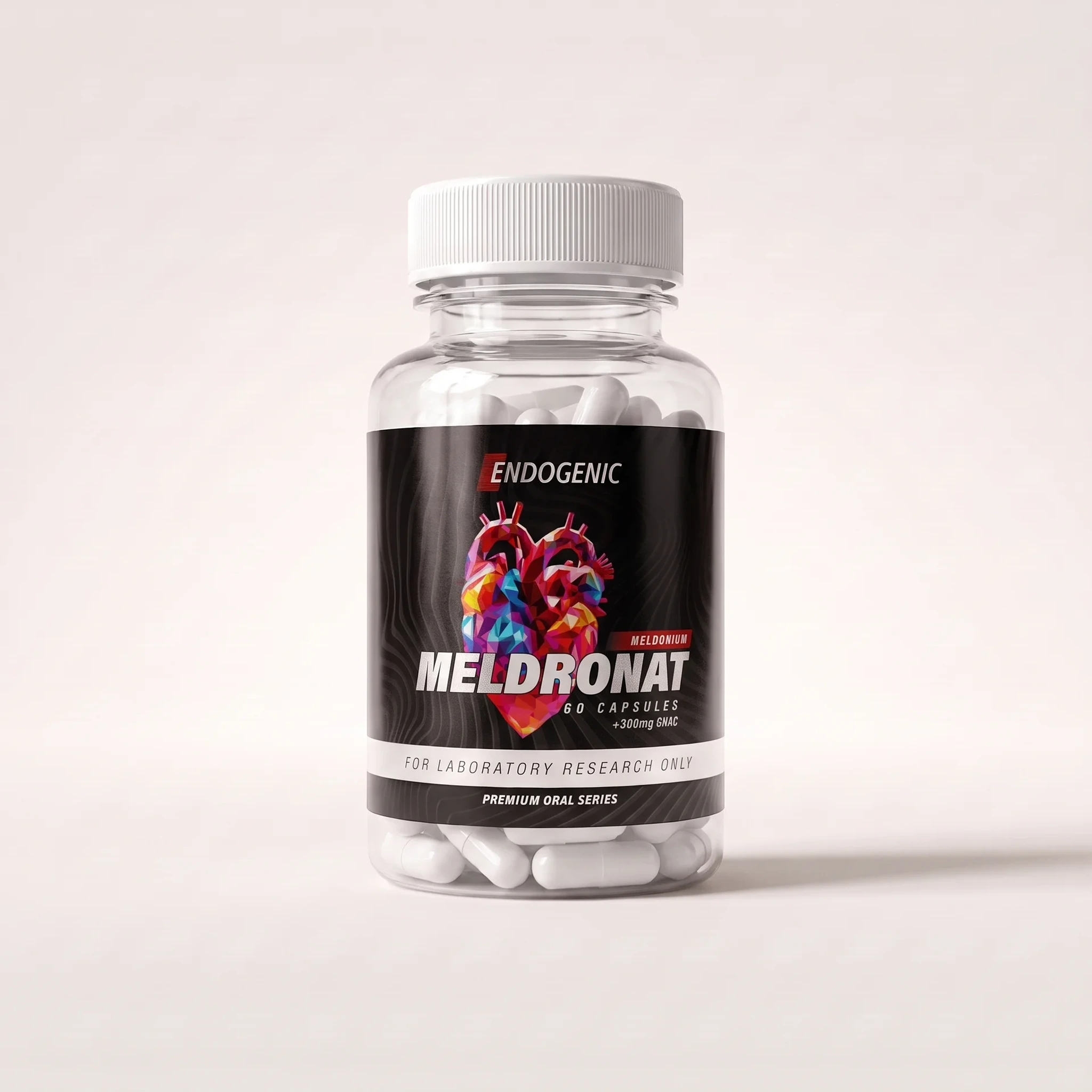
Meldonium (meldronate, Mildronate, MET-88, THP) is a synthetic small molecule – an analogue of gamma-butyrobetaine, a precursor of carnitine – from the class of metabolic modulators. Acts as an inhibitor of carnitine biosynthesis: it inhibits the enzyme gamma-butyrobetaine hydroxylase (BBOX), lowering L-carnitine levels and shifting energy metabolism from beta-oxidation of fatty acids to glucose oxidation. They were developed at the Institute of Organic Synthesis in Latvia; in the countries of the former USSR it functions as a drug in the indication of ischemic heart disease. It remains a research reagent outside the jurisdiction of registration.

Meldronat 60 caps
Meldonium (meldronate) 60 capsules is a synthetic small molecule from the class of metabolic modulators (Endogenic line) – an analogue of gamma-butyrobetaine developed in Latvia (Mildronate, Grindeks). It acts as an inhibitor of carnitine biosynthesis: it inhibits the BBOX enzyme, reduces the level of L-carnitine and shifts energy metabolism from beta-oxidation of fatty acids to the less oxygen-intensive oxidation of glucose – the basis of the anti-ischemic profile. Research Use Only reagent
47,99 €
Fast shipping
Delivery options
Returns policy
Meldonium (Meldronat) 60 capsules - research reagent
- Meldonium (meldronate) 60 capsules is a synthetic small molecule from the class of metabolic modulators (Endogenic line) - an analogue of gamma-butyrobetaine developed in Latvia (Mildronate, Grindeks).
- It acts as an inhibitor of carnitine biosynthesis: it inhibits the BBOX enzyme, reduces the level of L-carnitine and shifts energy metabolism from beta-oxidation of fatty acids to the less oxygen-intensive oxidation of glucose - the basis of the anti-ischemic profile.
- Research Use Only reagent
Meldonium is on the World Anti-Doping Agency (WADA) Prohibited List S4 – hormones and metabolic modulators, prohibited both in competition and out of competition. The substance has been added to the list January 1, 2016, and already in the first months of the ban, meldonium became one of the most famous anti-doping cases of the decade – it was detected in the samples of numerous athletes, including in the famous tennis case from 2016.
It is imperative that Registered Athletes (ADAMS) verify the current Prohibited List before any decision – the presence of meldonium or its metabolites in a doping sample constitutes an anti-doping rule violation.
Introduction
Energy metabolism of the heart and muscles in conditions of limited oxygen access – ischemia and hypoxia – has remained one of the main topics of cardiovascular pharmacology for decades. At rest, the heart muscle derives most of its energy from fatty acid beta-oxidation, but this pathway consumes relatively much oxygen for each ATP molecule produced.
When the supply of oxygen decreases, the oxidation of glucose – a less oxygen-intensive energy source – becomes more metabolically advantageous. In response to this problem, the Latvian School of Medicinal Chemistry has proposed a molecule that deliberately shifts energy metabolism towards glucose. Meldonium (also known as meldronate) is one of the best described members of the class of metabolic modulators.
Pro-Body supplies it in line Endogenous as a research reagent in format 60 capsules. Chemically, it is a small molecule – an analogue of gamma-butyrobetaine, a precursor in the carnitine biosynthetic pathway. In terms of mechanism, it is carnitine biosynthesis inhibitor: inhibits the enzyme gamma-butyrobetaine hydroxylase (BBOX), lowering L-carnitine levels and restructuring the way the cell obtains energy.
Its vector of action is exactly the opposite of that provided by z supplements L-carnitine — meldonium lowers the carnitine pool instead of increasing it. Meldonium was developed in Latvia, at the Institute of Organic Synthesis, and was introduced into production by the Grindeks company under the trade name Mildronate. In the countries of the former USSR, it was registered as a drug for the treatment of ischemic heart disease.
In research terms, meldonium remains a model tool for studying the remodeling of energy metabolism, protection of the myocardium under ischemia and the role of carnitine in the transport of fatty acids. Purity verified by HPLC ≥98%, identity confirmed by mass spectrometry, COA available for each batch.
REGULATORY STATUS
Meldonium is not registered as a medicine in the EU or USA. In the countries of the former USSR (including Latvia) it functioned as a medicinal product (Mildronate) for the indication of ischemic heart disease – this registration does not cover other jurisdictions. Meldonium has been on the WADA Prohibited List in category S4 (hormones and metabolic modulators) since January 1, 2016. Communicating a product as a “performance booster”, “ischemic remedy” or “over-the-counter cardioprotector” is inconsistent with the Research Use Only framework.
Carnitine, beta-oxidation of fatty acids and glucose oxidation
L-carnitine serves as a molecular transporter in the cell: it transports long-chain fatty acids through the mitochondrial membrane to the interior of the mitochondrion, where they undergo beta-oxidation. Without a sufficient pool of carnitine, the cell is unable to burn fatty acids effectively – and naturally shifts energy metabolism towards glucose oxidation. It is this relationship that underlies the mechanism of meldonium.
Beta-oxidation of fatty acids provides a large amount of ATP, but is a relatively oxygen-intensive pathway — for each molecule of ATP, it uses more oxygen than the oxidation of glucose. In conditions of full oxygen supply this is not a problem, but in a state of ischemia (limited blood flow) or hypoxia, every saved oxygen molecule is important.
Shifting the metabolism towards glucose means energy production with less oxygen demand – and this is the central research hypothesis behind meldonium. Meldonium lowers carnitine levels by inhibiting the enzyme that produces it — gamma-butyrobetaine hydroxylase (BBOX). A lower pool of carnitine limits the transport of fatty acids to the mitochondria, which shifts the cell’s energy balance towards glucose oxidation.
In models of cardiac ischemia, this shift has been described as the basis for the observed cardioprotective profile – protection of the myocardium in conditions of limited oxygen access. The world of pharmacology is keeping an eye on meldonium for several reasons. Firstly, as a model metabolic modulator – a tool for studying how the intentional reduction of carnitine restructures the energy metabolism of the heart and muscles.
Secondly, as an anti-ischemic compound – in the study of myocardium protection mechanisms in limited oxygen. Third, as a molecule with documented effects on nitric oxide (NO) production and endothelial function, useful in vascular research.
What is Meldonium?
Chemically, meldonium is a small molecule — a structural analogue of gamma-butyrobetaine, a natural precursor of carnitine.
- Common name: Meldonium, meldronate
- Trade name (drug): Mildronate (Grindeks, Latvia)
- Research code / synonyms: MET-88, THP
- Systematic name: 3-(2,2,2-trimethylhydrazinium)propionate
- Pharmacological class: metabolic modulator; carnitine biosynthesis inhibitor (gamma-butyrobetaine hydroxylase inhibitor, BBOX); a compound with a cardioprotective profile in ischemia models
- CAS number: 76144-81-5 (in case of uncertainty – “to be verified in the batch COA”)
- Summary formula: C₆H₁₄N₂O₂ (to be verified in the batch COA)
- Molar mass: ~146.19 g/mol (to be verified in the batch COA)
- Laboratory of Origin: Institute of Organic Synthesis (Latvia); put into production by Grindeks
- Delivered form: hard capsule, 60 capsules; pharmaceutical grade ≥98% HPLC (substance content per capsule – typically 250 or 500 mg – to be verified on the batch label)
Table of physicochemical characteristics
| Parameter | Value | Attention |
|---|---|---|
| Name | Meldonium (meldronate), Mildronate | MET-88, THP |
| Systematic name | 3-(2,2,2-trimethylhydrazinium)propionate | — |
| Chemical grade | gamma-butyrobetaine analogue (small molecule) | not a peptide |
| Pharmacological class | metabolic modulator, carnitine biosynthesis inhibitor (BBOX) | cardioprotective profile in models |
| CAS | 76144-81-5 | for verification in the batch COA |
| Summary formula | C₆H₁₄N₂O₂ | for verification in the batch COA |
| Molar mass | ~146.19 g/mol | for verification in the batch COA |
| Cleanliness | ≥98% HPLC | UV detection, per batch verification |
| Character | capsule, 60 capsules | content/capsule to be verified on the label |
| Molecular target | gamma-butyrobetaine hydroxylase (BBOX) | carnitine biosynthesis enzyme |
| Clinical status | registration as a drug (Mildronate) in the countries of the former USSR | no EU/US registration |
| WADA status | Prohibited List, Category S4 (Metabolic Modulators) | from January 1, 2016 |
Origin: Meldonium was designed and characterized at the Institute of Organic Synthesis in Riga (Latvia). The starting point was a structural analogue of gamma-butyrobetaine – a natural substrate of the BBOX enzyme, the last stage of carnitine biosynthesis. By replacing the gamma-butyrobetaine molecule with a trimethylhydrazinium group, chemists obtained a competitive inhibitor of this enzyme.
The compound was put into production by the Latvian company Grindeks under the name Mildronate, and its registration as a drug for the indication of ischemic heart disease covered the countries of the former USSR. The early metabolic and cardiological characteristics of the molecule were described by, among others, team of Dambrova and colleagues.
Mechanism of action at the molecular level
Meldonium works in preclinical models through several interrelated, complementary pathways, the common denominator of which is the reduction of the carnitine pool and the reconstruction of the cell’s energy metabolism. Pharmacological profile observed in research models:
- Inhibition of carnitine biosynthesis (BBOX inhibition). The best described mechanism of meldonium. The molecule as an analogue of gamma-butyrobetaine competitively inhibits gamma-butyrobetaine hydroxylase (BBOX) — enzyme catalysing the last stage of L-carnitine biosynthesis. Inhibition of this enzyme reduces the level of carnitine in tissues (Dambrova et al. 2002). This is the original, direct molecular effect from which the remaining observations arise.
- Shift of energy metabolism from beta-oxidation to glucose oxidation. A lower pool of carnitine limits the transport of long-chain fatty acids to the mitochondria, which reduces the share of oxygen-absorbing beta-oxidation in ATP production and shifts the balance towards less oxygen-absorbing glucose oxidation. In the context of ischemia, this means producing energy with less oxygen demand – the central metabolic hypothesis behind the molecule.
- Anti-ischemic and cardioprotective effects in models. In models of myocardial ischemia (isolated heart, rodent infarction models), protection of the myocardium in conditions of limited oxygen access was observed, associated with a shift in metabolism towards glucose. This is the direction that drives most of the cardiovascular research on meldonium.
- Modulation of nitric oxide (NO) production and endothelial function. Some models described the effect of meldonium on the nitric oxide pathway and vascular endothelial cell function, suggesting a vascular component in addition to the metabolic profile. The accumulation of gamma-butyrobetaine (BBOX substrate) due to enzyme inhibition has been associated with signaling affecting NO production.
- Research on performance and metabolism in hypoxic conditions. The impact of metabolic remodeling on muscle function and exercise tolerance in oxygen-limited conditions remains the subject of research – this direction was directly related to the subsequent interest in the molecule in the anti-doping context and its inclusion on the Prohibited List.
Important distinction - metabolic modulator vs. stimulant and supplemented carnitine
Understanding meldonium’s position on the pharmacological map is the focal point of this brief:
- Mechanism of action — meldonium does not stimulate the central nervous system like a stimulant or activate the receptor like a hormonal ligand. Works by reconstruction of energy metabolism — inhibits the enzyme of carnitine biosynthesis (BBOX), lowers the carnitine pool and shifts the metabolism from beta-oxidation of fatty acids to glucose oxidation.
- Direction relative to carnitine — this distinction is most often confused. Supplemented L-carnitine raises the availability of carnitine and supports the transport of fatty acids into the mitochondria. Meldonium works contrary — on purpose lowers carnitine level by inhibiting the enzyme of its synthesis. Despite a common reference point (carnitine), the metabolic vectors of both molecules are opposite.
- Chemical grade — meldonium is a small molecule, an analogue of gamma-butyrobetaine, not a peptide, not a SARM and not a catecholamine. The chemical profile and mechanism distinguish them from these families.
- Ischemic context — Meldonium’s cardioprotective profile is due to a metabolic shift towards less aerobic glucose oxidation, and not to vasodilation or a direct inotropic effect.
This distinction is of both mechanistic and compliance importance: meldonium is sometimes mistakenly classified as a “carnitine booster” or a stimulant, while its pharmacology is different. In anti-doping terms, it remains classified by WADA as a metabolic modulator (S4) – regardless of common associations.
Applications in scientific research
Meldonium is used in research in several areas. In in vivo models (rat, mouse), its effect on the level of carnitine in tissues, on the balance of beta-oxidation and glucose oxidation, on the protection of the myocardium in ischemia models and on exercise tolerance in hypoxic conditions is examined. In vitro and ex vivo models (isolated heart, cell cultures) measure the activity of the BBOX enzyme, the accumulation of gamma-butyrobetaine and the effect on the nitric oxide pathway. Specific research directions include:
- Energy metabolism of the heart and muscles — meldonium as a tool to study the shift from beta-oxidation of fatty acids to glucose oxidation
- BBOX inhibition and carnitine management — measurements of how inhibition of the carnitine biosynthesis enzyme translates into the carnitine pool and fatty acid transport
- Anti-ischemic profile and cardioprotection — research on the protection of the myocardium in models of limited oxygen access, a field related to work on metabolic compounds such as SR-9009
- Endothelial function and the NO pathway — analysis of the effect of meldonium and gamma-butyrobetaine accumulation on nitric oxide production and vascular function
- Performance in hypoxic conditions — studies on metabolism and exercise tolerance with limited oxygen; a direction important for the anti-doping context, research convergent with other performance compounds such as GW-501516
- Detection methods in anti-doping analysis — meldonium as an analyte in the development of detection methods for WADA control
Summary
Meldonium (meldronate, 60 capsules) is a synthetic small molecule class metabolic modulators Latvian school of medicinal chemistry – an analogue of gamma-butyrobetaine, developed at the Institute of Organic Synthesis in Riga and introduced into production by Grindeks under the name Mildronate. Its central mechanism is inhibition of carnitine biosynthesis by inhibiting the BBOX enzyme, which reduces the carnitine pool and shifts energy metabolism from the oxygen-intensive beta-oxidation of fatty acids to the less oxygen-intensive oxidation of glucose.
In models of cardiac ischemia, this shift has been associated with an anti-ischemic and cardioprotective profile; the impact on nitric oxide production and endothelial function was also described, as well as studies on performance in hypoxic conditions. Meldonium is a small metabolic molecule (BBOX inhibitor), not a peptide, not a SARM or a stimulant, and in relation to L-carnitine it works in the opposite direction – it lowers its level instead of raising it.
In the countries of the former USSR, it functions as a drug (Mildronate, ischemic heart disease). HPLC purity ≥98%, MS, COA for each batch. Regulatory Status – Research Use Only outside registration jurisdiction; lack of EMA/FDA/EFSA authorization; WADA Prohibited List, category S4 (metabolic modulators) from January 1, 2016. The broader metabolic context of performance compounds and their impact on fat burning is discussed in the review Cardarine for weight loss.
Bibliography
- Dambrova M, Liepinsh E, Kalvinsh I (2002). Mildronate: cardioprotective action through carnitine-lowering effect. PubMed
- Sjakste N, Gutcaits A, Kalvinsh I (2005). Mildronate: an antiischemic drug for neurological indications. PubMed
- Görgens C, Guddat S, Dib J, et al. (2015). Mildronate (Meldonium) in professional sports — monitoring doping control urine samples using hydrophilic interaction liquid chromatography — high resolution/high accuracy mass spectrometry. PubMed
- Dambrova M, Makrecka-Kuka M, Vilskersts R, et al. (2016). Pharmacological effects of meldonium: biochemical mechanisms and biomarkers of cardiometabolic activity. PubMed
- Schobersberger W, Dünnwald T, Gmeiner G, Blank C (2017). Story behind meldonium — from pharmacology to performance enhancement: a narrative review. PubMed
Product Meldonium (Meldronat) – 60 capsules is sold exclusively as chemical reagent for laboratory tests in vitro, ex vivo and on animal models.
It is not a medicine, is not a dietary supplement and is not a product intended for human consumption. It is not intended to diagnose, treat, alleviate or prevent any disease, including coronary heart disease. In the countries of the former USSR, meldonium was registered as a medicine (Mildronate) – this registration does not cover the EU or the USA; outside this jurisdiction the compound is not authorized by EMA/FDA/EFSA.
Meldonium has been on the World Anti-Doping Agency’s Prohibited List in category S4 (hormones and metabolic modulators) since January 1, 2016 — became one of the most famous anti-doping cases of the decade; professional athletes and persons covered by anti-doping programs must verify the current WADA guidelines on their own. Sales addressed to qualified research personnel, scientific units and pharmacological laboratories.
The buyer assumes full responsibility for the legal and safe use of the reagent under laboratory conditions consistent with applicable regulations and institutional guidelines.
FAQ
Meldonium, as an analogue of gamma-butyrobetaine, competitively inhibits gamma-butyrobetaine hydroxylase (BBOX) – the enzyme catalyzing the last step of L-carnitine biosynthesis (Dambrova et al. 2002). Inhibition of the enzyme reduces the pool of carnitine in the tissues. Because carnitine transports long-chain fatty acids to the mitochondria, its deficiency limits beta-oxidation and shifts the metabolism towards glucose oxidation. This is the basic metabolic mechanism of the molecule, observed in preclinical models.
The direction of action is the opposite. Supplemented L-carnitine increases the availability of carnitine and supports the transport of fatty acids to the mitochondria. Meldonium works the opposite: it deliberately lowers the level of carnitine by inhibiting the enzyme (BBOX) responsible for its synthesis. Even though both molecules refer to the same transport pool, their metabolic vectors are opposite – one “adds” carnitine, the other “limits its production.” This distinction is important when designing research models on energy metabolism.
In models of myocardial ischemia (isolated heart, rodent models of infarction), myocardial protection was observed in conditions of limited oxygen access. The mechanistic hypothesis associates this profile with a shift in metabolism from the oxygen-demanding beta-oxidation of fatty acids to the less oxygen-demanding oxidation of glucose – in ischemia, the cell produces energy with a lower demand for oxygen. Observations relate to preclinical models and clinical practice in the drug registration jurisdiction; do not constitute a suggestion for the use of RUO reagent in humans.
Yes. Meldonium is located on WADA Prohibited List in category S4 (hormones and metabolic modulators), prohibited in competition and out of competition, from January 1, 2016. Shortly after the ban went into effect, meldonium was detected in the samples of numerous athletes – a case that became one of the most notorious anti-doping cases of the decade, including the highly publicized 2016 tennis case. Registered athletes (ADAMS) must absolutely verify the current Prohibited List; the presence of meldonium or its metabolites in the sample will result in an anti-doping rule violation.
Meldonium is small molecule — synthetic analogue of gamma-butyrobetaine (3-(2,2,2-trimethylhydrazinium)propionate), with a low molar mass (~146.19 g/mol). It is not a peptide (does not consist of amino acids), is not a SARM (does not bind the androgen receptor) and is not a stimulant (does not stimulate the central nervous system). It acts as a metabolic enzyme inhibitor (BBOX), rebuilding energy metabolism by lowering carnitine. The identity of the reagent is determined by the COA of the batch – mass confirmed by MS and HPLC purity.
5.0
2 reviews
-
Mary
 Polski
Product review
Bardzo zadowolona !
-
xx xx
Polski
Product review
długo na niego czekałem. Genialny produkt. moi podopieczni jak i ja jesteśmy bardzo zadowoleni!
Related products