


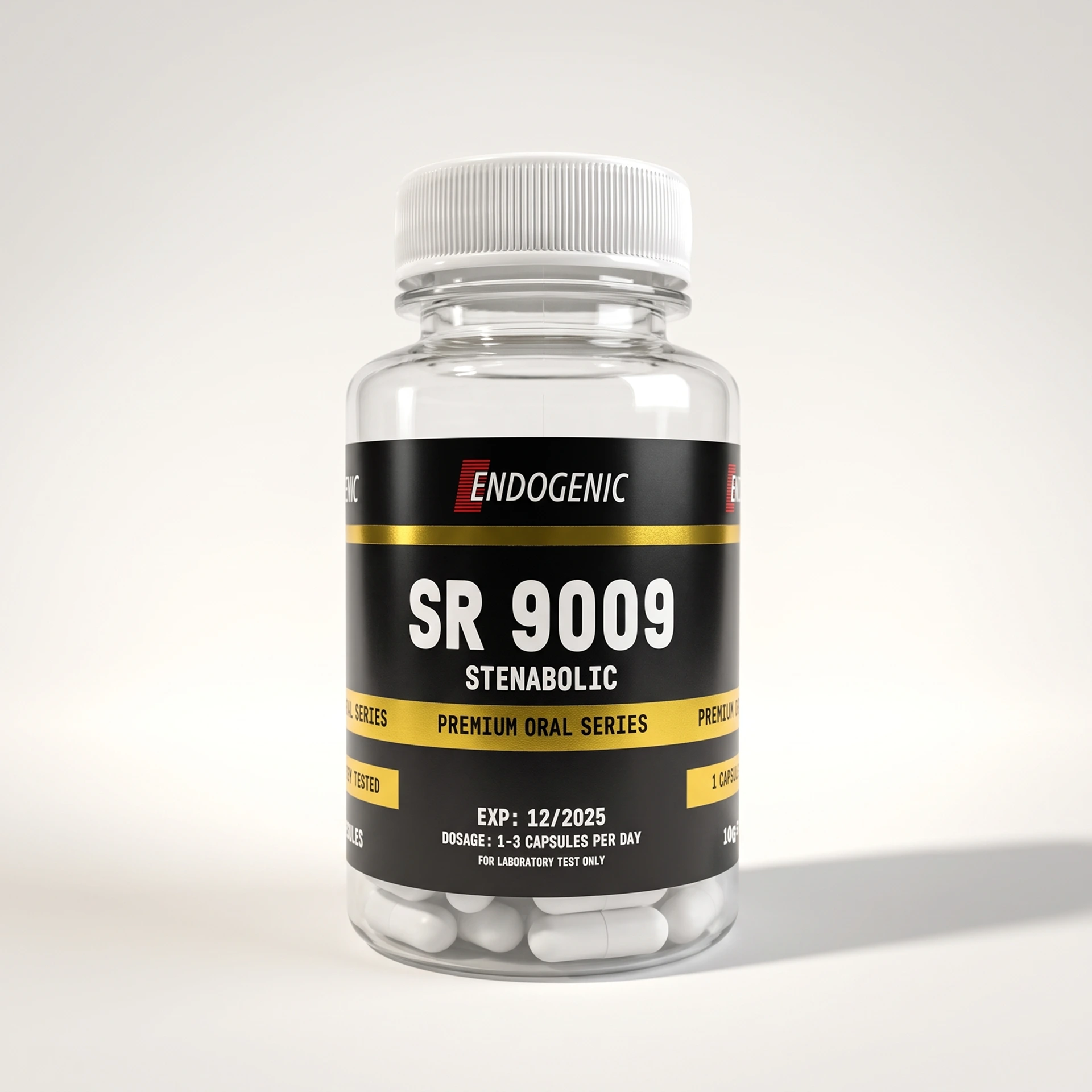
NO. SR-9009 (Stenabolic) is commonly placed next to SARMs in catalogs, but pharmacologically it is not one. SARMs (like Ostarine or RAD-140) are androgen receptor modulators – they act through the androgen axis. SR-9009 binds nuclear receptors REV-ERBα/β, core circadian clock transcriptional repressors, and acts as metabolic modulator. It does not bind the androgen receptor or exert an anabolic effect through androgen-dependent protein synthesis. This is an essential mechanistic and compliance distinction – WADA classifies SR-9009 as a metabolic modulator (S4.4) and not an anabolic agent.
SR9009 60 caps
SR-9009 (Stenabolic) 10 mg × 60 capsules is a synthetic small molecule from the class of metabolic modulators (Endogenic line) – an agonist of REV-ERBα/β nuclear receptors. It enhances the repressor activity of REV-ERB, inhibits BMAL1 expression and in mouse models is associated with mitochondrial biogenesis, increased energy expenditure and improved aerobic capacity. Research Use Only reagent
52,99 €
With code BLACK: 42,39 €
Lowest price in the 30 days before the discount:
52,99 €
Fast shipping
Free delivery from 350 €
Returns policy
SR-9009 (Stenabolic) 10 mg 60 caps - REV-ERB receptor agonist - reagent
- SR-9009 (Stenabolic): a REV-ERB nuclear receptor agonist.
- 10 mg per capsule; pack of 60 capsules.
- Research Use Only reagent, not a medicinal product.
Product status information
Chemical reagent intended exclusively for laboratory tests (Research Use Only). It is not a medicinal product, dietary supplement or food. It is not intended for use on humans or animals. Sales only to registered research units and laboratories.
WADA STATUS – CATEGORY S4.4 (METABOLIC MODULATORS)
SR-9009 (Stenabolic) as a REV-ERB receptor agonist is on the World Anti-Doping Agency (WADA) Prohibited List in the category S4.4 – metabolic modulators, prohibited both in competition and out of competition. WADA explicitly lists REV-ERB receptor agonists as an example of this subcategory, alongside PPARδ agonists. It is imperative that Registered Athletes (ADAMS) verify the current Prohibited List before making any decision – the presence of SR-9009 or its metabolites in a doping sample constitutes an anti-doping rule violation.
Introduction
The circadian clock and energy metabolism are two systems that are intertwined in the cell at the molecular level. The circadian rhythm not only regulates sleep and wakefulness – it also controls mitochondrial biogenesis, fatty acid oxidation and glucose management, adjusting energy expenditure to the time of day. For years, pharmacology has been searching for molecules that could intentionally influence the core of this clock to investigate how the reconstruction of the rhythm translates into metabolism.
SR-9009 (Stenabolic) is one of the best described such modulators. Pro-Body supplies SR-9009 in the Endogenic line, supplied as a research reagent in packs of 10 mg × 60 capsules. Chemically, it is a small synthetic molecule — a nuclear receptor agonist REV-ERBα and REV-ERBβ, which are transcriptional repressors of the core circadian clock. In terms of mechanism, the SR-9009 is in class metabolic modulators and is sometimes described in the literature as “exercise mimetic” – a compound that mimics in models some of the metabolic effects of exercise, such as mitochondrial biogenesis and improvement of aerobic capacity.
In the catalog, the reagent is listed alongside SARMs, although – as explained below – its pharmacology is different from them. SR-9009 was developed by Thomas Burris’ team at the Scripps Research Institute as a pharmacological tool to study the biology of REV-ERB receptors. In research terms, SR-9009 remains a model ligand for studying the association of the circadian clock with metabolism, mitochondrial biogenesis, and lipid and glucose metabolism in the liver and muscles. Purity verified by HPLC ≥98%, identity confirmed by mass spectrometry, COA available for each batch.
REGULATORY STATUS
SR-9009 is not registered as a drug in the EU or US. It has not undergone clinical trials on humans and remains a research-grade compound (tool compound). SR-9009 is on the WADA Prohibited List in category S4.4 (metabolic modulators – REV-ERB agonists). Communicating a product as a “fat burner”, “performance booster” or “exercise mimetic in a takeable capsule” is contrary to the Research Use Only framework.
REV-ERB receptors, circadian clock and metabolism
REV-ERBα and REV-ERBβ receptors are nuclear receptors that function as transcriptional repressors — they silence the genes whose promoters they attach to. At the core of the molecular circadian clock, REV-ERBs act as a negative feedback loop: they inhibit gene expression BMAL1, one of the main transcriptional activators of the clock. In this way, REV-ERBs co-create a rhythm that drives circadian oscillations in gene expression in almost every tissue.
What makes REV-ERB particularly interesting for metabolic pharmacology is that their natural ligand is heme — a molecule directly related to cellular metabolism. REV-ERBs therefore stand at the junction of two systems: the circadian clock and energy metabolism. Genes regulated by REV-ERB include pathways for mitochondrial biogenesis, fatty acid beta-oxidation, lipid metabolism, and glucose handling.
Thanks to this, the REV-ERB agonist is a tool for examining how interference in the clock core translates into the cell’s energy balance. The world of pharmacology is keeping an eye on SR-9009 for several reasons. First, as a model REV-ERB agonist – a tool to study how pharmacological activation of these receptors remodels circadian rhythm and metabolism.
Secondly, as an “exercise mimetic” compound – in testing whether pharmacological enhancement of mitochondrial biogenesis and substrate oxidation can mimic some of the metabolic effects of exercise in models. Third, as a molecule with a reported effect on lipid and glucose metabolism in the liver and muscles – useful in studies of metabolic disorders in animal models.
What is SR-9009?
Chemically, SR-9009 is a synthetic small molecule – REV-ERB nuclear receptor agonist developed as a pharmacological tool.
- Common name: SR-9009, Stenabolic
- Research code / synonyms: SR9009
- Pharmacological class: REV-ERBα/β nuclear receptor agonist; metabolic modulator; compound described as “exercise mimetic” in models
- CAS number: 1379686-30-2 (in case of uncertainty – “to be verified in the batch COA”)
- Molecular formula: C₂₀H₂₄ClN₃O₄S (to be verified in the batch COA)
- Molar mass: ~437.9 g/mol (to be verified in the batch COA)
- Laboratory of Origin: Thomas Burris team, Scripps Research Institute
- Delivered form: hard capsule, 10 mg of substance per capsule, 60 capsules; pharmaceutical grade ≥98% HPLC
Table of physicochemical characteristics
| Parameter | Value | Note |
|---|---|---|
| Name | SR-9009, Stenabolic | SR9009 |
| Chemical class | small synthetic molecule | not a peptide, not a steroid |
| Pharmacological class | REV-ERBα/β nuclear receptor agonist; metabolic modulator | “exercise mimetic” in models |
| CAS | 1379686-30-2 | for verification in the batch COA |
| Molecular formula | C₂₀H₂₄ClN₃O₄S | for verification in the batch COA |
| Molar mass | ~437.9 g/mol | for verification in the batch COA |
| Purity | ≥98% HPLC | UV detection, per batch verification |
| Form | capsule, 10 mg/capsule, 60 capsules | — |
| Molecular target | REV-ERBα and REV-ERBβ nuclear receptors | clock transcriptional repressors, inhibit BMAL1 |
| Oral bioavailability | low | significant pharmacokinetic limitation |
| Clinical status | no clinical trials on humans (tool compound) | no EU/US registration |
| WADA status | Prohibited List, Category S4.4 (Metabolic Modulators) | REV-ERB agonists listed explicitly |
Mechanism of action at the molecular level
SR-9009 works in preclinical models by activating REV-ERB receptors, resulting in a cascade of related metabolic effects. The following mechanisms have been documented mainly in murine and in vitro models. Pharmacological profile observed in research models:
- REV-ERB receptor agonism – core clock transcriptional repression. This is the best-described mechanism of SR-9009. The molecule acts as a synthetic agonist of REV-ERBα and REV-ERBβ nuclear receptors, enhancing their repressor activity. REV-ERB receptors inhibit gene expression BMAL1 — the main transcriptional activator of the circadian clock — whereby SR-9009 modifies the amplitude and course of the circadian rhythm of gene expression (Solt et al. 2012). This is the primary molecular effect from which other metabolic observations arise.
- Impact on metabolism – mitochondrial biogenesis, beta-oxidation, energy expenditure. In mouse models, activation of REV-ERB by SR-9009 was associated with increased mitochondrial biogenesis in muscles, increased beta-oxidation of fatty acids, and increased energy expenditure. This set of observations forms the core of the molecule’s metabolic profile and the basis for its designation as an “exercise mimetic.”
- Modulation of lipid and glucose metabolism in the liver and muscles. The effect of SR-9009 on lipid metabolism (lowering plasma lipid levels, modulation of fatty acid and cholesterol synthesis in the liver) and glucose metabolism has been described in animal models. REV-ERB regulates genes involved in these pathways, so pharmacological enhancement of their activity restructures the metabolic balance in target tissues.
- “Exercise mimetic” profile – aerobic capacity in mouse models. In studies on mice, SR-9009 was associated with improved aerobic capacity and increased mitochondrial content in skeletal muscle (Woldt et al. 2013), which was interpreted in the literature as partially mimicking metabolic adaptations to exercise. This is the direction that is driving most of the interest in the molecule in the context of exercise metabolism – and the reason for its presence on the WADA Prohibited List.
- Low oral bioavailability – a significant pharmacokinetic limitation. SR-9009 features low bioavailability after oral administration — the compound poorly penetrates into the general circulation from the gastrointestinal tract and is quickly metabolized. This is a research fact of fundamental importance: most of the convincing in vivo data have been obtained with controlled routes of administration in animal models, not with oral administration. For this reason, SR-9009 remains primarily a tool for in vitro and preclinical studies rather than a molecule with an established oral profile. This pharmacokinetic barrier was later to be addressed by the analogue SR-9011 with better properties.
Important distinction - REV-ERB modulator and androgenic SARM
Understanding SR-9009’s position on the pharmacological map is the focal point of this brief:
- Molecular target — SR-9009 binds nuclear receptors REV-ERBα/β, core circadian clock transcriptional repressors. It does not bind the androgen receptor. This is a fundamental difference from SARMs (androgen receptor modulators, such as Ostarine or RAD-140), which act through the androgen axis. SR-9009 is commonly listed next to SARMs in catalogs, but its pharmacology is different – it is a metabolic modulator, not an androgen receptor ligand.
- Mechanism — SR-9009 rebuilds energy metabolism by enhancing REV-ERB repressor activity and influencing genes for mitochondrial biogenesis, fatty acid oxidation and lipid and glucose management. It is not an anabolic mechanism through androgen-dependent muscle protein synthesis.
- Capsule variant and solution – this reagent is supplied as capsules 10 mg × 60; there is also variant SR-9009 in 30 ml solution. This is a difference in the form of delivery, not in pharmacology – the molecule is the same, the way of handling the reagent in laboratory conditions is different.
- SR-9009 and SR-9011 — SR-9011 is an analogue of SR-9009, designed for better pharmacokinetics. Both compounds are REV-ERB agonists with a similar metabolic profile, but differ in their pharmacokinetic properties.
- Oral bioavailability – SR-9009 features low bioavailability after oral administration, which makes it a compound mainly intended for in vitro and preclinical studies with a controlled route of administration.
This distinction is of both mechanistic and compliance importance: SR-9009 is sometimes mistakenly classified as a SARM, while its pharmacology is different. In anti-doping terms, WADA classifies SR-9009 as a metabolic modulator (S4.4 – REV-ERB agonists) and not as an anabolic agent.
Applications in scientific research
SR-9009 is used in research work in several areas. In vivo models (mouse) examine its impact on the circadian rhythm of gene expression, on mitochondrial biogenesis in muscles, on lipid and glucose metabolism in the liver, and on aerobic capacity. REV-ERB repressor activity, target gene expression (including BMAL1) and the effect on metabolic pathways are measured in in vitro models and isolated tissues. In comparative works, SR-9009 is sometimes compared with the analogue SR-9011 and with PPARδ agonists from the family GW-501516, as a mechanistically distinct metabolic modulator. Specific research directions include:
- Circadian clock axis – metabolism — SR-9009 as a tool to study how pharmacological activation of REV-ERB rebuilds the circadian rhythm and energy balance of the cell
- Mitochondria biogenesis and exercise metabolism — measurements of the effect of REV-ERB agonism on mitochondrial content, beta-oxidation and aerobic capacity in mouse models
- Lipid and glucose metabolism — studies on the impact of SR-9009 on lipid and glucose metabolism in the liver and muscles in models of metabolic disorders; an area thematically similar to the reagent line tested for fat burning
- Pharmacology of REV-ERB receptors — SR-9009 as a model agonist in structure-activity relationship analyzes and comparisons with the SR-9011 analogue, and GW-0742 (PPARδ agonist with a different mechanism, but research related)
- “exercise mimetic” profile — studies on the extent to which pharmacological enhancement of mitochondrial biogenesis can mimic metabolic adaptations to exercise in models
- Detection methods in anti-doping analysis — SR-9009 as an analyte in the development of detection methods for WADA control (Geldof et al. 2016)
REGULATORY STATUS
SR-9009 is located on WADA Prohibited List in category S4.4 (metabolic modulators) — prohibited in competition and out of competition. WADA explicitly lists REV-ERB receptor agonists as an example of this subcategory, alongside PPARδ agonists (like GW-501516). SR-9009 has not undergone clinical trials in humans and is not registered as a drug in the EU or US. Not authorized by EMA, FDA and EFSA. Registered Athletes (ADAMS) must verify the current Prohibited List before making any decision; the presence of SR-9009 or its metabolites in a doping sample results in an anti-doping rule violation.
Summary
SR-9009 (Stenabolic, 10 mg × 60 capsules) is a synthetic small molecule of the class metabolic modulators — REV-ERBα/β nuclear receptor agonist, developed by Thomas Burris’ team at the Scripps Research Institute as a pharmacological tool for studying the biology of REV-ERB receptors. Its central mechanism is enhancement of REV-ERB repressor activity, which inhibits BMAL1 expression and rebuilds the circadian rhythm and energy metabolism of the cell.
In mouse models, SR-9009 has been associated with mitochondrial biogenesis, increased beta-oxidation, increased energy expenditure and improved aerobic capacity – hence the description “exercise mimetic”. The effect on lipid and glucose metabolism in the liver and muscles has also been described. SR-9009 is a REV-ERB agonist (metabolic modulator), not an androgenic SARM — does not bind the androgen receptor.
Features low oral bioavailability, which makes it a compound mainly used for in vitro and preclinical studies; its pharmacokinetic limitations were to be addressed by the SR-9011 analogue. HPLC purity ≥98%, MS, COA for each batch. Regulatory Status – Research Use Only; lack of clinical trials and lack of EMA/FDA/EFSA authorization; WADA Prohibited List, Category S4.4 (Metabolic Modulators – REV-ERB Agonists).
The broader metabolic context of the REV-ERB analogue in the context of reduction is discussed in the entry SR-9011 – a fat burner unlike any other; the mechanism of the related PPARδ agonist and its role in endurance is reviewed Cardarine for weight loss.
Bibliography
- Solt LA, Wang Y, Banerjee S, et al. (2012). Regulation of circadian behavior and metabolism by synthetic REV-ERB agonists. PubMed
- Woldt E, Sebti Y, Solt LA, et al. (2013). Rev-erb-α modulates skeletal muscle oxidative capacity by regulating mitochondrial biogenesis and autophagy. PubMed
- Burris TP, Solt LA, Wang Y, et al. (2013). Nuclear receptors and their selective pharmacological modulators. PubMed
- Dierickx P, Vermunt MW, Muraro MJ, et al. (2019). SR9009 has REV-ERB-independent effects on cell proliferation and metabolism. PubMed
- Geldof L, Deventer K, Roels K, et al. (2016). In Vitro Metabolic Studies of REV-ERB Agonists SR9009 and SR9011. PubMed
FAQ
REV-ERBα and REV-ERBβ receptors are nuclear receptors that act as transcriptional repressors – they silence the genes to whose promoters they attach. In the core of the circadian clock, they inhibit the expression of the BMAL1 gene, one of the main transcriptional activators of the clock. SR-9009, as a REV-ERB agonist, enhances their repressor activity, thereby modifying the circadian rhythm of gene expression (Solt et al. 2012). Because REV-ERB also regulates metabolic genes, their activation remodels the cell’s energy balance – this clock-metabolism link is the basis of interest in the molecule.
The difference is the form of delivery, not the pharmacology. SR-9009 capsules (10 mg × 60) contain a weighed amount of powder per capsule, which facilitates handling of the reagent in the laboratory without weighing individual samples. The 30 ml solution variant delivers the same molecule in liquid form. The molecule, mechanism and pharmacological profile are identical – the method of preparation of working samples differs. The choice of form depends on the work pattern of a given research unit. The identity of each batch is determined by COA – MS mass and HPLC purity.
Yes. SR-9009 is located on WADA Prohibited List in category S4.4 (metabolic modulators), prohibited in competition and out of competition. WADA explicitly lists REV-ERB receptor agonists as an example of this subcategory, alongside PPARδ agonists (like GW-501516). Registered athletes (ADAMS) must absolutely verify the current Prohibited List; the presence of SR-9009 or its metabolites in a doping sample results in an anti-doping rule violation. This status applies to the reagent regardless of its pharmacokinetic limitations.
SR-9011 is an analogue of SR-9009, designed for better pharmacokinetics. Both compounds are agonists of REV-ERB receptors with a similar metabolic profile – they affect mitochondrial biogenesis, lipid and glucose metabolism, and circadian rhythm in models. They differ in their pharmacokinetic properties: SR-9011 was created as an attempt to improve the limitations of SR-9009, including its low bioavailability. In studies, both are compared in analyzes of the structure-activity relationship of REV-ERB ligands. The identity of each reagent is determined by the batch COA – MS mass and HPLC purity.
0.0
0 reviews
This product has no reviews yet.
Customers also bought

SEMA G 8mg PEN
SEMA G 8mg PEN
166,99 €