

Distilled water is neither sterile nor non-pyrogenic and is not suitable for the reconstitution of compounds intended for work under controlled conditions. Water for injection without a preservative (WFI) is sterile, but single-use — after puncture there is no barrier to the proliferation of microorganisms, so the solution must be used at once and the remainder discarded. Bacteriostatic water contains 0.9% benzyl alcohol, which inhibits bacterial growth and allows repeated withdrawal from the same vial over a 28-day window — which matches the real rhythm of protocols spread over weeks.
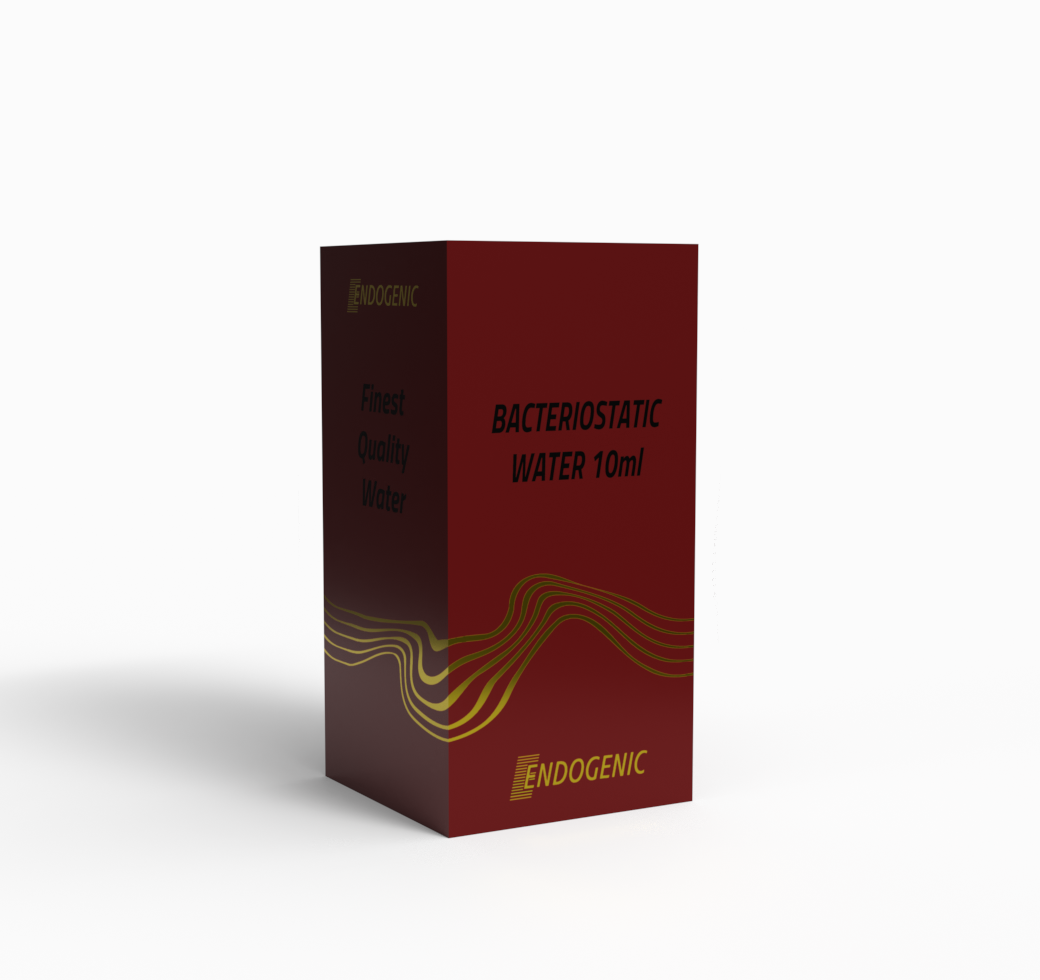
Bacteriostatic Water 10ml
Sterile Bacteriostatic Water for Injection (BWFI USP), 10-mL multidose vial with a rubber membrane, preserved with 0.9% benzyl alcohol. A larger-volume format for a series of reconstitutions—a single vial is sufficient to dissolve several vials of lyophilized powder within a single 28-day window. A laboratory supply, not a medicinal product.
9,99 €
Fast shipping
Delivery options
Free delivery from 350 €
Returns policy
Bacteriostatic Water 10 ml — sterile diluent for reconstitution of lyophilized research peptides
- Bacteriostatic water with 0.9% benzyl alcohol.
- 10 ml multidose vial.
- Laboratory accessory for reagent reconstitution.
A laboratory accessory (Sterile Bacteriostatic Water for Injection, Bacteriostatic Water for Injection USP) intended for the reconstitution of lyophilized research reagents under laboratory working conditions. It is not a medicinal product or a dietary supplement. The diluent itself is not intended for therapeutic use in humans or animals. An item from the laboratory practice category — a tool supporting the safe and reproducible reconstitution of lyophilized compounds.
A lyophilized peptide is a powder — and a powder tells the analyst nothing about itself until it is in a solution of a known, reproducible concentration. And this is where the first real problem of the research bench begins: what to dissolve the residue at the bottom of the vial with, so that the solution is homogeneous, sterile and stable for the entire week of the protocol, rather than for two hours.
The answer comes down to distinguishing between two diluents that look identical and are sometimes confused: water for injection (WFI, Water for Injection) and bacteriostatic water (BWFI, Bacteriostatic Water for Injection). WFI is pure, sterile water without a preservative — intended for a single puncture, after which the vial loses its sterility. BWFI is the same quality of water, but with the addition of 0.9% benzyl alcohol as a bacteriostatic preservative.
The difference is practical, not cosmetic: the preservative allows the same vial to be punctured repeatedly over many days without bacterial proliferation in the solution. For research protocols on lyophilized injectable peptides — BPC-157, TB-500, Ipamorelin, semaglutide and the remaining compounds from the catalog of RUO reagents — bacteriostatic water is the default diluent. The reason is trivial and therefore important: a single vial of lyophilizate is rarely used up in one day.
The working solution must survive a series of withdrawals spread over weeks, and during that time every puncture of the membrane is a potential introduction of microbiological contamination. The preservative does not make the solution a permanently sterile product — it inhibits the growth of whatever does, despite everything, get inside. This page describes exactly what bacteriostatic water is, how its preservative works, what quality standards the Pro-Body batch is subject to, and how to carry out the reconstitution of a lyophilized compound step by step — without loss of sterility and without concentration errors that ruin reproducibility.
What bacteriostatic water is
Bacteriostatic water for injection (BWFI) is sterile, non-pyrogenic water for injection of USP quality with the addition of a bacteriostatic agent — in the standard pharmacopeial formulation this is benzyl alcohol at a concentration of 0.9% v/v. The commercial form is a multidose vial sealed with a rubber membrane (a septum-type stopper), through which the diluent is withdrawn with a needle without opening the vial.
The term “bacteriostatic” is precise and worth understanding literally. A bacteriostatic agent inhibits the growth and proliferation of bacteria, but does not kill them — it is not a bactericidal agent. The practical consequence: if a small number of bacterial cells get into the solution during the puncture of the membrane, the preservative will hold back their multiplication to a safe level, instead of allowing the population to grow exponentially between successive withdrawals.
It is precisely this mechanism that justifies the multidose status — the vial can be punctured repeatedly within a defined time window. By comparison, water for injection without a preservative (WFI) is single-use by definition: as soon as it is opened or punctured, there is no barrier to the proliferation of microorganisms and the remainder must be discarded.
Hence the division of roles on the research bench — WFI where a single, one-time dissolution without a preservative is needed (e.g. a compound sensitive to benzyl alcohol), BWFI everywhere the working solution is meant to be used multiple times. The solution has a slightly acidic to neutral reaction (pH 4.5–7.0) and is hypoosmotic — in itself it contains no electrolytes or buffers.
This makes it a neutral background for the dissolved compound: the diluent contributes nothing to the solution other than water and a trace of preservative, which simplifies the interpretation of results.
Composition
| Component | Content | Function |
|---|---|---|
| Water for injection (Water for Injection USP) | up to 100% | Base diluent, sterile and non-pyrogenic |
| Benzyl alcohol (benzyl alcohol) | 0.9% v/v | Bacteriostatic preservative |
Characteristics of the preservative:
- Name: benzyl alcohol (benzyl alcohol)
- CAS number: 100-51-6
- Molecular formula: C₇H₈O
- Molar mass: 108.14 g/mol
- Concentration in the formulation: 0.9% v/v (pharmacopeial standard for BWFI)
- Physical form of BWFI: clear, colorless solution; pH 4.5–7.0; hypoosmotic solution
- Packaging: sterile 10 ml multidose vial with a rubber membrane (septum)
Benzyl alcohol is a well-characterized pharmaceutical preservative used in many multidose injectable preparations. The 0.9% concentration is the standard adopted in the United States Pharmacopeia (USP) for bacteriostatic water — sufficient for the bacteriostatic effect, while at the same time kept below the thresholds of significant toxicity in typical diluent volumes.
Mechanism of bacteriostatic preservation
The preservative action of benzyl alcohol is based on disrupting the integrity of the bacterial cell membrane. The molecule is amphiphilic — it has an aromatic part (a benzene ring, lipophilic) and a hydroxyl group (hydrophilic). This duality allows benzyl alcohol to embed itself into the lipid bilayer of the bacterial membrane, disrupt its ordering, and lead to denaturation of membrane proteins and an increase in membrane permeability.
The effect is a halt in metabolic processes and cell divisions — the bacterial population stops growing. It is important that at a concentration of 0.9% the effect is bacteriostatic, not bactericidal. The minimum inhibitory concentration (MIC) of benzyl alcohol for typical contaminating bacteria lies in the range of 0.15–0.5% — meaning the 0.9% concentration in BWFI maintains a noticeable margin above the growth-inhibition threshold.
At markedly higher concentrations benzyl alcohol begins to act bactericidally, but the BWFI formulation deliberately stays within the bacteriostatic window: it is meant to protect the solution during repeated punctures, not to sterilize the contents after the fact of contamination. The practical conclusion for the person performing the reconstitution: the preservative buys time and the safety of repeated withdrawal, but does not relieve one of asepsis.
Every puncture of the membrane with a disinfected swab, a fresh sterile needle for withdrawal, no touching of the septum — these are still the foundation. The bacteriostat is a safety net, not a substitute for sterile technique.
Step-by-step peptide reconstitution protocol
The protocol below describes the way to dissolve a lyophilized research compound while maintaining sterility and reproducibility of concentration. The example volumes and concentrations serve only to illustrate the logic of the calculations in laboratory work. The same procedure applies regardless of the form of the reagent — both for classic vials with lyophilizate and for ready-made peptide pens requiring the dry substance to be dissolved before use.
- Prepare the workstation and materials. A clean, disinfected work surface, a sterile syringe with a needle for withdrawing the diluent, a second sterile working needle/syringe, swabs soaked in 70% isopropyl alcohol. The vial of lyophilizate and the vial of bacteriostatic water should be at a temperature close to room temperature.
- Calculate the target diluent volume. Solution concentration = mass of compound in the vial / volume of added water. For example: 10 mg of lyophilizate + 2 ml of BWFI gives a concentration of 5 mg/ml. Select the volume for the planned working concentration and the capacity of the vial — the typical working range for peptides is 1–5 mg/ml. Record the value before you puncture anything.
- Disinfect both membranes. Wipe the rubber septum of the vial with bacteriostatic water and of the vial with lyophilizate using a swab with 70% isopropanol. Wait a dozen or so seconds for it to evaporate.
- Withdraw the diluent. With a sterile syringe, withdraw the calculated volume of bacteriostatic water from the BWFI vial. Avoid introducing excess air into the multidose vial.
- Introduce the water slowly, down the wall. Puncture the membrane of the vial with lyophilizate and direct the stream of water onto the inner wall of the vial, not directly onto the peptide residue. The slow flow of water down the glass minimizes the shear forces acting on the molecules — peptides are sensitive to aggressive mixing.
- Dissolve without shaking. Leave the vial for the residue to dissolve spontaneously, or gently rotate it in your hands with a circular motion (swirl). Do not shake vigorously — foaming and turbulence can denature the peptide structure and reduce the activity of the compound. The solution should become clear.
- Label and record. Describe the working solution vial: name of the compound, concentration (mg/ml), date of reconstitution, batch number. The reproducibility of a research protocol depends on documentation — an unrecorded concentration is a lost experiment.
Compatibility here is on the side of BWFI: most lyophilized peptides — including BPC-157 PEN, TB-500 PEN or semaglutide — dissolve well in bacteriostatic water and tolerate the presence of 0.9% benzyl alcohol. An exception are compounds declared by the manufacturer to be sensitive to the preservative — for these the protocol indicates WFI without benzyl alcohol. Always check the recommendations for the specific reagent in its documentation.
Stability
The stability of bacteriostatic water is considered in two windows — before opening the vial and after the first puncture of the membrane. Before opening (unpunctured vial): a sealed, sterile multidose vial is stable for 24–36 months at room temperature, stored in its original packaging away from light. The specific expiry date is given on the batch label.
After the first puncture of the membrane: in accordance with USP <797> guidelines for multidose preparations with a preservative, the standard in-use window (beyond-use date) is 28 days from the first piercing of the septum, when stored at 2–8°C or below 25°C in accordance with the batch recommendation. After 28 days the remainder must be discarded, regardless of whether the vial is still full — the preservative does not guarantee sterility indefinitely, and the safety margin decreases with each successive puncture.
The 28-day rule concerns the diluent itself. The stability window of the working solution after reconstitution of the compound is sometimes shorter and depends on the properties of the specific peptide — many peptides in solution retain acceptable integrity for several weeks at 2–8°C, but that is a parameter of the compound, not of the diluent.
Note both dates separately: the date of puncture of the BWFI vial and the date of reconstitution of each working solution.
Storage
- Unpunctured vial: room temperature 15–25°C, in its original packaging, protect from light and frost
- After the first puncture: 2–8°C (laboratory refrigerator) or below 25°C in accordance with the batch recommendation; use within 28 days
- Do not freeze — freezing is neither required nor recommended for bacteriostatic water; freeze-thaw cycles do not improve stability and may affect the tightness of the vial
- Keep out of the reach of children
- Do not use a solution that is cloudy, has changed color or contains visible particles — clarity is the first signal of integrity
Regulatory status
Bacteriostatic Water 10 ml in the Pro-Body catalog is listed as a laboratory accessory supporting the reconstitution of lyophilized research reagents (Research Use Only), not as a medicinal product in consumer circulation.
- The diluent itself is a well-characterized pharmacopeial preparation (Bacteriostatic Water for Injection USP), manufactured in accordance with sterility and quality control standards
- In the context of the Pro-Body offering it serves as a research bench tool — for dissolving RUO compounds under laboratory working conditions
- It does not change the regulatory status of the dissolved compounds: research peptides and SARMs remain Research Use Only reagents regardless of the diluent used
- Safety restrictions (contraindications in newborns/infants, the prohibition of the epidural and intrathecal routes) result from the properties of benzyl alcohol and apply in every context
Bibliography
- United States Pharmacopeia. Bacteriostatic Water for Injection USP — monograph. USP-NF.
- United States Pharmacopeia. General Chapter <797> Pharmaceutical Compounding — Sterile Preparations. USP-NF.
- United States Pharmacopeia. General Chapter <71> Sterility Tests. USP-NF.
- United States Pharmacopeia. General Chapter <85> Bacterial Endotoxins Test. USP-NF.
- U.S. Food and Drug Administration. Benzyl alcohol — neonatal “Gasping Syndrome” and Black Box warning for benzyl alcohol-preserved products. FDA.
- Gershanik J, Boecler B, Ensley H, McCloskey S, George W (1982). The gasping syndrome and benzyl alcohol poisoning. PubMed
- International Council for Harmonisation. ICH Q1A(R2) Stability Testing of New Drug Substances and Products. ICH.
FAQ
In accordance with USP <797> the standard in-use window is 28 days from the first piercing of the membrane, when stored at 2–8°C or below 25°C. After this time the remainder must be discarded, even if the vial is not empty. It is worth recording the date of the first puncture directly on the vial.
There is no such need and it is not recommended. The diluent is stable at room temperature before opening (24–36 months) and in the refrigerator after puncture. Freezing does not extend the in-use validity window after opening, and may compromise the tightness of the vial and the integrity of the membrane.
Most lyophilized research peptides — including BPC-157, TB-500 and semaglutide — dissolve well in BWFI and tolerate 0.9% benzyl alcohol. An exception are compounds for which the manufacturer declares sensitivity to the preservative — for these, water for injection without benzyl alcohol (WFI) is indicated. Always check the documentation of the specific reagent.
Vigorous shaking generates shear forces and foaming at the water-air interface, which can denature the spatial structure of the peptide and reduce the activity of the compound. The correct technique is to direct the stream of water onto the wall of the vial and gently rotate it with a circular motion (swirl) until a clear solution is obtained. For intranasal peptides requiring atomization, the working solution is then transferred to a dedicated vessel, such as a glass atomizer 10ml.
Each batch undergoes the USP <71> sterility test, pH control and preservative assay, and filling takes place under ISO Class 5 cleanliness conditions. The result of the control is documented in the certificate of analysis (COA) available for each numbered batch — a verifiable document, not a general assurance.
0.0
0 reviews
This product has no reviews yet.