

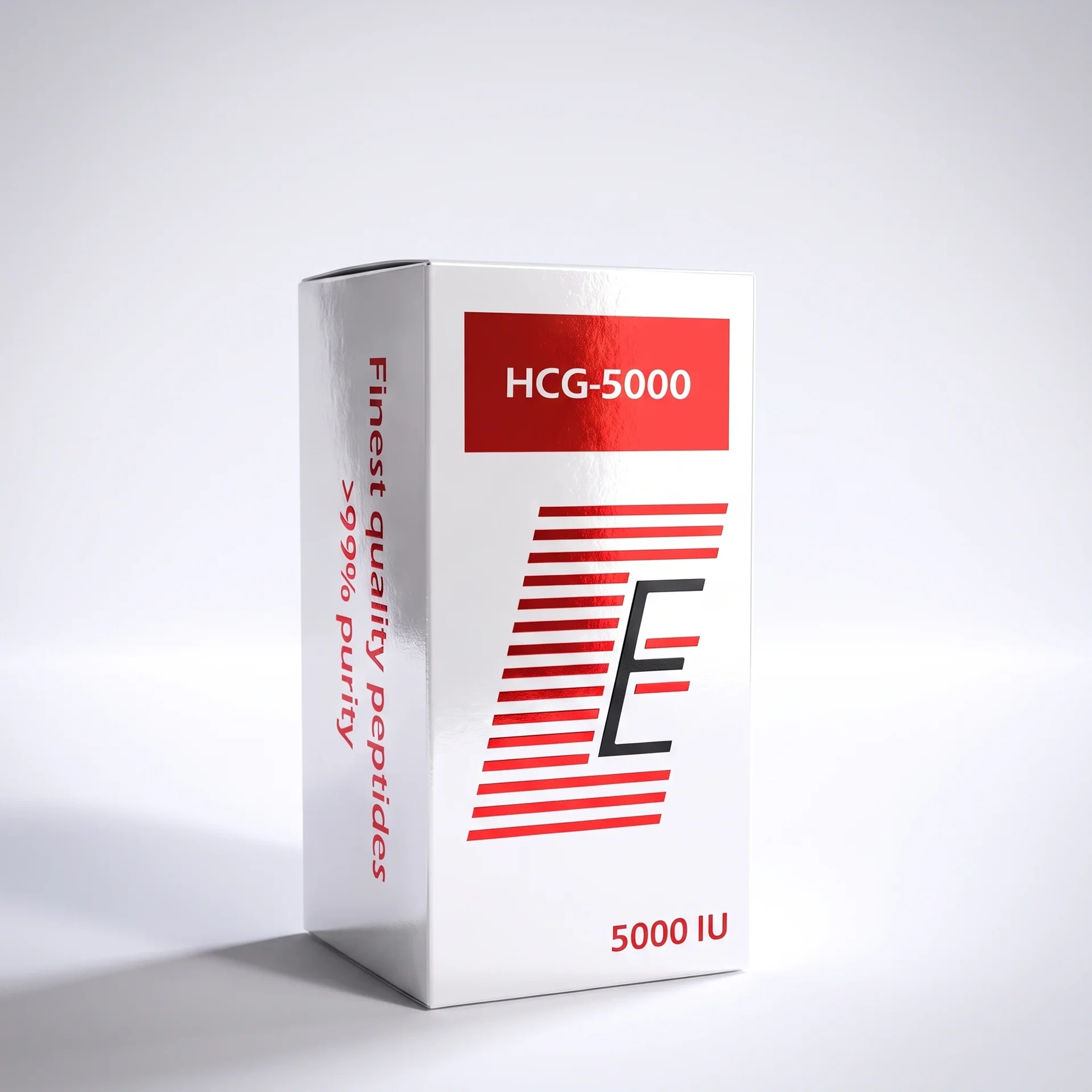
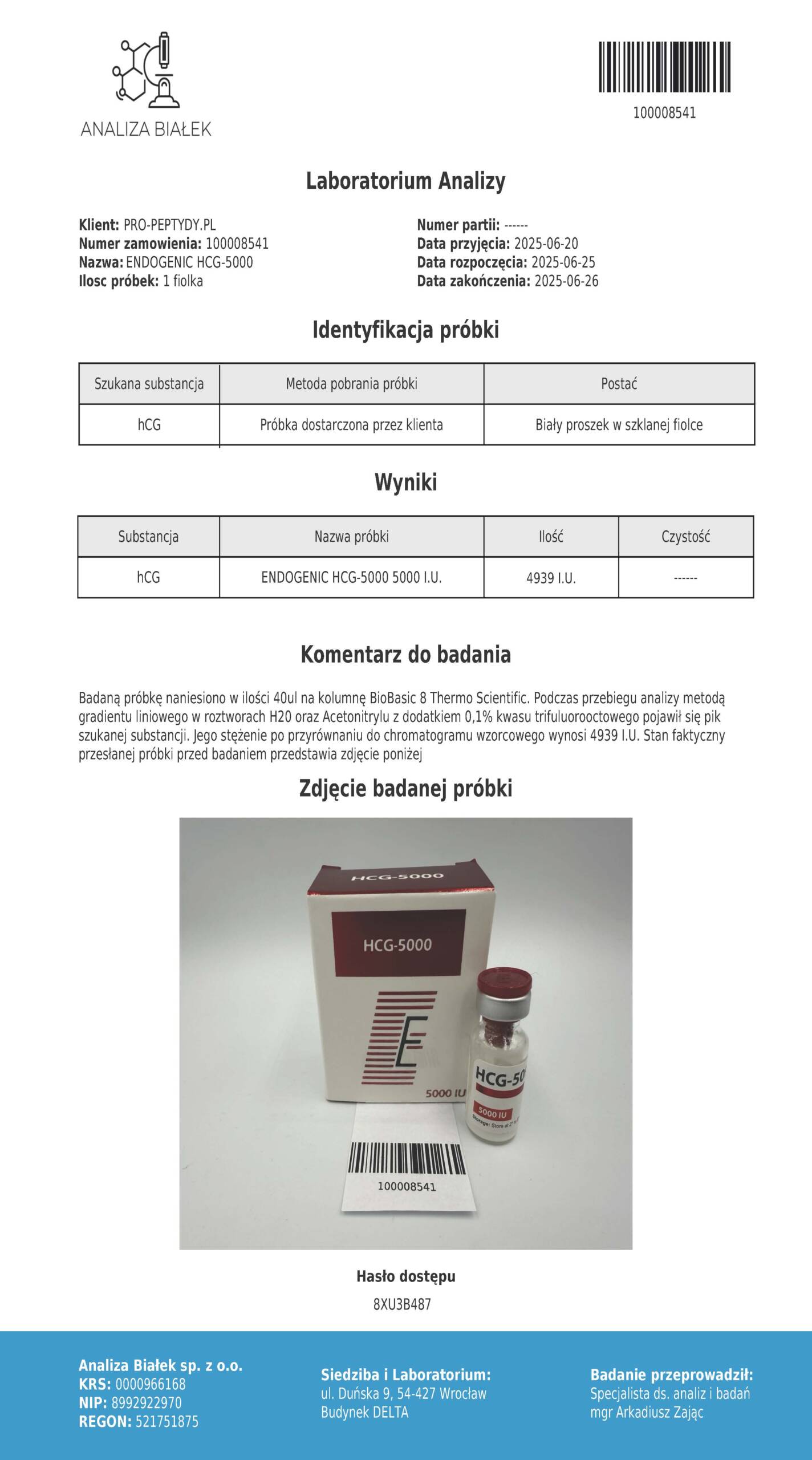
hCG (human chorionic gonadotropin) is a dimeric glycoprotein with a mass of ~36.7 kDa, composed of a common alpha subunit and a specific, highly glycosylated beta subunit. Physiologically, it is a signal of early pregnancy. As a reagent, it serves as a reference, stable analogue of luteinising hormone (LH) for research on the HPG axis and gonadal function. In the Pro-Body catalogue it is an RUO reagent – a molecular tool for laboratory work, not a medicinal product.
HCG 5000 IU
hCG 5000 IU – a dimeric gonadotropic glycoprotein in a larger vial of lyophilisate, for laboratory research. A reference LH analogue acting through the LHCGR receptor; models of the HPG axis, Leydig cells and steroidogenesis. RUO reagent with bacteriostatic water for reconstitution.
28,99 €
With code BLACK: 23,19 €
Lowest price in the 30 days before the discount:
28,99 €
Fast shipping
Delivery options
Free delivery from 350 €
Returns policy
hCG 5000 IU (chorionic gonadotropin) – RUO research reagent
- hCG 5000 IU – a dimeric gonadotropic glycoprotein in a larger vial of lyophilisate, for laboratory research.
- A reference LH analogue acting through the LHCGR receptor; models of the HPG axis, Leydig cells and steroidogenesis.
- RUO reagent with bacteriostatic water for reconstitution.
Product status notice
A chemical reagent intended solely for laboratory research (Research Use Only). It is not a medicinal product, dietary supplement or foodstuff. It is not intended for use in humans or animals. Sales are limited to registered research institutions and laboratories.
Regulatory status
Human chorionic gonadotropin (hCG) is the active substance of authorised medicinal products – including Pregnyl®, Ovitrelle® (choriogonadotropin alfa) and Choragon®. In its marketed forms, hCG is available only on prescription and requires medical supervision (reproduction, ovulation induction, assessment of gonadal function). The hCG 5000 IU RUO reagent from the Pro-Body catalogue is NOT a medicinal product, is not a substitute for Pregnyl®/Ovitrelle®/Choragon® and does not replace medical consultation.
Additionally, hCG is on the WADA Prohibited List in category S2 as a substance prohibited in men (in and out of competition). Athletes registered in ADAMS must check the current List before making any decision.
Introduction
hCG 5000 IU from the Endogenic line is the same dimeric glycoprotein that human physiology knows as a signal of early pregnancy – chorionic gonadotropin produced by the trophoblast, which supports the corpus luteum in the first weeks of embryonic development. As a reagent, however, it serves a different purpose: it is a reference luteinising hormone (LH) analogue, a molecular tool for research on the hypothalamic-pituitary-gonadal (HPG) axis and on Leydig cell function.
The Endogenic line brings together molecules that act on the body’s physiological regulatory loops – and hCG, which mimics the pituitary’s own hormone, is a textbook example of this approach. The 5000 IU format differs from the 2500 IU variant in one respect – a higher unit content per vial. It is the same lyophilisate of the same glycoprotein, but with more international units of biological activity in one vial.
For laboratory work, this means longer research protocols from one vial, a lower cost per unit of activity and a larger working volume of solution after reconstitution – while the molecule keeps all of its characteristics. The smaller format is HCG 2500 IU – the same glycoprotein in a vial with half the units. hCG remains a molecule with a dual regulatory identity that cannot be ignored: on the one hand, it is the active substance of medicines authorised for decades; on the other, it is a research reagent outside the pharmaceutical trade.
These two paths are not interchangeable. The hCG 5000 IU RUO reagent serves only as a molecular tool for HPG axis research, supplied as a vial of lyophilisate with an activity of 5000 IU and separate bacteriostatic water for reconstitution.
General description – hCG as a glycoprotein analogue of LH
Human chorionic gonadotropin (hCG) is a dimeric glycoprotein composed of two non-covalently linked subunits. The alpha subunit is common to the whole family of pituitary gonadotropins and thyrotropin – it is shared by luteinising hormone (LH), follicle-stimulating hormone (FSH) and thyroid-stimulating hormone (TSH). Identity and specificity are determined by the beta subunit – highly glycosylated in hCG, with a characteristic C-terminal extension rich in sialic acid residues.
It is this glycosylation that distinguishes hCG from other gonadotropins and gives the molecule its most important pharmacological feature. In the literature, hCG is described mainly as an agonist of the common LH/CG receptor (LHCGR) – it binds the same receptor as luteinising hormone and triggers an analogous intracellular signal. In research models it therefore serves as a long-acting, easily standardised LH analogue: where endogenous LH has a short half-life and is secreted in pulses, hCG provides a long, stable stimulus to the receptor.
This makes it a particularly convenient tool for work on the HPG axis and on the gonadal response to gonadotropin stimulation. In the Pro-Body catalogue, hCG 5000 IU belongs to the group of reagents for research on the hypothalamic-pituitary-gonadal axis. The 5000 IU format is a technical choice: more activity units per vial make work with longer protocols easier and lower the unit cost compared with the smaller 2500 IU variant.
The choice of format (5000 vs 2500 IU) is a decision about the scale of the research protocol, not about the nature of the molecule, which stays identical in both vials.
What is hCG 5000 IU – a larger vial of lyophilisate
hCG 5000 IU is a vial of glycoprotein lyophilisate with a biological activity of 5,000 international units (IU), with separate bacteriostatic water for reconstitution. The molecule is a dimeric glycoprotein with a mass of approx. 36.7 kDa and the CAS number 9002-61-3, composed of a common alpha subunit (92 amino acids) and a specific, highly glycosylated beta subunit (145 amino acids). hCG activity is expressed in international units (IU), which refer to biological gonadotropic activity rather than simple mass – the standard convention for gonadotropin preparations, where what matters is the strength of the signal at the receptor, not the mass of the protein itself.
The difference between the 5000 IU and 2500 IU formats comes down to the number of activity units per vial. After reconstitution, this gives a larger volume of working solution (or a higher concentration with the same volume of solvent), which translates into longer research protocols from one vial and a lower cost per unit of activity. The choice between 5000 IU and 2500 IU is a decision about the scale of laboratory work – the smaller 2500 IU vial suits short protocols and keeps losses down when used infrequently, while the larger 5000 IU vial suits intensive work with many working concentrations.
Heavy glycosylation of the beta subunit and the abundance of sialic acid residues are responsible for the prolonged half-life of hCG compared with LH. Sialic acid residues slow the renal clearance of the glycoprotein, so the signal at the LHCGR receptor persists much longer than after endogenous, pulsatile LH. This is the molecular explanation of why hCG is sometimes preferred over recombinant LH in research models as a lasting stimulus to gonadal cells.
Chemical characteristics – 5000 IU vial
| Parameter | Value |
|---|---|
| Name | hCG 5000 IU (human chorionic gonadotropin) |
| Line | Endogenic |
| Class | Dimeric gonadotropic glycoprotein (LH analogue) |
| Structure | Alpha subunit (shared with LH/FSH/TSH) + beta subunit (specific, highly glycosylated) |
| Target receptor | LHCGR (LH/CG common receptor) |
| Molecular weight | ~36.7 kDa |
| CAS number | 9002-61-3 |
| Activity/vial | 5000 IU (international units) |
| Format vs 2500 IU variant | Larger vial – twice the number of activity units |
| Physical form | Lyophilisate (powder for reconstitution) |
| Solvent | Bacteriostatic water (supplied separately) |
| Purity | HPLC; glycoprotein identity confirmed analytically |
Mechanism of action at the molecular level
In the literature, hCG is described as a glycoprotein acting through one central receptor but in several distinct physiological contexts. Below are five mechanistic axes, each with the name of the pathway and the effect observed in HPG axis research models.
LHCGR receptor agonism – LH mimicry
Core axis. hCG binds the common LH/CG receptor (LHCGR) – the same receptor that endogenous luteinising hormone activates. The LHCGR receptor belongs to the G protein-coupled receptor family; its activation triggers the cAMP/PKA cascade, leading to the expression of steroidogenic enzymes. Casarini et al. (2018) described subtle differences in intracellular signalling between hCG and LH despite their common receptor – hCG and LH are not fully identical in the profile of the pathways they activate, which makes hCG a separate molecular tool worth studying rather than a simple substitute for LH.
Stimulation of Leydig cells in men – intratesticular testosterone
In models of male gonadal function, LHCGR agonism in testicular Leydig cells leads to steroidogenesis – the production of testosterone, including high intratesticular testosterone concentrations. Liu and Handelsman (2003) discussed hCG in the context of hormonal support of testicular function and gonadal steroidogenesis within the HPG axis. In research models, hCG serves as a reference gonadotropic stimulus for assessing Leydig cell reserve and response – the classic “hCG stimulation test” of the endocrine literature. This is the context of research on gonadal function, not a suggestion for use in humans.
Support of the corpus luteum and induction of ovulation in women – the reproductive context
Physiologically, hCG is a signal of early pregnancy: produced by the trophoblast, it maintains the corpus luteum, which secretes the progesterone needed to sustain the embryo. The same agonist activity at LHCGR in the ovary, at the right moment of the cycle, induces ovulation – it mimics the pre-ovulatory LH surge. Cole (2010) described the biology of hCG and its function in reproduction in detail. Historically, this is the first and best-characterised area of the molecule’s physiology – and the context in which hCG is the active substance of authorised reproductive medicines.
Prolonged half-life relative to LH – glycosylation and sialic acid
Pharmacokinetic axis. A highly glycosylated beta subunit with a C-terminal extension rich in sialic acid residues gives hCG a much longer half-life than endogenous LH. Sialic acid residues slow the renal clearance of the glycoprotein – Choi and Smitz (2014) compared LH and hCG as stimuli for their common receptor, pointing to differences in pharmacokinetics and activation profile. The lasting signal makes hCG a convenient tool for standardisation in gonadotropin stimulation models, where pulsatile LH is difficult to control.
Research on the HPG axis and gonadal function
Integrative axis. The hypothalamic-pituitary-gonadal axis is a regulatory loop in which the hypothalamus (GnRH) controls the pituitary gland (LH/FSH), and the pituitary controls the gonads. By mimicking LH, hCG makes it possible to study the gonadal response independently of the upstream axis – directly at the level of the LHCGR receptor. This makes it a tool for studies of Leydig cell function, ovarian reserve and the steroidogenic response in models where bypassing the variability of the pituitary signal is desirable.
A complementary tool for stimulating the axis above the pituitary is Kisspeptin-10, which acts at the level of hypothalamic regulation of GnRH release. Reference data come from, among others, the work of Cole (2010), Casarini et al. (2018), Liu and Handelsman (2003) and Choi and Smitz (2014).
IMPORTANT DISTINCTION
“Stimulates Leydig cells” or “supports the corpus luteum” in the context of this description means: “LHCGR receptor agonism and stimulation of gonadal steroidogenesis have been observed in HPG axis research models.” It does not mean a guaranteed effect in humans or suggest that the hCG 5000 IU reagent can act as an agent for fertility, testosterone or testicular function. All the mechanisms described refer to physiology and research models – the reagent remains a molecular tool for laboratory research, not a substitute for authorised hCG medicines.
Important distinction – format, hormones and status
IMPORTANT DISTINCTION
The “hCG” designation calls for distinctions on several levels – format, hormone family and legal status. The identity of a batch is always confirmed by the analysis recorded in the COA, not by the trade name itself.
5000 IU vs 2500 IU format. Both variants are the same glycoprotein in the form of a lyophilisate – they differ in the number of activity units per vial. The larger 5000 IU vial delivers twice as many international units: longer protocols per vial, a lower cost per unit of activity and a larger working volume after reconstitution. The smaller chorionic gonadotropin 2500 IU vial suits shorter protocols and reduces waste when used infrequently. The choice of format is a decision about the scale of the work, not about the nature of the molecule.
hCG (LH analogue) vs FSH vs HMG. hCG mimics luteinising hormone (LH) – it acts on the LHCGR receptor and controls gonadal steroidogenesis. This is a different signal from FSH (follicle-stimulating hormone), which acts on its own receptor and is responsible for follicle maturation/spermatogenesis. HMG (human menopausal gonadotropin) is a mixture of LH and FSH activity isolated from the urine of postmenopausal women. These three reagents are not interchangeable – compare HMG 75 IU as a separate tool with an LH+FSH profile.
RUO reagent vs Pregnyl®/Ovitrelle®/Choragon® (medicines). hCG is the active substance of authorised medicinal products – Pregnyl® and Choragon® (urinary hCG) and Ovitrelle® (recombinant choriogonadotropin alfa). These preparations are available only on prescription and are intended for clinical use under medical supervision. The hCG 5000 IU RUO reagent is not a substitute for any of these medicines and does not share their pharmaceutical status – it is a tool for laboratory research, outside the trade in medicinal products.
A glycoprotein, not a steroid or SARM. hCG is a dimeric glycoprotein with a mass of ~36.7 kDa – a protein molecule acting through the LHCGR membrane receptor. It does not belong to the class of steroid compounds or selective androgen receptor modulators (SARMs). Although it stimulates gonadal steroidogenesis in research models, it is not itself a steroid molecule or a small-molecule nuclear receptor ligand – it is a protein agonist of the gonadotropic receptor.
Applications in scientific research
As an RUO reagent, hCG 5000 IU is used in several lines of research on the HPG axis. The 5000 IU format is particularly useful where the researcher needs longer protocols or more working concentrations from one vial without repeated reconstitution.
Studies of Leydig cell function. Models for assessing the reserve and steroidogenic response of Leydig cells – the classic gonadotropin stimulation test. Endpoints: testosterone production (including intratesticular), expression of steroidogenic enzymes, LHCGR receptor response. hCG serves as a reference, lasting stimulus at the LH/CG receptor.
Models of the HPG axis and gonadal steroidogenesis. Studies of the hypothalamic-pituitary-gonadal loop in which hCG makes it possible to stimulate the gonads while bypassing the variable pituitary signal. Endpoints: sex steroid profile, gonadal response dynamics, axis feedback. Comparative studies across the levels of the axis can also use reagents acting higher in the loop – a GnRH agonist at the pituitary level, such as the GnRH analogue Alarelin. For the separate hypothalamic-pituitary-adrenal axis, the reference point is ACTH 1-39.
Reproductive context – corpus luteum and ovulation. Research models of corpus luteum maintenance and ovulation induction in which hCG mimics the pre-ovulatory LH surge. Endpoints: progesterone secretion, ovulatory dynamics, ovarian response.
Comparative studies of LH vs hCG. As a stable LH analogue, the 5000 IU format is a tool for research on the differences in intracellular signalling between hCG and LH despite their common receptor (Casarini et al. 2018) and on the pharmacokinetics of the glycosylated glycoprotein relative to recombinant LH.
SCIENTIFIC PERSPECTIVE
The research directions listed concern reproductive physiology and HPG axis models. The endpoints (steroidogenesis, sex hormone profile, ovulatory dynamics) are the subject of scientific research, not an expected effect in people outside a controlled environment. The hCG 5000 IU reagent is a tool for laboratory work and does not reproduce the clinical uses of authorised hCG preparations.
REGULATORY STATUS
hCG is the active substance of authorised medicines (Pregnyl®, Ovitrelle®, Choragon®) available only on prescription – the RUO reagent is not a substitute for them. On the WADA Prohibited List, hCG is listed in category S2 (peptide hormones, growth factors and related substances) as a substance PROHIBITED IN MEN, in and out of competition. Athletes registered in ADAMS must check the current List of prohibited substances before any decision about use.
Summary
hCG 5000 IU is a dimeric gonadotropic glycoprotein (~36.7 kDa, CAS 9002-61-3) composed of a common alpha subunit and a specific, highly glycosylated beta subunit, supplied as a vial of lyophilisate with an activity of 5,000 international units and separate bacteriostatic water for reconstitution. In the literature, it is described as a reference analogue of luteinising hormone (LH) – an agonist of the common LHCGR receptor that in men stimulates steroidogenesis in Leydig cells and in women supports the corpus luteum and induces ovulation; thanks to glycosylation and sialic acid residues, it maintains a much longer signal at the receptor than endogenous LH.
The 5000 IU format differs from the 2500 IU variant only in the number of activity units per vial – more units mean longer research protocols from one vial, a lower cost per unit of activity and a larger working volume after reconstitution, while the molecule keeps all of its characteristics. The regulatory profile remains critical and clear: hCG is the active substance of authorised prescription medicines (Pregnyl®, Ovitrelle®, Choragon®), and the RUO reagent is not a substitute for them; on the WADA List, hCG is listed in category S2 as a substance prohibited in men.
References
- Choi J, Smitz J (2014). Luteinizing hormone and human chorionic gonadotropin: origins of difference. PubMed
- Cole L.A. (2010). Biological functions of hCG and hCG-related molecules. PubMed
- Casarini L, Santi D, Brigante G, Simoni M (2018). Two hormones for one receptor: evolution, biochemistry, actions, and pathophysiology of LH and hCG. PubMed
- Liu, P. Y., Handelsman, D. J. (2003). The present and future state of hormonal treatment for male infertility. PubMed
- Stenman UH, Tiitinen A, Alfthan H, Valmu L (2006). The classification, functions and clinical use of different isoforms of HCG. PubMed
DISCLAIMER – Research reagent (Research Use Only)
The product hCG 5000 IU (chorionic gonadotropin) is sold exclusively as a chemical reagent for in vitro laboratory research and research in animal models. It is not a medicine, a dietary supplement or a product intended for human consumption. It is not intended to diagnose, treat, cure, mitigate or prevent any disease. hCG is the active substance of authorised medicinal products (Pregnyl®, Ovitrelle®, Choragon®) available only on prescription – the RUO reagent is not a substitute for a medicinal product and does not replace medical consultation. hCG is on the WADA Prohibited List in category S2 as a substance prohibited in men; athletes covered by anti-doping programmes must check the current WADA guidelines themselves. Sales are aimed at qualified research staff, scientific institutions and pharmacological laboratories.
FAQ
hCG binds the common LH/CG receptor (LHCGR) – the same receptor that endogenous LH activates – and triggers the cAMP/PKA cascade leading to steroidogenesis. In men, LHCGR agonism in testicular Leydig cells stimulates testosterone production in research models, including high intratesticular concentrations. This makes hCG the reference stimulus in the classic gonadotropin stimulation test, which examines the reserve and response of Leydig cells. These are observations from HPG axis models, not an effect confirmed for use in humans outside the clinical setting of prescription medicines.
In the number of biological activity units per vial. The larger 5000 IU vial delivers twice as many international units of the same glycoprotein – longer research protocols per vial, a lower cost per unit of activity and a larger working volume after reconstitution. The smaller HCG 2500 IU vial suits shorter protocols and reduces waste when used infrequently. The molecule is identical in both variants; the only difference is scale.
hCG mimics luteinising hormone (LH) – it acts on the LHCGR receptor and controls gonadal steroidogenesis. FSH (follicle-stimulating hormone) acts on its own receptor and is responsible for follicle maturation and spermatogenesis – this is a different signal. HMG (human menopausal gonadotropin) is a mixture of LH and FSH activity isolated from the urine of postmenopausal women. These three reagents are not interchangeable and correspond to different gonadal regulatory loops. Compare: menotropin HMG.
hCG is on the WADA Prohibited List in category S2 (peptide hormones, growth factors and related substances) as a substance prohibited in men, in and out of competition. The reason: stimulating Leydig cells increases endogenous testosterone production – a form of performance enhancement. The ban applies to men and remains in force at all times. The RUO reagent form does not change this status. Athletes registered in ADAMS must check the current List before making any decision.
Bring the vial of lyophilisate and the bacteriostatic water to room temperature, disinfect the stoppers, draw up the chosen volume of water (matched to the target working concentration) and introduce it slowly down the wall of the vial, without directing the stream at the glycoprotein cake. Do not shake – swirl the vial gently until the lyophilisate dissolves, so as not to damage the protein structure. After reconstitution, label the vial and keep it cool. The larger 5000 IU vial gives a larger working volume or a higher concentration than the 2500 IU variant.
5.0
14 reviews
-
Stanisław Mankiewicz Verified purchase
Drogo lecz działa
Na plus działa cena trochę wysoka..
Szybka dostawa to plus -
mlody822
 Polski
Verified purchase
Product review
Wszystko super jak zawsze
-
Jerry
Polski
Verified purchase
Product review
Czas wysyłki 5+, szkoda tylko, że do paczkomatu sie nie da.
Kupiłem z polecenia, mam nadzieję że bedzie działać -
przemek.k
Polski
Verified purchase
Product review
Tylko endogenic szybka wysyłka najlepsza jakość mały gratis polecam
-
Bartek
Polski
Verified purchase
Product review
Najlepsze hcg na rynku, serio, nie ma co szukać po piwnicach jeżeli pod nosem ma się najlepszy produkt. O samej obsłudze zamówienia też wiele można powiedzieć, szybka wysyłka, dobry kontakt, oby tak dalej, macie stałego klienta + sprzedawca docenia stałych klientów, mówię z autopsji ;)
-
Christoph98
Polski
Verified purchase
Product review
Zamawiałem 2x HCG 5000 oraz MK-677. Wysyłka zrealizowana bardzo szybko – w poniedziałek rano odebrana przez kuriera, a dziś (wtorek) koło południa już była paczka. Polecam serdecznie!
-
Mykyta A.
Polski
Verified purchase
Product review
Dostała w 2 dni
-
rabe
Polski
Verified purchase
Product review
Szybka wysyłka
-
Kamil
Polski
Verified purchase
Product review
Zdecydownie najlepsze hcg na rynku…
-
Paweł
Polski
Verified purchase
Product review
Jest tak, jak powinno być :)
-
Mario
Polski
Verified purchase
Product review
Najlepsze ze wszystkich firm, a trochę testowałem.
-
Sko
Polski
Verified purchase
Product review
Dotarła na paczkomat za pobraniem w 2 dni.
-
Marcin
Polski
Verified purchase
Product review
Mega szybka dostawa na paczkomat. Polecam firmę.
-
Michał
Polski
Product review
Najlepsze hcg na rynku. Używam regularnie już od dłuższego czasu i mogę śmiało stwierdzić, że lepszego nie znajdziecie!
-
wiedzmin9999
Polski
Verified purchase
Product review
HCG z tej firmy to dobra sprawa, polecam.
Black Week
Black Week deals before everyone else
Sign up for the newsletter and get access to the Black Week promotion before other customers.
By signing up you agree to receive the Pro-Body newsletter with news and promotions. You can unsubscribe at any time with one click in the e-mail. Privacy policy