

NO. Generic extracts often combine the root with leaves and standardize to a higher concentration of withanolides (8-10%) – the higher number comes from withaferin A from the leaves, a cytotoxic compound in vitro and not present in significant amounts in traditional root extract. KSM-66 is only root, ≥5% withanolides (according to the traditional profile), water-based extraction without alcohol. All the most frequently cited RCTs on ashwagandha from the last decade (Chandrasekhar 2012, Wankhede 2015, Langade 2019, Lopresti 2019) were performed on KSM-66.
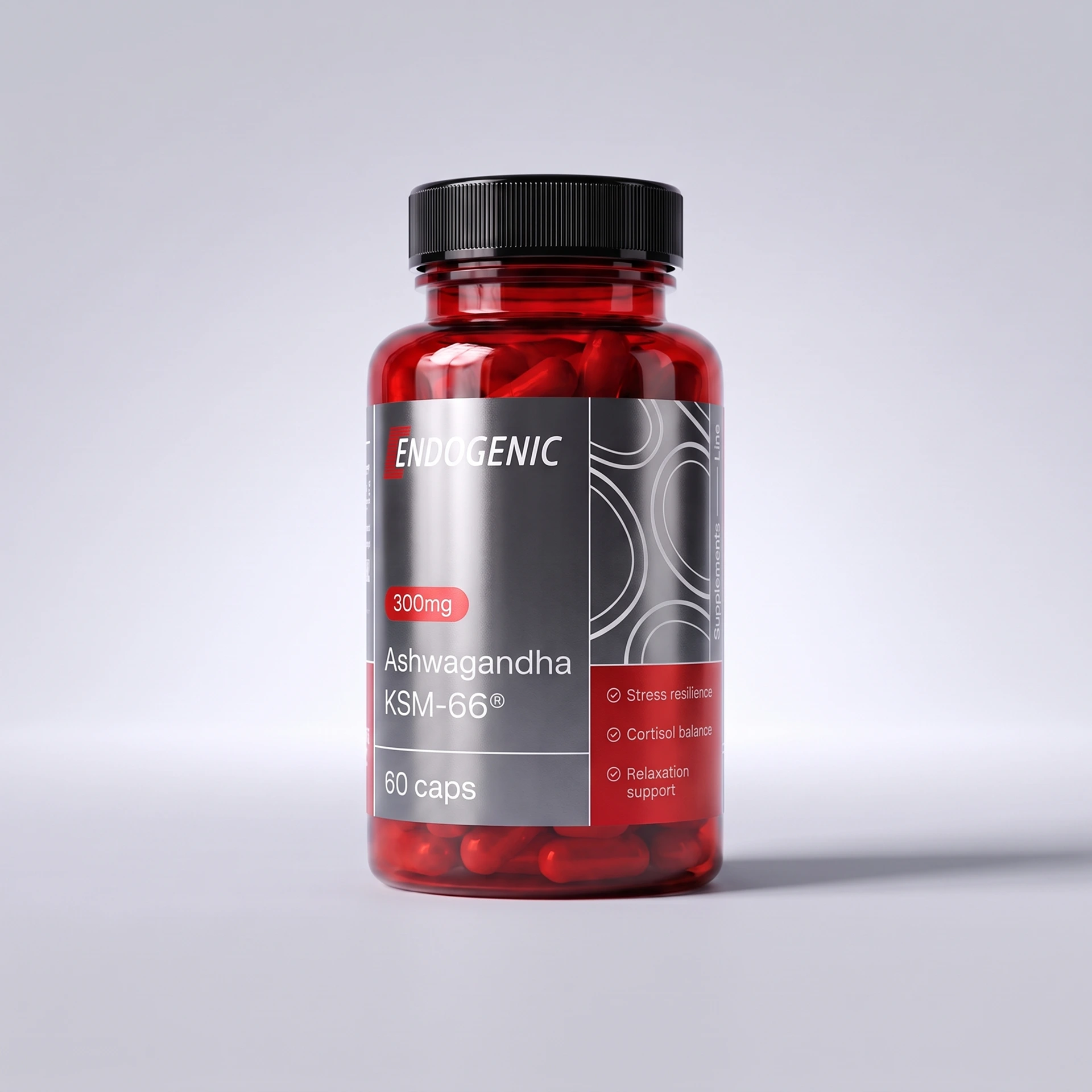
ASHWAGANDHA KSM-66 300mg 60 caps
Ashwagandha KSM-66 300 mg — standardized root extract Withania somnifera. In clinical trials, it reduces cortisol by 15-30% and the PSS stress scale by 30-44%. Supports adaptation to chronic stress, sleep quality, post-workout regeneration and vitality markers in men 35+.
14,99 €
Fast shipping
Delivery options
Free delivery from 350 €
Returns policy
Ashwagandha KSM-66 300 mg - adaptogen for stress, cortisol, and regeneration of the HPA axis
- Ashwagandha KSM-66: Withania somnifera root extract.
- 300 mg per capsule; pack of 60 capsules.
- Standardized to at least 5% withanolides.
Ashwagandha (Withania somnifera) is an adaptogen from Ayurvedic medicine, which has undergone over 30 randomized clinical trials involving humans in the last decade. The best-studied standardized root extract is KSM-66 (Ixoreal Biomed) – in clinical trials it reduces morning cortisol by 15-30% and the stress score by 30-44%. The extract joins the line supplements in capsules Pro-Body as specialized support for the HPA axis for people functioning in a state of chronic stress.
What is Ashwagandha KSM-66?
Ashwagandha is a plant from the nightshade family, used in Ayurvedic medicine for over 3,000 years as a rejuvenating and strengthening agent. The plant’s molecular pharmacy contains over 40 identified withanolides – lactone steroids with activity on GABA-A receptors, modulating the HPA axis and exhibiting cytoprotective effects at the mitochondrial level.
The problem with the ashwagandha market is simple: most extracts on the market are a mixture of root and leaves or pure leaf extract, standardized to a higher concentration of withanolides (8-10%). Sounds better – works differently. The higher concentration of withanolides in the leaf extract comes mainly from withaferin A, a cytotoxic compound in vitro, which does not belong to the adaptogenic profile of the root. The Ayurvedic tradition used only the root, and most human RCTs were conducted with root extract.
KSM-66 is a full-spectrum root extract Withania somnifera, developed by the Indian company Ixoreal Biomed in a 14-year R&D process. It is distinguished by five features:
- Root only – no leaves, no withaferin A as the main ingredient
- Water-based extraction – without alcohol and organic solvents, 14-day low-temperature process
- Standardization of ≥5% withanolides (HPLC) – without artificial “boosting” with withaferin A from leaves; profile consistent with traditional root extract
- Most clinical evidence – over 24 human RCTs (cortisol, stress, sleep, strength, testosterone, cognition)
- GRAS status (FDA) + USDA Organic, Kosher, Halal, FSSC 22000 certifications
HPA axis, cortisol and ashwagandha
The HPA (hypothalamic-pituitary-adrenal) axis is the central stress response system. In short: the hypothalamus releases CRH → the pituitary gland releases ACTH → the adrenal glands release cortisol. Under conditions of acute stress, the entire pathway adapts and returns to baseline within 1–2 hours. In conditions of chronic stress – deadlines, lack of sleep, intense training without deload, coffee at 4 p.m., scrolling
Physiological consequences, well documented in the literature:
- Disturbance of sleep architecture – higher night cortisol suppresses melatonin, shortens REM by 15-20%, fragments deep sleep
- Decrease in free testosterone – cortisol competes with testosterone at the level of biosynthesis in Leydig cells; chronic stress correlates with a decrease in free T by 10–20%
- Visceral tissue accumulation – cortisol promotes lipogenesis in visceral adipocytes by activating the 11β-HSD1 enzyme
- Decrease in cognitive performance – chronic hypercortisolemia damages hippocampal neurons (studies on rodent models + observations in humans with PTSD)
- Prolonged post-training regeneration – slower glycogen resynthesis, worse anabolic response to a strength stimulus
Your problem becomes recursive: stress raises cortisol → cortisol ruins sleep → poor sleep raises stress → cortisol even higher. Without intervention, the HPA axis does not spontaneously return to baseline – it requires either reduction of the stressful stimulus (rarely realistic), or pharmacological modulation of the axis (SSRIs, benzodiazepines – with a serious risk profile), or an adaptogen with proven cortisol modulation in RCTs.
KSM-66 falls into the third category – with the strongest evidence profile among legally available adaptogens
KSM-66 mechanism of action
Modulation of the HPA axis and lowering cortisol
Withanolides from ashwagandha root (withanolide A, withanoside IV and VI, sitoindoside VII and VIII) have glucocorticoid-like downregulatory activity – they signal negative feedback at the level of the hypothalamus and pituitary, reducing the release of CRH and ACTH. The net effect: lower blood cortisol concentrations, without completely suppressing the acute stress response.
In the study by Chandrasekhar (2012), KSM-66 supplementation at a dose of 300 mg twice a day for 60 days reduced cortisol concentration by 27.9% compared to the placebo group (p<0.0001), while reducing the PSS-10 (Perceived Stress Scale) score by 44.0%.
GABAergic activity
Withaferin A and withanolide A show in vitro affinity for GABA-A receptors (the main inhibitory receptors in the CNS), acting as positive allosteric modulators. It is a mechanism qualitatively similar to benzodiazepines – but with much lower affine and without activity on BZ receptors. Practically: subtle silencing of the activity of excitatory neurons, without sedation, without tolerance, without the risk of addiction. It falls into the same category of mechanism Phenibut as a direct analogue of GABA – an alternative with a stronger calming profile, but with the need for strict cycling.
This explains why people who use ashwagandha report better sleep onset and deeper REM sleep, without the typical “benzodiazepine hangover” in the morning. The mechanism was confirmed in the Langade study (2019) – KSM-66 600 mg for 10 weeks shortened the time to fall asleep by 30% and improved the quality of sleep on the PSQI scale.
Serotonergic and dopaminergic modulation
Withanolides modulate the activity of 5-HT1A and 5-HT2A receptors and influence the bioavailability of dopamine in mesolimbic areas. Effects observed in animal models – in practice, in humans, this translates into a lower score on the HAM-A (Hamilton Anxiety Rating Scale) and an improvement in mood in the “drive” and “motivation” dimensions. For people with a dominant serotonin deficit (evening irritability, problems falling asleep due to “overthinking”), it is worth considering parallel supplementation 5-HTP as a precursor of serotonin.
Anti-inflammatory and mitochondrial effects
Chronic stress increases inflammatory markers (TNF-α, IL-6, CRP) and decreases mitochondrial function in hippocampal neurons. Withanolides inhibit the NF-κB pathway (a central mediator of inflammation) and enhance mitochondrial biogenesis by activating PGC-1α. This is a long-term cytoprotective effect – acting in the background, but fundamental for the regeneration of the HPA axis after years of chronic stress.
How to dose Ashwagandha KSM-66?
Dosing protocols are based directly on clinical research – you choose the dose for your goal.
|
Objective |
Dose |
Diagram |
Time |
| Lowering cortisol and PSS (stress, focus) | 300 mg × 2 | Morning + evening with meal | 8 weeks |
| Sleep and calm | 300 mg × 2 or 600 mg in the evening | With the last meal | 8–10 weeks |
| Cognitive functions (memory, focus) | 300 mg × 2 | Morning + afternoon | 8 weeks |
| Strength, regeneration, testosterone | 300 mg × 2 | Morning + evening | 8 weeks |
| Start (tolerance assessment) | 300 mg × 1 | Morning for 7 days | 1 week before escalation |
Principles of ashwagandha supplementation:
- Take with a meal – the extract is lipophilic, bioavailability increases with dietary fat
- Cycle: 8-12 weeks of use, 2-4 weeks off – long-term data (>12 weeks of continuous supplementation) are limited, cycling is a cautious strategy
- First dose in the morning – supports CAR correction (cortisol awakening response)
- Second dose 4-6 hours before bedtime – supports the evening decrease in cortisol
- Full effect after 4-8 weeks – first subjective signals (better falling asleep, less neck tension) usually after 10-14 days
Treat the first week as a tolerance test – a small percentage of people react with daytime sleepiness (a signal of caffeine withdrawal or GABA modulation), headache or mild stomach discomfort. If this happens, stay on 300 mg/day longer or reduce the dose.
Reach for Ashwagandha KSM-66 if your cortisol is getting out of control and you want a protocol based on replicable RCTs, not label promises.
What to combine Ashwagandha KSM-66 with
Ashwagandha works best when it targets a specific axis – and when you add support for related pathways. Some sensible combinations:
Stack for chronic stress + sleep:
- Ashwagandha KSM-66 300 mg × 2 (morning + evening)
- Magnesium bisglycinate chelated 300–400 mg (evening)
- L-theanine 200 mg (evening, optional)
- Glycine 3 g (before bed, optional)
- If the problem is dominated by evening awakenings and sleep fragmentation – add a ready-made formula Endosleep in the deep sleep protocol
Stack for regeneration and lowering post-workout cortisol:
- Ashwagandha KSM-66 300 mg × 2
- Vitamin C 500 mg (post-workout – buffering post-workout cortisol)
- Creatine monohydrate 5 g (daily)
- Zinc bisglycinate 15 mg (evening)
Stack for vitality and hormones (men 35+):
- Ashwagandha KSM-66 600 mg/day
- Vitamin D3 4000 IU + K2 100 µg (breakfast)
- Zinc bisglycinate 15 mg (evening)
- Boron 6 mg (optional – effect on the SHBG fraction)
Stack for focus and memory (mental work):
- Ashwagandha KSM-66 300 mg × 2
- Omega-3 (EPA+DHA) 2–3 g (with meal)
- Caffeine 100–200 mg + L-theanine 200 mg (morning – synergy without crash)
- In difficult periods of mental work, add a nootropic base MINDHUNTER X (Phenylpiracetam + Aniracetam + Alpha-GPC) – a broader overview of the group can be found in the entry about nootropic substances
What to avoid when combining: strong CNS stimulants (DMHA, geranium, high doses of yohimbine) eliminate the effect of lowering cortisol; benzodiazepines and hypnotics – additive GABAergic effect; thyroid medications (levothyroxine) – interaction possible, medical consultation required.
Safety, contraindications, interactions
In clinical trials (total n>1000 participants, doses 250–1200 mg/day, duration 8–16 weeks), KSM-66 shows a favorable safety profile. Reported side effects were mild and of low frequency:
- Mild gastrointestinal discomfort (<5%)
- Daytime sleepiness (<3%, mainly in people on higher doses or combining with other GABA-modulators)
- Headache (<2%)
KSM-66 has GRAS (Generally Recognized as Safe) status according to the FDA.
Absolute contraindications
- Pregnancy and breastfeeding – no long-term data, withanolides may affect sex hormones
- Untreated hyperthyroidism – ashwagandha may increase T3/T4
- Autoimmune thyroid diseases (Hashimoto’s, Graves) – endocrinology consultation is mandatory
- Hypotension – Mild hypotensive effect possible
- Patients on immunosuppressive drugs – ashwagandha, which modulates the immune system
- Elective surgery within 2 weeks – stop at least 14 days before the procedure (sedative effect + interaction with anesthetics)
Drug interactions – caution required
- Benzodiazepines, hypnotics, neuroleptics – additive GABAergic effect
- Thyroid drugs (levothyroxine) – possible enhancement of the effect, requires TSH/T3/T4 monitoring
- Antihypertensive drugs – possible additivity
- Sugar-lowering drugs (metformin, insulin) – ashwagandha may lower glycemia
- SSRI, SNRI, MAOI – theoretical serotonergic interaction, no hard data, caution
In case of chronic drug therapy, consult supplementation with your doctor.
Summary
Ashwagandha KSM-66 300 mg Pro-Body is the choice if your HPA axis has been working above baseline for months or years – chronic stress, deadlines, sleep less than 7 hours, prolonged regeneration after training, subjective decrease in vitality and focus. KSM-66 is the most studied standardized root extract, with over 24 RCTs in humans (15-30% reduction in cortisol, 30-44% reduction in PSS, improvement in sleep, memory, strength and hormones in men). Standardized ≥5% withanolides, full-spectrum root, water-based extraction, GRAS FDA status. 8-week protocol, 300–600 mg/day with meals, cyclical period of 8–12 weeks of use + 2–4 weeks break.
Bibliography
- Chandrasekhar K, Kapoor J, Anishetty S. (2012). A prospective, randomized double-blind, placebo-controlled study of safety and efficacy of a high-concentration full-spectrum extract of ashwagandha root in reducing stress and anxiety in adults.
- Salve J, Pate S, Debnath K, Langade D. (2019). Adaptogenic and Anxiolytic Effects of Ashwagandha Root Extract in Healthy Adults: A Double-blind, Randomized, Placebo-controlled Clinical Study.
- Langade D, Kanchi S, Salve J, Debnath K, Ambegaokar D. (2019). Efficacy and Safety of Ashwagandha (Withania somnifera) Root Extract in Insomnia and Anxiety: A Double-blind, Randomized, Placebo-controlled Study.
- Choudhary D, Bhattacharyya S, Bose S (2017). Efficacy and Safety of Ashwagandha (Withania somnifera (L.) Dunal) Root Extract in Improving Memory and Cognitive Functions.
- Wankhede S, Langade D, Joshi K, Sinha SR, Bhattacharyya S. (2015). Examining the effect of Withania somnifera supplementation on muscle strength and recovery: a randomized controlled trial.
- Lopresti AL, Drummond PD, Smith SJ. (2019). A Randomized, Double-Blind, Placebo-Controlled, Crossover Study Examining the Hormonal and Vitality Effects of Ashwagandha (Withania somnifera) in Aging, Overweight Males.
FAQ
The first subjective signals (better falling asleep, less neck tension, easier “switching off” in the evening) usually appear after 10-14 days. Full effect on cortisol, PSS and sleep – after 4-8 weeks. Adaptation of the HPA axis takes time and it is not a molecule that works overnight. If you expect the effect “from the first dose”, adaptogen supplementation will disappoint you.
Yes, most people do not report interactions. Ashwagandha does not suppress the adrenergic stimulation from caffeine – it acts on a different axis (HPA, GABA). Practical observation: Some people report that KSM-66 reduces the “jittery” effect of caffeine, giving a clearer focus without nervousness. If you notice excessive calmness, separate caffeine from KSM-66 by 2 hours.
In studies on men aged 18–50 (Wankhede 2015, Lopresti 2019), KSM-66 600 mg/day for 8 weeks increased serum testosterone by an average of 14.7%. The mechanism is ambiguous – probably a combination of cortisol reduction (less competition at the level of sex hormone biosynthesis), LH modulation, and reduction of oxidative stress in Leydig cells. The net effect is real, but moderate – it does not replace TRT in men with clinical hypogonadism.
Yes – this is a common and safe combination for sleep. Magnesium bisglycinate (300–400 mg in the evening) acts on NMDA receptors and supports muscle relaxation; melatonin (0.3–1 mg 30 minutes before bedtime) regulates the circadian rhythm; KSM-66 lowers evening cortisol and modulates GABA-A. Three different axes, no antagonism, additive effect on sleep quality.
0.0
0 reviews
This product has no reviews yet.
Related products

GLP1+GIP 15mg
GLP1+GIP 15mg
147,99 €