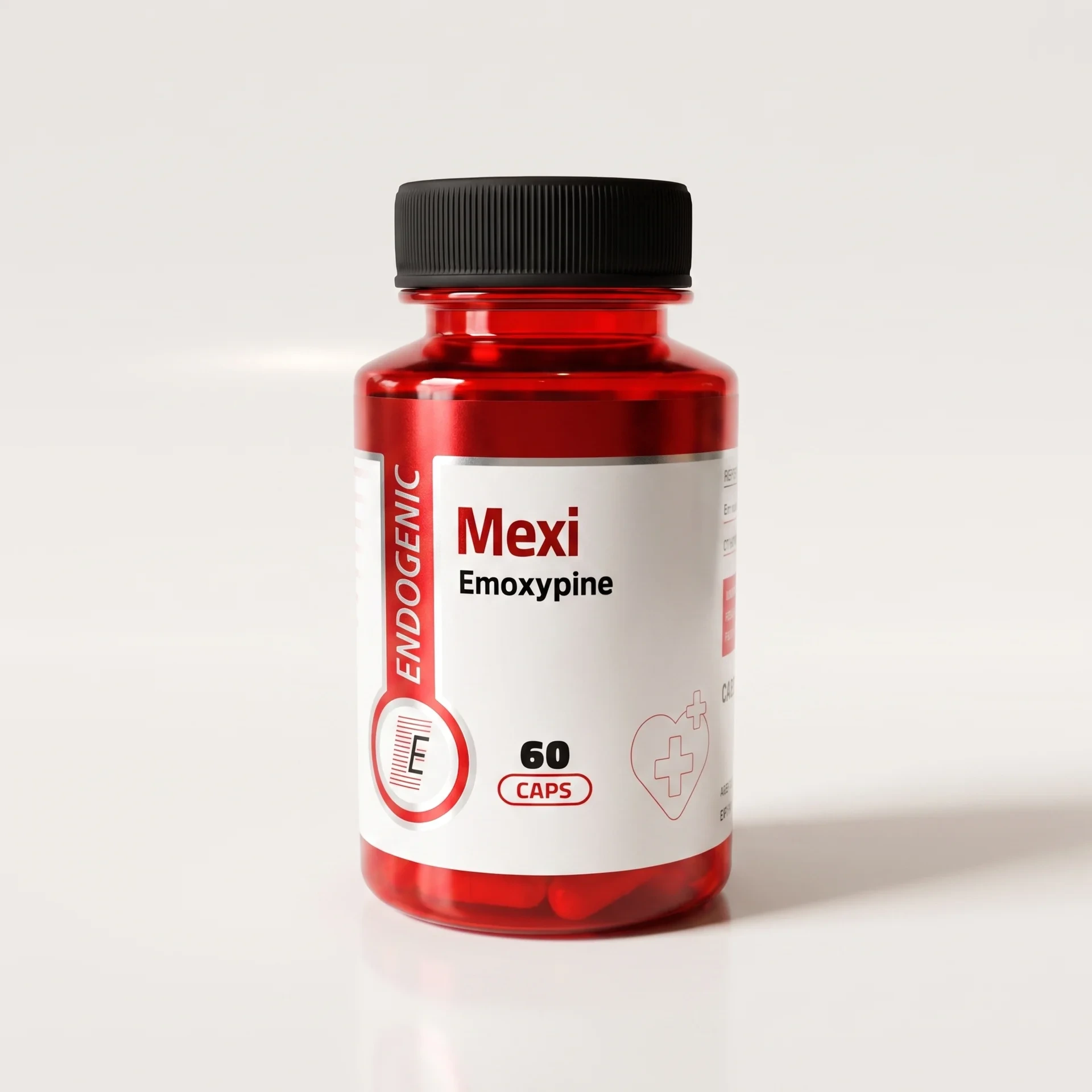
Chemically it is the same active substance — emoxypine succinate. The difference lies in the regulatory status and intended purpose. Mexidol® is a registered prescription drug (Russia, Belarus, Ukraine, Kazakhstan) in injectable and tablet forms, manufactured and controlled according to pharmaceutical requirements for a medicinal product, with clinical indications and medical supervision. MEXI Pro-Body is a Research Use Only reagent — intended exclusively for laboratory research, without registration as a drug in the EU and USA, without use in humans. The RUO reagent is not a substitute for the drug and does not replace medical consultation.
Mexi 125mg 60 caps
MEXI (emoxypine succinate) 125 mg × 60 capsules is a synthetic antioxidant from the 3-hydroxypyridine derivative family developed at the Institute of Pharmacology of the Russian Academy of Sciences. It combines free radical neutralization (a mechanism analogous to vitamin E) with succinate as a substrate of mitochondrial complex II. For research use only, for studies of oxidative stress, lipid peroxidation, and tissue protection in hypoxia.
40,99 €
With code BLACK: 32,79 €
Lowest price in the 30 days before the discount:
40,99 €
Fast shipping
Free delivery from 350 €
Returns policy
MEXI (Emoxypine) 125 mg 60 caps — emoxypine succinate, an antioxidant in research capsules
- MEXI: emoxypine succinate, a 3-hydroxypyridine derivative.
- 125 mg per capsule; pack of 60 capsules.
- Research Use Only reagent, not a medicinal product.
Chemical reagent intended exclusively for laboratory research (Research Use Only). It is not a medicinal product, dietary supplement or food product. It is not intended for use in humans or animals. Sale exclusively to registered research entities and laboratories.
Emoxypine (emoxypine succinate) is a synthetic antioxidant from the family of 3-hydroxypyridine derivatives, developed at the Institute of Pharmacology of the Russian Academy of Sciences as early as the 1980s. The compound occupies an unusual position in pharmacology: in one part of the world it is a registered prescription drug with decades of clinical circulation, in another — a research reagent without any regulatory authorization. This split status is the starting point for anyone who wants to work with emoxypine in the laboratory.
Structurally, the molecule combines two familiar biochemical motifs. The 3-hydroxypyridine fragment is closely related to pyridoxine (vitamin B6) and to the aromatic core of tocopherol (vitamin E) — it is this fragment that is responsible for the free-radical scavenger profile. The second component of the salt is succinic acid, that is, a substrate of the Krebs cycle harnessed into the respiratory chain of the mitochondrion. The combination of “antioxidant + fuel for the mitochondrion” in a single molecule makes emoxypine a model object for research into protecting tissue against oxidative stress and hypoxia.
This reagent is supplied in a format of 60 capsules of 125 mg of emoxypine succinate each — a form adapted to oral bioavailability studies and chronic exposure protocols in in vivo rodent models. A concentration of 125 mg per capsule allows standardization of exposure in long-term research protocols. Purity verified by HPLC ≥98%, identity confirmed by mass spectrometry, COA available for every batch.
Regulatory status (critical)
Mexidol® (emoxypine succinate) is a registered prescription drug in Russia, Belarus, Ukraine and Kazakhstan — in injectable and tablet forms, with indications including acute cerebral ischemia, encephalopathy, vegetative dystonia, anxiety syndromes and neuropathy. The MEXI RUO reagent offered by Pro-Body is not this drug, is not its substitute or equivalent and does not replace medical consultation.
In the EU and USA, emoxypine has no registration as a drug (no EMA and FDA authorization) nor EU authorisation as a food supplement ingredient. Communicating the product as a “memory drug”, a “natural anxiolytic” or an “antioxidant for biohackers” is contrary to the Research Use Only framework.
General description — context of 3-hydroxypyridine derivatives
3-hydroxypyridines are a class of heterocyclic compounds in which the pyridine ring carries a hydroxyl group at position 3. This phenolic group gives the molecule the ability to donate a hydrogen atom to a lipid radical — exactly the same chemical mechanism by which tocopherol (vitamin E) interrupts the chain peroxidation of lipids in cell membranes. For this reason, 3-hydroxypyridine derivatives are sometimes described in the literature as “synthetic analogs of membrane antioxidants”.
Emoxypine (2-ethyl-6-methyl-3-hydroxypyridine) is the most extensively characterized representative of this class in the Russian-language literature. In the form of a salt with succinic acid — emoxypine succinate — the compound gains an additional metabolic component: succinic acid (succinate) is a substrate of succinate dehydrogenase, that is, complex II of the electron transport chain. In hypoxia models, this provides a theoretical basis for sustaining ATP production under conditions of limited oxygen availability.
The pharmacological profile of 3-hydroxypyridine derivatives observed in preclinical models includes:
- Scavenging of reactive oxygen species (ROS) — direct neutralization of radicals through donation of a hydrogen atom from the 3-hydroxyl group; a mechanism analogous to tocopherol
- Inhibition of membrane lipid peroxidation — interruption of the chain reaction in membrane phospholipids
- Stabilization of cell membranes — modulation of lipid bilayer fluidity and the activity of membrane-associated enzymes
- Modulation of GABAergic transmission — some derivatives show affinity for the GABA-A receptor complex in rodent models
- Support of mitochondrial function — in the case of the succinate salt, through supply of a complex II substrate of the respiratory chain
Emoxypine occupies the flagship position in this class — it is around it that the most extensive corpus of preclinical and clinical data has been built (mostly published in Russian-language journals), and its succinate salt became the active ingredient of the commercial drug Mexidol®. The substance belongs to a broader group of low-molecular-weight tools studied as peptides for brain function and related neuroactive compounds used in work on the central nervous system.
SCIENTIFIC PERSPECTIVE
Most of the pharmacological data on emoxypine come from preclinical models (Wistar rat, mouse, neuronal cultures, ischemia-reperfusion models) and from clinical studies published primarily in Russian-language journals. This corpus has not been subjected to the same methodological validation (protocol registration, replication by independent centers, review by EMA/FDA agencies) as is applied to Western drugs. Many of the cited items require verification against the source database. Extrapolation of PK/PD profiles to research conditions outside the original context requires caution.
What is emoxypine (MEXI)?
Chemically, MEXI is the succinate salt of emoxypine.
- Common name: Emoxypine, Mexidol, meksydol, emoksypina, Emoxypine succinate, Mexifin, Mexi
- Chemical name: 2-ethyl-6-methyl-3-hydroxypyridine succinate
- Synonyms: emoxypine succinate, methylethylpyridinol succinate
- CAS number: 127464-43-1 (emoxypine succinate); for the emoxypine base itself 2364-75-2 — value to be verified in the batch COA
- Molecular formula: C₈H₁₁NO (emoxypine base, mass 137.18 g/mol) combined with succinic acid C₄H₆O₄ (succinate salt)
- Molar mass: ~255 g/mol (succinate salt); 137.18 g/mol (base itself)
- Chemical class: synthetic antioxidant; 3-hydroxypyridine derivative; structural analog of pyridoxine (vitamin B6) and the aromatic fragment of tocopherol (vitamin E)
- Supplied form: hard HPMC capsule (vegan), 125 mg of substance per capsule, 60 capsules; pharmaceutical grade ≥98% HPLC
Origin:
Emoxypine was developed at the Institute of Pharmacology of the Russian Academy of Sciences in the 1980s as a synthetic antioxidant modeled on the 3-hydroxypyridine structure. The succinate salt entered clinical circulation as the drug Mexidol® (injections and tablets) and remains so to this day in Russia, Belarus, Ukraine and Kazakhstan with neurological and psychiatric indications. Outside that regulatory area, the compound functions exclusively as a research reagent — without registration as a drug and without authorization as a dietary supplement ingredient in the EU, USA or other Western jurisdictions.
Mechanism of action at the molecular level
Emoxypine acts through several parallel antioxidant and membrane mechanisms. The compound does not have a single identified primary receptor — the observed effects are the resultant of chemical radical scavenging, interactions with the lipid bilayer and, in the case of the succinate salt, supply of a mitochondrial substrate.
Pharmacological profile observed in research models:
- Free-radical scavenger (ROS scavenger) — the 3-hydroxypyridine fragment donates a hydrogen atom to lipid and oxygen radicals, interrupting the chain peroxidation of membrane lipids. The mechanism is analogous to the action of tocopherol (vitamin E) — in in vitro models emoxypine reduces markers of oxidative damage (e.g. malondialdehyde, MDA) in membranes subjected to stress
- Stabilization of cell membranes — modulation of lipid bilayer fluidity and protection against lipid peroxidation translates in models into maintenance of the activity of membrane-associated enzymes. The literature has described effects on the activity of acetylcholinesterase and Na⁺/K⁺-ATPase — enzymes whose function depends on the integrity of the lipid environment
- Modulation of the GABA-A receptor complex and the benzodiazepine site — in rodent models an anxiolytic component has been described, linked to interaction with the GABA-A complex; the molecular mechanism has not been fully characterized at the level of receptor affinity
- Support of mitochondrial function — succinic acid, a component of the salt, is a substrate of succinate dehydrogenase (complex II of the electron transport chain). In hypoxia models this provides a theoretical basis for sustaining ATP production under conditions of limited oxygen availability — in research practice better maintenance of mitochondrial membrane potential was observed in cultures subjected to hypoxia
- Anti-inflammatory and anti-ischemic action — in ischemia-reperfusion models (ischemia with subsequent restoration of flow) emoxypine reduced the severity of oxidative stress accompanying reperfusion; the mechanism is linked to limiting the wave of free radicals generated upon re-delivery of oxygen
The mitochondrial component — support of complex II by succinate — brings the research profile of emoxypine closer to other low-molecular-weight antioxidant tools acting at the level of the respiratory chain, such as methylene blue, used in models as an alternative electron carrier. Both compounds belong to the same broad category of low-molecular-weight antioxidant reagents studied in connection with the protection of tissue under conditions of oxidative stress.
Pharmacokinetic profile (based on preclinical data and source literature):
- Oral bioavailability: the succinate salt is well soluble in water and well absorbed in rodent models; the precise profile in humans outside the drug’s registration context is not unambiguously characterized
- Plasma T½: short (of the order of single hours in models); the compound is rapidly metabolized and excreted
- Blood-brain barrier penetration: described as sufficient for central effects (the context of Mexidol’s neurological indications)
- Metabolism: hepatic with glucuronidation and conjugation; elimination mainly renal (partly in unchanged form)
Emoxypine in the class of 3-hydroxypyridine derivatives — pharmacological position:
In the family of synthetic antioxidants, emoxypine stands out in that it combines two distinct modes of action in a single salt:
- Tocopherol (vitamin E) — a natural membrane antioxidant, scavenges radicals, but does not contribute a mitochondrial component
- Pyridoxine (vitamin B6) — a structurally related 3-hydroxypyridine with the role of an enzymatic cofactor, without a radical-scavenger profile in the pharmacological sense
- Succinic acid (succinate) itself — a complex II substrate, metabolic support, but without its own antioxidant profile
- Emoxypine succinate — combines the phenolic 3-hydroxypyridine fragment (radical scavenging, membrane stabilization) with succinate (mitochondrial substrate) in a single molecule; this combination makes it a model compound for research into tissue protection under conditions of oxidative stress and hypoxia
Applications in scientific research
Emoxypine is used in research work in several areas related to oxidative stress and tissue protection. In in vivo models (Wistar rat, mouse, models of focal and global cerebral ischemia, ischemia-reperfusion models) its effect on markers of lipid peroxidation, behavioral parameters and the size of ischemic damage is studied. In in vitro models (neuronal cultures, isolated mitochondria, erythrocyte membranes) studies are conducted on the kinetics of radical scavenging, membrane integrity and respiratory chain function.
Specific research directions include:
- Ischemia and reperfusion models — focal and global cerebral ischemia (rat), infarct models, assessment of limiting the wave of free radicals upon reperfusion
- Oxidative stress and lipid peroxidation — comparative studies of emoxypine versus tocopherol on the inhibition of peroxidation in cell and mitochondrial membranes
- Mitochondrial function in hypoxia — the role of the succinate component as a complex II substrate in maintaining mitochondrial membrane potential
- GABAergic modulation and anxiolytic profile — anxiety models in rodents (open field test, elevated plus maze), studies on interaction with the GABA-A complex
- Stability and activity of membrane enzymes — the effect of lipid-peroxidation protection on the activity of Na⁺/K⁺-ATPase and acetylcholinesterase
Within neuro-research peptide tools, a related area of interest is occupied by compounds with a neuroprotective and pro-nootropic profile — an example is Semax 50mg, a peptide reagent studied in models of cognitive function and neuron protection; the broader classification and mechanisms of this group of compounds are discussed in the review of nootropic substances.
REGULATORY STATUS
Emoxypine (Mexidol®) is not named on the 2026 WADA Prohibited List. Class S0 (non-approved substances) does not cover it, because Mexidol® is registered as a medicine in Russia (state register GRLS). The compound is not registered as a drug in the EU or USA — registration as a prescription drug applies in Russia, Belarus, Ukraine and Kazakhstan. It is not authorised in the EU as an ingredient of food supplements. The MEXI RUO Pro-Body reagent is intended exclusively for laboratory research — communicating it as a drug or supplement is contrary to the Research Use Only framework. Registered athletes (ADAMS) should verify the current list before any decision.
Summary
MEXI (emoxypine succinate, Mexidol®) is a synthetic antioxidant from the family of 3-hydroxypyridine derivatives, developed at the Institute of Pharmacology of the Russian Academy of Sciences in the 1980s. The molecule combines the phenolic 3-hydroxypyridine fragment (free-radical scavenging, inhibition of lipid peroxidation, membrane stabilization — a mechanism analogous to tocopherol) with succinic acid as a substrate of complex II of the respiratory chain (support of mitochondrial function in hypoxia).
In research models, anti-ischemic (ischemia-reperfusion), antioxidant action and an anxiolytic component via the GABA-A complex have been described. Form of 60 capsules of 125 mg each, HPLC purity ≥98%, COA for every batch. Regulatory status — in the EU and USA exclusively Research Use Only; in Russia, Belarus, Ukraine and Kazakhstan a registered prescription drug (Mexidol®), which the RUO reagent does not replace. WADA status: not named on the 2026 List, outside class S0 because of the medicinal registration in Russia.
Bibliography
- Voronina TA (2012). Mexidol: the spectrum of pharmacological effects. PubMed
- Shchulkin AV (2018). A modern concept of antihypoxic and antioxidant effects of mexidol. PubMed
- Niki E (2009). Lipid peroxidation: physiological levels and dual biological effects. PubMed
- Traber MG, Atkinson J (2007). Vitamin E, antioxidant and nothing more. PubMed
- Tretter L, Patocs A, Chinopoulos C (2016). Succinate, an intermediate in metabolism, signal transduction, ROS, hypoxia, and tumorigenesis. PubMed
FAQ
It is about the chemical mechanism, not structural identity. The 3-hydroxypyridine fragment in emoxypine has a phenolic group that donates a hydrogen atom to lipid radicals and interrupts the chain peroxidation of lipids in membranes — exactly the same way the phenolic fragment of tocopherol (vitamin E) acts. Additionally, the whole molecule comes from the same class of 3-hydroxypyridines as pyridoxine (vitamin B6). In in vitro models, emoxypine is often compared directly with tocopherol in terms of the potency of peroxidation inhibition.
Succinate is a substrate of succinate dehydrogenase, that is, complex II of the electron transport chain in the mitochondrion. Under conditions of hypoxia (hypoxia, ischemia), supplying a complex II substrate provides a theoretical basis for sustaining ATP production when other pathways are limited. In research practice this means that the succinate salt combines two modes of tissue protection: chemical radical scavenging (the 3-hydroxypyridine fragment) and metabolic support of the mitochondrion (succinate).
The emoxypine base (CAS 2364-75-2, mass 137.18 g/mol) is the 3-hydroxypyridine molecule itself. Emoxypine succinate (CAS 127464-43-1, mass ~255 g/mol) is that base bound to succinic acid — and it is this form that is the active ingredient of Mexidol and what MEXI 125 mg supplies. The decisive analytical signal is mass spectrometry: MS shows whether the succinate ion is present in the batch alongside the pyridine fragment.
When purchasing a reagent, it is worth verifying in the COA that the succinate salt is declared, and not the base itself — they differ in molar mass, and therefore in the content of the active fragment per milligram.
Not by name. The 2026 WADA Prohibited List does not name emoxypine, and class S0 (non-approved substances) does not cover it, because Mexidol® is registered as a medicine in Russia. The compound is a synthetic antioxidant without a hormonal or stimulant profile that would qualify it for the prohibited classes. Registered athletes (ADAMS) should nonetheless verify the current list before any decision — the compound’s status may change in future updates.
The scientific corpus of emoxypine was created predominantly in Russian-language journals and in the context of the registration of the drug Mexidol® in jurisdictions of the former USSR. This corpus has not undergone the methodological validation required by EMA and FDA (protocol registration, independent replication, agency review), and indexing in Western databases (PubMed, Crossref) is sometimes incomplete — some works have ambiguous PMID/DOI identifiers. In accordance with Pro-Body policy, if the source identifier is not certain, we mark it as “source to be verified” instead of providing a potentially erroneous PMID/DOI.
0.0
0 reviews
This product has no reviews yet.
Related products
Selank 10mg
Selank 10mg
30,99 €
P21 5mg
P21 5mg
42,99 €