Skip to content

Free delivery on orders over €400. Fast delivery.

Search

What are you looking for?

Type at least 2 characters to see suggestions.

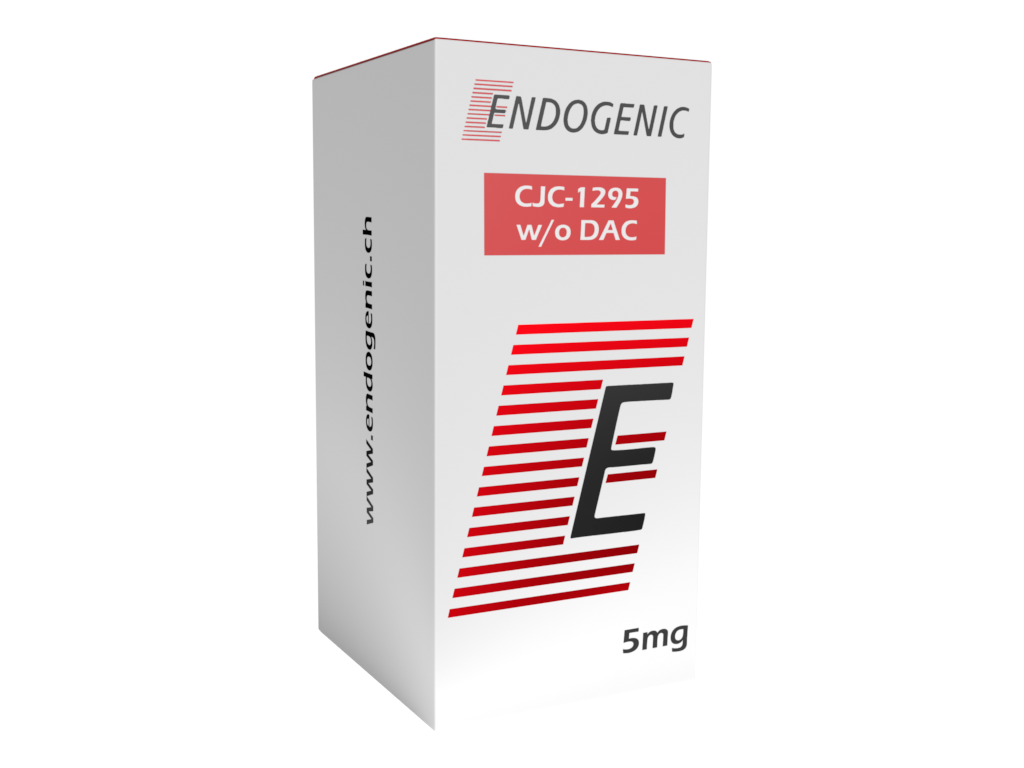
CJC-1295 w/o DAC 5mg

CJC-1295 w/o DAC 5mg

CJC-1295 without DAC (Mod-GRF 1-29) 5 mg lyophilisate from the Endogenic line – a modified GHRH(1-29) analogue without Drug Affinity Complex. Tetrasubstitution (Asp³, Ala⁸, Arg²⁹, Leu²⁷) protects the core against DPP-4, and the lack of DAC results in a short half-life (~30 min) mimicking the physiological, short pulse of GHRH – unlike the multi-day exposure of the DAC variant. GHRH receptor agonist increasing the amplitude of the GH pulse; a model tool for research on the GH/IGF-1 axis and GHRH + GHRP synergy. Research Use Only

22,99 €
Buy more, pay less
Fast shipping
Delivery options
Returns policy

CJC-1295 without DAC 5 mg - modified GHRH analogue without DAC, research reagent

  • CJC-1295 without DAC (Mod-GRF 1-29): modified GHRH analogue.
  • 5 mg lyophilisate in a vial; without Drug Affinity Complex.
  • Research Use Only reagent, not a medicinal product.

Product status information

Chemical reagent intended exclusively for laboratory tests (Research Use Only). It is not a medicinal product, dietary supplement or food. It is not intended for use on humans or animals. Sales only to registered research units and laboratories.

Regulatory frame – GHRH analogue without DAC

CJC-1295 without DAC (Mod-GRF 1-29) 5 mg is a research reagent from the Endogenic line in the form of a lyophilized product in a vial, containing a modified growth hormone-releasing hormone (GHRH) analogue without Drug Affinity Complex. The molecule belongs to the class of growth hormone secretagogues, which WADA lists in section S2 of the prohibited list (peptide hormones, growth factors, related substances and mimetics) – permanently prohibited substances, both in and outside competitions.

The reagent is not registered as a medicinal product in any jurisdiction. Communication suggesting human use to increase growth hormone, IGF-1 levels, accelerate recovery or body composition is contrary to the Research Use Only framework and is unacceptable.

Introduction

The Endogenic line in the Pro-Body catalog groups reagents whose common denominator is work with the body’s own endocrine pathways – molecular tools tested for stimulating endogenous hormone secretion, not exogenously replacing them. CJC-1295 without DAC, also known in the literature as Mod-GRF 1-29 (Modified GRF 1-29, modified GHRH(1-29)), is a model example of this philosophy: it is an analogue of growth hormone releasing hormone that stimulates the pituitary gland to release its own GH, while maintaining the physiological, pulsatile nature of the signal.

The heart of this molecule is the GHRH(1-29) fragment – the shortest, biologically active section of the human growth hormone releasing hormone.

Natural GHRH(1-29) has a serious research problem: it is rapidly degraded in plasma by the enzyme dipeptidyl peptidase-4 (DPP-4), which cleaves off the two N-terminal amino acids and inactivates the peptide within minutes. The CJC-1295 without DAC solves this issue by four amino acid substitutions (tetrasubstitution), which protect the core against proteolysis – without adding an albumin-binding complex.

The result is a GHRH analogue that is more stable than the native peptide, but still has a short half-life approximately 30 minutes, imitating a physiological, short GHRH pulse. This reagent is supplied as 5 mg lyophilisate in a vial, for reconstitution with bacteriostatic water in laboratory conditions.

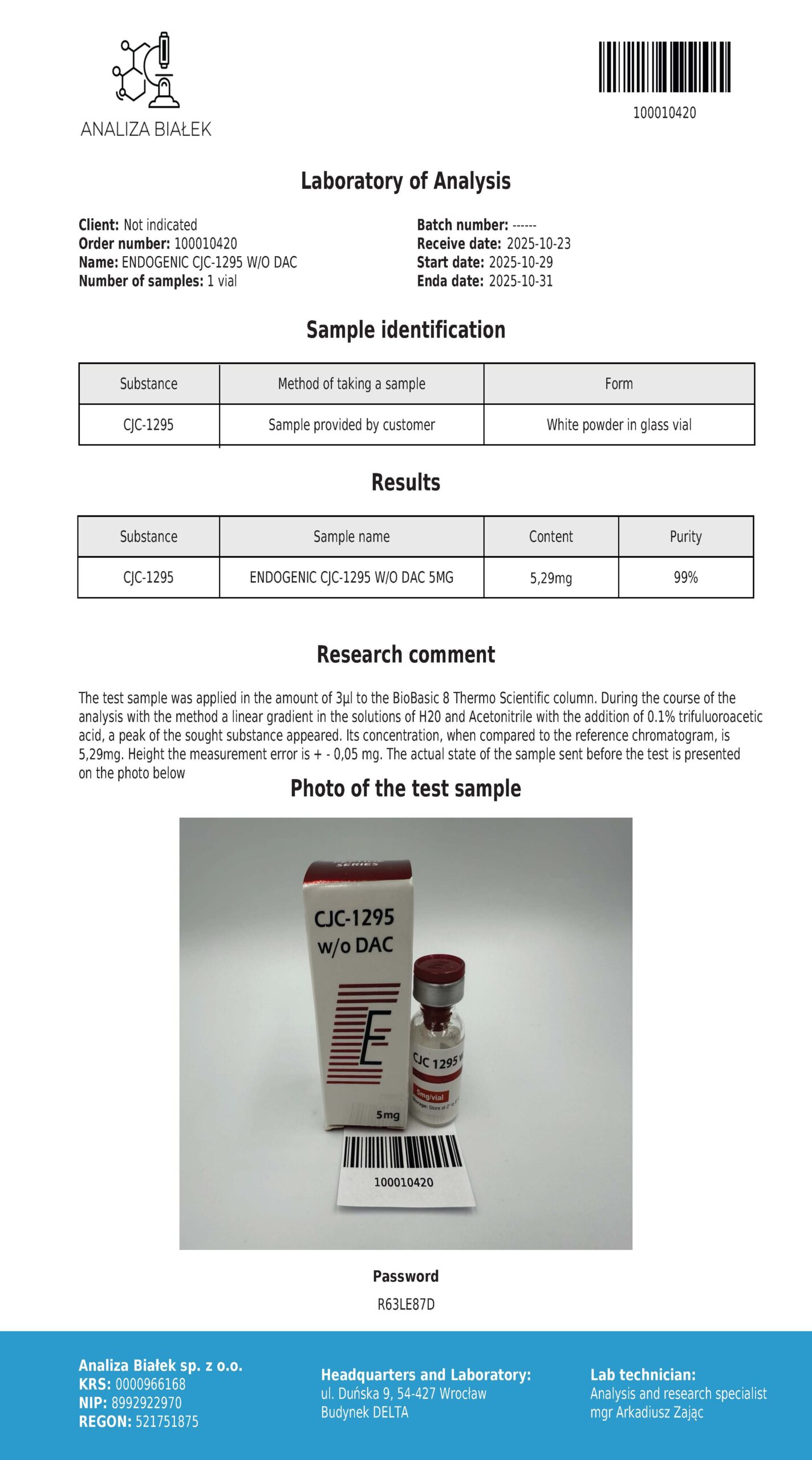
The freeze-dried form ensures stability of the peptide before dissolution and allows researchers to prepare working concentrations tailored to the experimental design. Purity verified by HPLC ≥98%, identity confirmed by Q-TOF mass spectrometry, COA available for each batch. Extended variant – CJC-1295 with DAC with a long half-life – remains available in parallel as a reference point for comparative studies on the effect of the albumin complex on pharmacokinetics.

Regulatory status

CJC-1295 without DAC (Mod-GRF 1-29) has never been registered as a medicinal product in the EU, USA or anywhere in the world. No EMA/FDA authorization as a medicine and no EFSA authorization as a dietary supplement ingredient. The molecule belongs to the class of growth hormone secretagogues listed in Section S2 of the WADA Prohibited List. Communication of the product as a “natural growth hormone booster”, “peptide for regeneration and sleep” or “body composition agent” is contrary to the Research Use Only framework.

GHRH/GHRP axis and pulsatile GH secretion

To understand what a GHRH analogue is without DAC, you first need to see how the pituitary gland secretes growth hormone. GH secretion is not a flat, steady stream – the pituitary gland releases the hormone impulses, in pulses of a specific amplitude and frequency, regulated by a pair of opposing signals from the hypothalamus.

On the one hand GHRH (growth hormone releasing hormone) tells the pituitary gland to “secret” on the other somatostatin says “hold”. Superimposed on this system is a third player – ghrelin and its receptor (GHS-R1a) – which acts as a separate, complementary switch for GH release.

The somatotropic cell of the anterior pituitary has at least two separate receptors on its surface that stimulate the release of growth hormone: GHRH receptor and growth hormone secretion receptor type 1a (GHS-R1a), i.e. ghrelin receptor. These are two different proteins, two different intracellular cascades and two different physiological signals – which converge on the same end result, the release of GH from secretory granules.

GHRH receptor is a receptor coupled to the Gs protein. Its stimulation increases intracellular cAMP, activates the PKA kinase-dependent pathway and leads to the release of growth hormone. Physiologically, GHRH is primarily responsible for amplitude GH pulse – for how high a single hormone release is.

This is exactly the receptor on which CJC-1295 without DAC is based. The pulsatile nature of GH secretion is the main physiological detail here. Unlike exogenous, recombinant growth hormone, which floods the circulation with a flat, nonphysiological concentration, secretagogues stimulate own pituitary to release GH in a way that preserves the pulsatile signal architecture – involving the somatostatin feedback loop.

This “endogenous, pulsatile” release pattern is the subject of research on the physiology of the GH/IGF-1 axis, the regulation of slow-wave sleep (in which the strongest nocturnal GH pulse occurs), and the differences between secretagogue stimulation and the administration of recombinant GH.

The pharmacology of growth hormone secretagogues includes two large classes of tools that they represent in the research catalog growth hormone-increasing peptides: :

  • GHRH analogues — mimic the endogenous GH-releasing hormone, stimulate the GHRH receptor, increase the pulse amplitude (CJC-1295, sermorelin, tesamorelin)
  • GH-releasing peptides (GHRP) and ghrelin mimetics — stimulate the GHS-R1a ghrelin receptor, increase the pulse rate and suppress somatostatin (Ipamorelin, GHRP-2, GHRP-6, hexarelin)

The CJC-1295 without DAC represents the first of these classes in its “short-acting” variant. This makes it a model research tool the GHRH arm itself — the impact of a single, short pulse of GHRH receptor stimulation on the release of growth hormone, isolated from the prolonged exposure introduced by the DAC variant.

What is Mod-GRF 1-29 (CJC-1295 without DAC)?

Chemically, CJC-1295 without DAC is a modified, 29-amino acid fragment of human GHRH with four stabilizing substitutions.

  • Common name: CJC-1295 without DAC, Mod-GRF 1-29, Modified GRF 1-29
  • Descriptive name: modified GHRH(1-29) analogue without Drug Affinity Complex
  • Synonyms: CJC-1295 without DAC, modified GRF 1-29, modified GHRH(1-29), tetrasubstituted GRF 1-29
  • CAS number: 863288-34-0 (peptide core; no DAC group) (to be verified in the batch COA)
  • Molar mass: ~3367 g/mol (to be verified in the batch COA)
  • Chemical class: modified GHRH analogue(1-29) without albumin affinity complex; short half-life (~30 min)
  • Structural modifications: four amino acid substitutions (Asp³, Ala⁸, Arg²⁹, Leu²⁷ – tetrasubstitution) protecting against DPP-4 degradation and increasing stability against plasma proteolysis
  • Delivered form: 5 mg lyophilisate in a vial, for reconstitution with bacteriostatic water; pharmaceutical grade ≥98% HPLC

Origin of the molecule: The core of CJC-1295 without DAC is the GHRH(1-29) fragment, known in the literature as GRF(1-29) or sermorelin in its native form – the shortest segment of human GHRH that retains full agonist activity towards the GHRH receptor. However, native GRF(1-29) is unstable: the DPP-4 enzyme cleaves off the two N-terminal amino acids, and the bonds within the sequence are hydrolyzed and oxidized, reducing the half-life to several minutes.

Four substitutions (tetrasubstitution Asp³, Ala⁸, Arg²⁹, Leu²⁷) were introduced precisely to block these degradation pathways – this is the stabilized “Mod-GRF 1-29”. The core itself is tetrasubstituted, without the DAC complex added later, is the CJC-1295 without DAC molecule. In the ConjuChem research program the same core, With attached DAC complex, produced a long-acting variant (Jetté et al. 2005; Teichman et al. 2006).

Parameter Value
Common name CJC-1295 without DAC / Mod-GRF 1-29
Pharmacological class Modified GHRH analogue; GHRH receptor agonist
Origin of the molecule Tetrasubstituted fragment GHRH(1-29); without albumin affinity complex
CAS number 863288-34-0 (peptide core) (to be verified in the batch COA)
Molar mass ~3367 g/mol (to be verified in the batch COA)
Structural modifications Tetrasubstitution (Asp³, Ala⁸, Arg²⁹, Leu²⁷) – protection against DPP-4; lack of albumin linker
Mechanism GHRH receptor agonist → increase in GH pulse amplitude
Pharmacokinetic profile Short half-life (~30 min) – mimics the physiological, short pulse of GHRH
Nominal concentration per vial 5 mg of lyophilisate
HPLC purity ≥98%
Identity confirmation Q-TOF mass spectrometry

SCIENTIFIC PERSPECTIVE

Data for CJC-1295 and its variants come primarily from early pharmacology studies of the GHRH(1-29) core (Jetté et al. 2005) and the ConjuChem Phase I clinical trial of the variant with DAC (Teichman et al. 2006; Ionescu, Frohman 2006). Variant profile without DAC (Mod-GRF 1-29) is described primarily in terms of the short half-life and pharmacology of native GHRH(1-29).

The CJC-1295 without DAC 5 mg (RUO) reagent was not the subject of these studies as a therapeutic form – the described mechanisms and endpoints are of a reference nature, they describe the profile of the molecule in the literature, and not the expected result of work with the RUO reagent. Extrapolation of PK/PD profiles to any human application requires caution and is inconsistent with the Research Use Only framework.

Mechanism of action at the molecular level

The CJC-1295 without DAC works through a single, well-defined mechanism: GHRH receptor agonism on somatotroph cells of the pituitary gland. What distinguishes this reagent from the DAC variant is not the receptor mechanism itself, but the… pharmacokinetics — including how long the molecule stays in circulation and how long it stimulates the receptor.

GHRH receptor agonism – pulse amplitude. Activation of the GHRH receptor (coupled to Gs protein) increases intracellular cAMP and triggers the PKA kinase-dependent pathway. The effect is increasing pulse amplitude — a single release of growth hormone becomes higher. In a working analogy: The CJC-1295 adjusts the “volume” of a single GH signal.

The receptor mechanism is identical for both variants of the molecule; the difference is in how long this signal lasts.

No DAC – short half-life, physiological pulse. This is the essence of the variant without DAC. In the DAC variant, a maleimide linker is attached to the core, binding to serum albumin, which acts as a reservoir for the molecule and extends the half-life to many days. Variant without DAC it does not have this reservoir – the half-life is about 30 minutes. The consequence is fundamental: instead of prolonged, multi-day exposure of the GHRH receptor, the molecule generates short, sharp pulse arousal that mimics the physiological release of endogenous GHRH.

This makes Mod-GRF 1-29 a tool for examining GH release in conditions similar to natural pulsatile rhythm.

Tetrasubstitution – protection against DPP-4. Four amino acid substitutions (Asp³, Ala⁸, Arg²⁹, Leu²⁷) were introduced at positions critical for the degradation of native GHRH(1-29). Substitution at position 8 (Ala) blocks cleavage by dipeptidyl peptidase-4, the main pathway for inactivating the native peptide. The remaining substitutions limit the oxidation and isomerization of sensitive residues. The result is a peptide that is significantly more stable than native GHRH(1-29) (whose half-life is several minutes), although it is still short-acting compared to the DAC variant.

Synergy with GHRP – amplitude plus frequency. In research protocols on the somatotropic axis, the GHRH analogue is often combined with a GHRP class peptide, such as Ipamorelin or GHRP-2. The rationale is mechanistic: GHRH provides a strong Gs/cAMP increasing signal amplitude pulse, while GHRP stimulates the ghrelin receptor (Gq cascade/phospholipase C), affects frequency and pulsatility and suppresses somatostatin — inhibitory hormone.

Because both peptides act through different receptors and different cascades, and the ghrelin arm additionally abolishes somatostatin inhibition, simultaneous stimulation of both pathways produces an effect in the models. greater than the sum of each individual’s actions.

The short half-life of Mod-GRF 1-29 allows it to deliver a sharp, time-aligned amplitude pulse in such study pairs.

Pulse profile preferred in research protocols. The short half-life of the non-DAC variant is sometimes treated in the literature as a methodological advantage where the goal is to imitate physiological, short pulse GHRH – as opposed to prolonged, continuous exposure of the DAC variant. A pulsatile stimulation pattern adapted to the natural rhythm is the subject of research on the architecture of GH secretion and its differences from constant, non-physiological stimulation.

IMPORTANT DISTINCTION

CJC-1295 without DAC vs. CJC-1295 with DAC are two structural variants of the same core molecule (tetrasubstituted GHRH(1-29)), which must not be confused — they differ in pharmacokinetics, not in the receptor mechanism.

  • Without DAC (Mod-GRF 1-29): short half-life order minutes (~30 min); generates short, physiological pulse stimulation of the GHRH receptor, similar to the natural GHRH release.
  • With DAC: the attached albumin affinity complex (maleimide linker) extends the half-life to an order of magnitude days; generates prolonged, multi-day exposure GHRH receptor and maintained GH/IGF-1 stimulation (Teichman et al. 2006).

The presence or absence of a DAC group is decisive COA of the party — this is a specification that the researcher must verify before planning the experiment, because the time profile of GH stimulation of both variants is fundamentally different. “Pulsatile, short” (without DAC) and “prolonged, continuous” (with DAC) are two different pharmacokinetic models. Any references to GH release in this description refer to mechanisms reported in the literature on GHRH molecules – they do not imply a guarantee of effect for anyone working with the RUO reagent.

Applications in scientific research

CJC-1295 without DAC as a single-component RUO reagent is used where the subject of the study is GHRH arm somatotropic axis in its short-acting variant. In vivo models (rat, mouse, pig as a model species for GH physiology) and in vitro models (isolated somatotropic pituitary cells, cell lines expressing the GHRH receptor) are used to investigate the mechanism, kinetics and pulsatility of growth hormone release. The GH/IGF-1 axis is also the background for a broader group of reagents studied as peptides for muscle mass in an anabolic context. Specific research directions include:

  • Pharmacology of the GHRH receptor — concentration-response curves for GHRH receptor stimulation; measurements of GH release from isolated pituitary cells in response to a short-acting GHRH analogue; characterization of the Gs/cAMP/PKA cascade
  • Pulsatility and architecture of GH secretion — studies of how a short GHRH pulse (Mod-GRF 1-29) modifies the GH pulse amplitude in animal models; comparison of the pulsatile release pattern with prolonged stimulation of the DAC variant and with the administration of recombinant GH
  • Structure-operation time relationship — comparison of the time profile of GH stimulation of the variant without DAC (short exposure, ~30 min) and with DAC (prolonged, albumin retention) in in vivo models; studies of the effect of the DAC complex on pharmacokinetics
  • GHRH + GHRP synergy — measurements of GH release upon stimulation of GHRH separately (Mod-GRF 1-29), GHRP separately and both simultaneously; quantitative characterization of the additive vs. synergistic effect for the pair of GHRH analogue plus ghrelin mimetic
  • Stability towards DPP-4 — comparative studies of the stability of tetrasubstituted Mod-GRF 1-29 against native GHRH(1-29) in plasma; characterization of peptide degradation pathways and the role of amino acid substitutions
  • GH/IGF-1 axis and secondary markers — IGF-1 measurements as a secondary marker of GH stimulation in animal models; studies on hepatic IGF-1 production in response to a pulsed vs. continuous GH signal

Summary

CJC-1295 without DAC (Mod-GRF 1-29) 5 mg to single-component RUO research reagent from the Endogenic line – lyophilisate in a vial containing a modified GHRH analogue without Drug Affinity Complex. The molecule is a tetrasubstituted fragment of GHRH(1-29) (Asp³, Ala⁸, Arg²⁹, Leu²⁷) – four substitutions protect the core from DPP-4 degradation, but without addition of the albumin complex. The result is a GHRH analogue that is more stable than the native peptide, but still short-acting (half-life ~30 min), imitating the physiological, short GHRH pulse. Mechanism: GHRH receptor agonism (Gs/cAMP cascade) increasing amplitude growth hormone pulse.

The most important distinction: variant without DAC generates a short, pulsed signal (minutes), a variant with DAC — prolonged, multi-day exposure (days); the party’s COA decides on the variant. In research protocols, Mod-GRF 1-29 is often combined with the GHRP peptide (Ipamorelin, GHRP-2) for amplitude + frequency synergy. Lyophilized form 5 mg in a vial, reconstitution with bacteriostatic water, HPLC purity ≥98%, MS Q-TOF, COA for each batch with confirmation of the absence of DAC. Regulatory Status – Research Use Only; lack of registration as a medicine; WADA: Section S2, Permanent Prohibited Substance.

Bibliography

  1. Teichman SL, Neale A, Lawrence B, Gagnon C, Castaigne JP, Frohman LA (2006). Prolonged stimulation of growth hormone (GH) and insulin-like growth factor I secretion by CJC-1295, a long-acting analogue of GH-releasing hormone, in healthy adults. PubMed
  2. Ionescu M, Frohman LA (2006). Pulsatile secretion of growth hormone (GH) persists during continuous stimulation by CJC-1295, a long-acting GH-releasing hormone analog. PubMed
  3. Jetté L, Léger R, Thibaudeau K, Benquet C, Robitaille M, Pellerin I, et al. (2005). Human growth hormone-releasing factor (hGRF)1-29-albumin bioconjugates activate the GRF receptor on the anterior pituitary in rats: identification of CJC-1295 as a long-lasting GRF analogue. PubMed
  4. Frohman LA, Downs TR, Heimer EP, Felix AM (1989). Dipeptidylpeptidase IV and trypsin-like enzymatic degradation of human growth hormone-releasing hormone in plasma. PubMed
  5. Sigalos JT, Pastuszak AW (2018). The safety and efficacy of growth hormone secretagogues. PubMed