In the preclinical literature, BPC-157 is described as a multidirectional compound – the literature indicates six complementary axes of molecular activity. The mechanism applies to the peptide itself, so it applies to the arginine salt as well as to the acetate. Below, each axle with the name of the route and the practical gear ratio observed in the research models.
VEGF/VEGFR2 modulation – angiogenesis
The best documented axis. VEGF (vascular endothelial growth factor) and its receptor VEGFR2 are the central pathway of angiogenesis – the formation of new blood vessels. In rat Achilles tendon rupture models (Chang et al. 2011), BPC-157 increased VEGFR2 expression in tendon cells and increased neovascularization in the area of injury. In experimental practice: better vascularization of the regenerating connective tissue was observed as a factor of faster reparation in an animal model. Angiogenesis is a bottleneck here – the tendon is a poorly vascularized tissue, and without a blood supply, repair progresses slowly.
FAK-paxillin pathway – fibroblast migration
FAK (focal adhesion kinase) and paxillin regulate cell adhesion and migration. Chang et al. (2011) showed that BPC-157 activates the FAK-paxillin cascade in tendon fibroblasts, increasing their migration towards the wound. In practice: fibroblasts are “repair” cells of connective tissue – they produce collagen and rebuild the matrix. Faster migration means faster settlement of the damaged area.
NO/eNOS axis – microcirculation
BPC-157 has been associated in the literature with modulation of the nitric oxide (NO) pathway via endothelial NO synthase (eNOS). Nitric oxide dilates blood vessels and improves microcirculation in the area of damaged tissue. This is a complementary axis to VEGF: VEGF builds new vessels, NO regulates the flow in existing ones.
Serotonergic and dopaminergic modulation
In behavioral models, BPC-157 showed activity on the central nervous system axis – effects on the serotonergic and dopaminergic systems as well as anti-anxiety and anti-depressant effects were reported in rodent models. This is a secondary, but recurring, direction of research on the molecule in the literature. The mechanism remains the subject of further work.
Anti-inflammatory effect – NF-κB, TNF-α, IL-6
In rat models of colitis, Tkalcević et al. (2007) reported a reduction in the severity of inflammatory lesions and a decrease in pro-inflammatory markers. The literature associates this effect with the modulation of the NF-κB pathway and the reduction of pro-inflammatory cytokines TNF-α and IL-6. In practice: limiting the inflammatory reaction in the area of damage, which promotes tissue remodeling.
Proteolytic stability
The sixth axis concerns the molecule itself: BPC-157 shows resistance to digestion in the gastrointestinal environment. The three-proline motif stiffens the chain and limits the access of proteases. From a researcher’s perspective, this feature simplifies the work – the peptide maintains its integrity under conditions where most peptides are degraded. The form of the arginine salt may additionally influence storage stability and solubility, although the proteolytic stability itself results from the sequence.
Reference data mainly comes from the work of Sikiric’s team (e.g. Sikiric et al. 1993, 2011) and groups working on tendon repair (Chang et al. 2011; Krivic et al. 2006) and gastrointestinal tract (Tkalcević et al. 2007).
IMPORTANT DISTINCTION – Arginine Salt vs. BPC-157 Acetate
ARG BPC-157 and BPC-157 acetate are the same peptide sequence (GEPPPGKPADDAGLV) – only the salt counterion (counterion) differs from them. In ARG BPC-157, the counterion is arginine; in BPC-157 acetate (BPC-157 acetate) — acetate. There are two consequences of the distinction. First of all – mass. The mass measured by mass spectrometry for the salt differs from the mass of the free peptide by the contribution of the counterion, so the mass of the arginine salt differs from the mass of the acetate salt. The type of salt must be taken into account when interpreting the MS spectrum and when making molar conversions.
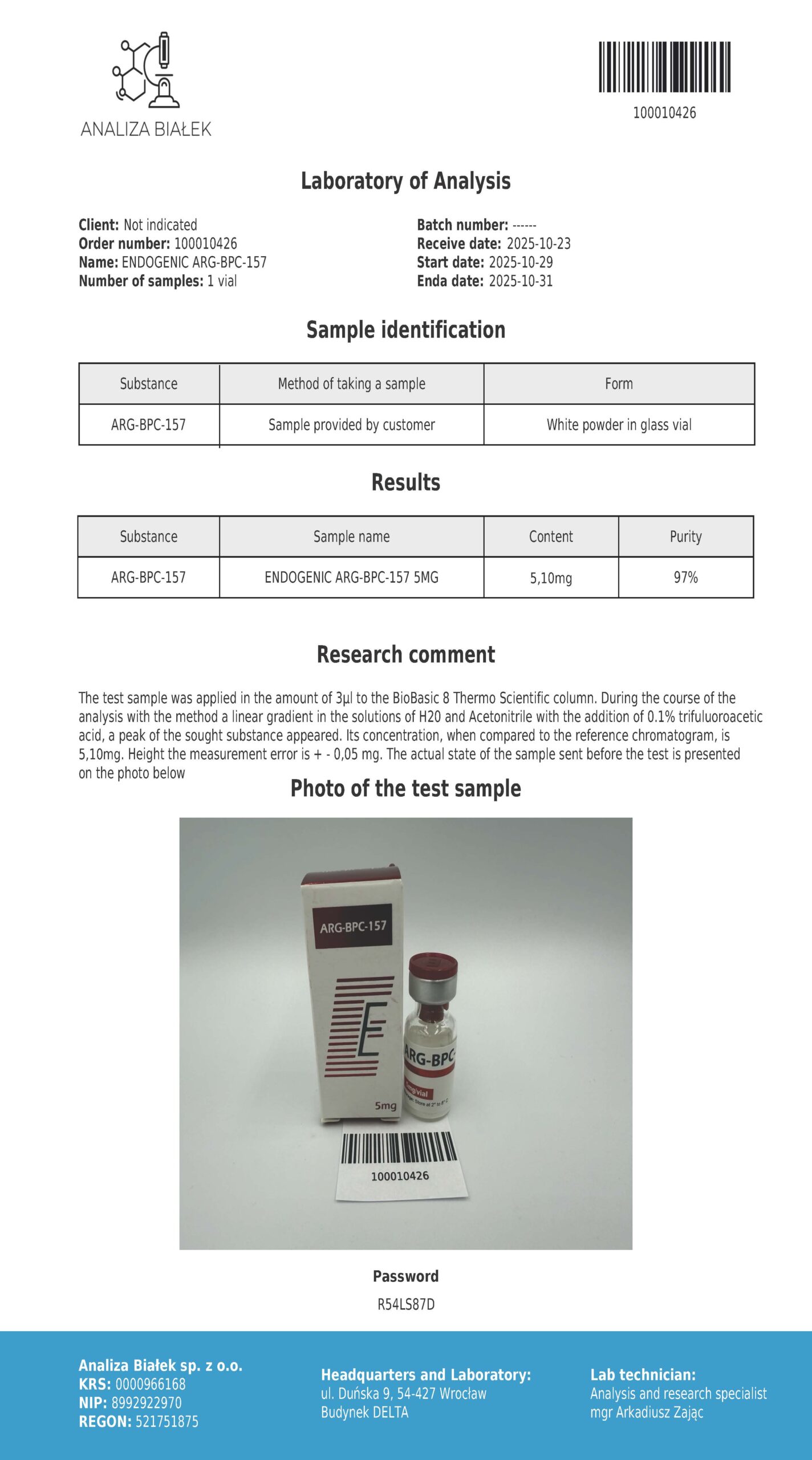
Secondly – physicochemical properties. Stability, solubility and hygroscopicity depend on the type of salt; arginine as a counterion can increase stability and solubility. Salt doesn’t change that What does the peptide (the mechanism relates to the sequence), but affects How behaves in storage and in solution. Identity decides sequence + mass MS in COA: the sequence GEPPPGKPADDAGLV confirms that it is BPC-157, and the measured salt mass allows us to verify the type of counterion. COA reading instructions – see section below.