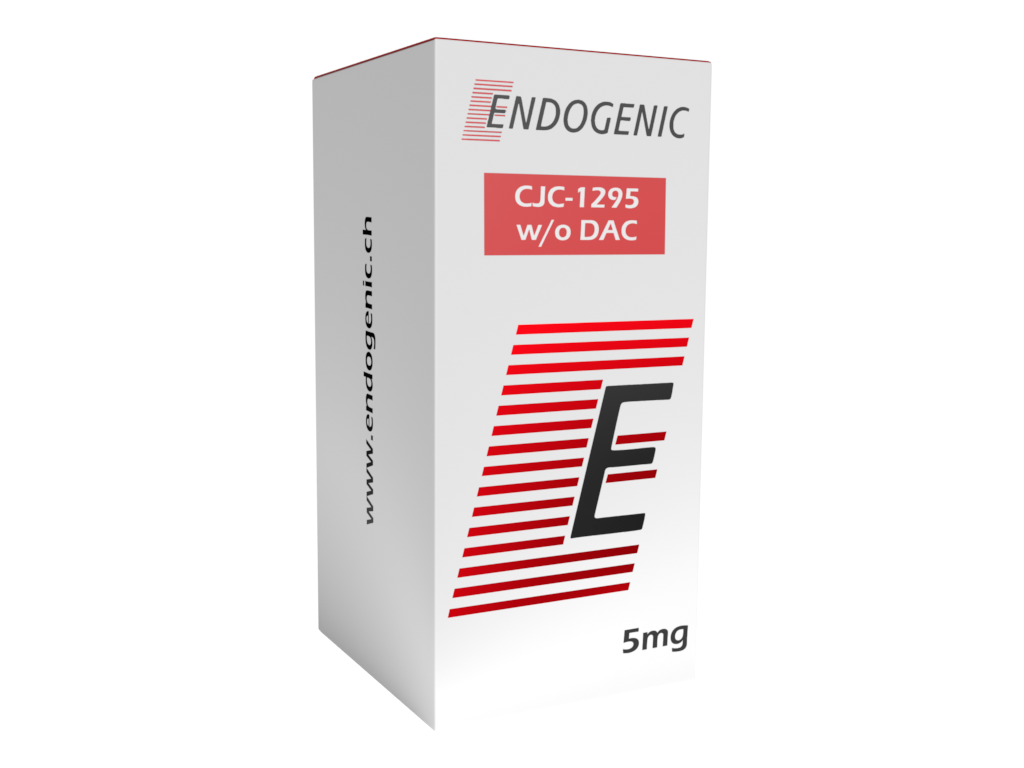


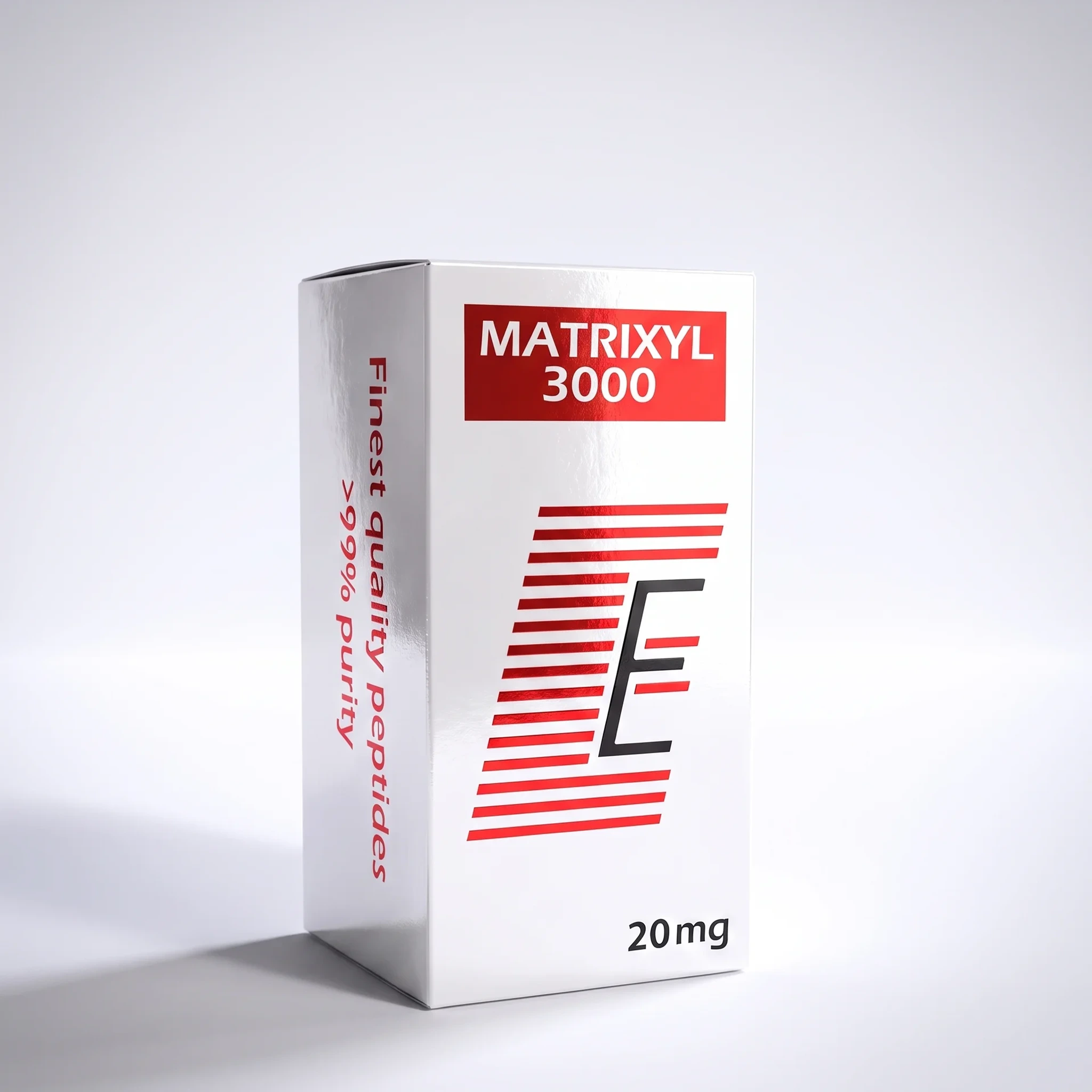
Matrixyl 3000 is a complex of two short matrikine peptides patented by Sederma: palmitoyl tripeptide-1 (Pal-GHK) and palmitoyl tetrapeptide-7 (Pal-GQPR). Both are signaling peptides of the skin’s extracellular matrix – in the models, they mimic fragments resulting from collagen degradation and “inform” fibroblasts about the need to rebuild the matrix. The palmitoyl residue (C16 fatty acid) attached to each peptide increases their lipophilicity and facilitates penetration through the epidermal barrier in skin models. In the Pro-Body catalog, the complex appears as a research reagent / RUO formulation raw material, not a finished cosmetic.
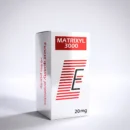
Matrixyl 3000
Matrixyl 3000 (concentrate/lyophilisate, Endogenic line) — complex of two matrikine peptides: palmitoyl tripeptide-1 (Pal-GHK) + palmitoyl tetrapeptide-7 (Pal-GQPR). Extracellular matrix signal peptides: in fibroblast models, they mimic fragments of collagen degradation and stimulate the synthesis of collagen (types I, III, IV), fibronectin and hyaluronic acid. Research reagent
35,99 €
Fast shipping
Delivery options
Free delivery from 350 €
Returns policy
Matrixyl 3000 - matrikine peptide complex, RUO research reagent
- Matrixyl 3000 (concentrate/lyophilisate, Endogenic line) — complex of two matrikine peptides: palmitoyl tripeptide-1 (Pal-GHK) + palmitoyl tetrapeptide-7 (Pal-GQPR).
- Extracellular matrix signal peptides: in fibroblast models, they mimic fragments of collagen degradation and stimulate the synthesis of collagen (types I, III, IV), fibronectin and hyaluronic acid.
Chemical reagent intended exclusively for laboratory tests (Research Use Only). It is not a medicinal product, dietary supplement, food or finished cosmetic. It is not suitable for consumption or direct application to human skin outside a controlled research environment. Sales only to registered research units, R&D laboratories and cosmetic formulators working on recipes.
Matrixyl 3000 from the line Endogenous is a patented complex of two short signal peptides designed for one, well-defined direction of research: communication with skin fibroblasts about the need to rebuild the extracellular matrix. It is not a hormone receptor ligand or a connective tissue regenerative peptide in the systemic sense – it is a pair of so-called matrikines, i.e. peptide signaling fragments that mimic the breakdown products of collagen and other matrix proteins.
The entire concept of matrikines is based on an observation that was described in the dermatological literature in the early 2000s: the extracellular matrix of the skin is not a passive scaffolding. When it degrades – with age, under the influence of UV radiation or oxidative stress – short peptide fragments are created, which become signals themselves.
These fragments “inform” fibroblasts that the matrix needs to be rebuilt and stimulate them to synthesize new collagen and other components. Matrixyl 3000 takes advantage of this principle: it provides two synthetic matrikine peptides that mimic such a repair signal in skin models. The complex connects palmitoyl tripeptide-1 (Pal-GHK) — an analogue of the well-described GHK tripeptide — and palmitoyl tetrapeptide-7 (Pal-GQPR), a fragment with a profile that modulates the inflammatory response.
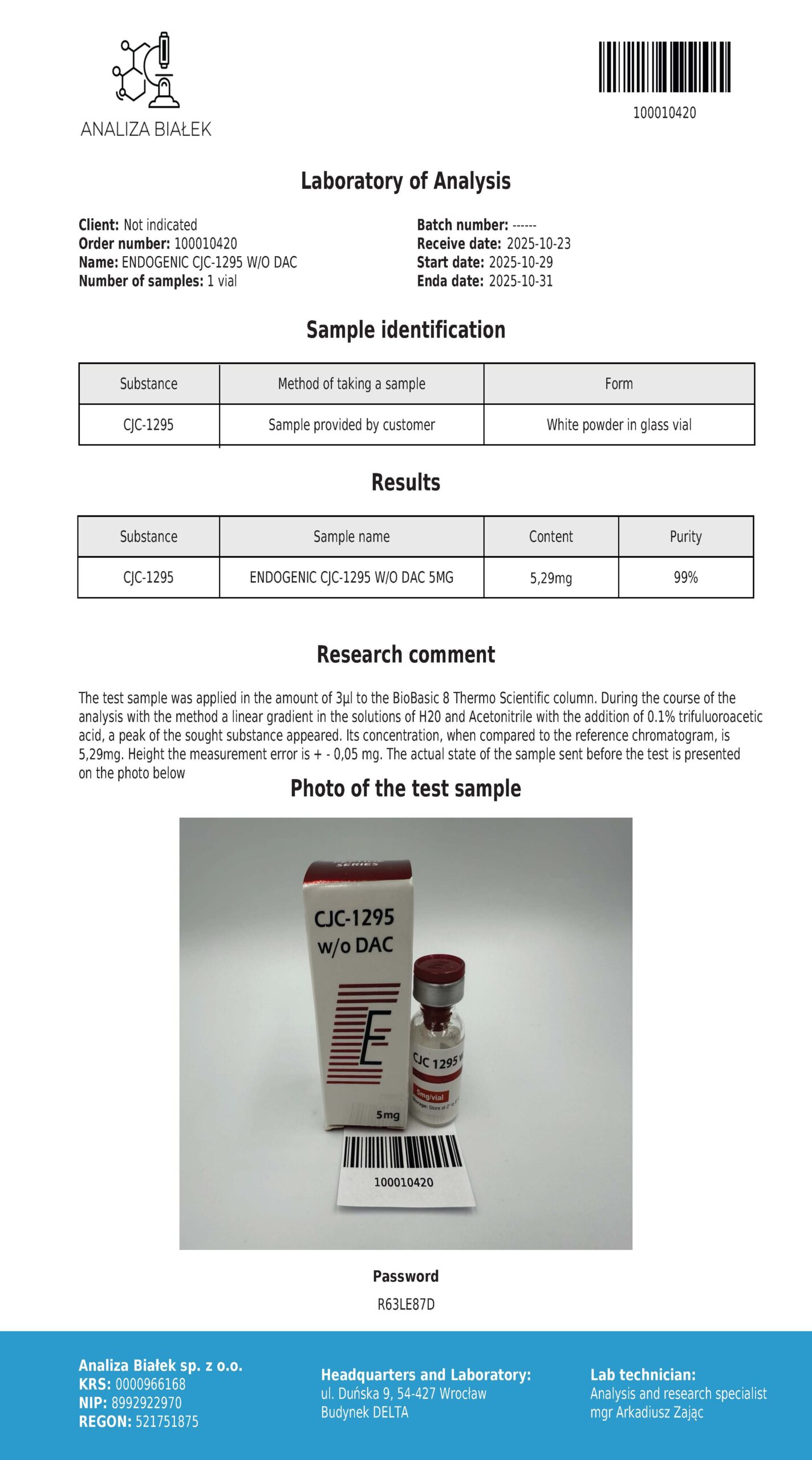
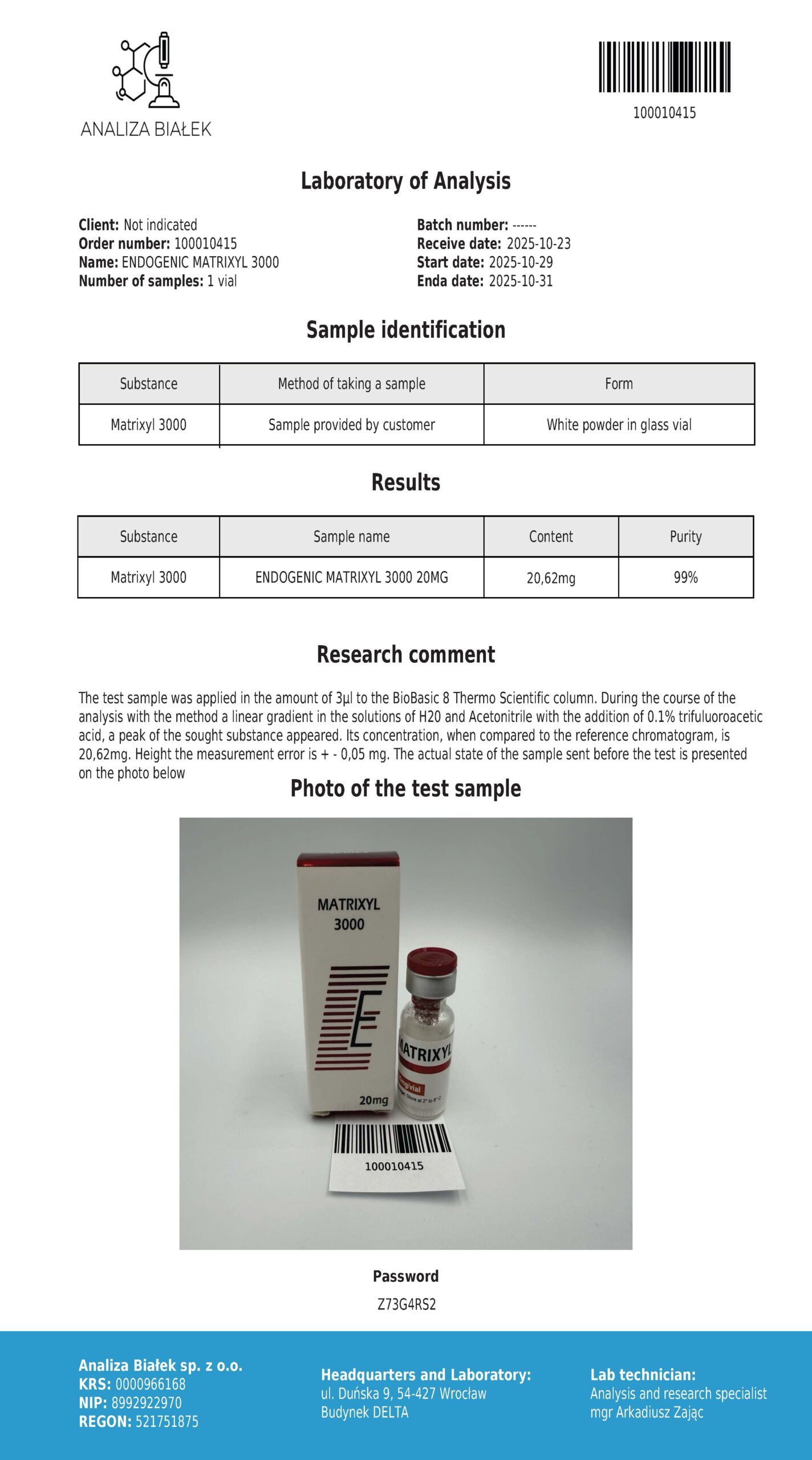
Both peptides are equipped with a lipophilic palmitoyl residue, which in skin models increases affinity for cell membranes and penetration through the stratum corneum. This reagent is supplied as concentrate or lyophilisate to prepare a working solution or to be added to a cosmetic base in laboratory conditions — a format that gives the researcher and formulator the freedom to select the working concentration for a specific experimental system or recipe. Purity and peptide content verified by HPLC, COA available for each batch.
Matrikins and extracellular matrix signaling
The extracellular matrix of the dermis (ECM – extracellular matrix) is a network of structural proteins: collagen (mainly types I and III), elastin, fibronectin and space-filling glycosaminoglycans, including hyaluronic acid. It gives the skin firmness, elasticity and the ability to retain water. With age, the synthesis of these components weakens and their degradation accelerates – the effect visible in the models is a thinner, less tense matrix.
The concept turned out to be a breakthrough for peptide cosmetology matrikin — described, among others, by Maquart et al. (2004) and Lintner and Peschard (2000). Matrikins are peptide fragments resulting from the partial degradation of extracellular matrix proteins that act as signaling molecules. In other words: the product of collagen breakdown is not just waste – it is a message.
Such a fragment is recognized by fibroblasts as a signal “the matrix has been damaged, start rebuilding”, which in the models leads to increased synthesis of new matrix proteins. Signal peptides in cosmetology constitute a separate class of molecular tools. Unlike neuromuscular peptides (such as SNAP-8 or Argireline), the described mechanism of which is to limit the contraction of facial muscles by interfering with the release of a neurotransmitter, matrikines act on fibroblasts and matrix synthesis.
In reviews of cosmetic peptides, Matrixyl and its derivatives are included in the category of signal peptides – distinguished from neurotransmitter peptides and carrier peptides (such as GHK-Cu as a copper transporter). The role and mechanism of peptides in care preparations is discussed in more detail in the article about what they are peptides in cosmetics.
In the Pro-Body catalog Matrixyl 3000 is one of the research tools on skin biology and extracellular matrix, complementary to copper peptide GHK-Cu 50mg.
What is Matrixyl 3000 - Pal-GHK + Pal-GQPR complex
Matrixyl 3000 is a complex patented by Sederma two palmitoylated matrikine peptides: :
- Palmitoyl tripeptide-1 (Pal-GHK) — palmitoylated analogue of the glycine-histidine-lysine tripeptide (GHK). The GHK motif itself is one of the best described skin signal peptides, associated in the literature with the remodeling of the extracellular matrix and stimulation of collagen synthesis. The palmitoyl residue increases the lipophilicity of the molecule and its affinity for membranes.
- Palmitoyl tetrapeptide-7 (Pal-GQPR) — palmitoylated tetrapeptide with the sequence glycine-glutamine-proline-arginine. In the literature, it is associated with the modulation of the skin’s inflammatory response, including the effect on interleukin IL-6 – which places it in the field of research on low-grade inflammation accompanying skin aging.
The original name “Matrixyl 3000” refers to the specific, patented ratio of these two peptides in the carrier. Both fragments are short (tri- and tetrapeptide), and the common denominator is the palmitoyl residue – a long-chain fatty acid attached to the peptide, which in skin models acts as a “lipid anchor” facilitating contact with cell membranes and crossing the epidermal barrier.
Chemical characteristics
| Parameter | Value |
|---|---|
| Trade name | Matrixyl 3000 (patented complex, Sederma) |
| Line | Endogenous |
| Class | Matrikine peptide complex (ECM signal peptides) |
| Ingredient 1 (INCI) | Palmitoyl Tripeptide-1 (Pal-GHK) |
| Ingredient 2 (INCI) | Palmitoyl Tetrapeptide-7 (Pal-GQPR) |
| Core Sequence 1 | Gly-His-Lys (GHK) with palmitoyl residue [to be verified in COA] |
| Core Sequence 2 | Gly-Gln-Pro-Arg (GQPR) with palmitoyl residue [to be verified in COA] |
| Molecular target/axis | fibroblast matrikine signaling; collagen and ECM synthesis |
| The rest is lipophilic | palmitoyl (palmitic acid, C16) |
| CAS number of ingredients | [to be verified in the party’s COA] |
| Net peptide content | [to be verified in the party’s COA] |
| Physical form | concentrate / lyophilisate for working solution or base |
| Purity/identity | HPLC, COA per batch |
Mechanism of action at the molecular level
In the cosmetology literature, Matrixyl 3000 is described as a complex with a consistently pro-repair profile towards the extracellular matrix of the skin. The literature points to four related axes of activity observed in models. Below, each with the name of the mechanism and its translation into experimental observations.
Matrikine signaling – mimicking fragments of ECM degradation
Central axis of the profile. Both peptides of the complex were designed to mimic short fragments resulting from the degradation of collagen and other extracellular matrix proteins in skin models. These fragments are recognized by fibroblasts as a signal that the matrix requires reconstruction. In this way, Matrixyl 3000 “informs” cells about the need for remodeling, not by providing the building material itself, but by activating the cell’s repair program. This is a signaling mechanism, not a structural one—the core of the matrikine concept described by Maquart et al. (2004) and Lintner and Peschard (2000).
Stimulation of the synthesis of collagen and matrix components
The second axis concerns the measurable response of fibroblasts. In skin fibroblast culture models and in application studies, matrikine peptides were associated with increased synthesis collagen (types I, III and IV), fibronectin and hyaluronic acid — the main ingredients that make the skin firm and moisturized. This is a direct translation of the matrix signal into the production of new matrix proteins. Robinson et al. (2005) described palmitoylated peptides in the context of the effect on skin parameters in an application study.
Pal-GHK as a GHK analogue – matrix remodeling
The third axis details the role of the first component. Theme GHK (glycine-histidine-lysine) is one of the best-studied skin signal peptides. Pickart and Margolina (2018) described GHK in the context of extracellular matrix remodeling, regulation of tissue repair-related gene expression, and balancing collagen synthesis and degradation. The palmitoylated analog (Pal-GHK) retains the GHK signaling core, and the palmitoyl moiety improves its delivery across the epidermal barrier in skin models. This makes Pal-GHK the matrikin “reconstruction arm” of the complex.
Pal-GQPR and modulation of the inflammatory response
The fourth axis concerns the second component. Pal-GQPR (palmitoyl tetrapeptide-7) has been associated in the literature with the modulation of the skin’s inflammatory response – in particular with the effect on interleukin IL-6, one of the mediators of low-grade inflammation accompanying skin aging (so-called inflammaging). Silencing this signal in models was associated with a more favorable environment for fibroblasts and matrix synthesis.
This is the inflammatory “arm” of the complex, complementary to the pro-synthetic action of Pal-GHK. The common denominator of both peptides is lipophilic palmitoyl residue, which in skin models increases the affinity for cell membranes and facilitates penetration through the stratum corneum – the basic condition for a short, hydrophilic peptide to be able to reach the fibroblasts of the dermis.
Applications in scientific research
Matrixyl 3000 as an RUO reagent is used as a molecular tool and formulation raw material in several areas of skin and extracellular matrix research. The concentrate/lyophilized form works well when a researcher or formulator needs the freedom to select the working concentration for a specific experimental system or test recipe.
Synthesis of collagen and matrix components in fibroblast cultures. Dermis fibroblast cultures (human and mouse lines). Endpoints: collagen type I, III and IV synthesis, fibronectin expression, hyaluronic acid production, expression profile of genes related to matrix remodeling. This is historically the most explored area of research on matrikine peptides.
Reconstructed skin models and the epidermal barrier. Three-dimensional models of reconstructed skin and models of penetration through the stratum corneum. Endpoints: penetration of palmitoylated peptides through the epidermal barrier, thickness and organization of the dermal layer in the model, peptide distribution in the layers.
Modulation of the skin’s inflammatory response. Cultures of keratinocytes and fibroblasts in pro-inflammatory conditions. Endpoints: level of IL-6 and other inflammatory mediators, effect of Pal-GQPR on the cytokine profile in a low-grade inflammation model.
Formulation work and application research. Preparing test recipes with specific concentrations of assets, assessing the stability of peptides in a cosmetic carrier, in vivo application tests on volunteers in the context of skin parameters (firmness, hydration, visibility of lines). Robinson et al. (2005) described this type of assay for a palmitoylated peptide. It is useful for formulation work peptide cream as an application medium and sterile laboratory accessories. It is also used in studies on the absorption of melting agents into the scalp Derma Roller for microneedling.
Summary
Matrixyl 3000 (concentrate/lyophilisate, Endogenic line) is a Sederma patented a complex of two matrikine peptides — palmitoyl tripeptide-1 (Pal-GHK) and palmitoyl tetrapeptide-7 (Pal-GQPR). Matrikins are peptide signaling fragments of the extracellular matrix: in skin models, they mimic collagen degradation products and “inform” fibroblasts about the need to rebuild the matrix. Four axes of activity of the complex have been described in the literature: matrikine signaling (mimicking fragments of ECM degradation), stimulation of the synthesis of collagen (types I, III, IV), fibronectin and hyaluronic acid in fibroblast models, the action of Pal-GHK as a GHK analogue in matrix remodeling and modulation of the inflammatory response by Pal-GQPR (effect on IL-6).
The lipophilic palmitoyl residue increases the affinity for membranes and penetration through the stratum corneum in skin models. What distinguishes Matrixyl 3000 from other skin peptides is its matrikine nature – a signal peptide acting on fibroblasts and matrix synthesis, unlike neuromuscular peptides such as Snap-8 or Argireline, which limit the contraction of facial muscles.
It also differs from the original Matrixyl (Pal-pentapeptide-4 itself) and from Matrixyl Synthe’6 (Pal-tripeptide-38) – these are three separate complexes with different compositions. The regulatory profile remains clear: the ingredients are listed in the INCI as cosmetic, but the raw material is not a finished cosmetic or medicine (no EMA/FDA authorization). Pro-Body Matrixyl 3000 appears in the Pro-Body catalog as a Research Use Only reagent / formulation raw material – with HPLC and COA verification for each batch.
Related cosmetic peptides and materials
In research on peptides modulating the skin matrix, Matrixyl 3000 is sometimes combined with other peptides used topically in skin care. The entire segment peptide cosmetics Endogenous includes raw materials for skin research. In the context of matrix remodeling, a related signaling motif is represented by a copper tripeptide GHK-Cu 20mg, and a ready-made duo is available for research on tissue aging Epithalon + GHK-Cu.
The combination of the three most frequently researched anti-aging ingredients is described in the review GHK-Cu, Snap-8 and Matrixyl. All of these materials are related to the cosmetic framework (fusible application) and are separate from this RUO reagent.
Bibliography
- Maquart FX, Pasco S, Ramont L, Hornebeck W, Monboisse JC (2004). An introduction to matrikines: extracellular matrix-derived peptides which regulate cell activity. Implication in tumor invasion. PubMed
- Pickart L, Margolina A (2018). Regenerative and Protective Actions of the GHK-Cu Peptide in the Light of the New Gene Data. PubMed
- Lintner K, Peschard O (2000). Biologically active peptides: from a laboratory bench curiosity to a functional skin care product. PubMed
- Robinson LR, Fitzgerald NC, Doughty DG, Dawes NC, Berge CA, Bissett DL (2005). Topical palmitoyl pentapeptide provides improvement in photoaged human facial skin. PubMed
Chemical reagent Research Use Only. Matrixyl 3000 (concentrate/lyophilisate, Endogenic line) in the Pro-Body catalog is not a ready-made cosmetic, medicinal product, dietary supplement or food. The ingredients are listed in the INCI nomenclature as cosmetic, but the raw material is not a cosmetic approved for consumer trade – it requires a full recipe, safety assessment and notification (CPNP).
Matrixyl 3000 It is not authorized by EMA or FDA as a medicinal product. Matrikine peptides are not on the WADA prohibited list. The information in the description is of an educational and scientific nature and refers to the results reported in the literature on the skin and extracellular matrix – it does not constitute medical or cosmetic advice or instructions for use on human skin.
FAQ
Matrikins are peptide fragments resulting from the partial degradation of skin extracellular matrix proteins – collagen, elastin, fibronectin. Importantly, these fragments are not just waste: they act as signaling molecules. Fibroblasts recognize them as the message “the matrix has been damaged, start rebuilding” and in the models respond with increased synthesis of new collagen (types I, III, IV), fibronectin and hyaluronic acid.
Matrixyl 3000 uses this principle: it provides two synthetic peptides that mimic such a repair signal in skin models. It’s a signaling mechanism, not a structural one – peptides are not building blocks, but messages. All observations come from cell models and application studies.
These are two different classes of skin peptides with different mechanisms. Matrixyl 3000 is a peptide matrikine (signal) — acts on fibroblasts and extracellular matrix synthesis, imitating the repair signal and stimulating collagen production. The neuromuscular peptide Snap-8 works completely differently: in models it interferes with the release of a neurotransmitter at the neuromuscular junction, which has been associated with limiting the contraction of facial muscles responsible for facial wrinkles. One complex rebuilds the matrix, the other limits muscle movement. In research recipes, they are sometimes considered complementary, not interchangeable.
Palmitoylated peptides are amphiphilic in nature: a hydrophilic part of the peptide and a lipophilic palmitoyl residue. In formulation work, the raw material is gradually introduced into the selected carrier – aqueous phase, buffer or emulsion base – while mixing gently, without vigorous shaking, which promotes foaming and degradation of peptides. The concentration of the assets is selected according to the target share in the test recipe, and introduction into the finished carrier requires assessment of the stability of the peptides in a given base.
This is a formulation procedure for the RUO reagent, not an instruction for preparing the product for direct use on human skin.
NO. The ingredients of the complex (palmitoyl tripeptide-1, palmitoyl tetrapeptide-7) are listed in the INCI nomenclature as cosmetic ingredients, but the raw material in the form of a concentrate/lyophilisate is not a ready-made cosmetic approved for consumer trade. The finished care product requires a complete recipe, safety assessment by a qualified person (Cosmetic Regulation EC 1223/2009) and notification on the CPNP portal before being placed on the market.
In the Pro-Body Matrixyl 3000 catalog it appears only as a research reagent / RUO formulation raw material. Communication such as “a cream that will rejuvenate the skin” in relation to this raw material is contrary to its status.
The concentrate/lyophilisate is stored in cool conditions, away from heat sources, protected from light and moisture – the palmitoyl residue and short peptides are sensitive to oxidation and hydrolysis. Tightly closing the packaging after each collection limits the influence of moisture and oxygen. The working solution or test recipe is stored in accordance with the procedures of the research facility and the stability of the given medium; the raw material in dry form is more stable in storage than the ready-made aqueous solution in which peptide hydrolysis takes place. Detailed conditions for a given batch are provided by COA.
0.0
0 reviews
This product has no reviews yet.
Related products