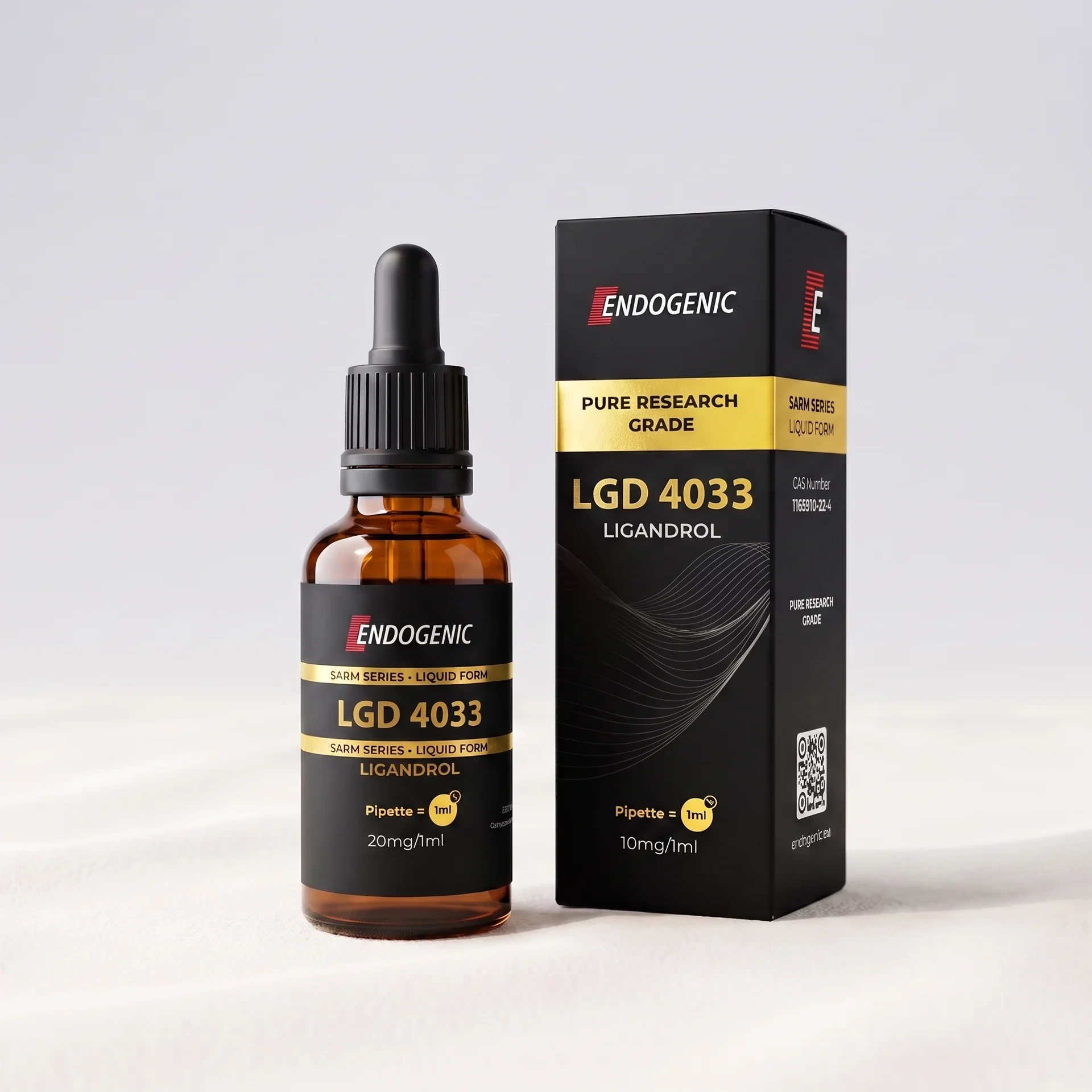
The androgen receptor (AR) regulates muscle anabolism and bone density, but the classic androgen ligands – testosterone and anabolic-androgenic steroids – stimulate it without tissue discrimination. Muscle stimulation is then accompanied by stimulation of the prostate, skin and gonadal axis, which drives the adverse effect profile of this entire class. Selective androgen receptor modulators (SARMs) are pharmacology’s answer to this problem: molecules that were supposed to preserve the anabolic stimulation of AR in muscle and bone, while limiting activity in androgen-dependent tissues such as the prostate. LGD-4033 (ligandrol, VK5211, code Anabolicum) is one of the strongest and best clinically tested representatives of this class.
Pro-Body supplies it in line Endogenic as a research reagent in format oral solution in a 30 ml dropper bottle — the concentration of active substance (mg/ml) is declared by the COA of each batch. Chemically, it is a small non-steroidal molecule from the group of pyrrolidine-benzonitrile derivatives – not a steroid, despite a similar molecular attachment point.
In terms of mechanism, it is a tissue-selective androgen receptor ligand with high affinity: in research models it behaves as a strong AR agonist in muscle and bone, with much weaker androgenic activity in the prostate and sebaceous glands. This puts ligandrol in the group SARMs for muscle mass most frequently mentioned in androgen receptor pharmacology.
LGD-4033 was developed by the American company Ligand Pharmaceuticals, and clinical development under the code VK5211 was continued by Viking Therapeutics. Characterization of the molecule includes phase I studies (including dose-dependent increase in lean body mass) and phase II studies on regeneration after hip fracture. The strength and selectivity profile makes ligandrol one of the most frequently cited SARMs in androgen receptor pharmacology – next to ostarine (MK-2866) and testolone (RAD-140).
In research terms, ligandrol remains a model tool for studying muscle anabolism, bone metabolism and dose-dependent suppression of the gonadal axis. Purity verified by HPLC ≥98%, identity confirmed by mass spectrometry, COA available for each batch.
Regulatory status
LGD-4033 is not registered as a medicine in the EU or USA. Clinical development (phase I/II conducted by Ligand Pharmaceuticals and Viking Therapeutics as VK5211) has not been completed with a full registration program, so Ligandrol has not received FDA or EMA authorization. The FDA also issued Warning Letters against entities marketing SARMs as ingredients of human products. LGD-4033 is on the WADA Prohibited List in category S1.2 (other anabolic agents). Communicating the product as a “SARM for mass”, a “safer steroid” or an “anabolic without side effects” is contrary to the Research Use Only framework.