

The nature of androgen receptor activation. S-23 is described as full agonist High affinity AR – capable of maximal receptor activation. Partial agonists, such as S-4 (andarine) or ostarine, activate the receptor only partially, so even when fully saturated, the anabolic response does not reach its maximum. The consequence of full S-23 agonism is a stronger anabolic profile in the models, but at the same time a more pronounced effect on the gonadal axis. This comparison is mechanistic and refers to observations in research models; does not constitute a suggestion for the use of RUO reagent in humans.
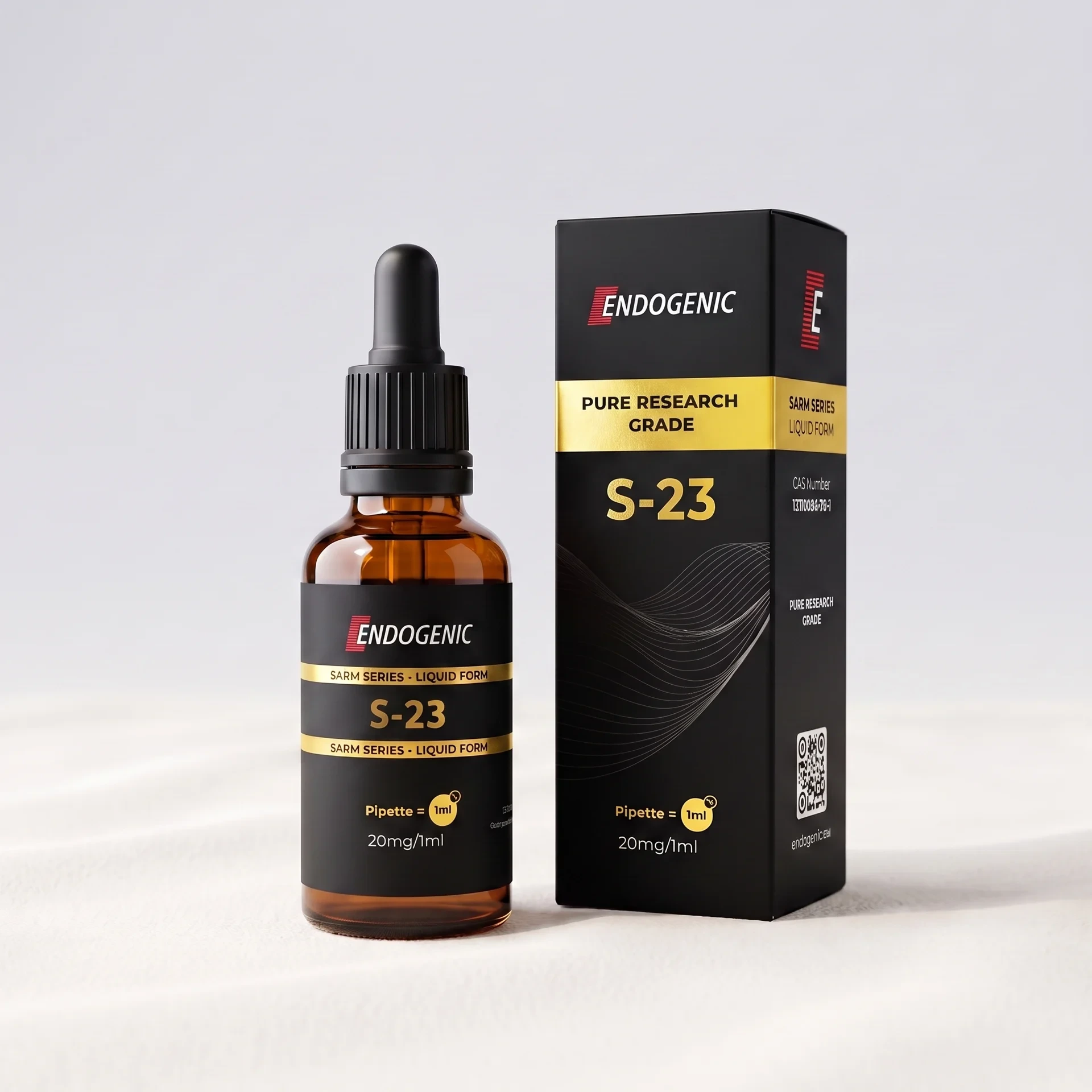
S23 20mg/1ml LIQUID
S-23 (oral solution in a 30 ml dropper bottle, mg/ml concentration according to COA) from the Endogenic line is a non-steroidal selective androgen receptor modulator (SARM) from the arylpropionamide group, related to andarine (S-4), developed by GTx. Its distinguishing feature is full androgen receptor agonism with high affinity – as opposed to partial agonists (S-4, ostarine) – which places it among the most anabolically powerful SARMs in the models. Research Use Only reagent.
47,99 €
Fast shipping
Delivery options
Returns policy
S-23 30 ml solution - SARM research reagent from the Endogenic line
- S-23: a non-steroidal SARM and full androgen receptor agonist.
- Solution in a 30 ml dropper bottle; concentration according to the batch COA.
- Research Use Only reagent, not a medicinal product.
Product status information
Chemical reagent intended exclusively for laboratory tests (Research Use Only). It is not a medicinal product, dietary supplement or food. It is not intended for use on humans or animals. Sales only to registered research units and laboratories.
WADA status – category S1.2 (other anabolic agents)
S-23 as a selective androgen receptor modulator (SARM) is on the World Anti-Doping Agency (WADA) Prohibited List in the category S1.2 – other anabolic agents. The substance is prohibited in both competition and non-competition. The entire SARM class has been under an anti-doping ban continuously since 2008. It is imperative that Registered Athletes (ADAMS) verify the current Prohibited List before making any decision – the presence of S-23 or its metabolites in a doping sample constitutes an anti-doping rule violation.
Introduction
The androgen receptor (AR) regulates muscle anabolism and bone density, but the classic androgen ligands – testosterone and anabolic-androgenic steroids – stimulate it without tissue discrimination. Selective androgen receptor modulators (SARMs) were designed to maintain anabolic AR stimulation in muscle and bone while limiting activity in androgen-dependent tissues. Within this class, however, individual molecules differ in strength – and precisely in this respect S-23 takes an extreme position. Unlike partial AR agonists such as S-4 (andarine), S-23 is described as full androgen receptor agonist with high affinity – one of the strongest compounds of the entire SARM class.
Pro-Body delivers the S-23 in the line Endogenic as a research reagent in format oral solution in a 30 ml dropper bottle, in which the content is declared as volumetric concentration (mg/ml according to the batch COA). In the catalog, the reagent belongs to SARM liquids — a liquid grade variant, alongside the capsule version. Chemically, it is a small non-steroidal molecule from the arylpropionamide group – structurally related to andarine (S-4), developed by the American biopharmaceutical company GTx.
Mechanistically, S-23 is a potent, tissue-selective androgen receptor ligand with a particularly pronounced effect on the hypothalamic-pituitary-gonadal axis – a feature that has made it the subject of research on reversible male hormonal contraception (Jones et al. 2009). In research terms, S-23 remains a tool for studying musculoskeletal anabolism, the pharmacology of full AR agonism, and gonadotropin (FSH/LH) suppression and spermatogenesis in rodent models. Purity verified by HPLC ≥98%, identity confirmed by mass spectrometry, COA available for each batch.
Regulatory status
S-23 is not registered as a medicine in the EU or USA. It has not undergone a full clinical development program – available data are from preclinical models and early pharmacological characterization. S-23 as a SARM is on the WADA Prohibited List in category S1.2 (other anabolic agents). The FDA has issued Warning Letters against entities marketing SARMs as ingredients of human products. Communication of the product as “the strongest SARM for mass”, “safer steroid” or “anabolic without side effects” is contrary to the Research Use Only framework.
SARMs and the difference between full and partial androgen receptor agonists
Selective androgen receptor modulators (SARMs) are a pharmacological class identified at the turn of the 1990s and 2000s as a response to the limitations of anabolic-androgenic steroids. The starting point was the observation that the androgen receptor functions differently in different tissues – the conformation of the ligand-receptor complex and the set of recruited coregulators (coactivators and corepressors) differ between muscle, bone, prostate and skin.
The design hypothesis assumed that a structurally appropriate molecule could stimulate AR like an agonist in some tissues and have a weaker effect in others. For a complete overview of the class and the differences between each compound, see the category SARMs in the Endogenic catalog.
Within this class, however, molecules differ in the nature of receptor activation. Some of the compounds are partial agonists AR – bind the receptor and activate it only partially, so that even when the receptor is fully saturated, the anabolic response does not reach its maximum (such a profile has been described, among others, for S-4, andarine).
S-23 belongs to the opposite extreme: it is described as full androgen receptor agonist with high affinity, capable of maximal activation of the receptor. It is this feature – full, not partial agonism – that makes S-23 one of the most anabolically powerful SARMs in research models, but also a compound with a particularly pronounced effect on the gonadal axis.
S-23 as a non-steroidal arylpropionamide is structurally related to andarine (S-4) and comes from the same line of work by GTx. In rodent models, it has high affinity for the androgen receptor and has better pharmacokinetics and oral bioavailability than S-4. The world of pharmacology is watching S-23 for several reasons: as one of the most potent full AR agonists in the SARM class, as a tool for studying musculoskeletal anabolism, and – which is its most characteristic research direction – as a candidate studied in the context of reversible male hormonal contraception, due to strong inhibition of gonadotropins and spermatogenesis.
What is S-23?
Chemically, S-23 is a small non-steroidal molecule – arylpropionamide that binds the androgen receptor with high affinity, a full AR agonist.
- Common name: S-23, S23
- Pharmacological class: non-steroidal selective androgen receptor modulator (SARM); arylpropionamide (andarine/S-4 related derivative); full androgen receptor agonist (unlike S-4 partial agonists)
- CAS number: 1010396-29-8 (in case of uncertainty – “to be verified in the batch COA”)
- Molecular formula: C₁₈H₁₃ClF₄N₂O₃ (to be verified in the batch COA)
- Molar mass: ~416.75 g/mol (to be verified in the batch COA)
- Laboratory of Origin: GTx, Inc. (USA); Preclinical characteristics, male contraceptive research
- Delivered form: oral solution in a 30 ml dropper bottle; concentration (mg/ml) declared in the batch COA; research grade ≥98% HPLC
Table of physicochemical characteristics
| Parameter | Value | Note |
|---|---|---|
| Name | S-23, S23 | — |
| Chemical class | arylpropionamide (small molecule non-steroidal) | andarine related derivative/S-4; not a steroid, not a peptide |
| Pharmacological class | selective androgen receptor modulator (SARM) | full AR agonist (vs partial agonists like S-4) |
| CAS | 1010396-29-8 | for verification in the batch COA |
| Molecular formula | C₁₈H₁₃ClF₄N₂O₃ | for verification in the batch COA |
| Molar mass | ~416.75 g/mol | for verification in the batch COA |
| Molecular target | androgen receptor (AR) | high affinity, full agonism |
| Power profile | one of the strongest SARMs | full agonism + marked HPG suppression |
| Purity | ≥98% HPLC | UV detection, per batch verification |
| Form | oral solution, 30 ml dropper bottle | concentration mg/ml according to COA |
| Oral bioavailability | high | beneficial towards S-4 (andarine) |
| Clinical status | preclinical studies/early characterization | no EU/US registration |
| WADA status | Prohibited List, Category S1.2 (other anabolic agents) | SARM class banned since 2008 |
Origin: Arylpropionamides as a SARM scaffold originate from work on analogues of bicalutamide – an antiandrogen used in oncology. Structural modifications of this skeleton allowed the transformation of the androgen receptor antagonist into molecules with an agonistic, tissue-selective profile. S-23, structurally related to andarine (S-4), was characterized by work by GTx, Inc. A particularly influential report describing S-23 as a candidate for a reversible male contraceptive – based on its potent, reversible suppression of spermatogenesis in a rat model – was published in 2009 in the journal Endocrinology (Jones et al.).
It is the profile of strong inhibition of the gonadal axis, in addition to high affinity for AR and full agonism, that defines S-23’s position among SARMs.
Mechanism of action at the molecular level
S-23 works in research models by binding and fully activating the androgen receptor. The following axes are described in the preclinical literature. Pharmacological profile observed in research models:
- Full high affinity androgen receptor agonism. The best described S-23 mechanism and the feature that distinguishes it in the SARM class. As a non-steroidal arylpropionamide molecule, it binds the androgen receptor ligand domain with high affinity and acts as full agonist — capable of maximal activation of the receptor, unlike partial agonists such as S-4 (andarine). This is the original, direct molecular effect from which the remaining observations arise.
- Tissue-selective but strong muscle-bone anabolism. In rodent models, S-23 exhibits strong anabolic stimulation in skeletal muscle and bone tissue – effects on muscle mass and bone parameters were observed. Full AR agonism translates into one of the strongest anabolic profiles in the SARM class, which makes the molecule a tool in research on muscle anabolism and bone metabolism.
- High oral bioavailability and favorable pharmacokinetics. In preclinical models, S-23 has good oral bioavailability – more favorable than the structurally related andarine (S-4). This pharmacokinetic property makes it a more convenient research tool compared to some previous arylpropionamides.
- Strong inhibition of the hypothalamic-pituitary-gonadal axis – marked suppression of FSH/LH and spermatogenesis. The most characteristic direction of research on S-23. In a rat model, the compound caused a strong, reversible suppression of gonadotropins (FSH, LH) and spermatogenesis – an effect that made it a candidate being investigated as a component of reversible male hormonal contraception (Jones et al. 2009). After discontinuation, fertility was observed in the model. This is a more pronounced effect on the gonadal axis than in the case of weaker, partial AR agonists.
- Anabolic in muscle and bone in rodent models. In addition to full AR agonism, a consistent effect of S-23 on muscle anabolic markers and bone metabolism has been described in animal models, which places the molecule among the most anabolically potent SARMs in preclinical studies.
- No conversion to estrogens (no aromatization). As a non-steroidal arylpropionamide S-23, it is not an aromatase substrate – it is not subject to conversion to estrogens typical of testosterone and some steroids. This distinguishes the profile of the molecule from steroid androgens at the level of hormonal metabolism.
IMPORTANT DISTINCTION
“Full AR agonism, strong musculoskeletal anabolism and gonadal axis suppression” in the context of this description refers only to observations in preclinical models (rat, mouse, cell cultures). This is not a guarantee or suggestion of effect in humans using the RUO reagent. The most important pharmacological distinctions: first, S-23 is full androgen receptor agonist — unlike partial agonists such as S-4 (andarine) or ostarine; full agonism means a stronger anabolic profile in models, but also more pronounced suppression of the hypothalamic-pituitary-gonadal axis (FSH/LH and spermatogenesis), for which S-23 was investigated as a candidate male contraceptive.
Secondly, this reagent is oral solution in a 30 ml dropper bottle, in which the content is declared as concentration (mg/ml according to COA) — a format different from the capsule variant (standardized capsule weight); both variants contain the same molecule, but differ in the way the reagent is handled in the laboratory. Third, S-23 is small non-steroidal molecule (arylpropionamide), not a steroid and not a peptide — binds the androgen receptor, but does not have a sterane skeleton, does not aromatize and is not a testosterone derivative.
Compound remains an investigational tool – it has not undergone a full clinical program and its safety profile in humans has not been approved by regulatory authorities.
Important distinction - full vs. partial agonist; HPG suppression; solution and capsules
Understanding S-23’s position in the SARM catalog and map is the focal point of this description:
- Full agonist and partial agonists (S-4, ostarine) — S-23 is described as full androgen receptor agonist with high affinity, capable of maximal activation of the receptor. This is what sets it apart from partial agonists SARM grades such as S4 liquid (andarine) or ostarine, which activate the receptor only partially. The consequence of full agonism is a stronger anabolic profile in models, but at the same time a more pronounced effect on the gonadal axis – these are two sides of the same, higher pharmacological potency.
- Gonadal axis suppression and the context of contraception — the most characteristic feature of S-23 is strong, reversible suppression of gonadotropins (FSH/LH) and spermatogenesis in a rat model, for which it was tested as a candidate for a reversible male contraceptive (Jones et al. 2009). This profile distinguishes S-23 from SARMs with a milder effect on the HPG axis and results directly from its full, strong AR agonism.
- Oral solution and capsule variant – this reagent is supplied as oral solution in a 30 ml dropper bottle, in which the content is declared as volumetric concentration (mg/ml according to batch COA). The capsule variant contains a standardized capsule dose. These are two formats for operating the same molecule – the choice depends on the methodology of a given research model; the identity and purity of both is determined by the COA of the batch (mass confirmed by MS, HPLC purity).
- Chemical class — S-23 is a non-steroidal arylpropionamide, structurally related to andarine (S-4), neither an anabolic-androgenic steroid nor a peptide. It binds the androgen receptor, but it does not come from testosterone, it does not have a sterane ring and it does not aromatize to estrogens.
This distinction is of both mechanistic and compliance importance: S-23 is sometimes mistakenly classified as the “strongest steroid” or equated with the weaker andarine, while its pharmacology (non-steroidal full AR agonist with marked HPG suppression) is different from both. In anti-doping terms, it remains classified by WADA as an anabolic agent (S1.2) – regardless of its non-steroidal structure.
Applications in scientific research
S-23 is used in research work in several areas. In vivo models (rat, mouse) examine its effect on muscle mass, bone parameters, suppression of gonadotropins and spermatogenesis, and the reversibility of these effects after discontinuation. In vitro models measure androgen receptor affinity and characterize the full agonist profile in various cell lines. In studies on body recomposition in animal models, S-23 is analyzed next to compounds classified as SARMs to harden your figure, due to strong muscle-bone anabolism in the absence of aromatization. Specific research directions include:
- Pharmacology of full AR agonism — S-23 as a model full androgen receptor agonist in studies on the difference from partial agonists (S-4, ostarine)
- Reversible male hormonal contraception — S-23 as a tool in models of spermatogenesis and gonadotropin suppression and in the study of fertility reversibility (Jones et al. 2009)
- Muscle anabolism and bone metabolism — analysis of the strong anabolic-skeletal profile of a full AR agonist in rodent models
- Comparative pharmacology of SARMs — S-23 in analyzes with andarine (S-4), ostarine, RAD-140 and LGD-4033 for agonist potency, bioavailability and effects on the gonadal axis
- Structure-activity relationship of arylpropionamides — S-23 as a derivative related to andarine in studies on skeleton modifications and their impact on potency and selectivity
- Detection methods in anti-doping analysis — S-23 as an analyte in the development of SARM detection methods for WADA control
Summary
S-23 (oral solution in a dropper bottle of 30 ml; concentration mg/ml according to COA) is a non-steroidal selective androgen receptor modulator (SARM) from the arylpropionamide group, structurally related to andarine (S-4), developed by GTx. Its distinguishing feature is full androgen receptor agonism with high affinity – unlike partial agonists such as S-4 or ostarine – which makes it one of the most anabolically powerful SARMs in preclinical models. The studies described strong muscle and bone anabolism, high oral bioavailability (favorable compared to S-4) and lack of aromatization.
The most characteristic research direction is strong, reversible suppression of the hypothalamic-pituitary-gonadal axis — marked inhibition of FSH/LH and spermatogenesis, for which S-23 was tested as a candidate for a reversible male contraceptive (Jones et al. 2009).
S-23 is a small non-steroidal molecule (arylpropionamide), not a steroid and not a peptide. The 30 ml oral solution (mg/ml according to COA) differs in format from the capsule variant. HPLC purity ≥98%, MS Q-TOF, COA for each batch. Regulatory Status – Research Use Only; lack of EMA/FDA/EFSA authorization; WADA Prohibited List, Category S1.2 (other anabolic agents).
The guide discusses the broader context of selecting compounds of this class for training purposes – strength, mass and body hardness SARMs for bodybuilders.
Bibliography
- Jones A, Chen J, Hwang DJ, Miller DD, Dalton JT (2009). Preclinical characterization of a (S)-N-(4-cyano-3-trifluoromethyl-phenyl)-3-(3-fluoro, 4-chlorophenoxy)-2-hydroxy-2-methyl-propanamide: a selective androgen receptor modulator for male hormonal contraception. PubMed
- Solomon ZJ, Mirabal JR, Mazur DJ, Kohn TP, Lipshultz LI, Pastuszak AW (2019). Selective Androgen Receptor Modulators: Current Knowledge and Clinical Applications. PubMed
- Narayanan R, Mohler ML, Bohl CE, Miller DD, Dalton JT (2008). Selective androgen receptor modulators in preclinical and clinical development. PubMed
- Gao W, Dalton JT (2007). Expanding the therapeutic use of androgens via selective androgen receptor modulators (SARMs). PubMed
- Chen J, Kim J, Dalton JT (2005). Discovery and therapeutic promise of selective androgen receptor modulators. PubMed
FAQ
Reagent handling format. The oral solution in a dropper bottle (30 ml) declares the contents as volumetric concentration (mg/ml according to the batch COA) and is sometimes more convenient in methodologies that require precise volume measurement. The capsule variant contains a standardized dose of powder per capsule. Both variants contain the same molecule (S-23, CAS 1010396-29-8); the identity and purity of each batch is determined by COA – mass confirmed by MS Q-TOF (~416.75 g/mol) and HPLC purity ≥98%.
Because its full, strong agonism of the androgen receptor translates into a clear inhibition of the hypothalamic-pituitary-gonadal axis. In a rat model, S-23 caused a strong, reversible suppression of gonadotropins (FSH, LH) and spermatogenesis, and after discontinuation, return of fertility was observed (Jones et al. 2009). This profile made it the subject of research into reversible male hormonal contraception. This is an observation from an animal model and does not constitute a suggestion for use of the RUO reagent in humans or in any contraceptive context.
Both molecules are non-steroidal arylpropionamides from the work of GTx and are structurally related but differ in profile. S-4 (andarine) is described as partial agonist androgen receptor with a weaker anabolic profile and limited pharmacokinetics, among others. short half-life and visual effects reported in studies. S-23 is full agonist AR with a higher anabolic profile in models, better oral bioavailability and more pronounced suppression of the gonadal axis. These are mechanistic and pharmacokinetic differences observed in the study models and are not indicative of use of the reagent in humans.
Yes. S-23 as a selective androgen receptor modulator (SARM) is found on WADA Prohibited List in category S1.2 (other anabolic agents), prohibited in competition and out of competition. The entire SARM class has been under an anti-doping ban continuously since 2008. Registered athletes (ADAMS) must absolutely verify the current Prohibited List; the presence of S-23 or its metabolites in a doping sample results in an anti-doping rule violation.
Because it has a high affinity for the androgen receptor with full agonism — unlike partial agonists of the SARM class, such as S-4 or ostarine. Full agonism means the ability to maximally activate the receptor, which in rodent models translates into strong muscle and bone anabolism. However, the same high pharmacological potency is also responsible for a more pronounced suppression of the gonadal axis (FSH/LH, spermatogenesis).
Strength and influence on the HPG axis are two sides of the same, full AR agonism. All of these observations are from preclinical models and do not suggest the use of the RUO reagent in humans.
0.0
0 reviews
This product has no reviews yet.
Related products