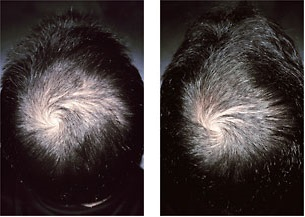
Three compounds target different nodes of the androgenic alopecia axis. RU58841 is an androgen receptor antagonist – it blocks the AR receptor itself in the follicle, designed to act locally. Finasteride it is a 5α-reductase inhibitor – reduces the production of DHT, has a systemic effect (orally). Minoxidil it works by activating potassium channels and affecting microcirculation, a mechanism not directly related to the androgen axis. RU58841 and finasteride hit the same (androgenic) axis, but at different levels – signal reception (RU58841) vs. signal production (finasteride). Related reagent RU58841 + Minoxidilum combines both mechanisms in one test solution.
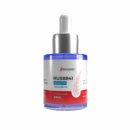
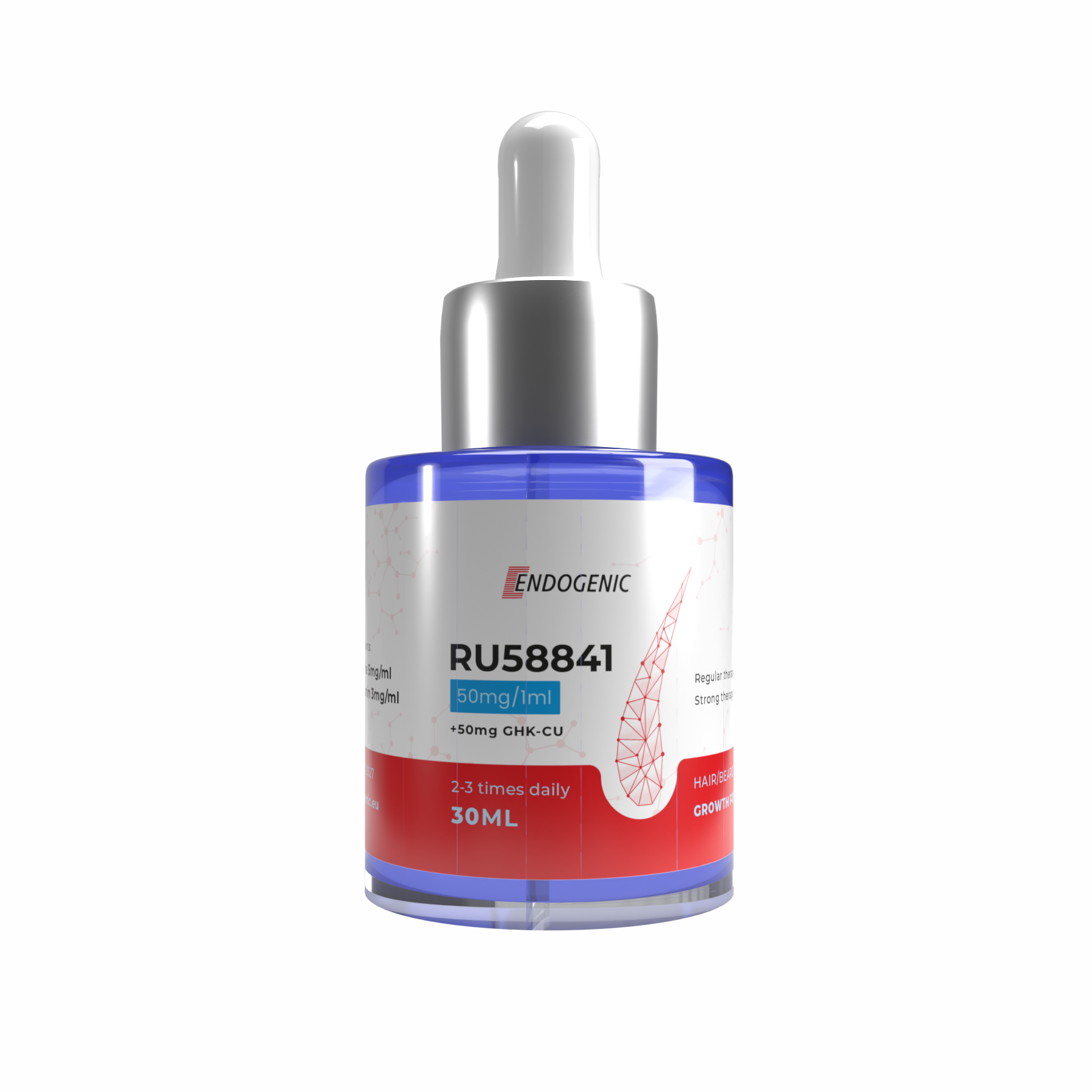
RU58841 50mg/1ml 30ml
RU58841 50 mg/ml × 30 ml (Endogenic line) is a topical solution of a non-steroidal androgen receptor (AR) antagonist in a blend with GHK-Cu, melatonin and caffeine, without DMSO. RU58841 competes with DHT for the androgen receptor in the follicle, designed to act locally. Research Use Only – Not for use on humans or animals.
59,99 €
Fast shipping
Delivery options
Free delivery from 350 €
Returns policy
RU58841 50 mg/ml 30 ml - Androgen Receptor Antagonist, Research Solution
- RU58841 50 mg/ml × 30 ml (Endogenic line) is a topical solution of a non-steroidal androgen receptor (AR) antagonist in a blend with GHK-Cu, melatonin and caffeine, without DMSO.
- RU58841 competes with DHT for the androgen receptor in the follicle, designed to act locally.
- Research Use Only - Not for use on humans or animals.
Product status information
Chemical reagent intended exclusively for laboratory tests (Research Use Only). It is not a medicinal product, dietary supplement or food. It is not intended for use on humans or animals. Sales only to registered research units and laboratories.
RU58841 (RU-58841, PSK-3841, HMR-3841) is a synthetic, nonsteroidal androgen receptor (AR) antagonist designed to act local — at the level of the tissue to which it was applied. In the literature on androgenetic alopecia (AGA), this compound holds the position of a model tool for studying one well-defined axis: competition with dihydrotestosterone (DHT) for the androgen receptor in the cells of the dermal papilla of the hair follicle.
Belongs to the line Endogenous Pro-Body – in this case as a melt solution combining the main anti-androgen with three auxiliary ingredients with a profile observed in studies on the condition of the scalp and follicles.
The history of RU58841 dates back to the 1980s and 1990s, when the compound was developed by Roussel-Uclaf, and then Hoechst Marion Roussel, as a candidate for topical treatment of acne and androgen-driven alopecia. However, clinical development was abandoned before the compound had gone through the full registration path – and since then, RU58841 has only functioned as research relationship without a completed clinical phase and without registration as a drug in any jurisdiction.
This reagent is supplied as melt solution 50 mg/ml RU58841 in a 30 ml bottle — in a format intended for application on skin models and in research on the androgen axis of the hair follicle.
The solution has character asset mix: in addition to RU58841, it contains GHK-Cu (copper tripeptide), melatonin and caffeine; without DMSO as a carrier. RU58841 purity verified by HPLC ≥98%, identity confirmed by mass spectrometry, COA with ingredient concentrations available for each batch.
Regulatory status
RU58841 has not completed any phase of human clinical trials – development by Roussel-Uclaf/Hoechst was abandoned in the 1990s. Compound is not registered as a drug with the EMA, FDA or anywhere in the world and is not listed among the authorized ingredients of dietary supplements (EFSA). Unlike registered drugs for androgenic alopecia (oral finasteride, topical minoxidil), RU58841 remains a research tool. Marketing a product as an “anti-androgen for baldness”, “hair regrowth treatment” or “topical finasteride without side effects” is contrary to the Research Use Only framework.
Androgen axis of the hair follicle and DHT
Androgenetic alopecia is the best described model of androgen-driven hair follicle miniaturization. The central actor in this process is dihydrotestosterone (DHT) — a testosterone derivative produced locally in the skin under the influence of the 5α-reductase enzyme. DHT binds to androgen receptor (AR) in the dermal papilla cells of sensitive follicles – mainly in the frontal area and on the top of the head – and triggers a transcription program leading to a gradual shortening of the growth phase (anagen), reducing the volume of the follicles and producing increasingly thinner, less colored hair.
The mechanism of this axis and the strategies of influencing it are described in more detail in the material about androgenetic alopecia therapy.
Pharmacological strategies to influence this axis are roughly divided into two groups. The first one limits DHT production — this is how finasteride and dutasteride work by blocking 5α-reductase, most often in oral form, i.e. systemically. The second one hits androgen signal reception — by blocking the AR receptor itself so that DHT (or testosterone) cannot activate it.
RU58841 belongs to the latter group: it is androgen receptor antagonist, designed to act locally, in the scalp, without the ambition of systemic blocking of androgens throughout the body. This distinction is important in understanding why RU58841 became the focus of research.
Classic systemic antiandrogens (e.g. flutamide, cyproterone) block AR effectively, but their action covers the entire body – with consequences for the hormonal balance. RU58841 is designed as a compound that is applied to the skin is metabolized locally, aiming for action limited to the site of administration, with minimal systemic exposure. In preclinical models, it is this profile—local AR blockade without systemic spillover of androgenic effect—that has been the primary focus of characterization (Battmann et al. 1994; Pan et al. 1998).
What is RU58841?
Chemically, RU58841 is a synthetic non-steroidal androgen receptor antagonist from the anilide group.
- Common name: RU58841, RU-58841
- Synonyms: PSK-3841, HMR-3841
- CAS number: 154992-24-2
- Summary formula: C₁₇H₁₉F₃N₄O₃
- Molecular weight: ~384.36 g/mol
- Pharmacological class: non-steroidal androgen receptor (AR) antagonist for topical studies on androgenetic alopecia
- Mechanism at the goal level: competitive AR blockade against DHT, local action
- Delivered form: melt solution 50 mg/ml RU58841 in a 30 ml bottle; asset blend (RU58841 + GHK-Cu + melatonin + caffeine), without DMSO
Origin: RU58841 was created as part of the search for locally acting anti-androgens conducted by Roussel-Uclaf (later Hoechst Marion Roussel) – with the assumption of impact on androgen-driven skin diseases: acne and androgenetic alopecia. Compound was pharmacologically characterized as an AR antagonist with an affinity to compete with DHT in the target tissue. Clinical development did not progress to registration, and RU58841 remained an investigational compound – used in work on hair follicle biology and the pharmacology of the androgen receptor in the skin.
Composition of the blend – RU58841 solution with auxiliary assets
The solution doesn’t just contain RU58841 – it blend a primary antiandrogen with three components with a profile observed in hair follicle and scalp studies. Medium it is not DMSO.
| Component | Class/role in the blend | Observed direction in the literature (research models) |
|---|---|---|
| RU58841 (main asset) | Nonsteroidal androgen receptor antagonist | Competitive blockade of AR against DHT in dermal papilla cells – androgen axis of follicle miniaturization |
| GHK-Cu | Copper tripeptide (glycine-histidine-lysine: Cu²⁺) | Tissue remodeling, modulation of extracellular matrix synthesis, pro-angiogenic activity of the skin |
| Melatonin | Indoleamine, antioxidant | Protection of the follicles against oxidative stress; melatonin described in the context of hair follicle biology |
| Caffeine | Methylxanthine, phosphodiesterase inhibitor | Stimulation of follicle stem cell proliferation, phosphodiesterase antagonism in in vitro models |
Mechanism of action at the molecular level
The central axis of the blend is competitive androgen receptor antagonism implemented by RU58841, supported by three auxiliary ingredients targeting other aspects of the biology of the follicle and scalp.
- Non-steroidal AR antagonist (RU58841) — RU58841 binds to the androgen receptor in the cells of the dermal papilla of the hair follicle and competes for this place with dihydrotestosterone. By occupying the receptor, it blocks the androgen miniaturization signal – a message that in androgen-sensitive follicles leads to shortening of anagen and gradual atrophy of the follicle. Unlike 5α-reductase inhibitors (finasteride), RU58841 does not reduce the production of DHT, but affects reception its signal at the receptor level.
- Local (topical) action — the compound is designed so that after application to the skin it is metabolized locally, aiming for minimal systemic absorption. This is in contrast to systemic antiandrogens (oral finasteride), whose effect covers the entire body. The local profile was the main reason for interest in RU58841 in AGA studies – the goal was AR blockade limited to the scalp.
- GHK-Cu – tissue remodeling and angiogenesis — copper tripeptide is described in skin research as a modulator of extracellular matrix protein synthesis and a pro-angiogenic factor (Pickart & Margolina 2018). In the context of the scalp, perifollicular microcirculation and matrix health constitute a node separate from the androgen axis.
- Melatonin – a scalp antioxidant — indoleamine described in the literature on the hair follicle as a protective factor against oxidative stress; melatonin and its receptors are present within the follicle, making it the subject of research on the hair cycle and antioxidant protection (Fischer et al. 2008).
- Caffeine – follicle stimulation — methylxanthine acting as a phosphodiesterase inhibitor; in in vitro models over the hair follicle, its effect on the proliferation of follicle stem cells and antagonism to the inhibitory effect of androgens in culture have been described.
Blend therefore connects one main axis (AR antagonism by RU58841) with three ingredients targeting adjacent aspects of follicle biology – remodeling, antioxidant protection and stimulation. This is a multi-component architecture in which RU58841 remains the dominant anti-androgenic asset, and the remaining components address separate research nodes. A mechanistically related reagent is GHK-Cu 20mg, also available as a systemic form for research on tissue remodeling.
IMPORTANT DISTINCTION
“Androgen axis blockade and follicular protection” in the context of this description refers only to observations in preclinical models (in vitro receptor systems, animal models, cell cultures). This is not a guarantee of human hair regrowth or a suggestion to use the solution as a treatment for baldness. Two categories should be clearly distinguished: RU58841 is a research compound without a completed clinical phase and without registration as a medicine — unlike registered drugs for AGA, such as topical minoxidil or oral finasteride.
RU58841 works locally as a receptor antagonist, while finasteride acts systemically as a 5α-reductase inhibitor – these are different mechanisms and different exposure profiles. The safety profile of RU58841 in humans after topical application has not been characterized in clinical studies.
Applications in scientific research
RU58841 is used in work on the pharmacology of the androgen receptor and hair follicle biology. In vitro models examine its affinity for AR and the ability to competitively displace DHT from the receptor in dermal papilla cells. The effect of AR blockade on markers of androgen-dependent miniaturization and the expression of androgen response genes is analyzed in skin models and follicle cultures. Specific research directions include:
- Pharmacological studies on the androgen receptor in the skin — characterization of AR antagonists, affinity mapping, structure-activity relationship (SAR) analyzes in the context of local action on the follicle
- Models of androgen-dependent miniaturization of the follicle — assessment of the impact of AR blockade on the hair cycle in cellular and animal systems
- Studies on local delivery of antiandrogens — comparison of topical vs. systemic exposure profiles, studies on local metabolism and transdermal absorption in models
- Analyzes of multi-component blends — study of the interaction of RU58841 with remodeling factors (GHK-Cu), antioxidant protection (melatonin) and stimulation (caffeine) in follicle models
- Comparative studies with other anti-AGA strategies — RU58841 (AR antagonist) as a reference to 5α-reductase inhibitors and potassium channel activators (minoxidil)
A mechanistically related reagent in follicle biology research is Minoxidil, acting through a separate node (potassium channels, microcirculation) than the androgenic axis of RU58841 – which makes both compounds the subject of comparative analyzes in the androgenic alopecia paradigm. Research protocols on the percutaneous penetration of RU58841 and minoxidil also use microneedling, e.g. using a tool such as Derma Roller, and ready-made sets combining an anti-androgen with a potassium channel activator and a roller, such as RU58841 + Minoxidil Roller.
Summary
RU58841 50 mg/ml × 30 ml (Endogenic line) is a bulk solution of a synthetic non-steroidal androgen receptor antagonist, supplied as a blend of RU58841 with GHK-Cu, melatonin and caffeine, without DMSO as a carrier. The main asset is RU58841 (CAS 154992-24-2, C₁₇H₁₉F₃N₄O₃, ~384.36 g/mol) – a compound historically developed by Roussel-Uclaf/Hoechst for local treatment of androgen-dependent skin diseases, the clinical development of which was abandoned in the 1990s. In models preclinical RU58841 was characterized as a competitive AR antagonist blocking the androgen follicle miniaturization signal, designed to act locally with minimal systemic exposure – unlike systemic finasteride.
Auxiliary ingredients address remodeling (GHK-Cu), antioxidant protection (melatonin) and follicle stimulation (caffeine). RU58841 HPLC purity ≥98%, MS Q-TOF, COA with ingredient concentrations for each batch. Regulatory Status – Research Use Only; no clinical phase in humans; no registration as a doctor.
Bibliography
- Battmann T, Bonfils A, Branche C, et al. (1994). RU 58841, a new specific topical antiandrogen: a candidate of choice for the treatment of acne, androgenetic alopecia and hirsutism. PubMed
- Münster U, Hammer S, Blume-Peytavi U, et al. (2005). RU 58841-myristate — prodrug development for topical treatment of acne and androgenetic alopecia. PubMed
- Pan HJ, Wilding G, Uno H, et al. (1998). Evaluation of RU58841 as an anti-androgen in prostate PC3 cells and a topical anti-alopecia agent in the bald scalp of stumptailed macaques. PubMed
- Pickart L, Margolina A (2018). Regenerative and Protective Actions of the GHK-Cu Peptide in the Light of the New Gene Data. PubMed
- Fischer TW, Slominski A, Tobin DJ, Paus R (2008). Melatonin and the hair follicle. PubMed
DISCLAIMER – Research reagent (Research Use Only)
Product RU58841 50 mg/ml – 30 ml (melt solution, blend) is sold exclusively as chemical reagent for laboratory tests in vitro and on animal/skin models. It is not a medicine, it is not a dietary supplement, it is not a cosmetic and it is not a product intended for human use. It is not intended to diagnose, treat, alleviate or prevent any disease, including alopecia.
RU58841 has not completed human clinical trials – clinical development was abandoned in the 1990s, and all available literature is in preclinical and in vitro models. Sales addressed to qualified research personnel, research units and laboratories. The buyer assumes full responsibility for the legal and safe use of the reagent under laboratory conditions consistent with applicable regulations and institutional guidelines.
FAQ
RU58841 is designed to be metabolized locally within the skin after topical application, aiming for minimal systemic exposure. This means that in the research models, the goal was AR blockade limited to the target tissue, without systemic effects on androgens throughout the body. Oral finasteride has the opposite effect – it blocks 5α-reductase systemically, so its effect affects the entire body. The local profile was the main reason for interest in RU58841 in studies of androgenetic alopecia.
The solution combines four assets. RU58841 it is the main antiandrogen (AR blockade). GHK-Cu — copper tripeptide studied in the context of tissue remodeling and skin angiogenesis. Melatonin — an antioxidant described in follicle biology, protection against oxidative stress. Caffeine — methylxanthine, a phosphodiesterase inhibitor, associated with stimulation of follicle cell proliferation in in vitro models. Each ingredient addresses a distinct research node in follicle and scalp biology – RU58841 remains the dominant anti-androgenic asset.
The lack of DMSO in the carrier is a conscious formulation choice. DMSO is a common carrier that increases transdermal penetration, but it also affects the skin tolerance profile and may change the kinetics of penetration of other ingredients. A solution without DMSO allows you to test the penetration profile and tolerance of the blend in conditions devoid of this strong carrier – which is sometimes important for comparative formulation tests.
RU58841 is not currently listed specifically on the WADA Prohibited List as a listed substance. Compound with an anti-androgenic/hormonal profile, however, requires verification of its status in current guidelines, as the categories of hormonal and metabolic modulators tend to be interpreted broadly. Registered Athletes (ADAMS) must verify the current Prohibited List before making any decision.
RU58841 has not completed any phase of human clinical trials. Development by Roussel-Uclaf/Hoechst was abandoned in the 1990s, before the compound had gone through the full registration process. The available literature is limited and is mainly based on preclinical models – in vitro receptor systems, animal models and follicle cell cultures. The pharmacokinetic profile after topical application in humans and the long-term safety profile have not been characterized in clinical studies.
5.0
1 review
-
Kasia
 Polski
Product review
Polecam. Świetny skład :)
Customers also bought