

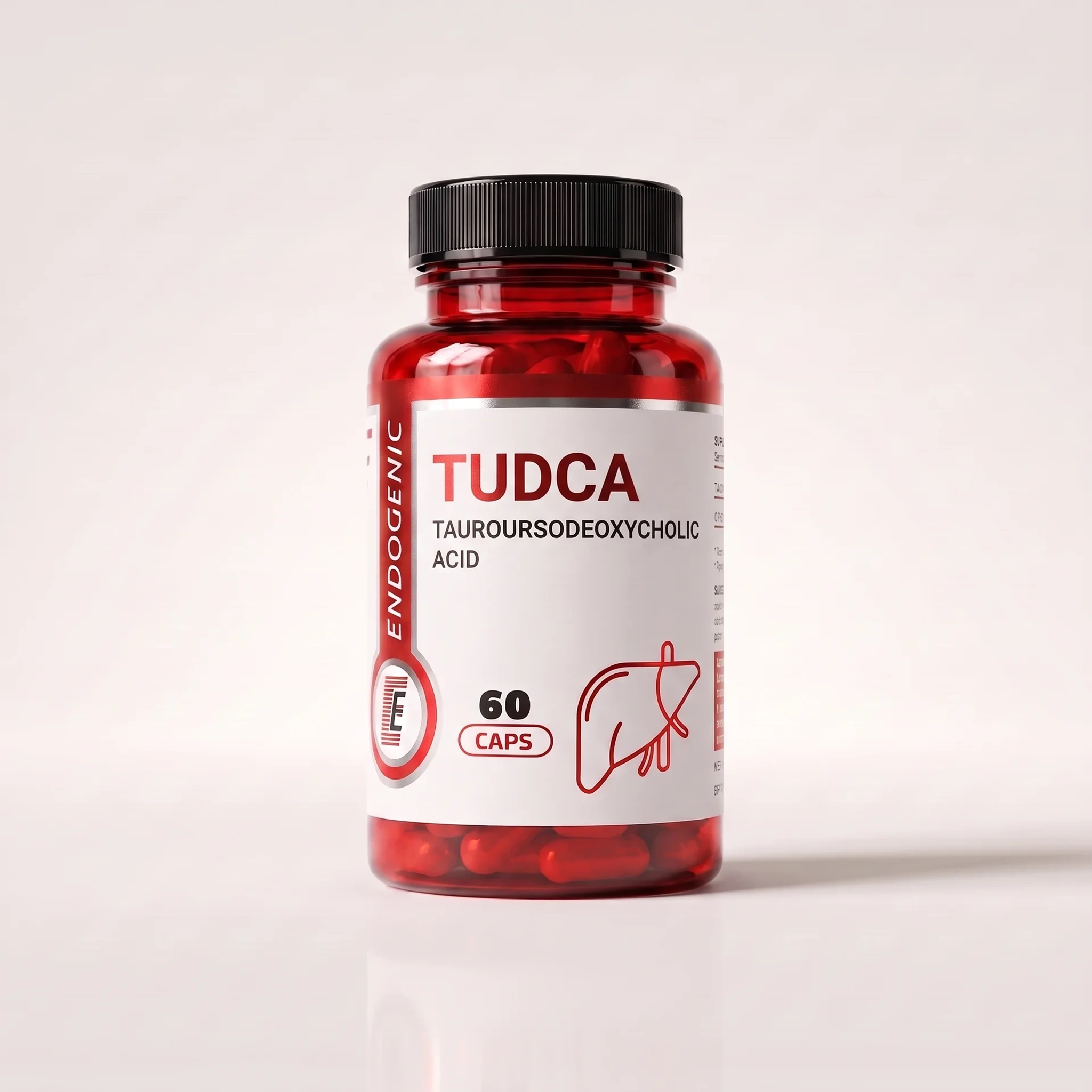
TUDCA (tauroursodeoxycholic acid) is a conjugate of ursodeoxycholic acid (UDCA) with taurine. The combination with taurine increases the solubility and hydrophilicity of the molecule. Both compounds belong to hydrophilic bile acids with a protective profile for the hepatocyte, but their status differs: UDCA is a registered prescription drug (including for cholestasis and gallstones), while TUDCA is available as a dietary supplement. This distinction has legal and practical significance – a supplement does not replace medicine or medical supervision.
TUDCA 300 mg 60 caps
TUDCA 300 mg × 60 capsules is a dietary supplement providing tauroursodeoxycholic acid – a hydrophilic bile acid with a molecularly described hepatoprotective profile. Supports hepatocyte function (reduction of ER stress, anti-apoptotic effect) and bile flow. A popular ingredient in on-cycle support protocols, 300 mg daily.
42,99 €
Fast shipping
Delivery options
Free delivery from 350 €
Returns policy
TUDCA 300 mg 60 capsules - tauroursodeoxycholic acid
- TUDCA: tauroursodeoxycholic acid.
- 300 mg, 60 capsules.
- Dietary supplement for adults, not a medicine.
TUDCA 300 mg is a dietary supplement intended for adults. The active substance is tauroursodeoxycholic acid – a hydrophilic bile acid. The product is not a medicine and does not replace a varied diet or medical consultation. Do not use during pregnancy and breastfeeding. People with bile duct obstruction, gallstones or liver disease should consult a doctor before using the product.
The liver metabolizes virtually everything that enters the bloodstream – from alcohol and drugs to hormones and protein breakdown products. This is an organ that works in the background until it begins to signal an overload of elevated enzymes in a blood test. ALT and AST markers can increase several times above the upper limit of normal in response to a hepatotoxic load – either pharmacological or resulting from an aggressive sports protocol.
For a conscious athlete who runs a cycle that puts strain on the liver, the question is not “whether to support this organ”, but “with what”. TUDCA – tauroursodeoxycholic acid – falls squarely into this area. It is a hydrophilic (“friendly”) bile acid which, unlike toxic, hydrophobic bile acids, does not burden the hepatocyte but stabilizes it.
The mechanism was described at the molecular level: TUDCA acts as a chemical chaperone, reduces endoplasmic reticulum stress and inhibits the mitochondrial apoptosis pathway in liver cells. This is a rare case of an ingredient whose hepatoprotective properties have a well-established biochemical basis, and not only a tradition of use. This product delivers 60 HPMC capsules of 300 mg TUDCA — a weight within the typical range used in on-cycle support protocols.
The capsule form allows you to precisely measure the portion without using powder with a characteristic, bitter taste profile of bile acid. The raw material is subjected to purity and identity control, and the declared TUDCA content is confirmed analytically – with the active substance weighing hundreds of milligrams, batch repeatability has a real impact on the noticeable effect.
SCIENTIFIC PERSPECTIVE
TUDCA has conducted research on humans – including trials assessing insulin sensitivity and liver function – which distinguishes it from many “research compounds” based solely on animal models. However, some of the strongest data comes from clinical populations (cholestasis, NAFLD, metabolic disorders), so the translation to a healthy cycling athlete is an extrapolation of the mechanism. Take this supplement with realistic expectations: it supports hepatocyte function and bile flow, not a “detox” in the marketing sense.
What is TUDCA and where does it come from?
Chemically, TUDCA is a conjugate of two molecules: ursodeoxycholic acid (UDCA) and the amino acid taurine. The combination with taurine gives the molecule high solubility and hydrophilicity, thanks to which TUDCA remains “gentle” for cell membranes – unlike hydrophobic bile acids, which, when accumulated, have a detergent effect on the hepatocyte and lead to its damage.
- Common name: TUDCA, tauroursodeoxycholic acid, ursodeoxycholic taurate
- International name: Tauroursodeoxycholic acid
- CAS number: 14605-22-2
- Summary formula: C₂₆H₄₅NO₆S
- Molar mass: 499.71 g/mol
- Compound Class: hydrophilic bile acid (taurine and UDCA conjugate)
- Delivered form: HPMC capsule, 300 mg TUDCA, 60 capsules
TUDCA occurs naturally in bile, although only in trace amounts in humans – it constitutes a small fraction of the bile acid pool. Much higher concentrations were recorded in bear bile, which became the basis for centuries of use of bear bile in traditional Chinese medicine (TCM) for liver and gastrointestinal ailments. A modern supplement raw material is synthesized or semi-synthetic tauroursodeoxycholic acid of defined purity – without animal raw material – which determines both the repeatability of portions and the ethics of acquisition.
Bile acids - why they are not all created equal
To understand why TUDCA protects the liver, you need to look at the bile acid pool as a collection of molecules with very different profiles. Bile acids are biological detergents – they emulsify fats in the intestine and enable their absorption. However, the same detergent nature has a flip side: hydrophobic bile acids (e.g. deoxycholic acid, lithocholic acid) when accumulated in the hepatocyte dissolve cell membranes and induce apoptosis.
In cholestasis, when bile flow is impaired, it is this toxic hydrophobic charge that damages liver cells. TUDCA represents the opposite pole. As a hydrophilic acid, it does not damage membranes, and additionally “dilutes” the pool of bile acids, shifting its composition to a less toxic side. It’s a concept that can be compared to ballast in a boat – you add a molecule that stabilizes the entire system rather than tilting it toward failure.
In practice, this means two vectors of protection at the same time: direct stabilization of the hepatocyte and indirect reduction of the toxicity of the biliary environment. This distinction also explains why TUDCA and its “cousin” UDCA are used in gastroenterology, while other bile acids are treated as damaging agents. It is determined by hydrophilicity and the way the molecule interacts with the membrane and the cellular apparatus of the hepatocyte.
Mechanism of action - four axes of hepatoprotection
TUDCA does not have a single point of attachment. The literature describes at least four complementary mechanisms that together contribute to the hepatoprotective profile. Each of them ends with the same practice: a more stable, better functioning hepatocyte.
Reduction of endoplasmic reticulum stress (chemical chaperone)
The endoplasmic reticulum (ER) is the intracellular protein “assembly line” – it is here that amino acid chains fold into functional spatial structures. When metabolic overload, toxins or oxidative stress occur, folding breaks down, misfolded proteins accumulate and the cell triggers the ER stress response (UPR – unfolded protein response). Chronic ER stress pushes the hepatocyte towards apoptosis.
TUDCA works like chemical chaperone — stabilizes the protein folding process and moderates the UPR response. In practice: the cell “panics” less often due to the accumulation of defective proteins, which translates into greater resistance of the hepatocyte to the load. This is a mechanism described in metabolic models and considered one of the main axes of TUDCA action.
Anti-apoptotic effect (inhibition of the mitochondrial cell death pathway)
Apoptosis, i.e. programmed cell death, runs, among others, mitochondrial pathway: damaged mitochondria release cytochrome c, which activates caspases – executive enzymes that disassemble the cell. In a liver loaded with toxins or hydrophobic bile acids, this pathway may be overactive. TUDCA inhibits this cascade mechanism – it stabilizes the mitochondrial membrane and limits the release of cytochrome c and the activation of caspases. The result is less hepatocyte loss under stress conditions. This anti-apoptotic vector has been described for both TUDCA and the related UDCA and is considered to be the biochemical core of their protective effects.
Improved bile flow (choleretic effect)
TUDCA has choleretic properties – it supports the outflow of bile and protects the bile ducts. In states of cholestasis, when bile remains, hydrophilic tauroursodeoxycholic acid helps maintain the flow and protects the biliary epithelium against the toxic effects of retained, hydrophobic bile acids. The mechanism was associated with, among others, with an impact on membrane transporters responsible for the secretion of bile components. In sports and metabolic practice, this means supporting the part of the hepatobiliary system that is responsible for the removal of metabolic products – more efficient bile outflow means less congestion.
Modulation of lipid metabolism, insulin sensitivity and protection against lipotoxicity
The fourth axis goes beyond the liver itself in a narrow sense. Human studies have described the effect of TUDCA on insulin sensitivity, and in metabolic models – on lipid metabolism and protection of cells against lipotoxicity (damage resulting from excess fatty acids) and oxidative stress. Since fatty liver disease (NAFLD) and insulin resistance are linked, this direction explains the interest in TUDCA in the context of metabolic health and not just acute hepatoprotection.
There is an honest line to be drawn: the strongest metabolic data comes from populations with disorders (insulin resistance, steatosis), and transfer to the healthy, trained athlete is an area where large trials are lacking. The literature suggests a real mechanism – it does not promise a dramatic improvement in parameters in a healthy person.
What the research shows
TUDCA is one of the better documented bile acids with hepatoprotective potential, with experience including human trials. In a controlled study, Kars et al. 2010 (Diabetes), TUDCA was administered to obese people and insulin sensitivity was assessed. The authors reported an improvement in insulin sensitivity at the liver and muscle level compared to baseline values, linking the observation to the effect of TUDCA on ER stress.
This is one of the attempts that transferred the “chemical chaperone” mechanism from an animal model to a human – provided the group size was small. The review by Beuers 2006 (Nat Clin Pract Gastroenterol Hepatol) describes the mechanisms and sites of action of ursodeoxycholic acid (UDCA – directly related to TUDCA) in cholestasis. The author indicates three main vectors: stimulation of bile secretion, protection of cholangiocytes against toxic bile acids and anti-apoptotic effect.
It is from this trend that the well-established description of the choleretic and protective profile of this class of compounds comes. The neuroprotective direction of TUDCA and UDCA—beyond the liver—was summarized in a review by Vang et al. 2014 (Glob Adv Health Med), indicating a surprisingly wide spectrum of applications of both bile acids beyond liver diseases, including in models of neurodegenerative diseases.
A separate topic of neuroprotection was developed by the group of Boatright et al. 2009 (J Ocul Biol Dis Infor), describing the protective effect of bile acids, including TUDCA, in models of retinal nerve cell degeneration. In the context of an athlete and a person who cares about their metabolism, it is worth keeping the proportions in mind: the strongest data concern cholestasis, fatty liver and metabolic disorders, and the transfer to a healthy body carrying out a cycle that burdens the liver is an area of mechanism, not a clinically confirmed benefit. This is a fair framework of expectations.
How to dose TUDCA
TUDCA works in weights of hundreds of milligrams – hence the capsule form with a measured 300 mg dose has a practical advantage over weighed bitter powder.
- Standard portion: 1 capsule (300 mg) daily as general support; in on-cycle support protocols, higher portions are used – most often 500–1000 mg per day, divided into 1–2 receptions
- Party time: TUDCA is sometimes taken without regard to meals; some people prefer to take it with a meal containing fat for gastric comfort. When dividing the dose, spread the receptions into the morning and evening
- On-cycle vs off-cycle: during periods of liver stress (hepatotoxic protocol, intensive pharmacology), a higher portion is used for the entire duration of the stress; outside the cycle, a lower portion is sufficient as supporting support
- Cyclic use: TUDCA is most often woven into the framework of a specific cycle (e.g., the duration of the challenging protocol plus the period after it); long-term continuous use should be consulted with a doctor and monitored with a liver panel
- Do not exceed a reasonable portion without the need – at high doses a laxative effect is possible (see below)
Start by assessing your tolerance with a lower dose before switching to the full dose on-cycle. This is a reasonable approach for any ingredient that affects the biliary system. The best compass for a liver-loading protocol remains your blood tests – the liver panel before, during and after the cycle gives a real picture that no supplement can replace.
SCIENTIFIC PERSPECTIVE
The range of TUDCA doses is wide because it depends on the goal: a person looking for general metabolic support has different needs than an athlete on a strenuous protocol. A higher dose is not automatically better – when the intestinal tolerance is exceeded, a laxative effect occurs, which sets a practical portion ceiling for you. Listen to your body’s reaction and do not double the dose “to get stronger”.
What to combine with TUDCA - liver support stack
TUDCA fits well into a broader liver support protocol (on-cycle support), where individual ingredients act at different stages of metabolism and protection of the hepatocyte. If you prefer a ready-made, multi-component formula instead of a single bile acid, the alternative is a comprehensive hepatoprotector Liver Guard for the liver; TUDCA can also be treated as a targeted supplement to such a database:
- NAC (N-acetylcysteine) — a precursor of glutathione, the main intracellular antioxidant of the liver. TUDCA stabilizes the hepatocyte structurally (ER, mitochondria), NAC enhances its antioxidant potential – two different vectors of the same protection
- Milk thistle (silymarin) — the best documented plant hepatoprotector, affecting, among others, for hepatocyte regeneration and membrane protection. The classic partner of TUDCA in the liver stack
- Choline — supports fat metabolism in the liver and limits their accumulation; important in the context of steatosis. Complementary to the metabolic axis of action of TUDCA
- B vitamins and antioxidants (e.g. ALA – alpha-lipoic acid) as a supplement to metabolic and redox support
The logic of the stack is simple: TUDCA covers the bile axis and the structural stabilization of the hepatocyte, NAC and milk thistle – the antioxidant and regenerative axis, choline – the fat axis. A related flavonoid with a hepatic profile, most often associated with protection from alcohol exposure, is DHM hepatic flavonoid — is sometimes woven into the same context of the hepatocyte envelope.
Whenever combining, start with a low, single serving of each ingredient and watch your body’s reaction. Full stack on-cycle support is worth consulting with your doctor, especially if you are taking medications at the same time.
IMPORTANT DISTINCTION
Liver support in the form of TUDCA and related ingredients does not make a hepatotoxic protocol safe. The protective supplement limits the load and does not eliminate its cause. Deciding on any liver-stressing protocol is a separate topic of medical liability and oversight – TUDCA is a support tool, not a license to risk.
Safety profile and contraindications
When maintaining the supplementation dose, TUDCA is usually well tolerated. The most common side effect – resulting directly from the nature of bile acid – is:
- diarrhea/loose stools at higher doses (osmotic-laxative effect of bile acid in the intestine); usually goes away when the portion is reduced or the dose is divided
- possible gastrointestinal discomfort, nausea in sensitive people
Absolute precautions and contraindications:
- Biliary obstruction — when bile outflow is blocked, choleretic stimulation may be inadvisable; requires medical evaluation
- Cholelithiasis — use only after consulting a doctor
- Acute diseases of the liver and biliary tract — protocol conducted under medical supervision and research control
- Pregnancy and breastfeeding — insufficient data, do not use
- Taking medications in parallel — bile acids may affect the absorption of some substances; consult your doctor when using pharmacotherapy
In case of a strenuous protocol, it is worth using TUDCA together with liver panel monitoring (ALT, AST, GGTP, bilirubin) – it makes the situation objective and allows you to react in time. The cover supplement does not release you from the responsibility for parameter control.
REGULATORY INFORMATION
TUDCA in this product is an ingredient of a dietary supplement. The dietary supplement is not a medicinal product and is not intended to diagnose, treat or prevent disease. Claims regarding liver and biliary function are made in the support category, in line with the framework used for dietary supplements in the EU. It is important to distinguish TUDCA (supplement) from ursodeoxycholic acid (UDCA) as a prescription drug.
Summary of benefits
TUDCA 300 mg × 60 capsules is a dietary supplement providing tauroursodeoxycholic acid – a hydrophilic bile acid with a well-established hepatoprotective profile described at the molecular level. The mechanism works on four axes: reducing endoplasmic reticulum stress (chemical chaperone), inhibiting the mitochondrial apoptosis pathway, supporting bile flow and modulating lipid metabolism and insulin sensitivity.
The Kars 2010 study transferred the chaperone mechanism to humans, and the work of Beuers 2006 and the Vang 2014 review consolidated the description of the choleretic, protective and antiapoptotic effects of this class of bile acids. A portion of 300 mg daily as general support, 500-1000 mg in on-cycle support protocols, awareness of contraindications and liver panel control – this is a reasonable framework for use.
Scientific sources
- Vang S, Longley K, Steer CJ, Low WC (2014). The Unexpected Uses of Urso- and Tauroursodeoxycholic Acid in the Treatment of Non-liver Diseases. PubMed
- Kars M, Yang L, Gregor MF, Mohammed BS, Pietka TA, Finck BN, et al. (2010). Tauroursodeoxycholic acid may improve liver and muscle but not adipose tissue insulin sensitivity in obese men and women. PubMed
- BeuersU (2006). Drug insight: Mechanisms and sites of action of ursodeoxycholic acid in cholestasis. PubMed
- Boatright JH, Nickerson JM, Moring AG, Pardue MT (2009). Bile acids in treatment of ocular disease. PubMed
FAQ
On-cycle support is a protocol for supporting the body during a cycle that burdens selected organs – most often the liver. TUDCA serves as a shield for the hepatocyte: it stabilizes the liver cell at the level of the endoplasmic reticulum and mitochondria and supports the flow of bile. In practice, it is used for the duration of the challenging protocol, often at a dose of 500–1000 mg daily, along with monitoring of the liver panel.
The endoplasmic reticulum is the intracellular assembly line for proteins—the place where they fold into functional structures. When metabolic overload occurs, folding breaks down, defective proteins accumulate and the cell triggers a stress response (UPR), which, if chronically intense, leads to apoptosis. TUDCA acts as a chemical chaperone – it supports proper folding and moderates the ER stress response. In practice: the hepatocyte is more resistant to stress.
As general support, take 1 capsule (300 mg) daily. In on-cycle support protocols, the portions are higher – most often 500–1000 mg per day, divided into 1–2 receptions. TUDCA is sometimes taken regardless of meals, although some people prefer to take it with a meal containing fat for gastric comfort. Start with a lower dose to assess tolerance and do not exceed the dose unnecessarily.
At higher doses, a laxative effect is possible – this is a natural consequence of the action of bile acid in the intestine. Loose stools usually go away by lowering the portion or splitting the dose into two doses. Intestinal tolerance is individual and in practice determines the practical portion ceiling – if discomfort occurs, reduce the dose.
TUDCA fits well in a liver support stack with NAC (glutathione precursor, antioxidant axis), milk thistle (silymarin, regenerative axis) and choline (fat metabolism in the liver). Each ingredient works at a different stage of hepatocyte protection. When combining, start with a small, single portion of each ingredient, and consult the full stack on-cycle support with your doctor – especially in the case of parallel pharmacotherapy.
5.0
1 review
-
Wojciech
 Polski
Product review
Fajnie, że firmie udało się dodać ten produkt do oferty. Zamówiłem, używam, nie mam się do czego przyczepić :) Paczka doszła na drugi dzień. Polecam
Customers also bought