Skip to content

Free delivery on orders over €350. Fast delivery.

Search

What are you looking for?

Type at least 2 characters to see suggestions.

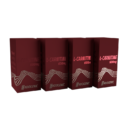
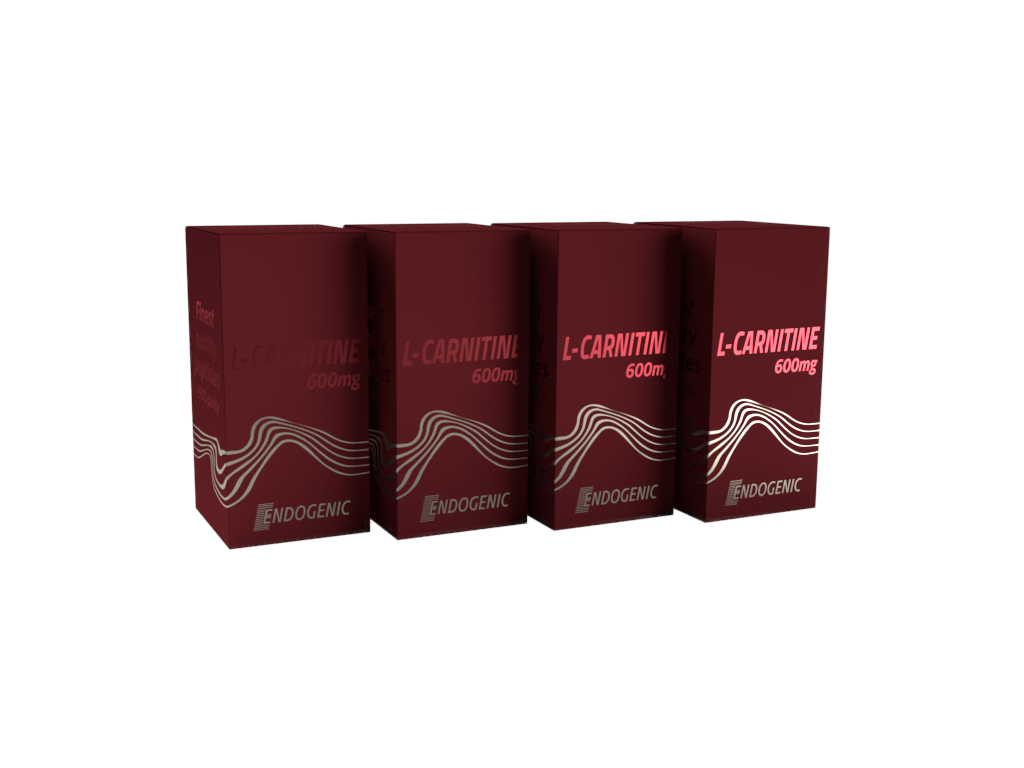
Zestaw 3x L-Carnitine 600mg/ml + 1 gratis

Zestaw 3x L-Carnitine 600mg/ml + 1 gratis

Set 3x L-Carnitine 600 mg/ml + 1 free (4 × 10 ml = 40 ml = 24,000 mg) — L-carnitine in solution for intramuscular injection, highest concentration in the series. Fatty acid transport molecule (CPT1/CPT2 system) with injection bioavailability close to 100%. Variant for advanced users 21+ with experience with concentrations of 200/400.

192,99 €
Fast shipping
Delivery options Free delivery from 350 €
Returns policy
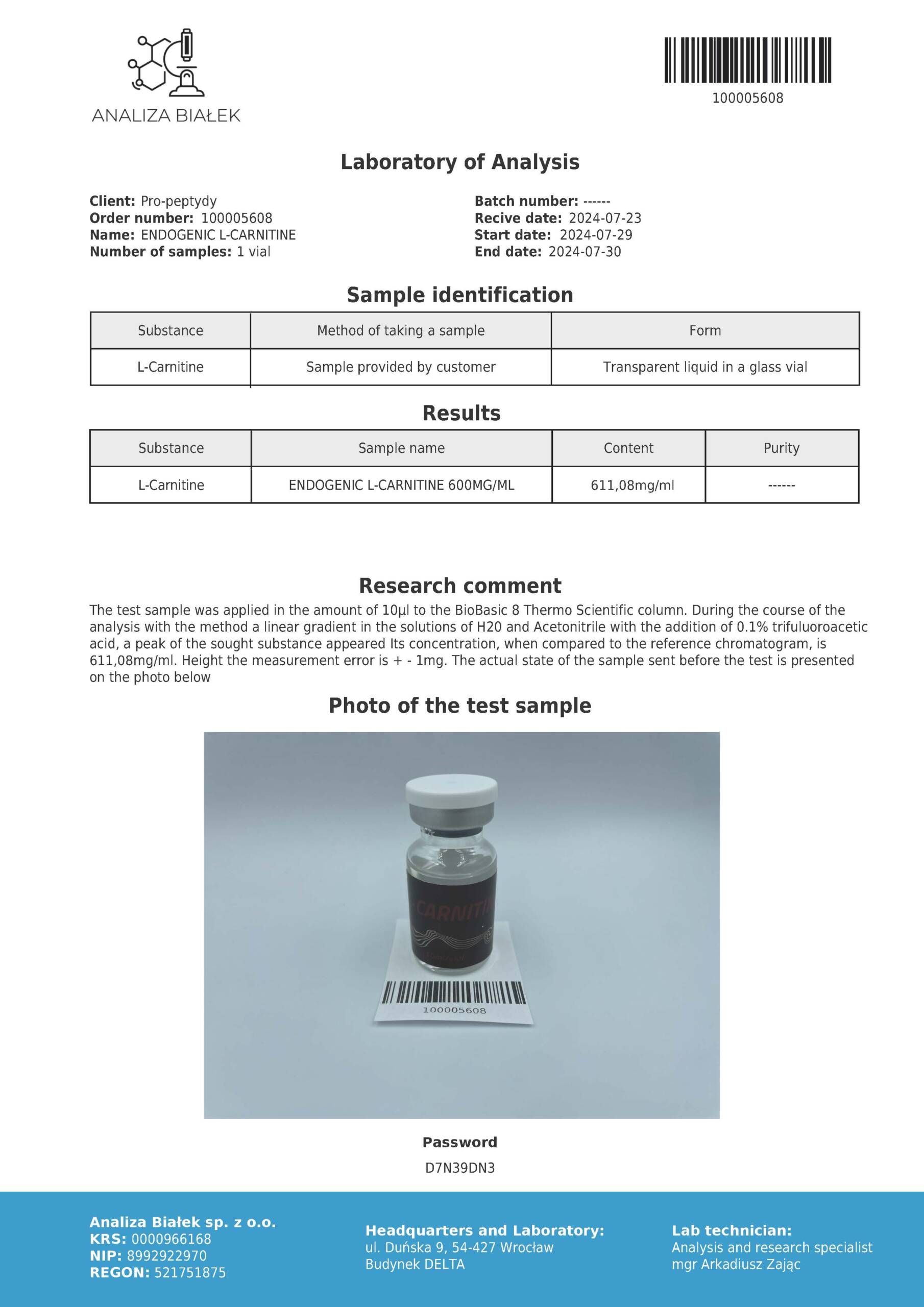
View the laboratory analysis report

Set 3x L-Carnitine 600 mg/ml + 1 free - L-carnitine, solution for intramuscular injection, highest concentration

  • L-carnitine: concentration of 600 mg/ml.
  • Buy 3, get 1 free: four 10 ml vials, totalling 40 ml and 24,000 mg.
  • Product characteristics, contraindications and legal status are described below.

A specialized sports preparation in the form of a solution for intramuscular injection, intended only for adults (21+) with documented tolerance to lower concentrations, for self-assessment of risk. L-carnitine injection solution is not a dietary supplement in the Polish and EU legal sense or a medicinal product. The concentration of 600 mg/ml is the highest and most advanced variant in the series – it is not intended for people without previous experience with the injection form.

Please read the “Critical Warnings for 600 mg/ml” section, the “Legal Status” section and the absolute contraindications at the end of the description before making any decision.

WARNING – WADA M2.2 (Professional Athlete Prohibition)

Intravenous and intramuscular injections in volumes exceeding 100 ml in a period of 12 hours are prohibited by the World Anti-Doping Agency (WADA) under section M2.2 (chemical and physical manipulations) — regardless of the substance administered. L-carnitine itself is not listed as a prohibited substance, however route of administration in the form of injection subject to volume limitations. Registered athletes (ADAMS) must check the current list of prohibited methods before making any decision regarding use. The volume threshold also applies to a single injection.

L-carnitine in injectable form is one of the more misunderstood tools in a weight loss athlete’s arsenal. Orally, the molecule has a real problem: the bioavailability of tablets and capsules ranges around 14–18%, and most of the ingested dose never reaches the muscle in an active form (Rebouche, pharmacokinetic data). Hence the interest in the intramuscular route – it bypasses the digestive tract and first-pass metabolism, delivering the molecule into the circulation with a bioavailability close to 100%.

The entire series L-carnitine in injection addresses this very problem of bioavailability. Variant 600 mg/ml is the highest concentration in the Pro-Body series and the answer to a specific question for advanced users: how to administer a high dose with the smallest possible injection volume. At this concentration, 1 ml of solution contains 600 mg of L-carnitine – a dose that would require three milliliters in the 200 mg/ml variant.

A smaller volume means a shorter injection and less fluid deposited in the tissue at one time. However, the same solution density that is an advantage for advanced users is also a source of increased local risk – and this is the axis around which this entire description is built. Coach Marek would say straight: 600 mg/ml is not the concentration you start with.

This is the concentration you reach after going through 200 and 400, when the injection technique is mastered and the muscle tissue knows what to expect. If you have never performed an intramuscular injection, this product is not a starting point – start with the starting variant which is set 3x L-Carnitine 200mg with the lowest local risk.

This set is four vials of 10 ml (3 + 1 free = 40 ml, total 24,000 mg L-carnitine) at a concentration of 600 mg/ml, pharmaceutical quality, purity ≥98% HPLC, identity confirmed by mass spectrometry (MS confirmation), COA available for each batch.

Positioning the 600 mg/ml concentration - when and why it is highest

The Pro-Body injection L-carnitine series includes three concentrations that vary solely by the density of the solution — the particle, purity and quality are identical. The practical difference comes down to the volume needed to administer the same dose and the local risk profile.

Concentration Volume for 600 mg Volume for 1200 mg Local risk profile For whom
200 mg/ml 3 ml 6 ml Lowest (least dense solution) First injection, tolerance assessment
400 mg/ml 1.5 ml 3 ml Moderate Standard for experienced
600 mg/ml 1 ml 2 ml Highest (hyperosmolarity) Advanced with mastered technique

The 600 mg/ml logic is purely volumetric. At high working doses (1800–2400 mg), the 200 mg/ml variant requires 9–12 ml of solution, which translates into several injections or one very large volume deposited in the muscle. A concentration of 600 mg/ml reduces this to 3-4 ml – less fluid, shorter injection, less tissue stretching at one time. However, this advantage comes at a price. The thicker the solution, the higher its osmolality and the greater the tissue irritation at the injection site. Therefore, 600 mg/ml is an option for people who:

  • have completed cycles at concentrations of 200 and/or 400 mg/ml without excessive local reactions,
  • have mastered the intramuscular injection technique, including the Z-track method,
  • they use strict rotation of injection sites,
  • they consciously choose a smaller volume at the expense of higher local risk.

If any of these conditions are not met, the standard option is the right choice – set 3x L-Carnitine 400mg with moderate local risk or lower concentration. Concentration is not a measure of quality – it is a measure of the advancement of the person using it.

Mechanism of action at the molecular level

L-carnitine is not a stimulant or a “burner” in the common sense. It is a transport molecule – its function is to transport fatty acids across the mitochondrial membrane, i.e. to the threshold beyond which fat can be burned for energy. Without it, long-chain fatty acids have no way to enter the mitochondria.

Fatty acid transport – CPT1/CPT2 system

The heart of L-carnitine’s action is carnitine pendulum (carnitine shuttle). Long-chain fatty acids do not cross the inner mitochondrial membrane on their own. Enzyme CPT1 (carnitine palmitoyltransferase 1) on the outer membrane, it attaches carnitine to an activated fatty acid (acyl-CoA), forming acylcarnitine. This form crosses the membrane and on the other side CPT2 it detaches carnitine and releases acyl-CoA into the mitochondrion (Karlic and Lohninger 2004). In practice: L-carnitine is a “pass” without which fat stops at the border of the mitochondrion and is not used as fuel.

β-oxidation – what happens on the mitochondrial side

After being introduced into the mitochondrial matrix, acyl-CoA enters β-oxidation — a cycle of reactions that break down fatty acid into acetyl-CoA units, which power the Krebs cycle and the respiratory chain. This is where ATP is produced from fat. The availability of carnitine is one of the factors limiting the rate of this process, especially in conditions of increased energy demand (Stephens, Constantin-Teodosiu and Greenhaff 2007). In sports practice: in case of caloric deficit and aerobic exercise, carnitine supports the metabolism towards fat oxidation.

CoA pool buffering – an underestimated mechanism

L-carnitine also acts as a buffer for free coenzyme A. During intense exercise, acetyl-CoA accumulates in the muscle, which “binds” the pool of free CoA needed for further energy reactions. Carnitine takes over acetyl groups (forming acetylcarnitine), releasing free CoA and maintaining the efficiency of energy metabolism (Stephens, Constantin-Teodosiu and Greenhaff 2007). This is a mechanism that connects carnitine not only with fat reduction, but also with exercise capacity.

Post-exercise recovery markers

Some studies indicate the role of L-carnitine in limiting muscle damage after exercise. Volek and colleagues (2002) showed that L-carnitine supplementation was associated with lower markers of muscle tissue damage and less oxidative stress after resistance training, possibly by improving blood flow and reducing tissue hypoxia. In practice: fewer markers of damage may translate into better tolerance of training volume.

Impact on muscle endurance and metabolism

In a controlled human study, Wall and colleagues (2011) showed that long-term L-carnitine supplementation (with simultaneous administration of carbohydrates to increase its muscle uptake) increased muscle carnitine content and modulated energy metabolism during exercise – with an intensity-dependent effect. This is one of the few studies that has shown an actual increase in muscle carnitine in healthy people, which is a prerequisite for any functional effect.

Dose positioning - metering at 600 mg/ml

The highest concentration means that small volumes translate into large doses. This is an advantage (less fluid in the muscle) and at the same time a pitfall (easier to make a measurement error). Conversion table:

Volume L-carnitine dose
0.5 ml 300 mg
1 ml 600 mg
1.5 ml 900 mg
2 ml 1200 mg
3 ml 1800 mg
4 ml 2400 mg (maximum dose)

At 600 mg/ml, a difference of 0.5 ml on the syringe is 300 mg – measurement error is more important than at lower concentrations. Hence the recommendation to use a syringe with a clear scale and to measure it calmly.

Critical warnings for concentration 600 mg/ml

This is the section that distinguishes 600 mg/ml from the lower variants. The hyperosmolarity of the solution generates three specific local threats that should not be underestimated.

Reaction at the injection site (irritation, pain, inflammation)

The hyperosmolar solution “draws” water from the tissues at the injection site, which increases pain, redness and swelling. At 600 mg/ml, the injection pain is stronger than at 200/400 mg/ml – this is not a sign of a product defect, but a consequence of the physics of the solution. Injecting slowly and warming the vial to body temperature before injection reduces discomfort. Pain lasting more than 48 hours, increasing swelling, redness with warmth or fever requires contact with a doctor – these are possible symptoms of infection.

Intramuscular fibrosis (fibrosis) with frequent injections in the same place

Repeated injection of a hyperosmolar solution into the same muscle leads to chronic tissue irritation and deposition of fibrous tissue (fibrosis). Fibrosis manifests itself as muscle hardening, pain and limited mobility. This is the main reason why Seat rotation is mandatory, not optional, and no muscle should be used more than once a week. Fibrosis develops in secret – prevention is the only real strategy.

Sterile abscess

A hyperosmolar solution deposited too shallowly or in excessive volume may cause a sterile abscess – a painful, inflammatory thickening without the involvement of bacteria. Technique Z-track and depositing the solution deep intramuscularly (not subcutaneously) are the simplest prevention. Any growing, hard, painful lump at the injection site requires medical evaluation.

The overriding principle

At 600 mg/ml, technique and rotation are more important than dose. If local reactions are severe despite correct technique, the most appropriate decision is to return to the concentration of 400 mg/ml. Choosing the highest concentration is not an end in itself.

Safety rules

Injectable L-Carnitine 600 mg/ml has a real risk profile dominated by local risks (discussed above) and several systemic issues.

TMA/TMAO – metabolic context

Oral L-carnitine is metabolized by the intestinal microbiome to trimethylamine (TMA) and then in the liver to TMAO (trimethylamine N-oxide) — a metabolite associated with cardiovascular risk in observational studies (Koeth et al. 2013, Nat Med). Intramuscular injection bypasses the intestinal pathway, which theoretically limits TMAO production from this route. This does not change the fact that data on the long-term safety of chronic carnitine intake remain a subject of debate – an important issue, especially for people with cardiac problems.

Other rules

  • Do not exceed the maximum dose (4 ml / 2400 mg per injection) – excess plasma carnitine is excreted renally and “overload” does not increase muscle saturation
  • Renal failure is a contraindication (carnitine eliminated renal)
  • Thyroid disorders – L-carnitine may modulate the peripheral action of thyroid hormones; consultation for hyper/hypofunction
  • Caution with anticoagulant drugs from the coumarin group (warfarin, acenocoumarol) – potential intensification of the anticoagulant effect has been reported
  • Absolutely maintain sterility: new needle and syringe for each injection, skin disinfection, no reuse
  • Cyclical, not continuous use

Lack of experience with lower concentrations = contraindication

This is a rule specific to the 600 mg/ml variant. The highest concentration is not the starting point. Lack of previous experience with L-carnitine injections at a concentration of 200 or 400 mg/ml constitutes contraindication to starting with 600 mg/ml — due to the increased local risk and the requirement to master the Z-track technique. The first injection in life should not be an injection of a hyperosmolar solution.

Absolute contraindications

  • Pregnancy and breastfeeding
  • Age under 21
  • No experience with the injection form of L-carnitine (200/400 mg/ml) – for the 600 mg/ml variant
  • Kidney failure
  • Uncontrolled thyroid disorders
  • Use of anticoagulants from the coumarin group (without consultation)
  • A history of injection site reactions, fibrosis, or abscesses
  • Professional athletes subject to anti-doping control – due to the WADA M2.2 volume threshold for the injection route

Legal status

The status of L-carnitine depends on the route of administration – and this distinction is legally important.

  • Oral form (allowed in food): L-carnitine and acetyl-L-carnitine are ingredients evaluated and approved by EFSA for use in food and dietary supplements. In this form, the molecule is a legal nutraceutical ingredient.
  • Injection form (outside the dietary supplement framework): solution for intramuscular injection is not a dietary supplement in the Polish and EU legal sense – parenteral route excludes the category of food. We classify this preparation as: specialist sports preparation for adults (21+), for independent risk assessment, outside the framework of a dietary supplement and outside the scope of drug registration.
  • GIS: The Chief Sanitary Inspectorate does not qualify the L-carnitine injection solution as a permitted form of dietary supplement – the parenteral form remains outside the food framework. For this reason, the preparation functions as a product for advanced users 21+, not as a supplement.
  • WADA (section M2.2): L-carnitine itself it is not a prohibited substance. But injections (intravenous and intramuscular) in a volume exceeding 100 ml per 12 hours are prohibited as a method of chemical and physical manipulation (M2.2), regardless of the substance administered. Registered Athletes (ADAMS) must verify the current list of prohibited methods before making any decision.

The preparation is intended only for adults (21+) with documented tolerance to lower concentrations, for self-assessment of risk. Communication of the product as a medicine, as a dietary supplement or as a means of “guaranteeing fat burning” is unacceptable.

Summary

L-carnitine (CAS 541-15-1, C₇H₁₅NO₃, 161.20 g/mol) is a transport molecule whose function is to transfer long-chain fatty acids across the mitochondrial membrane via the CPT1/CPT2 system – that is, making fat available for β-oxidation and ATP production (Karlic and Lohninger 2004, Stephens et al. 2007). It also acts as a buffer of the CoA pool and is associated with lower markers of muscle damage after exercise (Volek et al. 2002) and with the modulation of muscle metabolism (Wall et al. 2011).

Variant 600 mg/ml is the highest concentration in the series — its advantage is practical (small volumes at high doses: 1 ml = 600 mg, 4 ml = 2400 mg max), not pharmacodynamic. The price of this advantage is increased local risk resulting from hyperosmolarity: stronger injection pain, risk of fibrosis and sterile abscess – hence the mandatory rotation of sites, the Z-track technique and the requirement for previous experience with concentrations of 200/400 mg/ml.

The injection form bypasses the problem of low oral bioavailability (~14–18% → ~100%) and the intestinal TMA/TMAO pathway. This set includes 4 vials (3 + 1 free = 40 ml = 24,000 mg), purity ≥98% HPLC, MS confirmation, COA per batch – specialized sports preparation for advanced users (21+), not a drug and not a dietary supplement. Injections above 100 ml/12 h are covered by the WADA M2.2 ban.

Bibliography

  1. Stephens FB, Constantin-Teodosiu D, Greenhaff PL (2007). New insights concerning the role of carnitine in the regulation of fuel metabolism in skeletal muscle. PubMed
  2. Wall BT, Stephens FB, Constantin-Teodosiu D, Marimuthu K, Macdonald IA, Greenhaff PL (2011). Chronic oral ingestion of L-carnitine and carbohydrate increases muscle carnitine content and alters muscle fuel metabolism during exercise in humans. PubMed
  3. Volek JS, Kraemer WJ, Rubin MR, Gómez AL, Ratamess NA, Gaynor P (2002). L-Carnitine L-tartrate supplementation favorably affects markers of recovery from exercise stress. PubMed
  4. Karlic H, Lohninger A (2004). Supplementation of L-carnitine in athletes: does it make sense?. PubMed
  5. Pekala J, Patkowska-Sokoła B, Bodkowski R, Jamroz D, Nowakowski P, Lochyński S, et al. (2011). L-carnitine — metabolic functions and meaning in human life. PubMed