

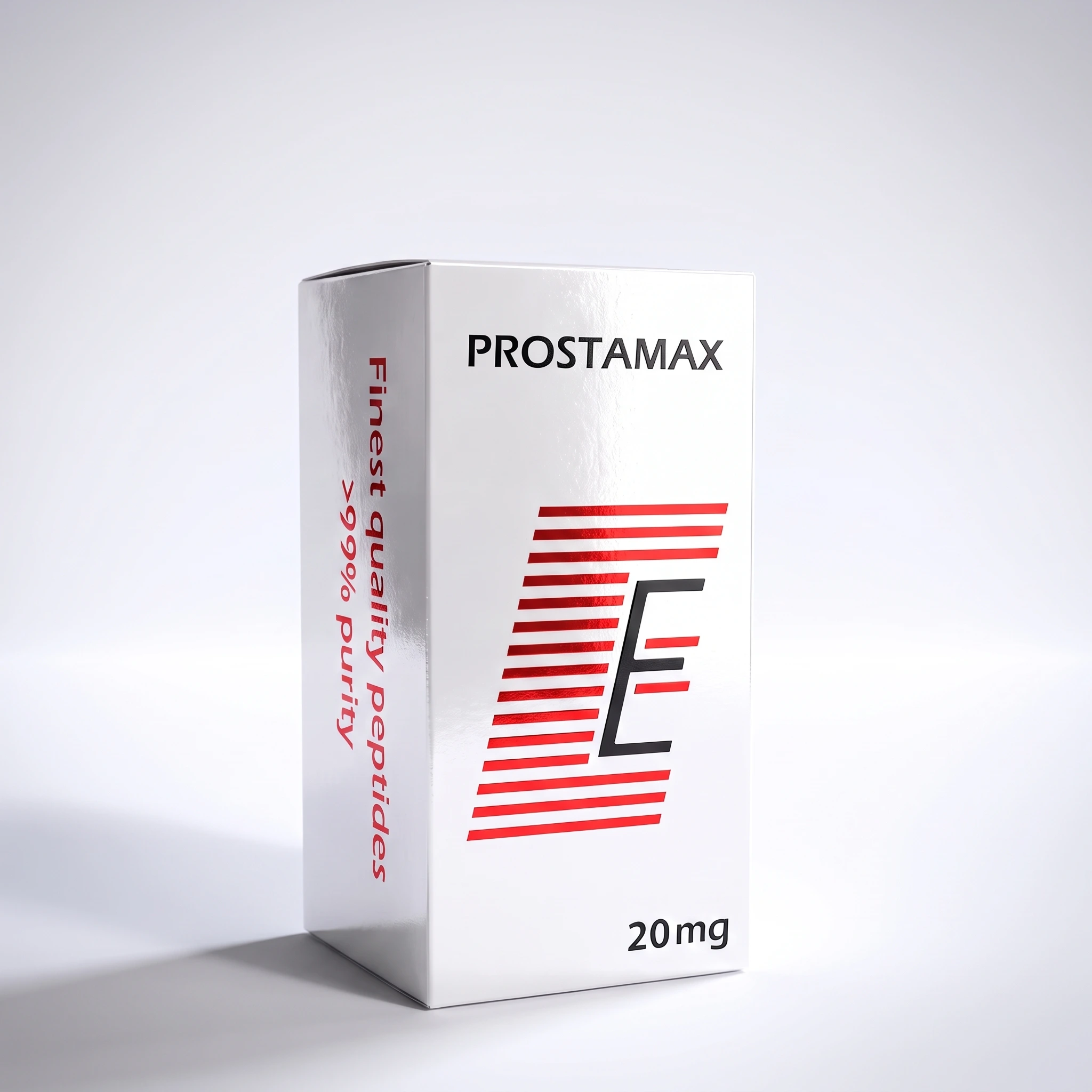
Bioregulatory peptides are short peptides (usually di-, tri- and tetrapeptides) studied in the tradition of the Khavinson school for tissue-specific regulation of cell renewal processes. Unlike a classic drug, which usually acts on a single receptor, the proposed bioregulation model assumes an epigenetic effect – penetration of the peptide into the cell nucleus and modulation of gene expression in the source tissue (here: prostate). This assumption comes mainly from one research school and requires independent confirmation. Prostamax is a reagent to test this concept, not a medicinal product.

Prostamax
Prostamax 20 mg a short tissue-specific regulatory peptide for the prostate, embedded in the peptide bioregulation tradition of the Khavinson school. Traditionally associated with the tetrapeptide KEDP or the peptide fraction of prostate extract. A chemical reagent intended exclusively for laboratory research on the concept of tissue-specific bioregulation of the prostate gland.
37,99 €
Fast shipping
Delivery options
Returns policy
Prostamax 20 mg - short prostate regulatory peptide (Khavinson bioregulator)
- Prostamax 20 mg a short tissue-specific regulatory peptide for the prostate, embedded in the peptide bioregulation tradition of the Khavinson school.
- Traditionally associated with the tetrapeptide KEDP or the peptide fraction of prostate extract.
- A chemical reagent intended exclusively for laboratory research on the concept of tissue-specific bioregulation of the prostate gland.
Chemical reagent intended exclusively for laboratory tests (Research Use Only). It is not a medicinal product, dietary supplement or food. It is not intended for use on humans or animals. Sales only to registered research units and laboratories.
Prostamax is a class representative short regulatory peptides (peptide bioregulators) – a group of compounds developed since the 1970s by the Vladimir Khavinson research school in St. Petersburg Institute of Bioregulation and Gerontology. The defining feature of this class is its tissue-specific nature: each peptide is traditionally associated with a specific source organ and tested for modulation of regenerative processes in that particular tissue.
Prostamax is assigned to the tissue of the prostate gland (prostate). Conceptually, the relationship comes from two traditions. The first are peptide complexes extracted from animal prostate tissue (historically associated with a preparation such as Prostatilen), where the active fraction is a mixture of short peptides weighing less than a few kilodaltons. The second are synthetic short regulatory peptides – in the case of Prostamax, a tetrapeptide with the sequence Lys-Glu-Asp-Pro (KEDP) appears in the literature, although the exact sequence of a given batch requires confirmation in the COA.
This distinction between tissue extract and defined synthetic peptide is research important and we return to it in the section on replication limitations. This reagent is supplied in injectable form 20 mg each, ready for laboratory procedures. Prostamax fits into a broader offer research peptides available as laboratory reagents.
Regulatory status
Prostamax has not been registered as a medicinal product in the EU, the USA or anywhere outside the post-Soviet area, where peptide bioregulators were and are sold in the category of parapharmaceuticals – which is not equivalent to drug registration or EFSA authorization as a food ingredient. There are no large, independent, controlled clinical trials. Communication of the product as “prostate peptide for men”, “urological support” or “natural solution for the prostate gland” is contrary to the Research Use Only framework.
General description - Khavinson's peptide bioregulation
The concept of peptide bioregulation assumes that short peptides (usually di-, tri- and tetrapeptides) function as tissue-specific signals regulating the processes of cell renewal and differentiation in the organ from which they originate. According to this theory, a peptide isolated from the prostate would preferentially modulate processes occurring in the prostate tissue, a peptide from the thymus – in the lymphoid tissue, and a peptide from the pineal gland – within the pineal system.
This assumption of “organ specificity” is the core of the entire research school and distinguishes it from classical receptor pharmacology. The mechanistic model proposed by Khavinson and colleagues goes further: short regulatory peptides would penetrate the cell nucleus and bind to specific DNA sequences within gene regulatory regions, thereby modulating the expression of genes responsible for the regeneration of a given tissue.
In this approach, the peptide is not a classic membrane receptor ligand, but epigenetic transcription modulator — this is a strong claim requiring careful interpretation, to which we return in the distinction box. The class of short regulatory peptides includes several well-recognized “organ” members studied in this tradition:
- Thymic peptides — related to thymus tissue and modulation of immune processes in models; this family includes, among others, Thymulin – thymic peptide
- Pineal peptides — associated with the pineal gland and the melatoninergic axis; the best-known representative is the tetrapeptide Epithalon (Ala-Glu-Asp-Gly)
- Vascular and cardiac peptides — associated with vascular and cardiac tissue; an example is Cardiogen – cardiac bioregulator
- Prostate peptides — the group to which Prostamax belongs; examined for modulation of processes in prostate tissue in models
In this landscape, Prostamax positions itself as a tissue-specific research tool for the prostate – a model compound for exploring the concept of peptide bioregulation in relation to the prostate epithelium and stroma. If you are interested in the broader Khavinson family of organ bioregulators, related reagents are offered in the same research tradition, including: Bronchogen (bronchial peptide), Livagen (liver peptide), Pancragen (pancreatic peptide) and Cortagen (cortical peptide).
Mechanism of action at the molecular level
The proposed mechanism of Prostamax results from the general concept of tissue-specific peptide bioregulation. Unlike classic drugs acting on a single receptor, the Khavinson model describes multi-level action, with an emphasis on the regulation of gene expression in the source tissue. The following subsections present the proposed profile in the models – with caution regarding the strength of the evidence. Mechanistic profile described in the models:
- Tissue-specific peptide bioregulation — the core of Khavinson’s concept assumes that short peptides penetrate the cell and nucleus, bind to specific DNA sequences in regulatory regions and modulate the expression of genes responsible for prostate tissue renewal. In this model, the peptide acts as an epigenetic signal rather than a classic membrane receptor ligand. The theorem about direct peptide-DNA binding comes mainly from the work of this school and requires independent confirmation
- Modulation of prostate cell proliferation and differentiation — in cellular models of the prostate epithelium, the influence of the peptide fraction on the balance between cell proliferation and differentiation was described; a profile interpreted as “normalizing” tissue regeneration processes under model stress conditions
- Antioxidant and anti-inflammatory effects in prostate tissue models — effects on oxidative stress markers and mediators of the inflammatory process in prostate tissue have been described in tissue preparations and in vivo models
- Regulation of the secretory function of prostate epithelial cells — the prostate gland is a secretory organ; The models examined the influence of the peptide fraction on the parameters of the secretory function of epithelial cells and the composition of the secretion
Pharmacological characteristics of the class (based on the literature of the bioregulation school):
- The action is described as tissue-specific – preferential towards the source tissue of the peptide
- Model of epigenetic action (regulation of gene expression) instead of classical receptor pharmacology
- Low molecular weights of regulatory peptides – assumption of the ability to penetrate membranes and access the nuclear compartment
- Safety profile in models described as favorable at low concentrations, subject to limited independent verification
In preclinical models, prostate peptide fractions were tested over a wide range of working concentrations, assessing proliferation parameters, markers of oxidative stress, and indicators of tissue secretory function. The profile was interpreted within the concept of bioregulation as “normalizing” tissue processes – a phenotype that, however, requires careful interpretation due to the origin of the sources and the nature of the models.
IMPORTANT DISTINCTION
Khavinson’s concept of peptide bioregulation comes largely from one research school (St. Petersburg Institute of Bioregulation and Gerontology) and related literature, largely Russian-language, about limited independent replication in peer-reviewed journals with a wide international reach. Claims about the direct binding of short peptides to DNA and the regulation of gene expression in prostate tissue should be treated as mechanistic hypotheses of this school, not as an established consensus.
Data are from preclinical models – no large randomized clinical trials. Additionally the peptide sequence of a given batch must be confirmed in the COA (sequence + mass MS are the only binding identity signals – tissue extract and defined synthetic peptide are different materials). Statements such as “Prostamax models prostate regeneration” refer only to modeling observations in this research tradition and do not constitute a guarantee of effect in humans.
Applications in scientific research
Prostamax is used as a reagent in research work on the concept of peptide bioregulation of prostate tissue. In vitro models (prostate epithelial cell cultures, tissue preparations) examine the influence of the peptide fraction on proliferation, differentiation, oxidative stress markers and parameters of secretory function. In vivo models (rodents, prostate tissue stress models) assess the tissue-specific action profile within the hypotheses of the bioregulation school. Specific research directions include:
- The concept of tissue-specific bioregulation — Prostamax as a model prostate “organ” peptide; research on the hypothesis of preferential modulation of the source tissue
- Models of proliferation and differentiation of the prostate epithelium — assessment of the impact of the peptide fraction on the balance of cell renewal processes in models
- Oxidative stress and inflammatory processes in prostate tissue — examination of oxidative markers and inflammatory mediators in tissue preparations
- Hypothesis of epigenetic regulation of gene expression — research on the proposed mechanism of peptide-DNA binding and transcription modulation in prostate tissue (area requiring independent verification)
- Molecular gerontology — Prostamax in the context of a broader concept of bioregulation of tissue aging processes, developed by the Khavinson school
- Identity analysis of regulatory peptides — Prostamax as a model material for distinguishing tissue extract from a defined synthetic peptide using HPLC/MS methods
Summary
Prostamax is a short tissue-specific regulatory peptide for the prostate gland, embedded in the tradition of peptide bioregulation developed by the school of Vladimir Khavinson (St. Petersburg Institute of Bioregulation and Gerontology). Traditionally, it is associated with a peptide complex extracted from the prostate (prostatilen type) or with a synthetic short peptide (in the literature, tetrapeptide Lys-Glu-Asp-Pro / KEDP – batch sequence for verification in COA).
The profile proposed in the models includes tissue-specific modulation of gene expression, effects on prostate epithelial cell proliferation and differentiation, antioxidant and anti-inflammatory effects, and regulation of secretory function – all within the hypotheses of this school, with limited independent replication and lack of large clinical trials with a control group.
Bibliography
FAQ
In the literature, Prostamax is associated with the tetrapeptide Lys-Glu-Asp-Pro (KEDP) or with a low molecular weight peptide fraction of prostate tissue extract (Prostatilen type). These are two different types of material. For this reason the sequence and weight of a given batch must be confirmed in the COA — sequence plus mass determined by mass spectrometry are the only binding identity signals. In the case of material with a defined sequence, MS Q-TOF allows you to confirm the declared peptide; for the extract fraction, the mass profile of the fraction is reported.
Most of the literature on peptide bioregulators of the prostate comes from the Khavinson school and related publications, largely in Russian. Independent replication of core observations outside this center is limited, and large randomized controlled trials are lacking. Data mainly come from preclinical models (cell cultures, tissue preparations, rodents). Therefore, we treat all mechanistic statements as hypotheses of this school, and not as established scientific consensus – which is the standard for reliable communication about a research reagent.
NO. Prostamax is not currently on the WADA Prohibited Substances List. However, it should be remembered that short peptides of tissue origin may be difficult to clearly identify analytically in anti-doping protocols, and the status of individual compounds may change in subsequent updates of the list. Registered Athletes (ADAMS) should verify the current list before making any decision.
0.0
0 reviews
This product has no reviews yet.
Related products