

This is a family of short, several-amino acid peptides (most often tri- and tetrapeptides) developed at St. Petersburg Institute of Bioregulation and Gerontology under the supervision of Vladimir Khavinson. The central hypothesis of this school is that short peptides have tissue affinity and modulate gene expression in a given cell type – through postulated interaction with DNA sequences or transcription factors. Each peptide has been assigned a “parent” organ: pineal gland (Epithalon), thymus, vessels, heart (Cardiogen) and others. The concept is original and consistently developed by this school, but requires independent replication and mechanistic confirmation outside the parent centers.

Cardiogen
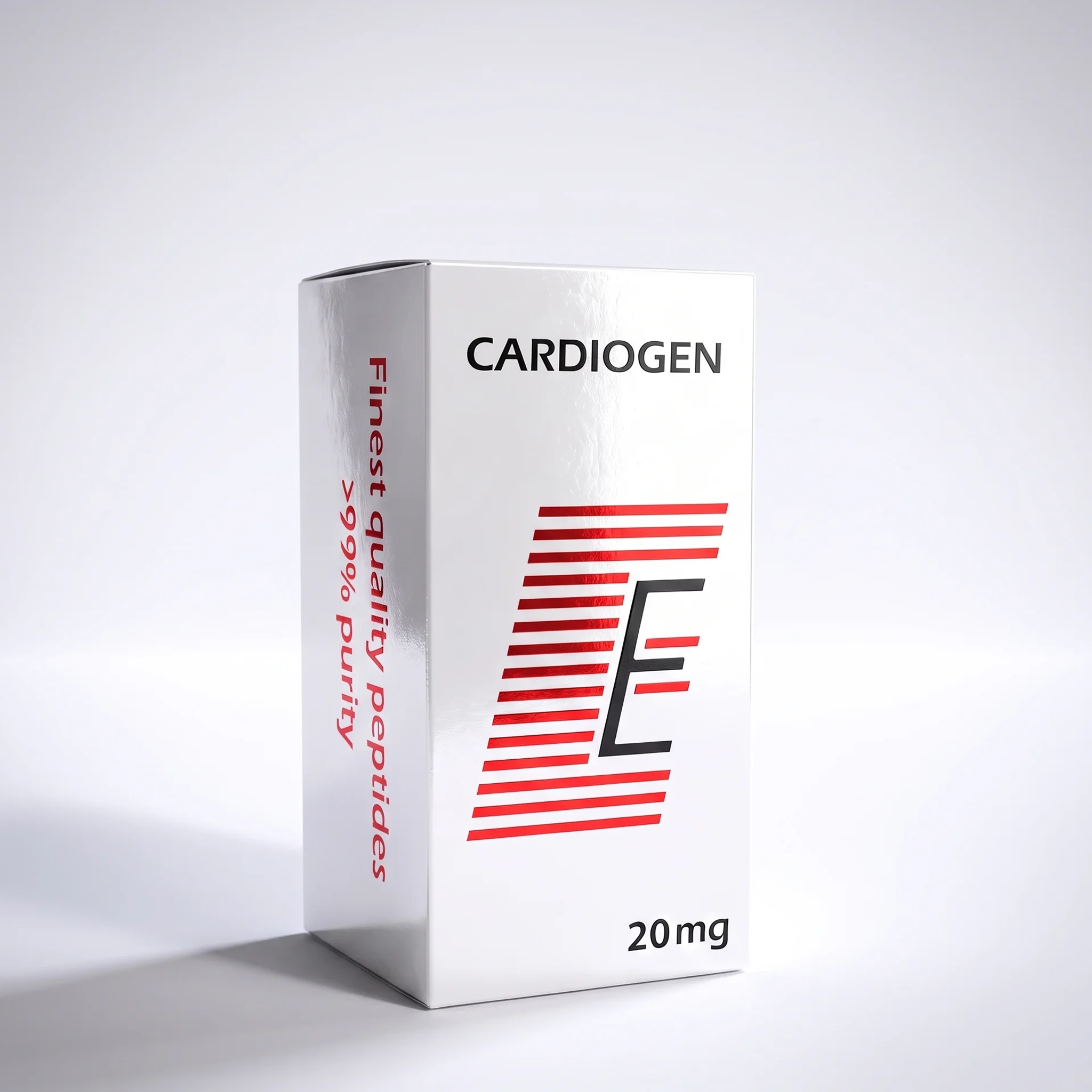
Cardiogen 20 mg in a vial (lyophilisate for reconstitution) is a synthetic short regulatory peptide from the family of tissue-specific bioregulators of the Khavinson school, traditionally associated with the tetrapeptide Ala-Glu-Asp-Arg (AEDR) and attributed to the heart muscle. Research context: peptide bioregulation of cardiomyocyte – modulation of gene expression, regeneration, cytoprotection and antioxidant activity in cellular and animal models. Research Use Only
47,99 €
Fast shipping
Delivery options
Returns policy
Cardiogen 20 mg - myocardial bioregulator peptide
- Cardiogen 20 mg in a vial (lyophilisate for reconstitution) is a synthetic short regulatory peptide from the family of tissue-specific bioregulators of the Khavinson school, traditionally associated with the tetrapeptide Ala-Glu-Asp-Arg (AEDR) and attributed to the heart muscle.
- Research context: peptide bioregulation of cardiomyocyte - modulation of gene expression, regeneration, cytoprotection and antioxidant activity in cellular and animal models.
Chemical reagent intended exclusively for laboratory tests (Research Use Only). It is not a medicinal product, dietary supplement or food. It is not intended for use on humans or animals. Sales only to registered research units and laboratories.
Cardiogen is a synthetic short regulatory peptide derived from the concept peptide bioregulation developed in St. Petersburg Institute of Bioregulation and Gerontology under the supervision of Vladimir Khavinson. In this research school, Cardiogen belongs to the family of tissue-specific “cyto-peptides” (lineage ending in “-gene”), traditionally associated with a tetrapeptide with the sequence Ala-Glu-Asp-Arg (AEDR). The conceptual assumption of the entire group is that short, several-amino acid peptides have affinity for the tissue from which they were originally isolated or to which their design concerns – in the case of Cardiogen, it is the heart muscle and cardiomyocyte.
Cardiogen is part of the research trend on… peptide regulation of aging (peptide bioregulation of aging), which has been developed mainly by the Russian scientific school since the 1980s. The central hypothesis of this school is the modulation of gene expression by direct or indirect interaction of short peptides with specific DNA sequences, leading to the regulation of proliferation, differentiation and functions of cells of a given tissue type.
Unlike signal peptides acting through membrane receptors, bioregulatory peptides of this family are considered primarily as hypothetical modulators of transcription – a concept that remains a matter of debate and requires independent replication outside the home media. This reagent is supplied as lyophilisate in a vial, 20 mg of peptide, as material for laboratory tests.
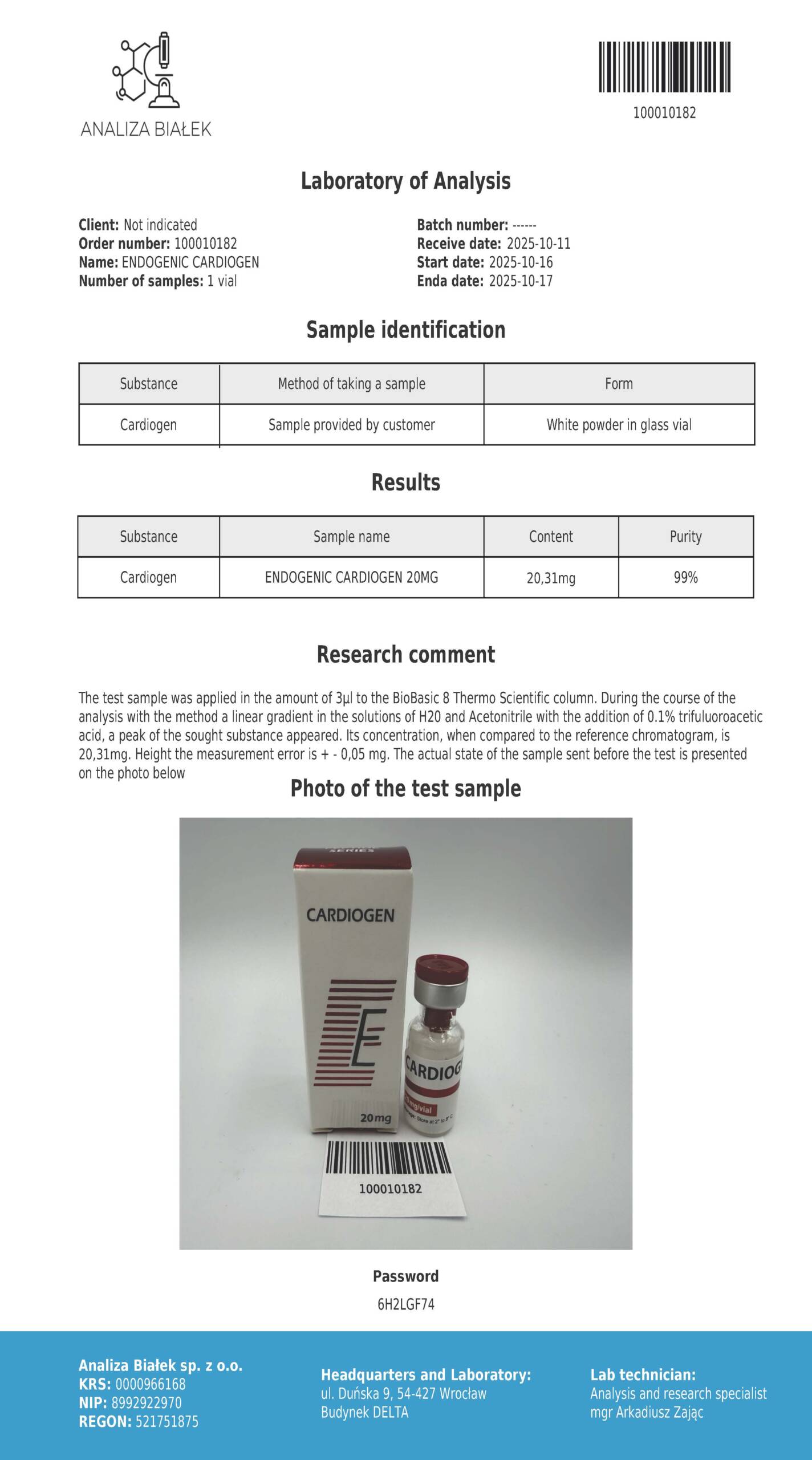
The lyophilized form ensures the stability of the peptide during transport and storage, and reconstitution before use allows the researcher to freely select the working concentration appropriate to the experimental system. Purity verified by HPLC ≥98%, identity confirmed by mass spectrometry, COA available for each batch.
Regulatory status
Cardiogen has never been registered as a medicinal product in the EU, the US or anywhere in the world. No EFSA authorization as an ingredient of a dietary supplement and no EMA/FDA authorization as a medicine. Most of the available literature comes from the centers of the Russian school of bioregulation and is based on cellular and animal models – without large, independent randomized clinical trials. Marketing the product as a “heart peptide”, “cardioprotector for athletes” or “heart muscle support” is inconsistent with the Research Use Only framework.
General description - peptide bioregulation in the Khavinson school
The concept of peptide bioregulation is based on the observation that short peptides composed of two to four amino acid residues can influence cell function in a tissue-specific manner. In a series of works (Khavinson 2002; Anisimov, Khavinson 2010), Vladimir Khavinson and colleagues hypothesized that these types of peptides are part of an internal regulatory system that controls gene expression in response to the functional state and age of the tissue.
As part of this concept, a whole family of peptides assigned to specific organs was isolated: the pineal gland, thymus, vessels, liver, bones – and the heart, for which the working name became Cardiogen. The entire line of these short regulatory peptides is available in the category research peptides as a reagent material for experimental work.
Mechanistically, this school proposes that short regulatory peptides enter the cell and then interact with specific sites in the DNA strand or with proteins that regulate transcription, thereby modulating the expression of genes relevant to a given cell type. In tissue culture models, the influence of peptides of this family on the proliferation and differentiation of cells derived from the “mother” tissue of the peptide was observed (Chalisova, Zhekalov 2014).
The tissue specificity hypothesis is one of the most distinctive – and at the same time most controversial – elements of this concept, because it requires a mechanism for tissue recognition by a very short peptide sequence. More broadly, the Khavinson family of short regulatory peptides includes several recurring research themes:
- Tissue-specific modulation of gene expression — hypothesis of the interaction of short peptides with DNA sequences and transcription factors
- Effect on cell proliferation and differentiation in tissue cultures derived from the “parent” organ of the peptide
- Cytoprotective and antioxidant effects in cell models subjected to stress (oxidative, hypoxia)
- Gerontological context — peptides as hypothetical modulators of processes related to tissue aging (Khavinson 2002; Anisimov, Khavinson 2010)
- Short sequence and low molecular weight — tetra- and tripeptides, designed as fragments of larger tissue regulators
Cardiogen takes the place of a peptide in this family tissue-specific for the heart muscle — tools to study the concept of peptide bioregulation of the cardiomyocyte, its proliferation, regeneration and resistance to metabolic stress in experimental models. A related peptide of the same family, assigned to a different organ, is Prostamax – prostate bioregulator peptide, studied in an analogous tissue specificity paradigm.
What is Cardiogen?
Chemically, Cardiogen is traditionally associated with a linear tetrapeptide with the sequence Ala-Glu-Asp-Arg.
- Common name: Cardiogen, cardiac bioregulator peptide, cardiopeptide
- Sequence (traditionally assigned): Ala-Glu-Asp-Arg (AEDR) – alanyl-glutamyl-asparaginyl-arginine; sequence for verification in the batch COA
- Chemical class: synthetic short regulatory peptide (tetrapeptide); family of bioregulator peptides of the Khavinson school
- CAS number: for verification in the batch COA
- Molar mass: dependent on confirmed sequence; for the AEDR variant of approximately 460 g/mol (indicative value – the mass from the MS analysis of the batch is binding)
- Delivered form: lyophilisate in a vial, 20 mg of peptide; for reconstitution before use; purity ≥98% HPLC
- Conceptual origin: Khavinson’s concept of peptide bioregulation (St. Petersburg Institute of Bioregulation and Gerontology); line of tissue-specific peptides “cyto-” / “-gene”
Mechanism of action at the molecular level
Cardiogen is considered in the literature through the prism of the concept of tissue-specific peptide bioregulation. The following description refers to hypotheses and observations from preclinical models – not to a validated human clinical mechanism. Profile observed and postulated in preclinical models:
- Tissue-specific peptide bioregulation of cardiomyocyte — the central hypothesis of the Khavinson school assumes that short regulatory peptides enter the cell and modulate gene expression by interacting with specific DNA sequences or with the transcription apparatus. In the case of Cardiogen, this concerns genes important for the function and survival of the cardiomyocyte. Mechanism: postulated transcription modulation, not classic membrane receptor stimulation (Khavinson 2002; Khavinson 2021)
- Modulation of myocardial cell regeneration and proliferation — the influence of peptides of this family on the parameters of proliferation and differentiation of cells derived from the stem tissue was observed in tissue culture models; for the cardiac context, among others, the influence of short peptides on the proliferation of organotypic heart muscle culture (Chalisova, Zhekalov 2014)
- Antioxidant and cytoprotective effects — the protective potential of the peptide against cellular damage was tested in models of cardiomyocytes subjected to oxidative stress or hypoxia (ischemia); the research context includes protecting the cell from reactive oxygen species and the consequences of ischemia
- Regulation of the metabolic function of the cardiomyocyte — postulated impact on the metabolic parameters of the heart muscle cell, considered within the general concept of tissue bioregulation and maintaining cell functions over time
Characteristics of peptides of this family (based on the literature of the bioregulation school):
- Short sequence (tetrapeptide) and low molecular weight – typical for the designed regulatory fragments
- Postulated ability to penetrate the cell and interact at the nuclear level – a hypothesis requiring further mechanistic verification
- The action is described as modulatory and contextual, rather than classically stimulating – the peptide is intended to “normalize” cell function, not to force a one-way response
- Human pharmacokinetic profile: uncharacterized; no data from randomized clinical trials
In cellular and animal models, peptides of this family have been tested for their effects on cell viability, proliferation parameters, and markers of oxidative stress – a phenotype interpreted by the authors as tissue-specific bioregulation. These observations should be treated as preliminary and require independent confirmation.
Applications in scientific research
Cardiogen is used as a reagent in research work on the concept of tissue-specific peptide bioregulation. In vitro models (cardiomyocyte cultures, tissue cultures, oxidative stress and hypoxia models) examine its impact on cell viability, proliferation, differentiation and markers of oxidative damage. In vivo models (animal models used by bioregulation centers) examined the impact of peptides of this family on tissue parameters related to aging and regeneration. Specific research directions include:
- The concept of peptide tissue bioregulation — Cardiogen as a model tissue-specific peptide for the heart muscle; testing the hypothesis of modulation of gene expression by short peptides
- Models of cardiomyocyte cytoprotection — assessment of the protective potential against oxidative stress and hypoxia in myocardial cell cultures
- Tissue proliferation and regeneration studies — the effect of the peptide on cell renewal parameters in breeding models
- Experimental gerontology — bioregulatory peptides as tools for studying processes related to tissue aging (Anisimov, Khavinson 2010)
- Independent and methodological verification — replication of observations of the bioregulation school in independent laboratories, including confirmation of the chemical identity and sequence of the tested material
Researchers working on other organs in the same paradigm use related bioregulators of this school – e.g. Bronchogen (peptide assigned to bronchial tissue) or telomeric Epithalon attributed to the pineal gland – which allows for comparison of the tissue-specific action profile of short peptides in a uniform breeding methodology.
REGULATORY STATUS
Cardiogen not listed on the WADA prohibited substances list (as of 2024). However, this does not relieve registered athletes (ADAMS) from the obligation to verify the current list before any decision, especially since the status of bioregulatory peptides in future updates may change. Cardiogen is not registered as a medicine in the EU, US or other jurisdiction; lack of EMA/FDA authorization as a medicinal product and EFSA as a dietary supplement ingredient. Material intended for laboratory testing only.
Summary
Cardiogen (traditionally linked to the Ala-Glu-Asp-Arg tetrapeptide, AEDR) is a synthetic short regulatory peptide from the family of tissue-specific bioregulators developed at the Vladimir Khavinson school (St. Petersburg Institute of Bioregulation and Gerontology). It is attributed to the heart muscle, and the conceptual assumption is the modulation of cardiomyocyte gene expression by a short peptide – a hypothesis covering four main threads: tissue-specific bioregulation, modulation of cardiac cell regeneration and proliferation, antioxidant/cytoprotective effects in models of oxidative stress and hypoxia, and regulation of cardiomyocyte metabolic function.
The whole concept remains mainly developed by the Russian school of science and is characterized by limited independent replication – data comes from cellular and animal models, without large randomized clinical trials. Form: lyophilisate in a vial, 20 mg of peptide, to be reconstituted before use; HPLC purity ≥98%, MS confirmation with sequence verification, COA for each batch.
Regulatory Status – Research Use Only; lack of registration as a medicine; DEFECT status: not listed. The sequence of each batch requires confirmation with the COA.
Bibliography
- Khavinson VKh (2002). Peptides and Aging. PubMed
- Khavinson VK, Popovich IG, Linkova NS, Mironova ES, Ilina AR (2021). Peptide Regulation of Gene Expression: A Systematic Review. PubMed
- Chalisova NI, Zhekalov AN (2014). The effect of leucine and lysine dipeptides on the proliferation of the myocardium and spleen from young and old rats in organotypic culture. PubMed
- Anisimov VN, Khavinson VKh (2010). Peptide bioregulation of aging: results and prospects. PubMed
FAQ
Cardiogen is traditionally associated with the tetrapeptide Ala-Glu-Asp-Arg (AEDR), i.e. alanyl-glutamyl-asparaginyl-arginine. However, this sequence should be treated as a traditionally assigned rather than an unconditionally established identity for each material on the market – bioregulatory peptides in the reagent trade tend to be inconsistent. For this reason, the only binding identity signal is sequence and molecular weight from MS analysis declared in the COA of a specific batch. When working with this reagent, always verify the sequence and mass on the certificate of analysis rather than assuming the sequence from the trade name.
Bring the vial to room temperature before opening to reduce moisture condensation on the lyophilized product. Introduce the solvent (bacteriostatic water or buffer compatible with the experimental system) slowly along the wall of the vial, without directing the stream at the peptide sediment. Do not shake the vial – leave it until the lyophilisate dissolves spontaneously, possibly by gently turning it.
The volume of solvent is selected by the investigator depending on the working concentration required in the protocol; the reference point is the net peptide content given in the COA of the batch. After reconstitution, store the solution at 2–8°C, and for longer storage, aliquot and freeze at −20°C, avoiding multiple freeze-thaw cycles.
There are no large, randomized clinical trials (RCTs) confirming the described effects in humans. The available literature is based primarily on cellular (cardiomyocyte cultures, tissue cultures) and animal models, published mainly by centers of the Russian school of bioregulation. Observations regarding regeneration, cytoprotection and antioxidant activity remain at the preclinical level and require independent confirmation. Any statement about “effects on the heart” should be read as an observation from a research model, not as a confirmed clinical effect.
Classical signal peptides typically act through G protein-coupled membrane receptors, triggering an intracellular cascade from outside the cell. Khavinson’s concept, however, postulates that short bioregulatory peptides enter the cell and act at the nuclear level – modulating gene expression by interacting with DNA or the transcription apparatus. This is an important distinction: the hypothesis assumes modulation of transcription “from the inside”, and not stimulation of a membrane receptor. This mechanism is one of the most controversial elements of the concept and requires further mechanistic verification.
NO. Cardiogen is not currently on the WADA Prohibited Substances List. However, registered athletes (ADAMS) should verify the current list before making any decision and be aware that the status of bioregulatory peptides may change in future updates. Regardless of WADA status, Cardiogen remains a Research Use Only reagent – with no human or animal use.
5.0
1 review
-
Greg
 Polski
Product review
Super jakość. Polecam