VIP and PACAP share high sequence homology and both bind VPAC1 and VPAC2 receptors with comparable affinity. The difference lies in the third receptor: PACAP has high affinity for the PAC1 receptor, to which VIP binds weakly. In research practice this means that PACAP has a stronger and broader neurotrophic profile, while VIP tends to be the preferred tool for studying the VPAC1/VPAC2 axis itself with less involvement of PAC1 signaling.

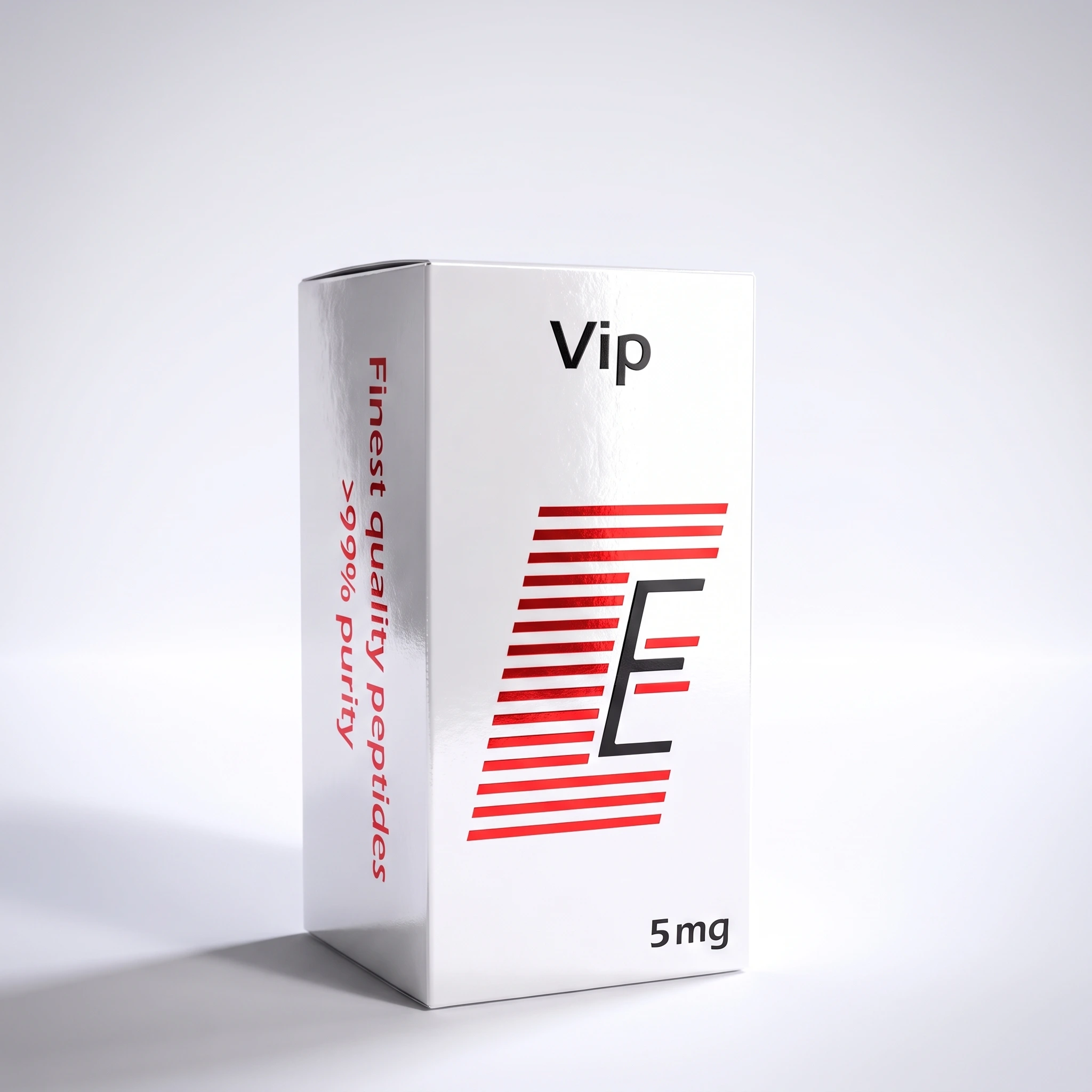
VIP 5mg
VIP (Vasoactive Intestinal Peptide) 5 mg is a 28-amino acid linear intestinal peptide discovered by Said and Mutt (1970), an agonist of VPAC1/VPAC2 receptors of the secretin/glucagon/PACAP superfamily. A chemical reagent intended exclusively for laboratory research on cAMP signaling, NO-dependent vasodilation, immunomodulation, and neuroprotection.
36,99 €
Fast shipping
Delivery options
Free delivery from 350 €
Returns policy
VIP 5 mg — Vasoactive Intestinal Peptide, research reagent in a vial (lyophilizate)
- VIP: Vasoactive Intestinal Peptide, 28 amino acids.
- 5 mg vial, lyophilisate.
- Research Use Only reagent, not for human use.
Chemical reagent intended solely for laboratory research (Research Use Only). It is not a medicinal product, dietary supplement, or food product. It is not intended for use in humans or animals. Sold exclusively to registered research entities and laboratories.
VIP (Vasoactive Intestinal Peptide) was discovered in 1970 — Said and Mutt isolated it from the small intestine as a “polypeptide with a broad spectrum of biological activity.” Half a century later, this 28-amino-acid intestinal peptide remains one of the most versatile mammalian neuromodulators, and at the same time one of the most difficult to translate into a drug — a plasma half-life in human beings measured in single-digit minutes has stalled many a promising clinical project.
VIP belongs to the VIP/secretin/PACAP/glucagon superfamily — peptides sharing a common evolutionary scaffold and signaling through class B GPCRs. In the body it functions as a neurotransmitter and neuromodulator: it dilates blood vessels, modulates the immune response, participates in the regulation of pulmonary surfactant secretion, and exhibits neuroprotective activity in models of central nervous system injury.
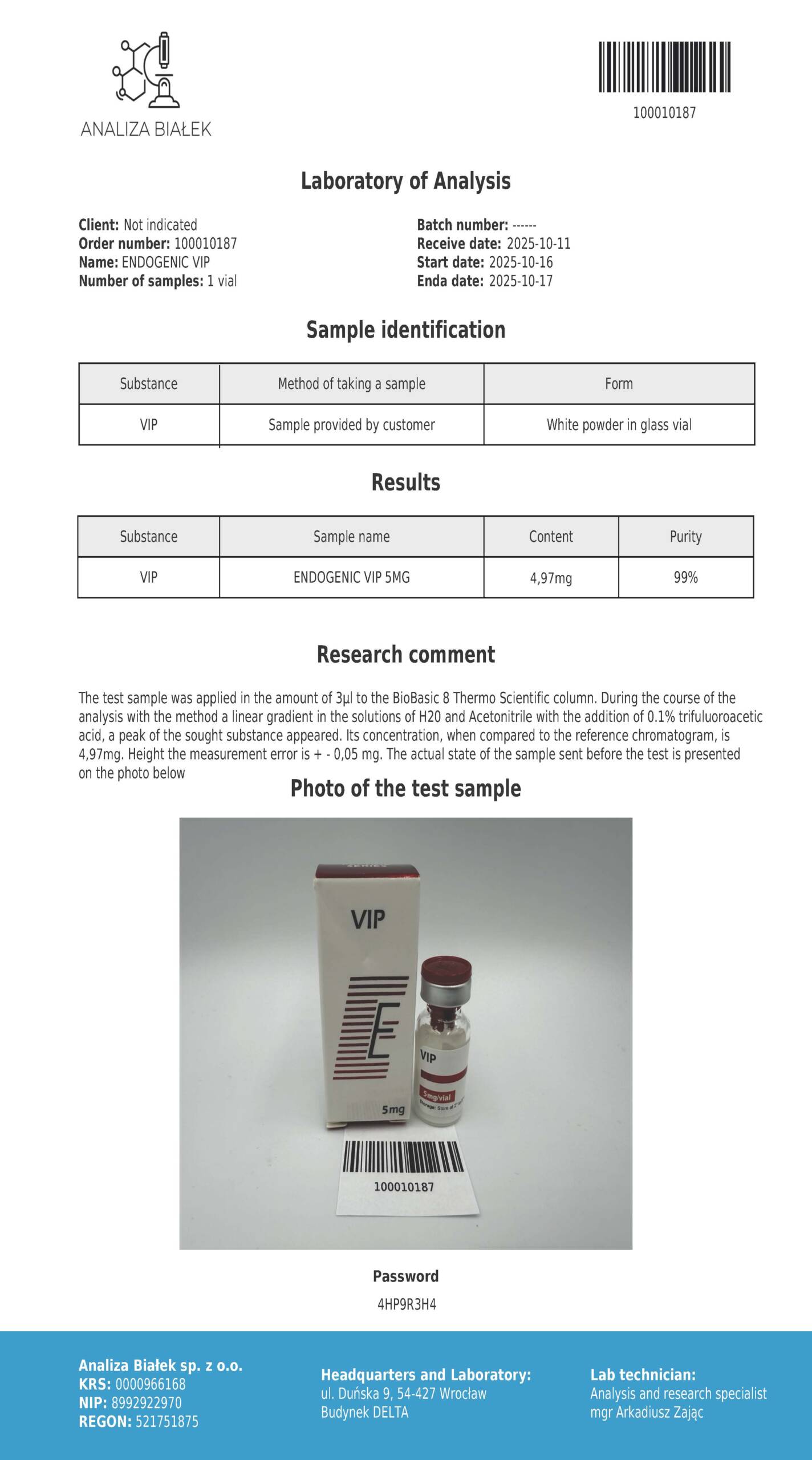
This makes it an attractive molecular tool for studying cAMP-dependent pathways — from the vascular endothelium to neuroimmunology. VIP fits into the broader family of research peptides used as reference receptor ligands in experimental pharmacology. This reagent is supplied as a lyophilizate in a 5 mg vial, reconstituted with bacteriostatic water. Purity verified by HPLC ≥98%, identity confirmed by mass spectrometry, COA available for every batch.
VIP is not registered as a drug in the EU or the USA. Clinical projects (including those on sarcoidosis and cystic fibrosis, inhaled application) have been abandoned — largely owing to the peptide’s extremely short half-life. There is no EFSA authorization as a dietary supplement ingredient. Communicating the product as a “peptide for circulation,” “immune support,” or an agent used in humans is contrary to the Research Use Only framework.
General description — context of the VIP/secretin/PACAP superfamily
VIP is a central member of the secretin/glucagon/PACAP/VIP peptide superfamily — a group of evolutionarily related molecules united by a similar amino acid arrangement at the N-terminus and a common type of molecular target: class B (secretin) G protein-coupled receptors. This family includes, among others, secretin, glucagon, GLP-1, GIP, GHRH, and PACAP (Pituitary Adenylate Cyclase-Activating Polypeptide) — the closest structural relative of VIP, sharing as many as two receptors with it.
The peptides of this superfamily act as gut hormones, neurotransmitters, and neuromodulators. In a pharmacological context, the best known today are the incretin analogs (GLP-1, GIP — semaglutide, tirzepatide), which through structural modifications have been extended from minutes to days. VIP represents the opposite pole of the same family: a molecule with a broad biological profile, yet in its native form practically untranslatable into a drug because of its lightning-fast enzymatic degradation. The biological profile of VIP encompasses a broad spectrum of activity observed in preclinical and early-clinical models:
- Vasodilation of blood vessels — one of the most potent endogenous vasodilators, acting through the release of nitric oxide (NO) from the endothelium
- Immunomodulation — inhibition of pro-inflammatory cytokines (TNF-α, IL-6), promotion of anti-inflammatory cytokines (IL-10, TGF-β); studied in models of autoimmunity
- Neuroprotection — protective activity for neurons in models of stroke and Parkinson’s disease
- Secretory regulation — modulation of pulmonary surfactant secretion, water, and electrolytes in the respiratory and intestinal epithelium
- Neuromodulation — VIP is a co-transmitter in autonomic neurons (parasympathetic system, non-cholinergic non-adrenergic nerve endings — NANC)
Within this superfamily VIP holds the position of a model ligand of VPAC receptors — a tool for studying cAMP/PKA signaling independent of the incretin axis.
What is VIP?
Chemically, VIP is a linear 28-amino-acid peptide with an amidated C-terminus.
- Common name: VIP, vasoactive intestinal peptide (vasoactive intestinal peptide, vasoactive intestinal polypeptide)
- Sequence (28 aa): His-Ser-Asp-Ala-Val-Phe-Thr-Asp-Asn-Tyr-Thr-Arg-Leu-Arg-Lys-Gln-Met-Ala-Val-Lys-Lys-Tyr-Leu-Asn-Ser-Ile-Leu-Asn-NH₂ (HSDAVFTDNYTRLRKQMAVKKYLNSILN-NH₂)
- CAS number: 37221-79-7 (in case of uncertainty — “to be verified in the batch COA”)
- Molecular formula: C₁₄₇H₂₃₇N₄₃O₄₃S
- Molar mass: ~3326 g/mol
- Chemical class: linear peptide of the secretin/glucagon/PACAP/VIP superfamily; amidated C-terminus (-NH₂), which is important for receptor affinity
- Supplied form: lyophilizate in a vial, 5 mg of active substance, for reconstitution with bacteriostatic water; research grade ≥98% HPLC
Origin: VIP was isolated in 1970 by Sami I. Said and Viktor Mutt from the small intestine of a pig — initially as a factor with a strong vasodilatory action (hence “vasoactive”). It soon turned out that the peptide is present not only in the gastrointestinal tract but widely throughout the nervous system (brain, peripheral nerves, autonomic endings) and in cells of the immune system.
Over the decades VIP has been characterized as an endogenous neuromodulator with functions extending far beyond the gut — from the regulation of circadian rhythm in the suprachiasmatic nucleus to the modulation of the inflammatory response.
SCIENTIFIC PERSPECTIVE
Most of the pharmacological data on VIP come from preclinical models (rat, mouse, guinea pig, isolated vascular and epithelial preparations, immune cell cultures) and a handful of early human studies discontinued because of pharmacokinetics. The vasodilatory, immunomodulatory, and neuroprotective observations require confirmation in full clinical trials — which, for native VIP, have not been completed. Extrapolation of PK/PD profiles to humans requires particular caution given the half-life measured in minutes.
Mechanism of action at the molecular level
VIP acts through two main receptors — VPAC1 and VPAC2 — coupled to the Gαs protein. Activation leads to an increase in cAMP, activation of protein kinase A (PKA), and downstream transcriptional pathways. The biological profile is multi-axial, and the individual effects depend on the distribution of receptors in a given tissue. Pharmacological profile observed in preclinical models:
- Agonism of VPAC1 and VPAC2 receptors — both are class B (secretin) GPCRs coupled to Gαs. VPAC1 predominates peripherally (gastrointestinal tract, lungs, liver, immune cells), while VPAC2 is more strongly represented in the central nervous system and vascular smooth muscle. The cascade: VIP → VPAC1/VPAC2 → activation of adenylate cyclase → increase in cAMP → activation of PKA → phosphorylation of the transcription factor CREB and regulation of gene expression. In research practice: VIP is a standard agonist for studying cAMP signaling in these cell lines
- Vasodilation of blood vessels via nitric oxide — VIP is one of the most potent endogenous vasodilatory compounds. In vascular models (isolated aortic rings, coronary bed), activation of VPAC on the endothelium leads to the release of NO, which diffuses into the smooth muscle layer and induces its relaxation (Henning and Sawmiller, 2001). Part of the vascular effect is endothelium-independent — directly through cAMP in smooth muscle myocytes
- Immunomodulation — inhibition of pro-inflammatory cytokines — in immune cell models (macrophages, T lymphocytes) VIP inhibits the production of pro-inflammatory cytokines (TNF-α, IL-6, IL-12) and promotes anti-inflammatory cytokines (IL-10, TGF-β), shifting the Th1/Th2 balance and supporting the differentiation of regulatory T lymphocytes. In preclinical models of autoimmunity — experimental autoimmune encephalomyelitis (EAE, a model of multiple sclerosis) and collagen-induced arthritis (RA model) — VIP reduced the severity of the inflammatory process (Delgado and Ganea, 2004). The anti-inflammatory profile of VIP is often juxtaposed with other immunomodulatory peptides studied in models of inflammation
- Neuroprotection — in in vitro and in vivo models VIP and its analogs exhibit protective activity for neurons; in models of ischemic stroke and Parkinson-like toxicity a reduction in neuronal loss has been observed. The mechanism involves cAMP-dependent pathways and, indirectly, the release of neurotrophic factors from astrocytes (linked to work on analogs, including Gozes et al., 1996)
- Regulation of pulmonary surfactant synthesis — in type II pneumocytes VIP modulated surfactant secretion and bronchial smooth muscle tone (bronchodilation). This provided a rational basis for phase II studies of inhaled application in sarcoidosis and cystic fibrosis — projects abandoned mainly because of the very short half-life of the native peptide
Pharmacokinetic profile (based on data in humans and models):
- Plasma half-life in humans: ~2 minutes — one of the shortest among regulatory peptides
- Main degradation pathways: dipeptidyl peptidase IV (DPP-4) and neutral endopeptidase (NEP) — rapid proteolysis in the bloodstream
- Oral bioavailability: practically ~0% (the peptide is degraded in the gastrointestinal tract)
- Distribution: broad, owing to the ubiquity of VPAC receptors in tissues
IMPORTANT DISTINCTION
“Vasodilation of blood vessels,” “immunomodulation,” and “neuroprotection” in the context of this description refer solely to observations in preclinical models (rodents, isolated tissue preparations, cell cultures) and discontinued early-clinical studies. This does not imply a guarantee of an effect in a human using the RUO reagent, nor a suggestion of using VIP as a “peptide for circulation,” “anti-inflammatory agent,” or “neuroprotector for humans.” The compound remains a research tool — the half-life measured in minutes was the main reason for abandoning therapeutic projects on native VIP.
VIP and its closest relatives — pharmacological position: In the secretin/glucagon superfamily VIP occupies a position partly shared with PACAP:
- PACAP — the closest relative of VIP; it binds both VPAC1/VPAC2 receptors with similar affinity, and additionally its own PAC1 receptor (for which VIP has low affinity). PACAP has a stronger neurotrophic profile
- Secretin — acts mainly through its own secretin receptor; it regulates bicarbonate secretion in the pancreas
- GLP-1, GIP — incretin peptides of the same superfamily; unlike VIP, they have gained long-acting pharmaceutical analogs thanks to modifications delaying DPP-4 degradation
- VIP — the most potent vasodilator of the group, broad immunomodulation through VPAC1/VPAC2, but the native form is limited by an extremely short T½
Applications in scientific research
VIP is used as a research reagent in several areas. In in vitro models (isolated vascular preparations, type II pneumocyte cultures, macrophages and T lymphocytes, cell lines expressing VPAC1/VPAC2) cAMP/PKA signaling, the kinetics of NO release, and the cytokine profile are studied. In in vivo models (rat, mouse, guinea pig, EAE and collagen-induced arthritis models) vascular, immunological, and neuroprotective parameters are assessed. Specific research directions include:
- Pharmacology of VPAC1/VPAC2 receptors — VIP as a reference agonist for characterizing affinity, ligand selectivity, and cAMP signaling; a point of reference for designing selective VPAC agonists and antagonists
- Models of vasodilation and endothelial function — study of the NO/cGMP pathway, vascular reactivity, and endothelium-dependent as well as endothelium-independent mechanisms
- Neuroimmunology and autoimmunity — EAE (multiple sclerosis) and RA models; the role of the VIP axis in shifting the cytokine balance and inducing regulatory T lymphocytes. In a similar vein, other peptides supporting the immune system are studied in models of autoimmunity
- Neuroprotection — models of ischemic stroke and Parkinson-like toxicity; study of cAMP-dependent pathways and the indirect astrocytic influence
- Respiratory physiology — modulation of surfactant secretion and bronchial smooth muscle tone in pneumocytes and airway preparations
- Chronobiology — the role of VIP as a neurotransmitter in the suprachiasmatic nucleus and the synchronization of circadian rhythm
A thematically related anti-inflammatory tool, studied in models of intestinal and skin inflammation, is the tripeptide KPV peptide (a fragment of α-MSH) — like VIP, it inhibits pro-inflammatory cytokine pathways, but through a different mechanism. Among peptides with an immune-supporting profile in preclinical research, Thymosin Alpha-1, a thymic peptide modulating the differentiation of T lymphocytes, is also mentioned.
REGULATORY STATUS
VIP does not appear on the WADA list of prohibited substances (as of 2024). As an endogenous regulatory peptide with a very short half-life, it is not classified in the anti-doping program. Registered athletes (ADAMS) should nonetheless verify the current list before making any decision. VIP is not registered as a drug in any jurisdiction; clinical projects (sarcoidosis, cystic fibrosis, inhaled application) have been abandoned because of the pharmacokinetics of the native peptide.
Summary
VIP (Vasoactive Intestinal Peptide) is a 28-amino-acid linear intestinal peptide discovered by Said and Mutt in 1970, belonging to the secretin/glucagon/PACAP/VIP superfamily. It acts as an agonist of VPAC1 and VPAC2 receptors (class B GPCRs coupled to Gαs → cAMP → PKA → CREB), exhibiting in preclinical models potent nitric oxide-dependent vasodilation of blood vessels, broad immunomodulation (inhibition of TNF-α/IL-6, promotion of IL-10/TGF-β in EAE and RA models), neuroprotective activity, and regulation of pulmonary surfactant secretion.
Native VIP is characterized by one of the shortest half-lives among regulatory peptides (~2 minutes, degradation by DPP-4 and NEP) — which was the main reason for abandoning clinical projects. Regulatory status — Research Use Only; no registration as a drug; WADA status: does not appear on the list.
Bibliography
- Said SI, Mutt V (1970). Polypeptide with broad biological activity: isolation from small intestine. PubMed
- Delgado M, Pozo D, Ganea D (2004). The significance of vasoactive intestinal peptide in immunomodulation. PubMed
- Henning RJ, Sawmiller DR (2001). Vasoactive intestinal peptide: cardiovascular effects. PubMed
- Gozes I, Bardea A, Reshef A, Zamostiano R, Zhukovsky S, Rubinraut S, et al. (1996). Neuroprotective strategy for Alzheimer disease: intranasal administration of a fatty neuropeptide. PubMed
- Said SI (1996). Vasoactive intestinal peptide and nitric oxide: divergent roles in relation to tissue injury. PubMed
FAQ
The main reason is pharmacokinetics. The plasma half-life in human beings is about 2 minutes — the peptide is degraded almost instantly by DPP-4 and neutral endopeptidase. Such a short duration of action makes maintaining a therapeutic concentration impractical. Clinical projects (including inhaled application in sarcoidosis and cystic fibrosis) were abandoned for this reason. The research direction has shifted toward analogs with an extended duration of action.
VIP is an agonist of VPAC1 and VPAC2 receptors — both belonging to class B (secretin) GPCRs, coupled to the Gαs protein. Activation leads to stimulation of adenylate cyclase, an increase in cAMP, activation of protein kinase A (PKA), and phosphorylation of the transcription factor CREB. VPAC1 predominates peripherally (gastrointestinal tract, lungs, immune cells), VPAC2 more strongly in the central nervous system and vascular smooth muscle.
In vascular models VIP activates VPAC receptors on the endothelium, which leads to the release of nitric oxide (NO). NO diffuses into the smooth muscle layer and triggers the cGMP pathway, inducing relaxation. Part of the effect is endothelium-independent — directly through an increase in cAMP in smooth muscle myocytes. This dual mechanism makes VIP one of the most potent endogenous vasodilators (Henning and Sawmiller, 2001).
VIP is a linear peptide without disulfide bridges stabilizing its structure — which makes it more susceptible to thermal degradation, oxidation of Met residues, and deamidation of Asn/Gln residues than cyclic peptides. Solution stability is low.
No. VIP does not currently appear on the WADA list of prohibited substances. It is an endogenous regulatory peptide with a very short half-life, which additionally complicates its potential analytical detection. Registered athletes (ADAMS) should nonetheless verify the current list before making any decision, since the classification of substances in future WADA updates may change.
5.0
1 review
-
Diana G
 Polski
Product review
Produkt zgodny z opisem, opakowanie wygląda bardzo solidnie. To już kolejne zamówienie i za każdym razem wszystko przebiega bez zarzutu. Polecam
Related products