


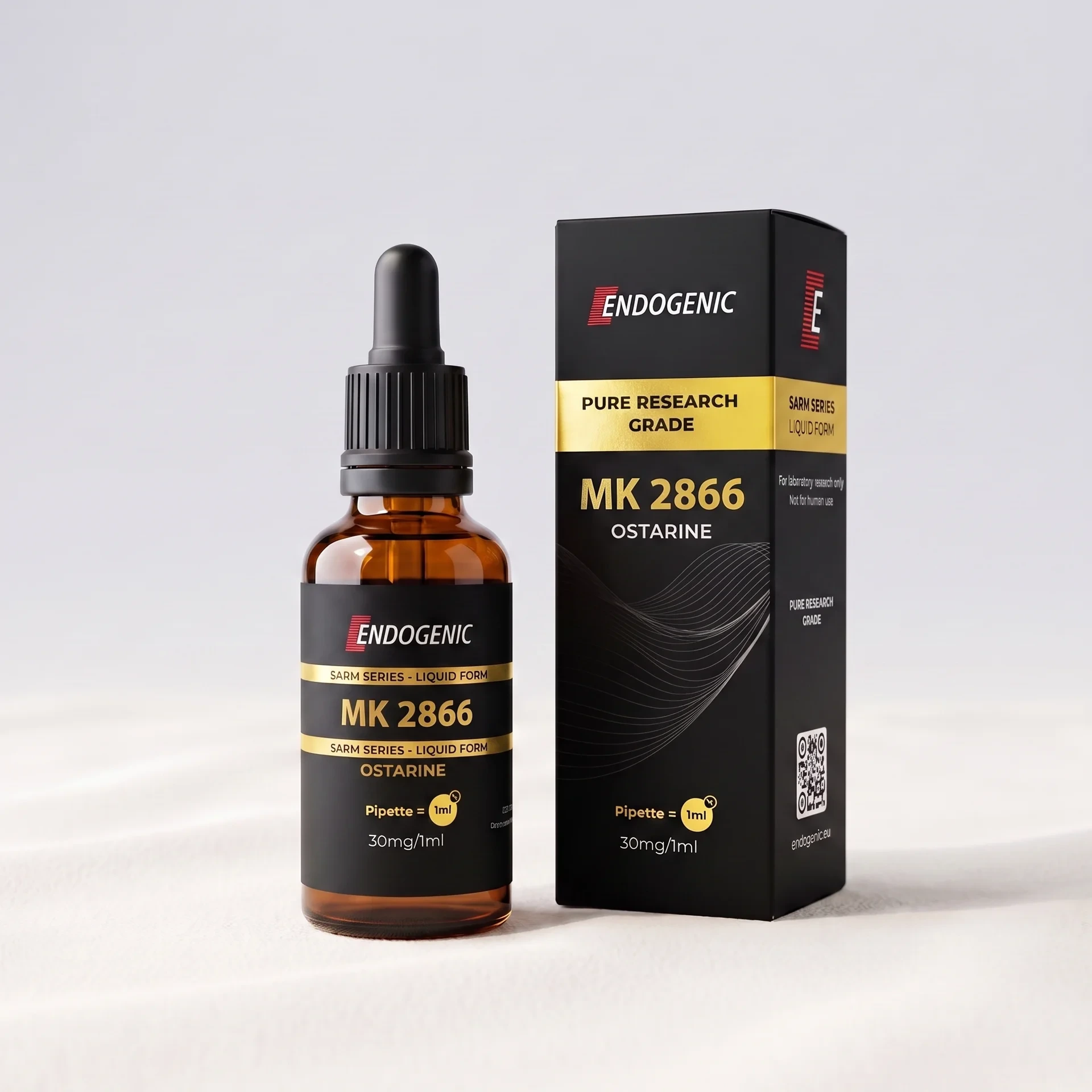

MK-2866 (ostarine)
Other categories
2 products
Black Week
Black Week deals before everyone else
Sign up for the newsletter and get access to the Black Week promotion before other customers.
By signing up you agree to receive the Pro-Body newsletter with news and promotions. You can unsubscribe at any time with one click in the e-mail. Privacy policy
MK-2866 (ostarine) - research reagents
MK-2866 is the same molecule the literature knows as ostarine, enobosarm and GTx-024. The three names describe one non-steroidal selective androgen receptor modulator of the arylpropionamide class, developed at GTx. The multiplicity of designations matters in practice, because any search for data or for regulatory status has to cover all three.
This molecule’s clinical programme went furthest in the whole class. In a phase II study in patients with cancer cachexia, total lean body mass rose in both active groups, in one by a median of 1.5 kg (range −2.1 to 12.6; p = 0.0012) and in the other by 1.0 kg (−4.8 to 11.5; p = 0.046), while in the placebo group the median change was 0.02 kg and was not significant (p = 0.88) (Dobs et al., 2013, PMID 23499390).
Reagents with this molecule come here in two forms, both for laboratory work and both without the status of a medicine or a dietary supplement. Further compounds of the section are gathered by the parent category SARMs.
Variants in the range
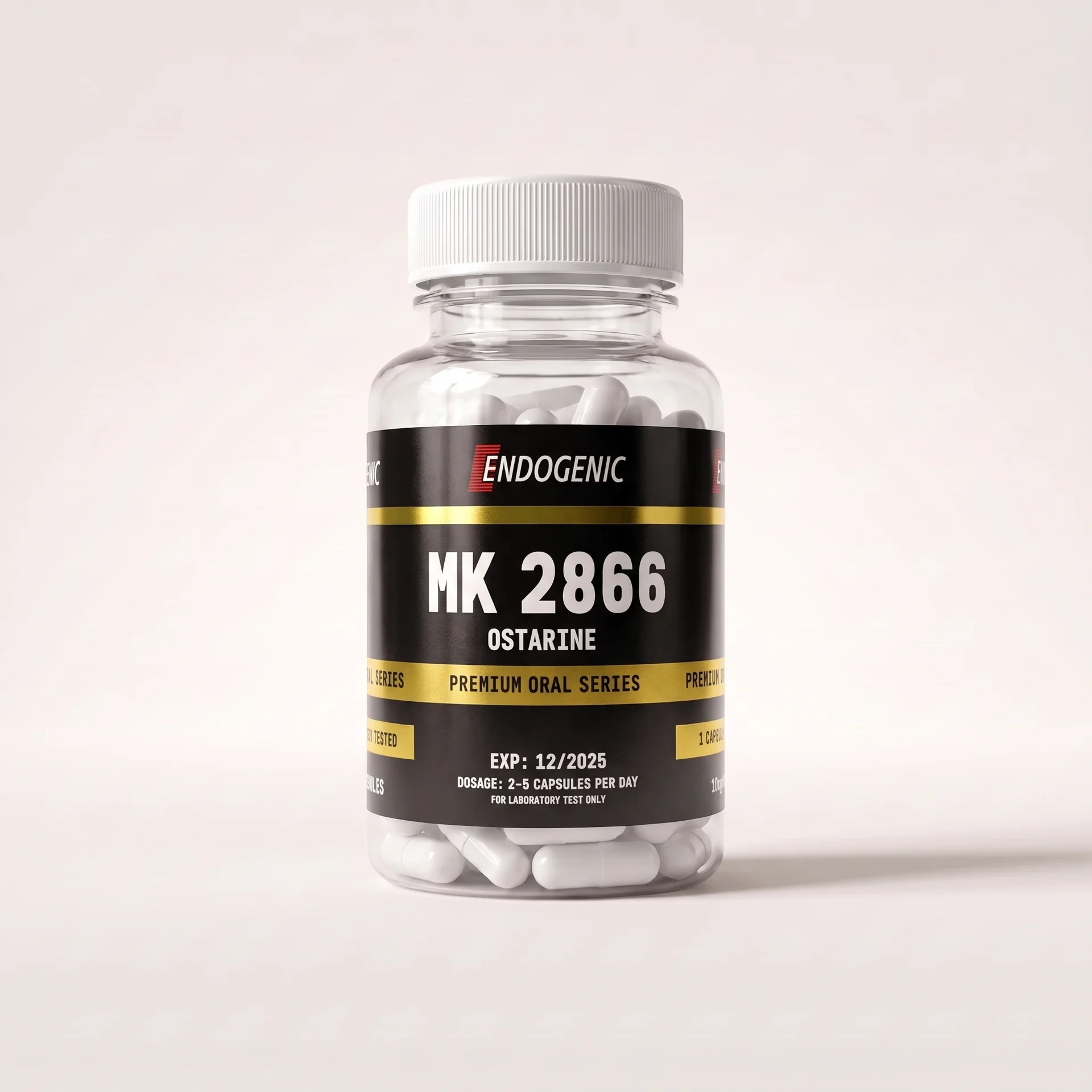
Two formats are available. MK2866 60 caps are capsules of 10 mg of substance, sixty to a pack. MK 2866 LIQUID holds 30 ml of solution in a dropper bottle, at a concentration recorded on the batch label and in its certificate of analysis.
Both variants hold the same arylpropionamide compound. Batch purity is verified by HPLC and identity by mass spectrometry. For this molecule the batch documentation has an additional analytical dimension: ostarine is among the most frequently detected compounds of the class in doping control, and its traces have been documented even on items shared between athletes (Kintz et al., 2024, PMID 38670521).
Applications in scientific research
Ostarine appears in work on lean body mass in chronic disease, in oncology of androgen receptor-dependent tumours, in bone models and in anti-doping analytics. Working concentrations are chosen by the researcher depending on the model; the subcategory gives no quantities and no schedules.
- Cancer cachexia. In the phase II study cited, the most frequent serious adverse events were progression of the malignant neoplasm (8 of 52 participants on placebo against 5 of 53 and 7 of 54 in the active groups), pneumonia and febrile neutropenia; none of them was deemed related to the study drug (Dobs et al., 2013).
- Oncology of receptor-dependent tumours. The molecule was assessed in a study in patients with advanced breast cancer dependent on the androgen and oestrogen receptors, without HER2 overexpression (Palmieri et al., 2024, PMID 38342115).
- Metabolic interactions. In a pharmacokinetic study itraconazole had no effect on the molecule’s profile, and the molecule itself did not significantly change the pharmacokinetics of celecoxib or rosuvastatin. Rifampicin had the largest influence, lowering the maximum plasma concentration by 23% and the area under the curve by 43%; probenecid raised the areas under the curve for the molecule and its glucuronide by 50% and 112% (Coss et al., 2016, PMID 27105861).
- A bone model in rats. In a study of bone healing in gonadectomised rats of both sexes, ostarine was assessed alone and in combination with an oestrogen receptor modulator; the combination reduced ostarine’s androgenic effect on the prostate, and the authors noted that the possible adverse effects of ostarine alone require consideration (Komrakova et al., 2026, PMID 42640291).
- Liver injury in case reports. Significant cholestatic liver injury associated with ostarine has been described (Bedi et al., 2021, PMID 34368386), as has hepatocellular injury in a 31-year-old man who had started a supplement containing enobosarm three weeks earlier; his symptoms resolved after discontinuation (Weinblatt et al., 2022, PMID 35655632). In a third report the injury appeared only about six months after first use, and exome testing found no pathogenic variants for cholestatic liver disease but three common heterozygous polymorphisms that raise the risk of intrahepatic cholestasis (Mertens et al., 2024, PMID 37871633).
- Trace transfer in doping control. In two athletes who shared the same neoprene hamstring sleeves, transfer of ostarine through sweat was documented. In the athlete who admitted use, concentrations were 190 pg/mg in hair, 780 pg/mg in fingernail clippings and 45 pg/mg in toenail clippings, and 3 to 142 pg/g across twelve pieces of the sleeves; the anti-doping organisation accepted the sleeves as the most likely source of contamination and found no fault (Kintz et al., 2024).
Scientific perspective. Ostarine has the broadest set of clinical data in its class, which does not change its status: it remains a substance without marketing authorisation. A 2026 review describes cholestatic liver injury as the dominant serious harm from preparations of this class used outside medical supervision, and notes that adverse analytical findings rose from 15 in 2014 to 142 in 2019, then stood at 139 in 2023 and 106 in 2024 (Adolf et al., 2026, PMID 42919612).
How MK-2866 differs from related compounds
By the maturity of its clinical programme, compared with the other SARMs in the category. Ostarine has a phase II study in patients with cachexia and a study in breast cancer oncology, LGD-4033 a short phase I study in healthy men, and RAD-140 a phase I study in oncology patients. Modulating the same receptor does not make these compounds interchangeable, because they differ in structure and in the range of endpoints studied.
By material format. A capsule holds a weighed portion steady across a whole series, while a solution makes smaller amounts reachable by dilution. The molecule stays the same in both variants.
Regulatory status and anti-doping note
MK-2866 is not authorised as a medicinal product under any of its names. The European Medicines Agency Article 57 listing (data as of 9 October 2026) contains no entry for ostarine or enobosarm, and the Drugs@FDA database and the National Drug Code catalogue hold no product with the substance as an active ingredient (checked 8 November 2026). It holds no authorisation as a food or dietary supplement ingredient in the European Union either, although it is detected in preparations sold over the counter as muscle-building aids (Weinblatt et al., 2022).
Anti-doping note. The molecule appears in subclass S1.2 of the 2026 List under two names, enobosarm and ostarine, listed among the androgen receptor modulators. The designation MK-2866 is absent from the list. The 2027 List, which applies from 1 January 2027, retains that wording. The prohibition applies at all times, in and out of competition. With this molecule the documented cases of trace transfer between athletes deserve attention, because an anti-doping violation is settled by the organisation’s proceedings rather than by the analytical finding alone (Kintz et al., 2024). The binding sources are the List in force and the ADAMS system. Materials from this subcategory are research reagents and do not serve as preparation for sporting competition.
Frequently asked questions (FAQ)
Are MK-2866, ostarine and enobosarm the same substance?
Yes. They are three names for one molecule, which research documentation also records as GTx-024. Any check of status or data has to cover all the designations.
What did the phase II study in cancer cachexia show?
An increase in total lean body mass in both active groups, by a median of 1.5 kg and 1.0 kg, with no significant change on placebo. The most frequent serious adverse events concerned the underlying disease and were not deemed related to the study drug (Dobs et al., 2013).
Which format suits which work?
By how the material reaches the sample. In a capsule the mass is weighed in advance; with the solution the researcher measures a volume at a known concentration.
Is ostarine a medicine?
No. It holds no marketing authorisation in any jurisdiction, despite having the broadest clinical programme in its class.
Why does the WADA List not carry the designation MK-2866?
Because the List names this molecule as enobosarm and ostarine. The absence of the MK-2866 abbreviation does not mean the substance is permitted; it is the same compound in subclass S1.2.
Category status notice
This category groups chemical reagents intended solely for laboratory research (Research Use Only). The compounds presented are not medicinal products, dietary supplements or foodstuffs. They are not intended for use in humans or animals. Sales are restricted to registered research institutions and laboratories.