



LGD-4033 (ligandrol)
Other categories
2 products
Black Week
Black Week deals before everyone else
Sign up for the newsletter and get access to the Black Week promotion before other customers.
By signing up you agree to receive the Pro-Body newsletter with news and promotions. You can unsubscribe at any time with one click in the e-mail. Privacy policy
LGD-4033 (ligandrol) - research reagents
LGD-4033, called ligandrol in research commerce, is a non-steroidal selective androgen receptor modulator. The molecule comes from the Ligand Pharmaceuticals laboratories, and its clinical development continued under the designation VK5211.
The human data for this compound differ in character from most reagents in the section: they come from a phase I study in healthy young men, in which lean body mass rose dose-dependently while fat mass did not change significantly. The same study described dose-dependent suppression of total testosterone, sex hormone-binding globulin, HDL cholesterol and triglycerides, with hormone and lipid values returning to baseline after discontinuation (Basaria et al., 2013, PMID 22459616).
In this subcategory the molecule comes in two forms. Both materials serve laboratory work and hold no status as a medicine or a dietary supplement. The rest of the section is gathered by the parent category SARMs.
Variants in the range
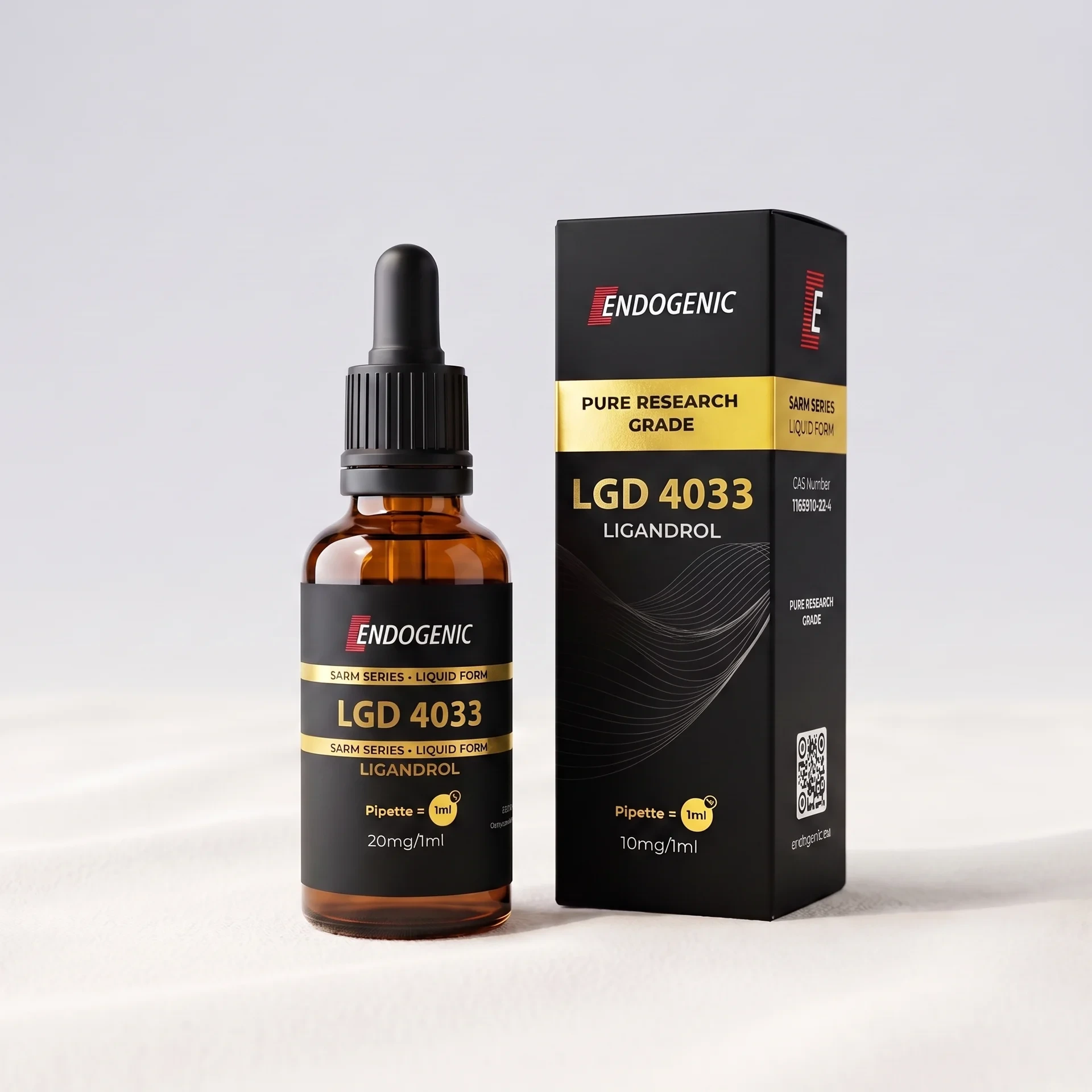
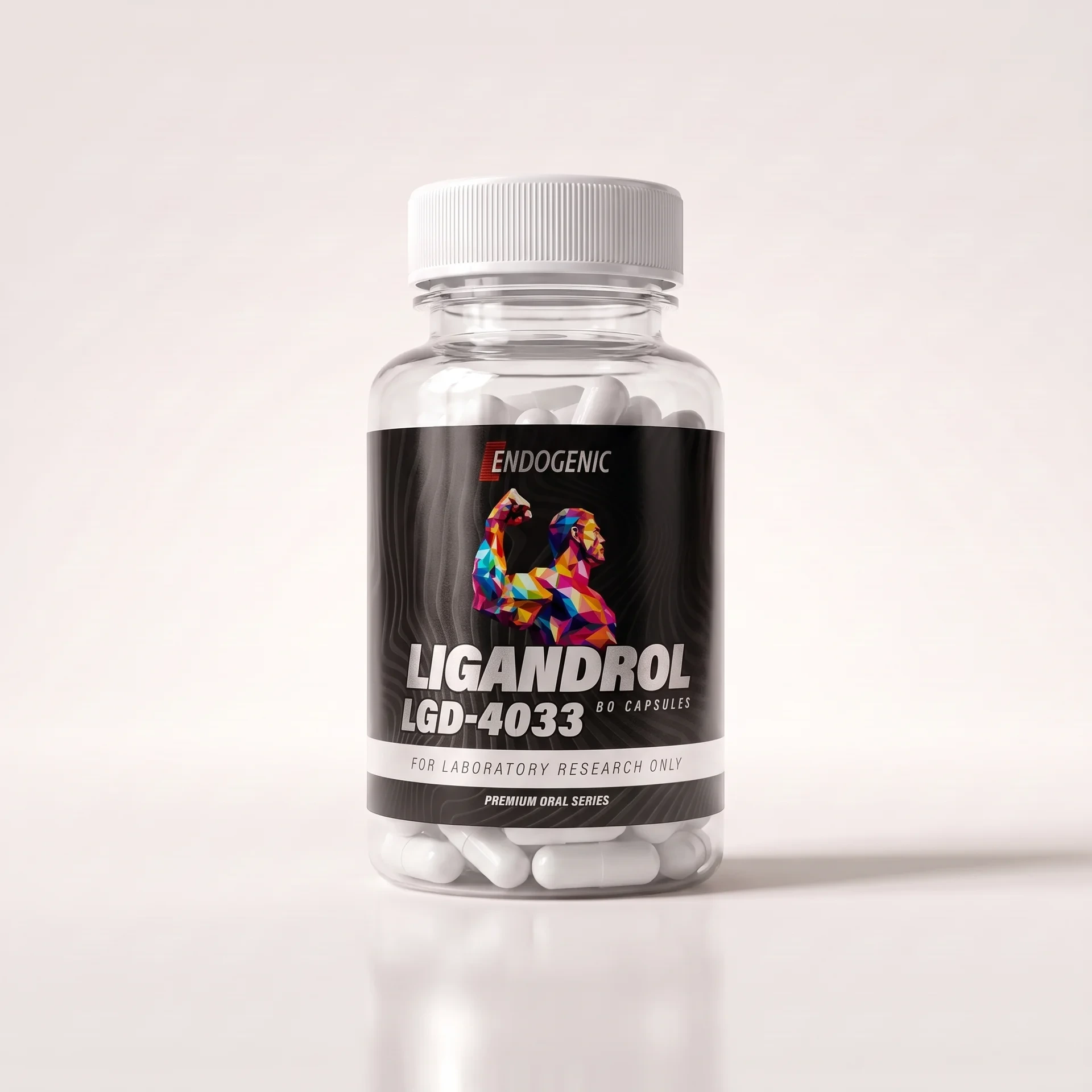
The subcategory covers two reagents. LGD-4033 60 caps is the capsule format: 10 mg of substance in one capsule, sixty capsules to a pack. LGD 4033 LIQUID is the liquid format: 30 ml in a dropper bottle, at a concentration declared in the batch documentation.
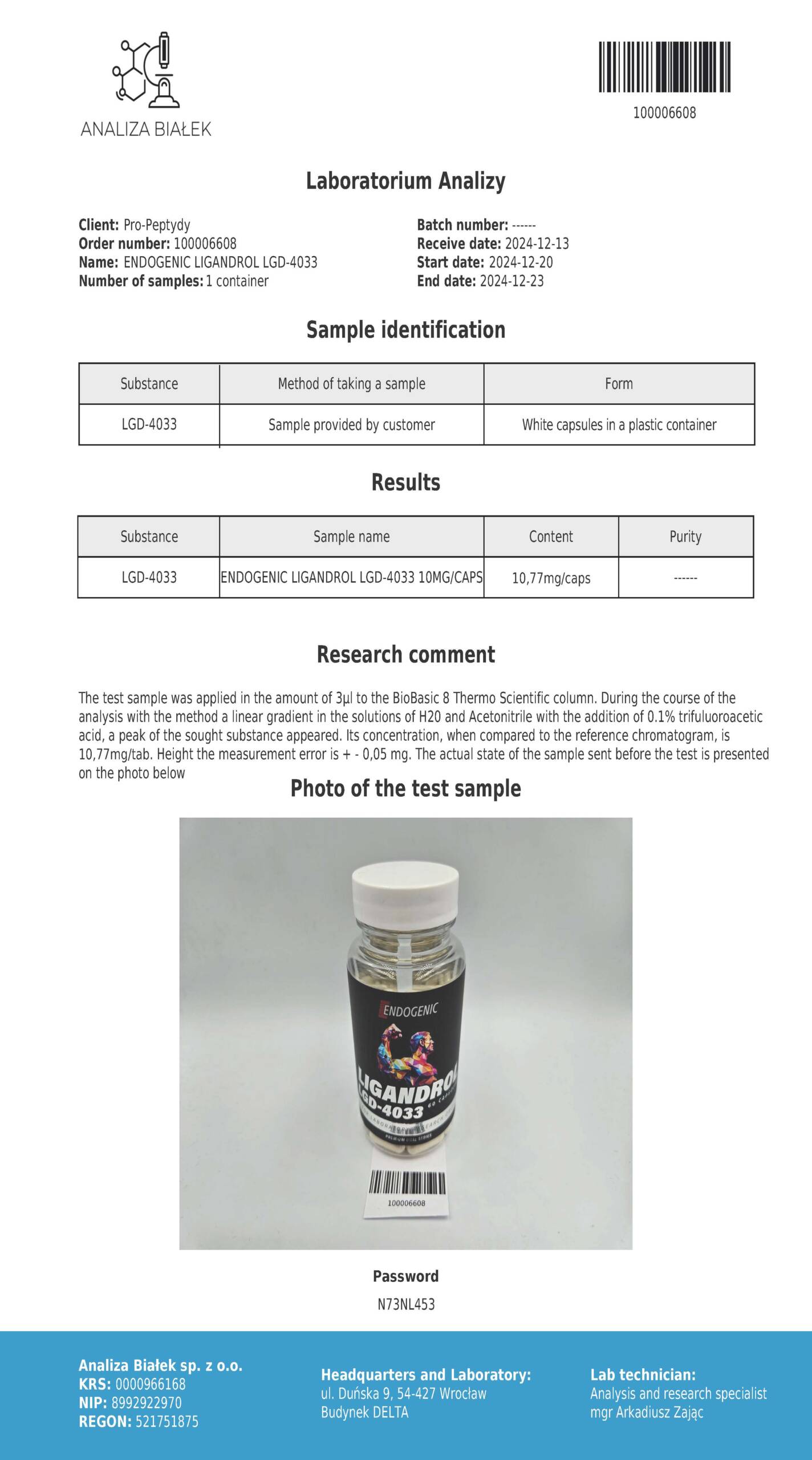
Both variants carry the same molecule, and the only difference is whether the material enters the sample as a weighed portion or as a volume of solution. Batch purity is verified by HPLC and identity by mass spectrometry. Batch documentation has a practical dimension here: in a review of adverse event reports the authors noted that data on the content and purity of consumer-market preparations are limited, which makes it hard to attribute effects to the substance itself (Leciejewska et al., 2024, PMID 38059982).
Applications in scientific research
Ligandrol appears in work on the tissue selectivity of androgen receptor modulators and in safety analyses of the class. Working concentrations are chosen by the researcher depending on the model; the subcategory gives no quantities and no schedules.
- The phase I study in healthy volunteers. The frequency of adverse events was similar in the active and placebo groups, and haemoglobin, prostate-specific antigen, transaminase activity and the QT interval did not change significantly at any level. Follicle-stimulating hormone and free testosterone were suppressed only at the highest level, and the compound had a long elimination half-life with proportional accumulation on repeated exposure (Basaria et al., 2013).
- Reports of liver injury. Since 2020, 20 reports of adverse events following use of agonists from this class have been published, most of them described as drug-induced liver injury; a cholestatic or hepatocellular pattern and jaundice predominated (Leciejewska et al., 2024). In a case report, liver injury appeared after three months of using a high-content ligandrol preparation, and the workup ruled out other causes (Labban et al., 2024, PMID 39421081).
- Multi-ingredient preparations. In a 2020 case report, one of the two supplements the patient had taken contained ligandrol together with RAD-140, and liver biopsy showed diffuse centrilobular canalicular cholestasis with a prominent ductular reaction (Barbara et al., 2020, PMID 33062783).
- A critical appraisal of the whole class. A 2025 review states that clinical trials show some efficacy of androgen receptor modulators in body composition and anti-tumour activity in advanced breast cancer, yet such results might equally well have been achieved with conventional androgens, because head-to-head trials are lacking. The authors also note that the absence of oestrogenic activity is a clinical problem in this class, especially for bone health and sexual function in men (Bond et al., 2025, PMID 41079187).
- Analytics and quality control. Determining the content and purity of the material and separating ligandrol from related modulators of the class; with consumer-market preparations that is a precondition for attributing any effect to a particular molecule (Leciejewska et al., 2024).
Scientific perspective. The evidence for ligandrol ends with a short phase I study in healthy volunteers and with reports of adverse events. The authors of that study themselves recommended longer randomised trials to assess the effect on physical function and health outcomes in selected populations; no such trials have been published. A research reagent is not an investigational medicine and does not inherit conclusions from those papers.
How LGD-4033 differs from related compounds
By research context, compared with the other SARMs in the category. Ligandrol has a phase I study in healthy men, RAD-140 a phase I study in oncology, and MK-2866 a phase II study in patients with cancer cachexia. All three modulate the androgen receptor, yet they were described in different populations and with different endpoints, so data on one molecule do not describe another.
By material format. The capsule format keeps a series on a fixed weighed portion, while the liquid eases dilutions done in a single vessel. The molecular target stays identical.
Regulatory status and anti-doping note
LGD-4033 is not authorised as a medicinal product. The European Medicines Agency Article 57 listing (data as of 9 October 2026) contains no entry for this substance, and the Drugs@FDA database and the National Drug Code catalogue hold no product with it as an active ingredient (checked 8 November 2026). As the review authors summarised, despite their presence in clinical trials no compound of this class has been approved for use either by the United States regulator or by the European Medicines Agency (Leciejewska et al., 2024). The substance holds no authorisation as a food or dietary supplement ingredient in the European Union either.
Anti-doping note. In subclass S1.2 of the 2026 List, headed “other anabolic agents”, the entry reads “LGD-4033 (ligandrol)”, and ligandrol stands there beside andarine, enobosarm, RAD140, S-23 and YK-11. The 2027 List, which applies from 1 January 2027, retains that wording. The prohibition applies at all times, in and out of competition. The binding sources are the List in force and the ADAMS system. Materials from this subcategory are research reagents and do not serve as preparation for sporting competition.
Frequently asked questions (FAQ)
What is LGD-4033?
A non-steroidal selective androgen receptor modulator, called ligandrol in research commerce. It comes from the Ligand Pharmaceuticals laboratories, and clinical development continued under the designation VK5211.
What did the phase I study show?
Lean body mass rose dose-dependently while fat mass did not change significantly; at the same time total testosterone, sex hormone-binding globulin, HDL cholesterol and triglycerides were suppressed, returning to baseline after discontinuation (Basaria et al., 2013).
Capsules or solution?
By how the sample is prepared. A capsule arrives with 10 mg weighed in advance, while the liquid lets a volume be measured once the concentration has been read from the batch documentation.
Is ligandrol a medicine?
No. No selective androgen receptor modulator holds approval for human use in the United States or the European Union, which the authors of the 2024 review state plainly.
Is LGD-4033 prohibited in sport?
Yes. In subclass S1.2 of both editions the entry covers the designation LGD-4033 together with the name ligandrol, and the prohibition applies at all times.
Category status notice
This category groups chemical reagents intended solely for laboratory research (Research Use Only). The compounds presented are not medicinal products, dietary supplements or foodstuffs. They are not intended for use in humans or animals. Sales are restricted to registered research institutions and laboratories.