



hCG (human chorionic gonadotropin)
Other categories
2 products
Black Week
Black Week deals before everyone else
Sign up for the newsletter and get access to the Black Week promotion before other customers.
By signing up you agree to receive the Pro-Body newsletter with news and promotions. You can unsubscribe at any time with one click in the e-mail. Privacy policy
hCG (human chorionic gonadotropin) - research reagents
Chorionic gonadotropin is a glycoprotein hormone built from two subunits: the alpha subunit shared across the gonadotropins and a specific beta subunit. Both chains are heavily glycosylated, and the glycosylation state governs the strength and selectivity of the signal passed into the cell (Shpakov, 2024, PMID 39344322).
The molecule acts on LHCGR, the receptor shared by luteinising hormone and chorionic gonadotropin, a member of the family of G protein-coupled receptors. In gonadal tissue the receptor sits in the Leydig cells of the testis and in the theca, luteal and luteinising granulosa cells of the ovary; small amounts are also expressed outside the gonads (Huhtaniemi, 2026, PMID 39840520).
For laboratory work hCG is a tool for studying one well-defined node of the hypothalamic-pituitary-gonadal axis. The materials here are research reagents; they are not medicinal products, although the substance itself is the active ingredient of authorised medicines. The remaining peptides of the section are gathered by the parent category Peptides.
Variants in the range
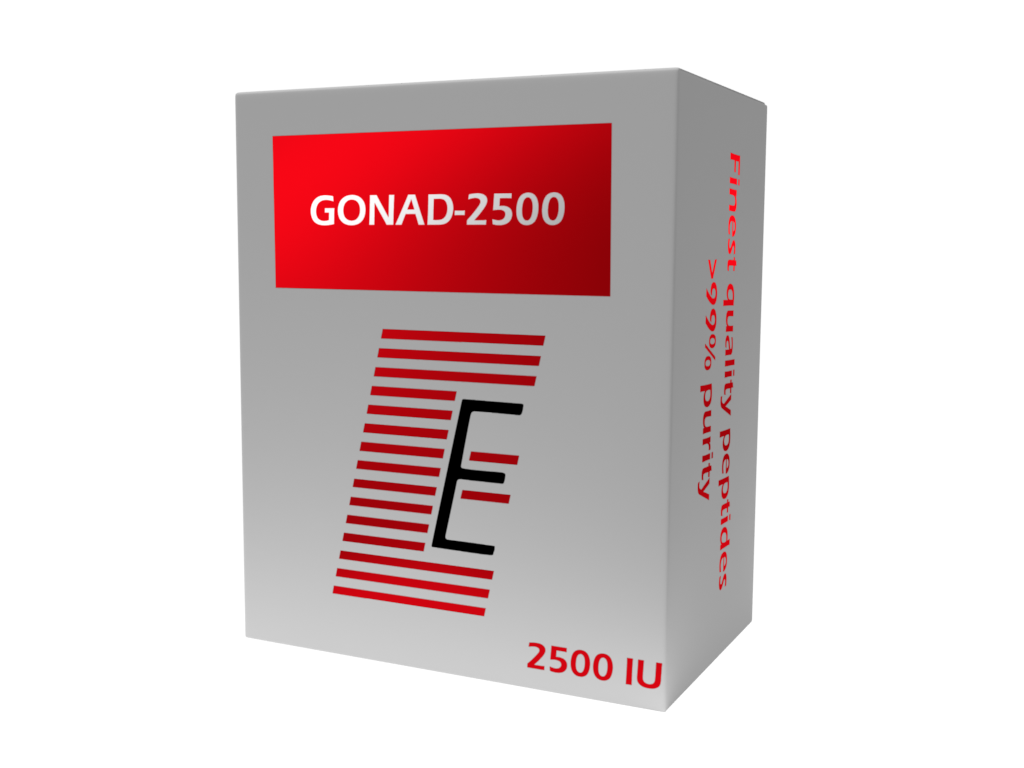
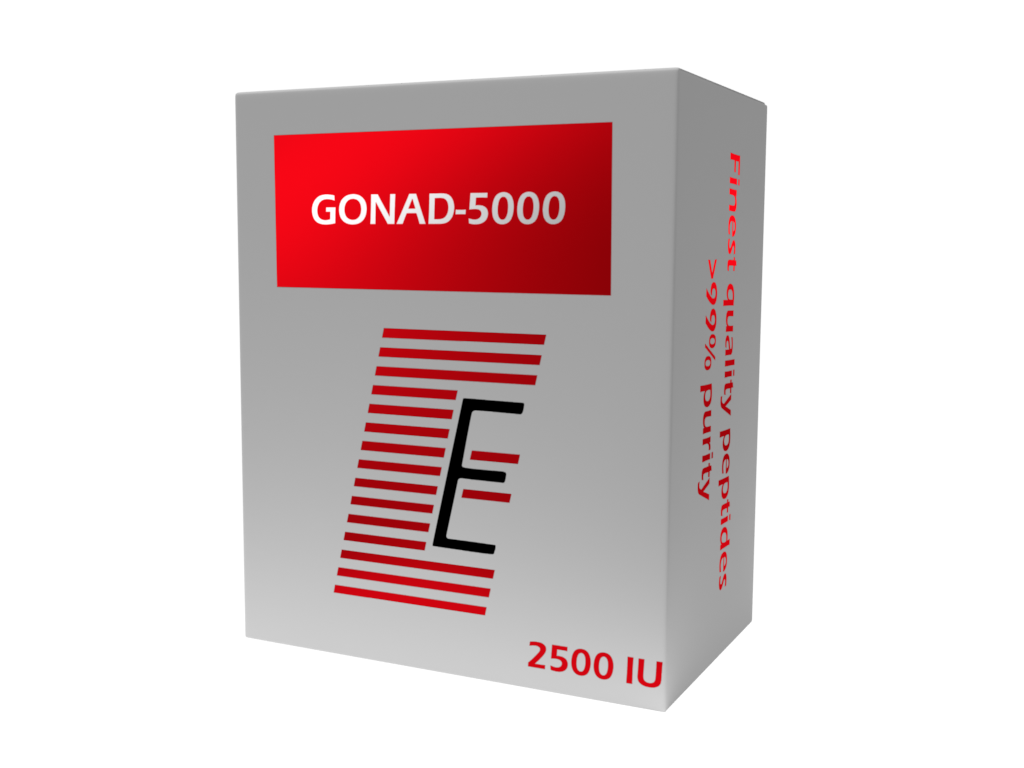
The subcategory covers two reagents holding the same glycoprotein at different unit contents. HCG 2500 IU is a vial of lyophilised powder with an activity of 2,500 international units, supplied with bacteriostatic water for reconstitution. HCG 5000 IU has the same form and the same water in the set, at twice the unit content per vial.
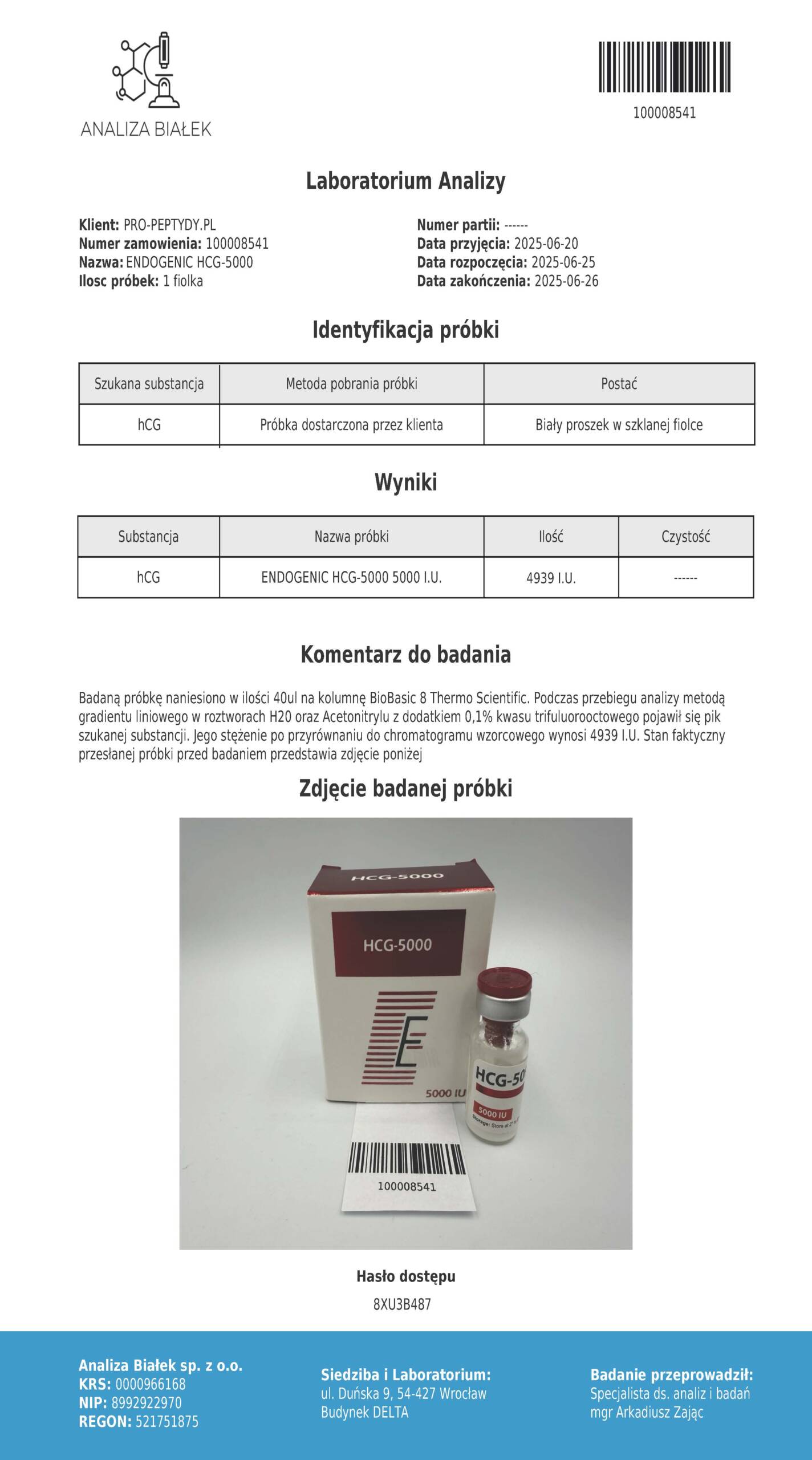
An international unit describes biological activity, not mass and not a separate molecule. For a glycoprotein that matters, because the same mass can carry a different activity depending on the batch glycosylation profile. The batch documentation closes with a certificate of analysis giving the HPLC result and identity confirmation, read together with the declared unit content.
Applications in scientific research
hCG appears in the literature in three roles: as a ligand of the LHCGR receptor in mechanistic work, as a functional probe of the gonads, and as an analyte in laboratory assays. Working concentrations are chosen by the researcher depending on the model; the subcategory gives no quantities and no schedules.
- Pharmacology of the LHCGR receptor. Once gonadotropin binds, the receptor engages G proteins of the Gs, Gq/11 and Gi types and β-arrestins, which triggers cyclic AMP-dependent cascades, the phospholipase pathway and mitogen-activated kinases. The efficiency and selectivity of those cascades differ between gonadotropins and depend on ligand glycosylation, on receptor complex formation and on allosteric sites across the receptor (Shpakov, 2024).
- Animal models. The mouse with the receptor gene inactivated, described in the literature as LuRKO, has for more than two decades served to separate receptor-dependent from receptor-independent effects, and combined with other modified models it produced unexpected findings (Huhtaniemi, 2026).
- A probe of gonadal function in humans. A stimulation test with steroid measurement by liquid chromatography coupled to tandem mass spectrometry showed differences in testicular steroidogenesis in Klinefelter syndrome (Belli et al., 2016, PMID 27188454).
- Clinical trials of authorised products. A randomised trial in 282 men with hypogonadism compared three arms, clomiphene citrate, hCG and combination therapy; the authors judged both monotherapies effective in restoring testosterone (Habous et al., 2018, PMID 29772111). In a single-arm phase III trial in 23 men with azoospermia and hypogonadotropic hypogonadism, 18 participants whose testosterone had normalised while azoospermia persisted entered a 52-week combined phase with a follicle-stimulating hormone analogue (Nieschlag et al., 2017, PMID 28270212).
- Metabolic endpoints. In 16 men with idiopathic hypogonadotropic hypogonadism and 20 matched healthy controls, parameters were assessed before gonadotropin therapy and after six months; at baseline the hypogonadal group had a higher body fat ratio, triglycerides, HOMA-IR and C-reactive protein, and lower fat-free mass (Bayram et al., 2016, PMID 26485362).
- Measurement and detection. hCG is one of three proteins measured at the start of testicular germ cell tumour diagnosis, with limited specificity, as it rises in seminomas and non-seminomas alike (Marroncelli et al., 2025, PMID 40723290). As a substance on the Prohibited List it is also an analyte for urine assays, for instance a microfluidic immunoassay with Raman detection (Ahi et al., 2022, PMID 34592500).
- Material quality on the informal market. Between 2020 and 2024 the Polish official medicines control laboratory analysed 601 samples seized by the police and prosecutors; 63 of them, 10.5%, declared substances used after steroid cycles, and hCG was detected in 41.3% of that group (Błażewicz et al., 2025, PMID 40177353).
Scientific perspective. The clinical results concern authorised medicinal products used under medical supervision, and a reagent does not inherit them. For a glycoprotein hormone the unit count is a property of the batch rather than of the molecule, which makes batch documentation part of the method rather than a formality.
How hCG differs from related compounds
By unit content, not by molecule. The 2,500 IU and 5,000 IU vials hold the same glycoprotein. What differs is the declared activity in international units per vial, meaning the number of units available for division into samples after reconstitution. The choice follows from the size of the experimental series.
By receptor target, compared with the other gonadotropins in the catalogue. hCG acts on the LHCGR receptor, where luteinising hormone acts physiologically. Follicle-stimulating hormone addresses a different receptor, and menopausal gonadotropin combines both activities. The distinction decides which node of the axis the researcher engages.
Regulatory status and anti-doping note
Chorionic gonadotropin is the active substance of authorised medicinal products on both sides of the Atlantic, which sets it apart from most reagents in this catalogue.
- European Union. In the listing of products authorised in the member states, maintained by the European Medicines Agency under Article 57 (data as of 9 October 2026), the substance appears in 27 entries, among them Brevactid in Germany, Chorapur in Belgium, Choriomon in Cyprus and Gonasi in Italy and Denmark.
- United States. The Drugs@FDA database holds Pregnyl, biologics licence BLA 017692, available on prescription; the older BLA 017067 is marked as discontinued. The National Drug Code catalogue also lists Novarel and preparations under the generic name. Checked 8 November 2026.
- A research reagent is not a medicine. The material here is not a substitute for those products and holds no status as a medicinal product.
Anti-doping note. The WADA Prohibited List 2026 names chorionic gonadotropin (hCG) explicitly in subclass S2.2.1, headed “peptides stimulating testosterone in males”, alongside luteinising hormone, gonadotropin-releasing hormone with its agonist analogues, and kisspeptin with its analogues. The 2027 List, which applies from 1 January 2027, carries the entry in the same wording. The prohibition covers males and applies at all times, in and out of competition. The binding sources are the List in force and the ADAMS system. Materials from this subcategory are research reagents and do not serve as preparation for sporting competition.
Frequently asked questions (FAQ)
What is hCG?
A glycoprotein hormone made of the alpha subunit shared across the gonadotropins and a specific beta subunit. It acts as an agonist of the LHCGR receptor, the same receptor luteinising hormone acts on.
What does the number of international units on the vial mean?
Biological activity, not the mass of the material and not a separate molecule. Both vials hold the same glycoprotein and differ in the declared number of units.
Is the hCG reagent in this subcategory a medicine?
No. The substance is the active ingredient of medicines authorised in the European Union and the United States, but the research material is none of those products and does not replace medical care.
How does hCG differ from follicle-stimulating hormone and menopausal gonadotropin?
By receptor target. hCG acts on LHCGR, follicle-stimulating hormone on its own receptor, and menopausal gonadotropin combines both activities. All three are gonadotropins, yet they engage different points of the axis.
Is hCG prohibited in sport?
Yes, in males. It is named in subclass S2.2.1 of the 2026 and 2027 Lists, among the peptides stimulating testosterone, and the prohibition applies at all times.
Category status notice
This category groups chemical reagents intended solely for laboratory research (Research Use Only). The peptides collected here are not medicinal products, dietary supplements or foodstuffs. They are not intended for use in humans or animals. Sales are restricted to registered research institutions and laboratories.