



MK-677 (ibutamoren)
Other categories
2 products
Black Week
Black Week deals before everyone else
Sign up for the newsletter and get access to the Black Week promotion before other customers.
By signing up you agree to receive the Pro-Body newsletter with news and promotions. You can unsubscribe at any time with one click in the e-mail. Privacy policy
MK-677 (ibutamoren) - research reagents
MK-677, also known as ibutamoren and described in the literature under the code MK-0677, is a non-peptide small molecule that the literature classifies as a ghrelin mimetic, an agonist of the ghrelin receptor. That receptor, present in the pituitary and the hypothalamus, was initially an orphan receptor: it became known through the synthetic compounds that activated it, and its natural ligand, ghrelin, was identified later (Muccioli et al., 2001, PMID 11314756).
Binding has been characterised on membranes from human hypothalamus and pituitary gland. Labelled ghrelin bound in both tissues to a single class of high-affinity sites, and MK-0677 displaced it from the hypothalamic sites, as did hexarelin and antagonists of this class; ghrelin stripped of its octanoyl group showed no competition, and neither did somatostatin (Muccioli et al., 2001).
The molecule was developed in the Merck laboratories in the 1990s. One distinction matters for the category it sits in: MK-677 does not bind the androgen receptor and is not a selective modulator of it, although research catalogues often place it alongside that group. Its molecular target is a different one. The remaining compounds of the section are gathered by the parent category SARMs.
Variants in the range
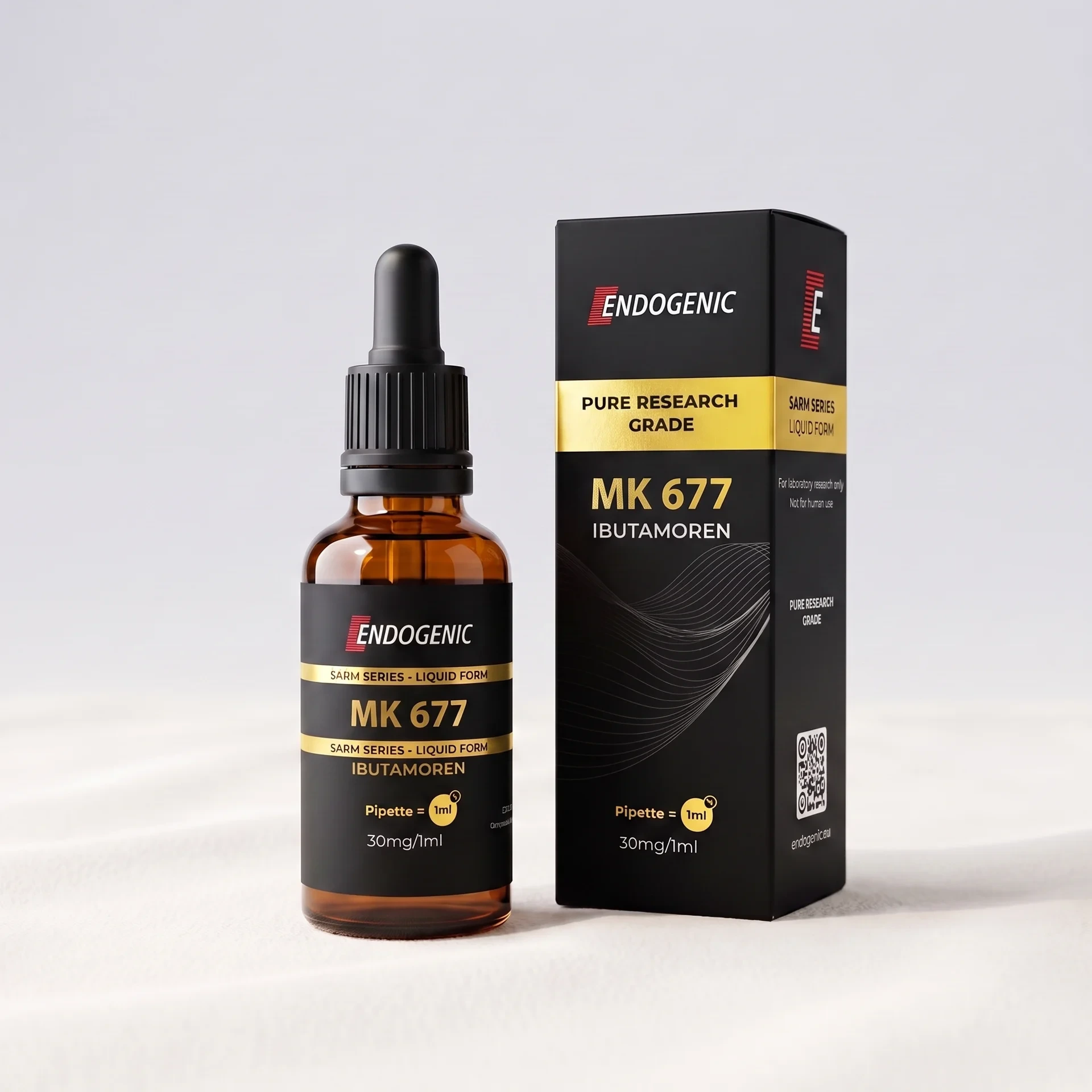
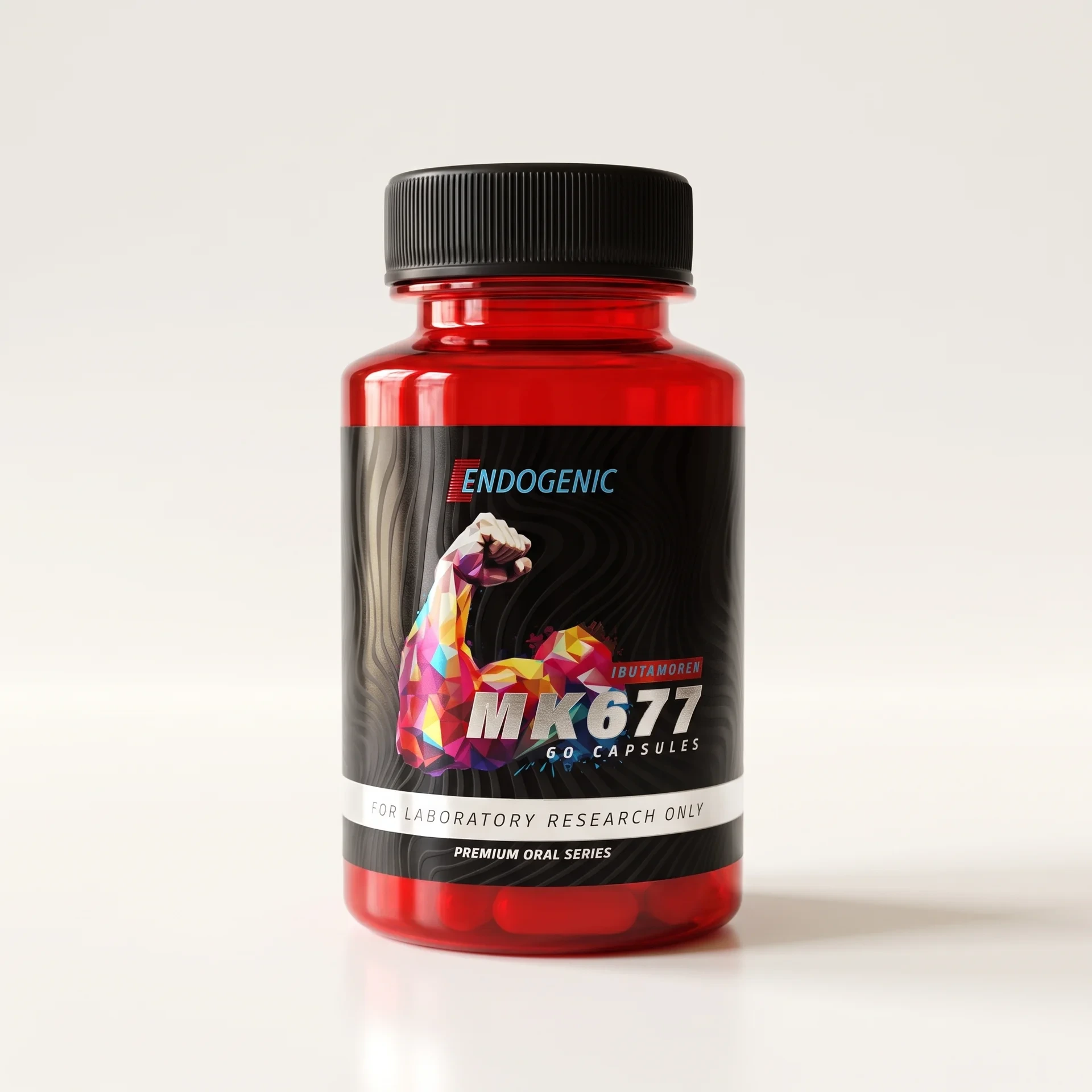
The subcategory covers two reagents containing the same substance in different forms. MK677 60 caps are hard capsules with a weighed content of 10 mg per capsule, in a pack of 60. MK 677 LIQUID is a solution in a 30 ml dropper bottle; the concentration in milligrams per millilitre is declared on the batch label and in the certificate of analysis.
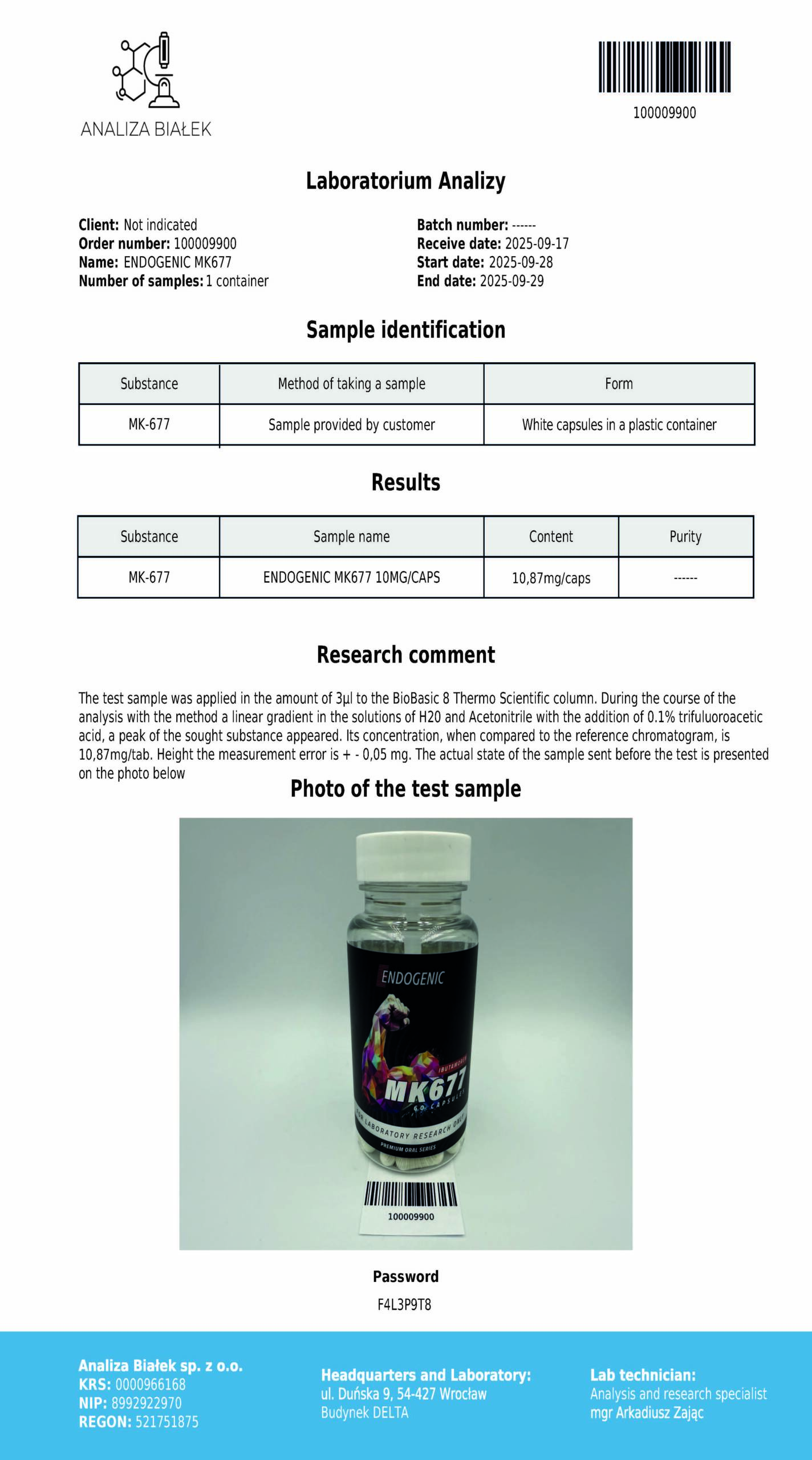
A capsule provides a ready weighed portion for standardising samples without an analytical balance, while a solution of known concentration needs no dissolution step, because the compound is small and stable in the aqueous phase. Batch purity is confirmed by an HPLC result and identity by mass spectrometry; both parameters are recorded in the certificate of analysis supplied with the batch.
Applications in scientific research
In the literature MK-677 is a reference ligand for the ghrelin receptor, and that is how research work uses it. Working concentrations are chosen by the researcher depending on the experimental system; the subcategory gives no quantities and no schedules.
- Pharmacology of the ghrelin receptor. Binding studies on membranes from human hypothalamus and pituitary gland, and characterisation of the signalling cascade triggered once the receptor is engaged (Muccioli et al., 2001).
- IGF-1 concentration as an endpoint. In a randomised crossover trial that enrolled 26 people on haemodialysis, of whom 22 completed it, insulin-like growth factor 1 rose 65% more than after placebo (95% CI 33–104%) (Campbell et al., 2018, PMID 28340044). In 161 patients recovering from hip fracture the increase was 84% (95% CI 63–107) against 17% (95% CI 8–28) on placebo, with no significant differences in functional performance measures or in the overall SIP-NH score (Bach et al., 2004, PMID 15066065).
- Body composition in models of ageing. In a two-year randomised trial in 65 healthy adults aged 60 to 81, fat-free mass after one year changed by 1.1 kg in the treated group and by −0.5 kg on placebo (p < 0.001) (Nass et al., 2008, PMID 18981485).
- Nitrogen balance under caloric restriction. In eight healthy volunteers on a calorie-restricted diet, nitrogen balance was 0.31 g per day against −1.48 g per day on placebo (p < 0.01) (Murphy et al., 1998, PMID 9467534).
- Sleep architecture. In a controlled trial in young adults the duration of stage IV increased by roughly 50% and REM sleep by more than 20% against placebo; in six people aged 65 to 71, REM sleep lengthened by nearly 50% (p < 0.05) and its latency shortened (p < 0.02) (Copinschi et al., 1997, PMID 9349662).
- Metabolic parameters as a safety signal. In 32 healthy people aged 64 to 81, IGF-1 rose from 141 µg/l at baseline to 219 µg/l at two weeks and 265 µg/l at four weeks (p < 0.05 against baseline), while fasting glucose rose from 5.4 to 6.8 mmol/l at four weeks (p < 0.01) (Chapman et al., 1996, PMID 8954023).
- Desensitisation in an animal model. In rats, six weeks of administration produced no increase in body mass or body length and none in IGF-1, and the secretory response to the compound was abolished; hypothalamic somatostatin mRNA expression rose markedly while pituitary SSTR-2 receptor expression fell (Lee et al., 2018, PMID 30450851).
Scientific perspective. The data for this molecule come from animal models and from early-phase clinical trials of a drug candidate. The clinical programme also produced warning signals: a phase IIb trial in 123 patients recovering from hip fracture was terminated early because of a congestive heart failure safety signal in a limited number of participants, and the authors summarised the safety profile in that population as unfavourable (Adunsky et al., 2011, PMID 21067829). Results are interpreted against the peer-reviewed literature, not against marketing material.
How MK-677 differs from related compounds
By molecular target, compared with the SARMs in the same category. Testolone (RAD-140), Ligandrol (LGD-4033) and Ostarine (MK-2866) are selective androgen receptor modulators and act through that receptor. MK-677 binds the ghrelin receptor and does not touch the androgen receptor. Its place in the catalogue follows from the literature discussing these groups together, not from a shared mechanism.
By form, not by substance. The 10 mg capsules and the 30 ml solution contain the same molecule with the same mechanism. What differs is the physical state of the material and the way a sample is standardised: a ready weighed portion in a capsule, or a known concentration per millilitre of solution, recorded in the batch certificate of analysis.
Regulatory status and anti-doping note
MK-677 holds no marketing authorisation as a medicine. The Drugs@FDA database holds no product with ibutamoren as an active ingredient, and the European Medicines Agency data on products authorised in the member states (Article 57, as of 9 October 2026) contain no entry for this substance; both sources checked 8 November 2026. The molecule has not moved beyond clinical research, the most advanced publications being phase II trials, and it holds no authorisation as a food or dietary supplement ingredient in the European Union.
Anti-doping note. The WADA Prohibited List names ibutamoren (MK-677) explicitly in category S2 (peptide hormones, growth factors, related substances and mimetics), in subclass S2.2, in an enumeration that also covers anamorelin, ipamorelin, capromorelin, lenomorelin, macimorelin and tabimorelin. The 2027 List, which applies from 1 January 2027, reads the same way: the entry and the category remain unchanged. The substance is prohibited at all times, in and out of competition, and category S2 also covers substances with a similar chemical structure or similar biological effect. The binding sources are the List in force and the ADAMS system. Materials from this subcategory are research reagents and do not serve as preparation for sporting competition.
Frequently asked questions (FAQ)
What is MK-677?
A non-peptide small molecule that the literature describes as a ghrelin mimetic, an agonist of the ghrelin receptor. It also appears under the names ibutamoren and MK-0677, and was developed in the Merck laboratories in the 1990s.
Is MK-677 a SARM?
No. SARMs modulate the androgen receptor, and MK-677 does not bind it; its target is the ghrelin receptor. Research catalogues often list the two kinds of compound together, yet the mechanisms are distinct.
How do the capsules differ from the 30 ml solution?
By the form of the material. A capsule holds a weighed content of 10 mg, which simplifies sample standardisation without an analytical balance. The solution has a concentration in milligrams per millilitre declared in the batch certificate of analysis and needs no dissolution step. The substance and its molecular target are the same in both variants.
Is MK-677 a medicine?
No. It holds no marketing authorisation as a medicine, and it is neither a dietary supplement nor a foodstuff. The materials collected here are reagents for laboratory research.
Is MK-677 prohibited in sport?
Yes. The WADA Prohibited List names ibutamoren (MK-677) explicitly in category S2, and the 2027 List keeps that entry. The prohibition applies at all times, in and out of competition.
Category status notice
This category groups chemical reagents intended solely for laboratory research (Research Use Only). The compounds presented are not medicinal products, dietary supplements or foodstuffs. They are not intended for use in humans or animals. Sales are restricted to registered research institutions and laboratories.