



Yohimbine HCl
Other categories
2 products
Black Week
Black Week deals before everyone else
Sign up for the newsletter and get access to the Black Week promotion before other customers.
By signing up you agree to receive the Pro-Body newsletter with news and promotions. You can unsubscribe at any time with one click in the e-mail. Privacy policy
Yohimbine HCl - research reagents
Yohimbine is an indole alkaloid originally obtained from the bark of the African tree Pausinystalia yohimbe, and classified in pharmacology as an antagonist of α2-adrenoceptors. For decades it has served as the reference tool for studying presynaptic control of noradrenaline release, because it blocks the receptor that normally restrains that process. In the Pro-Body catalogue it appears as the hydrochloride, the salt that provides solubility in water and stability in storage.
Adipose tissue is a good illustration of what this receptor does. Catecholamines stimulate fat breakdown through beta-adrenoceptors, yet the opposing α2 system operates in the same cells and restrains lipolysis. In microdialysis of subcutaneous adipose tissue in healthy non-obese subjects, α2 stimulation retained lipids in the tissue through vasoconstriction combined with antilipolysis, and yohimbine blunted the action of the agonist clonidine (Galitzky et al., 1993, PMID 8387538).
This subcategory collects reagents in which yohimbine hydrochloride is a substance of defined content, in contrast to crude bark extracts, where other alkaloids accompany yohimbine. The remaining materials of the section are gathered by the parent category Supplements.
Variants in the range
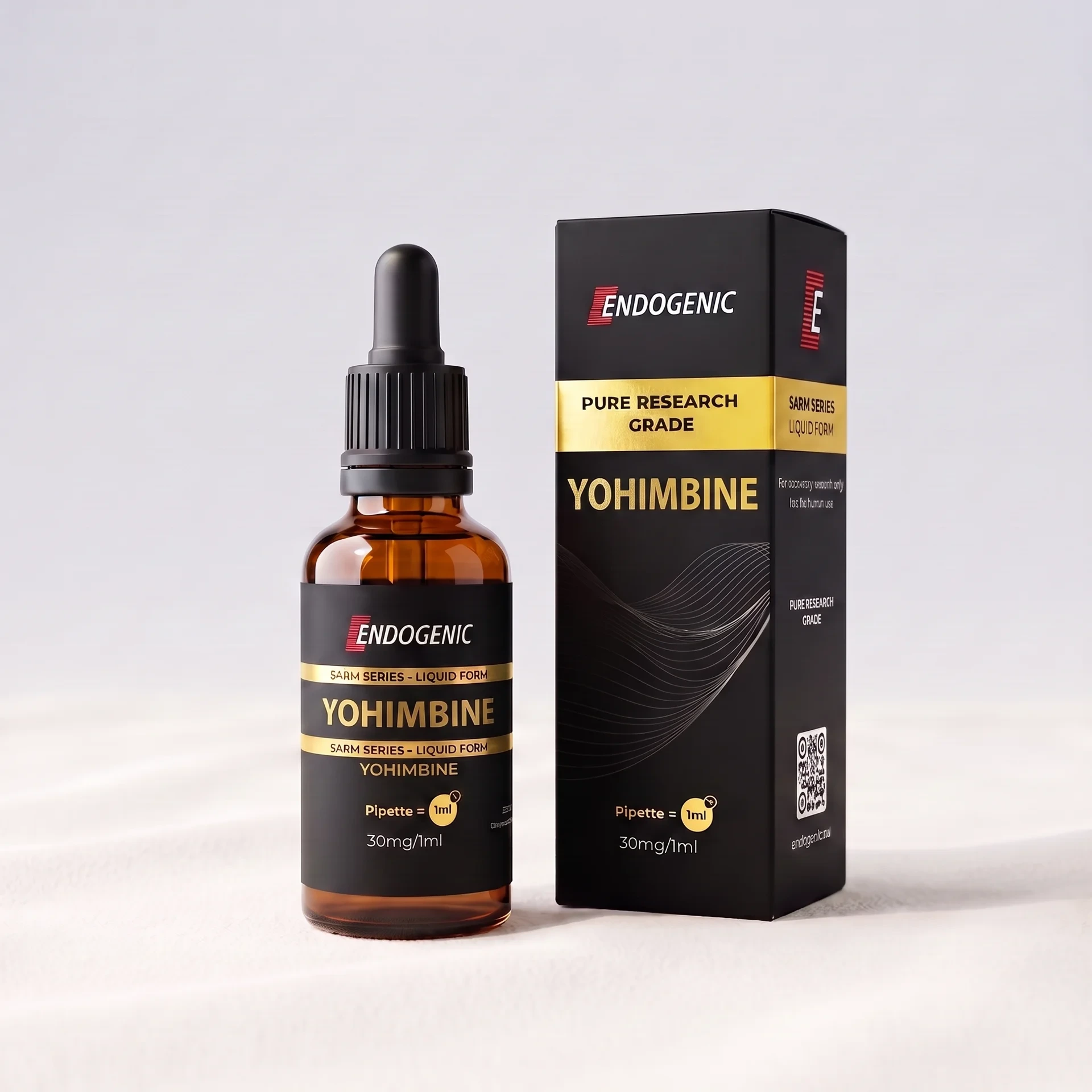
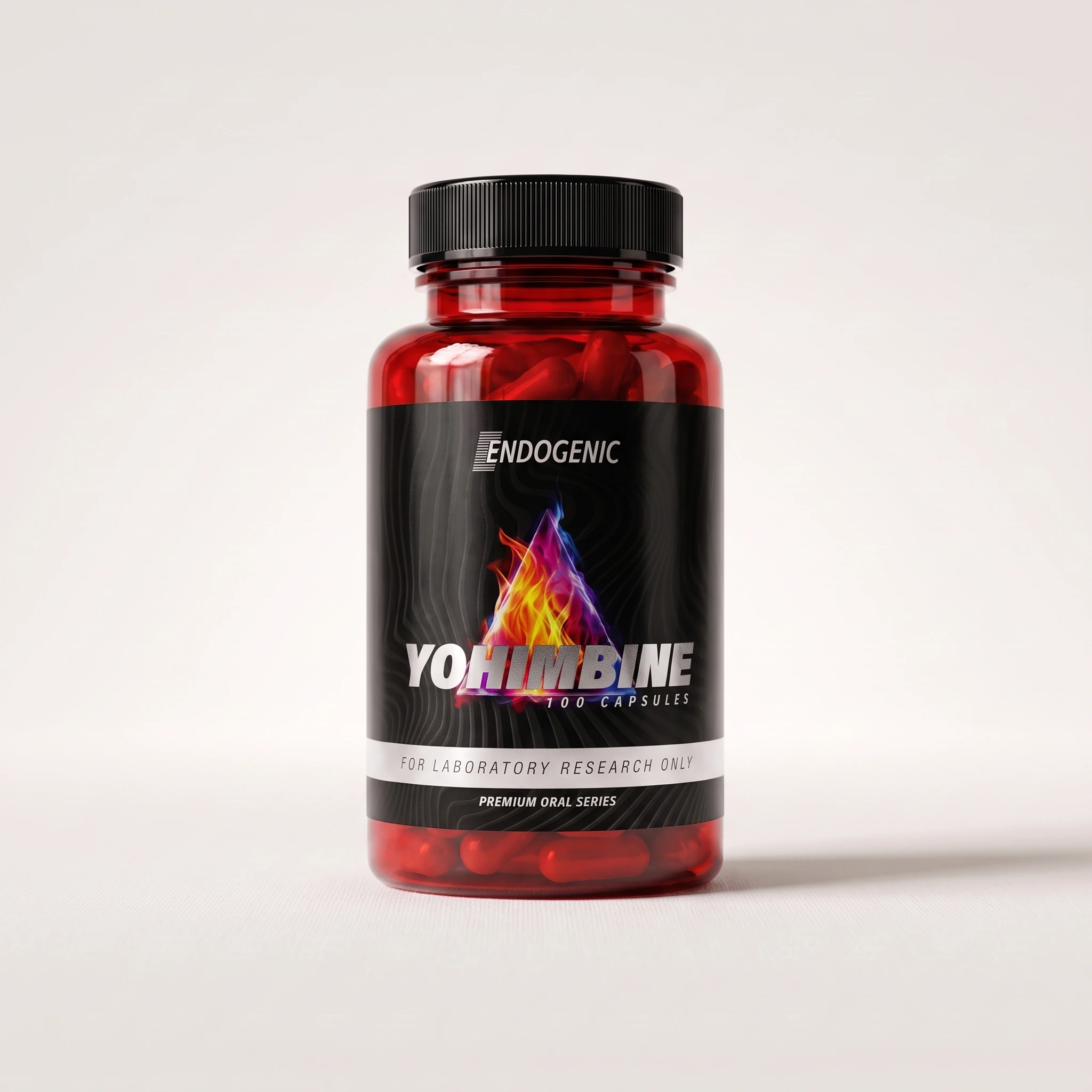
There are two reagents in the subcategory. Yohimbine 5mg – 100 caps are capsules with a content of 5 mg of yohimbine hydrochloride per capsule, in a pack of 100. Yohimbine HCl 30ml is 30 ml of solution in a dropper bottle; the concentration is stated on the batch label and in its certificate of analysis.
Both formats contain the same salt of the alkaloid, with batch purity confirmed by HPLC and identity by mass spectrometry. For this molecule the certificate carries additional weight, because accurate determination of content requires a method that separates yohimbine from corynanthine (Chen and Bryden, 2015, PMID 26268969).
Applications in scientific research
Yohimbine is the classic reference antagonist in the pharmacology of the sympathetic system. Working concentrations are chosen by the researcher depending on the system; the subcategory gives no quantities and no schedules.
- Characterisation of α2 receptors on fat cells. On human fat cell membranes the order of potency of three antagonists in competition studies with labelled yohimbine matched the order found in measurements of the extent to which they enhanced the lipolytic potency of adrenaline: yohimbine, idazoxan, SK&F-86 466 (Galitzky et al., 1988, PMID 2906290).
- The role of blood flow in lipid mobilisation. In the same microdialysis work, vasodilating agents abolished the pseudolipolytic effect of clonidine, and the response was more pronounced in gluteal than in abdominal tissue (Galitzky et al., 1993).
- Models of human physiology. In fasting healthy volunteers, plasma glycerol and non-esterified fatty acids rose, as did noradrenaline by 40–50%, with no significant change in heart rate or blood pressure over the course of the experiment. Physical exercise reinforced the effect, a meal suppressed it and propranolol partly blocked it (Galitzky et al., 1988).
- Studies on body composition. In 20 obese women on a 1,000 kcal daily diet, weight loss after three weeks was 3.55 ± 0.24 kg against 2.21 ± 0.37 kg on placebo (P < 0.005), with no significant effect on lipolysis under the conditions of that study (Kucio et al., 1991, PMID 1955308). In 20 professional footballers, body fat fell from 9.3 to 7.1% after 21 days (p < 0.05), with no change in body mass, muscle mass or performance indicators (Ostojic, 2006, PMID 17214405).
- Adverse effect profile in a clinical review. A review of the literature on erectile dysfunction summarised the efficacy of monotherapy as modest, and at much higher quantities identified elevation of blood pressure, a slight anxiogenic action and increased frequency of urination (Tam et al., 2001, PMID 11744068).
- Analytics of the raw material and of preparations. Chromatographic fingerprint analysis of 18 commercial yohimbe supplements showed wide variability in profiles and in yohimbine content, and in most samples the content was not consistent with the label claim (Sun and Chen, 2012, PMID 22221902).
Scientific perspective. The human data come from small studies conducted under the supervision of investigators, in defined populations and with stated endpoints; the authors of the clinical review noted that relatively few well-designed studies have been completed (Tam et al., 2001). Communicating this reagent as an agent for reducing body fat conflicts with the Research Use Only framework.
How yohimbine differs from related compounds
By the point of engagement in lipid metabolism. Cardarine (GW-501516) from the SARMs section acts through the nuclear receptor PPARδ, and so through the transcription of fatty acid oxidation genes. Yohimbine acts at the level of adrenergic transmission, by blocking a membrane receptor coupled to a G protein. These are two distinct nodes of the same pathway.
By the format of the material. Capsules with a weighed content of 5 mg simplify repeatable sample preparation, while a solution of known concentration allows material to be taken by volume. The substance is the same hydrochloride in both.
Regulatory status and anti-doping note
- Medicinal product in the European Union. Yohimbine is the active substance of the medicinal product Yocon-Glenwood, authorised in Germany and Austria; the marketing authorisation holder is Cheplapharm Arzneimittel GmbH. The data come from the listing of products authorised in the member states maintained by the European Medicines Agency under Article 57, as of 9 October 2026.
- United States. Yohimbine was available there as a prescription medicine under the trade name Yocon. The Drugs@FDA database and the National Drug Code catalogue hold no current product with it (checked 8 November 2026).
- Food in the European Union. Pausinystalia yohimbe bark and preparations derived from it appear in Part A of Annex III to Regulation (EC) No 1925/2006, the list of substances prohibited in food; the entry was introduced by Regulation (EU) 2019/650. An earlier opinion of the European Food Safety Authority could not establish a safe level of yohimbine intake in food. The reagent is neither a medicine nor a food.
Anti-doping note. Yohimbine is not named in the full text of the WADA Prohibited List 2026, nor in the 2027 List, which applies from 1 January 2027. Category S0 does not cover it either, because that category concerns substances with no approval for human use by any governmental regulatory health authority, and yohimbine holds such an approval in the European Union. The absence of an entry does not remove the need to verify: category S6 covers stimulants named explicitly together with substances of similar structure or similar effect, and the binding sources are the List in force and the ADAMS system. Materials from this subcategory are research reagents and do not serve as preparation for sporting competition.
Frequently asked questions (FAQ)
What is yohimbine?
An indole alkaloid from the bark of Pausinystalia yohimbe, and in pharmacology an antagonist of α2-adrenoceptors. Blocking those receptors removes feedback inhibition at sympathetic nerve endings, which is why it serves to study the control of noradrenaline release.
How does yohimbine hydrochloride differ from yohimbe bark extract?
By defined content. The hydrochloride is a single salt of the alkaloid with confirmed batch purity, whereas bark extract also contains other alkaloids, corynanthine among them. In an analysis of 18 commercial yohimbe supplements, the yohimbine content in most samples was not consistent with the label (Sun and Chen, 2012).
Is yohimbine a medicine or a dietary supplement?
Neither. The substance itself is the active ingredient of a medicine authorised in Germany and Austria, while yohimbe bark and its preparations are prohibited in food in the European Union. A Research Use Only reagent sits outside both regimes.
Is yohimbine on the WADA Prohibited List?
It is not named in the 2026 List or the 2027 List, and category S0 does not cover it, because it holds an approval as a medicinal product. The current status is verified in the List in force, as the stimulant entries change between editions.
What does the certificate of analysis cover for this molecule?
The purity result by HPLC, identity confirmation by mass spectrometry and the content of the substance in the batch. What matters is whether the method separates yohimbine from corynanthine, because without that the determination tends to be overstated (Chen and Bryden, 2015).
Category status notice
This category groups chemical reagents intended solely for laboratory research (Research Use Only). The substances collected here are not medicinal products, dietary supplements or foodstuffs. They are not intended for use in humans or animals. Sales are restricted to registered research institutions and laboratories.