Both forms share the same C-terminal active core ending with the sequence -Arg-Phe-NH₂, which binds and activates the KISS1R receptor. The difference lies in the chain length and the resulting pharmacokinetic profile. Kisspeptin-10 is a ten-amino-acid fragment – the shortest form with full receptor activity, but with shorter half-life and faster, transient action. Kisspeptin-54 is a full-length peptide (historically “metastin”) whose longer chain provides longer half-life and prolonged gonadotropin response. In research on receptor physiology, the 10-amino acid fragment is preferred, while in some clinical fertility studies, the full-length form is preferred.

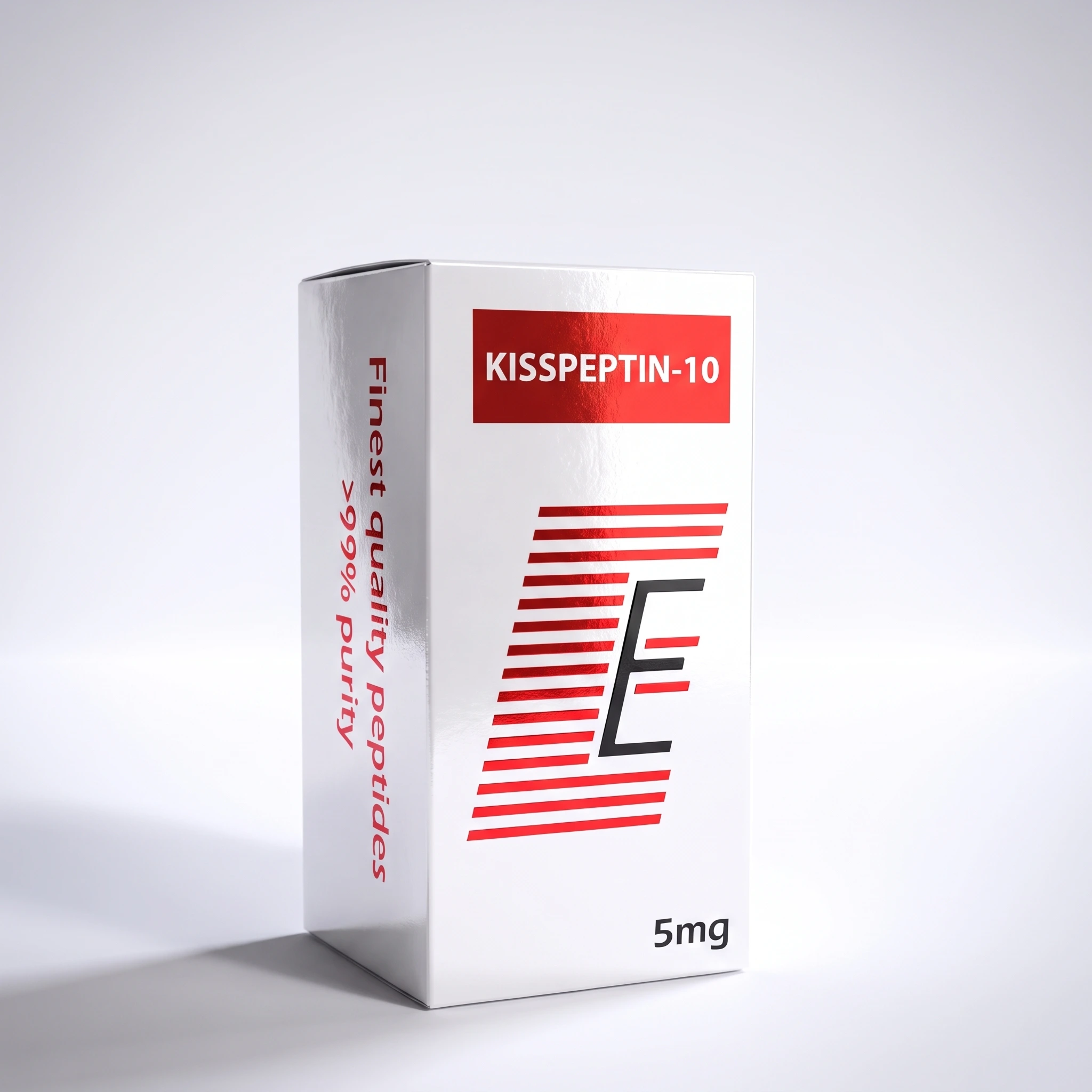
Kisspeptin-10 5mg
Kisspeptin-10 5 mg of lyophilisate is a ten-amino-acid active fragment of kisspeptin – an agonist of the KISS1R receptor and the master regulator of the HPG reproductive axis.
- Research Use Only reagent
- Molecular formula: C₆₃H₈₃N₁₇O₁₄
- Molar mass: 1302.4 g/mol
- CAS number: 374675-21-5
- Form: lyophilisate in a vial, 5 mg
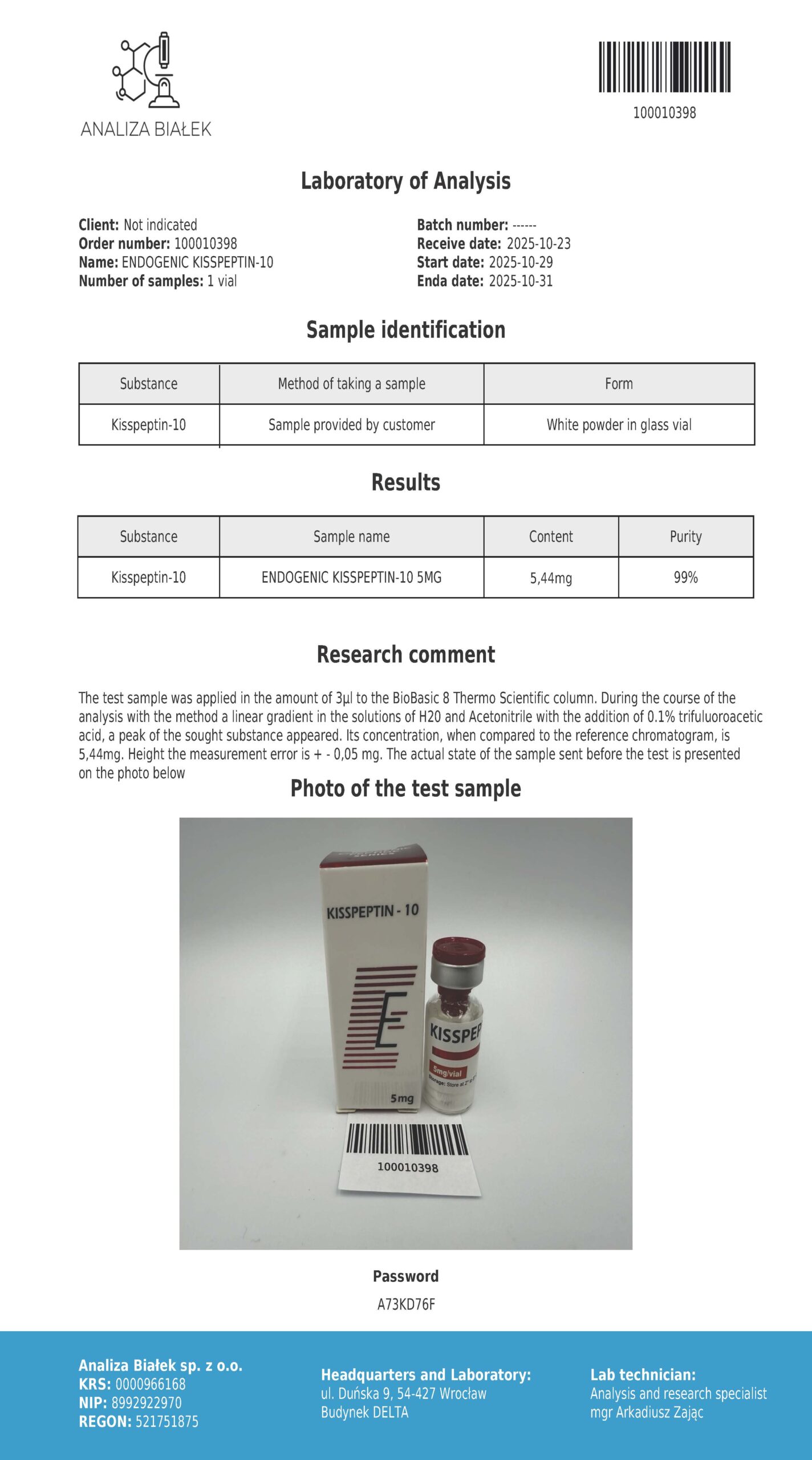
- Purity: ≥98% (HPLC)
32,99 €
With code BLACK: 26,39 €
Lowest price in the 30 days before the discount:
32,99 €
Fast shipping
Free delivery from 350 €
Returns policy
Kisspeptin-10 5 mg - KP-10 (metastin fragment 45-54), research reagent
- Kisspeptin-10 (KP-10): active kisspeptin fragment, KISS1R agonist.
- 5 mg lyophilisate in a vial.
- Research Use Only reagent, not a medicinal product.
Product status information
Chemical reagent intended exclusively for laboratory tests (Research Use Only). It is not a medicinal product, dietary supplement or food. It is not intended for use on humans or animals. Sales only to registered research units and laboratories.
Kisspeptin-10 (KP-10) is a ten-amino-acid, C-terminal active fragment of kisspeptin, a neuropeptide that, over two decades, has gone from being studied in the context of metastasis suppression (hence the historical name “metastin”) to being recognized as a master regulator of the mammalian reproductive axis. Line Endogenic Pro-Body groups research peptides mapping signaling molecules naturally present in the body – Kisspeptin-10 belongs to it as the active core of endogenous kisspeptin, the product of the KISS1 gene.
The breakthrough came in 2003, when two independent teams linked the loss of GPR54 receptor function (today KISS1R) with hypogonadotropic hypogonadism in humans (de Roux et al. 2003). This discovery placed kisspeptin at the heart of reproductive neuroendocrinology: without the kisspeptin–KISS1R signal, the hypothalamic-pituitary-gonadal (HPG) axis does not fire properly. Kisspeptin has thus become described as the “gateway” of the reproductive axis – the switch that determines the start of puberty and the maintenance of pulsatile gonadotropin secretion.
This reagent is supplied as lyophilisate in a 5 mg vial, reconstituted with bacteriostatic water in laboratory conditions. The freeze-dried form ensures the stability of the peptide before dissolution and allows researchers to prepare working concentrations selected for the experimental design. Purity verified by HPLC ≥98%, identity confirmed by mass spectrometry, COA available for each batch.
Regulatory status
Kisspeptin and its analogues are the subject of clinical trials for infertility, ovulation induction and assisted reproduction (IVF) protocols, but no form of kisspeptin has been registered as a medicinal product in the EU or USA. Not authorized by EFSA as an ingredient of a dietary supplement. Marketing a product as a “libido peptide”, “testosterone support for men” or a human drug is inconsistent with the Research Use Only framework.
HPG axis and kisspeptin as a reproductive gateway
The hypothalamic-pituitary-gonadal (HPG) axis is a three-level neuroendocrine system that controls reproduction. At the top there is the hypothalamus, where GnRH (gonadotropin-releasing hormone) neurons secrete gonadotropin-releasing hormone in a pulsatile manner. GnRH reaches through the portal circulation to the pituitary gland, where it stimulates the secretion of two gonadotropins – luteinizing hormone (LH) and follicle-stimulating hormone (FSH).
LH and FSH go to the gonads (testes, ovaries), where they control steroidogenesis (production of testosterone, estradiol) and the maturation of reproductive cells. The entire system is subject to negative feedback from sex hormones. For decades, the GnRH neuron was considered the highest element of this hierarchy. The discovery of kisspeptin changed this picture: it turned out that GnRH neurons themselves do not initiate their activity autonomously – they require a master signal.
This signal is kisspeptin, acting through the KISS1R receptor present on GnRH neurons. It is kisspeptin that is the real “trigger” of the axis – without it, the GnRH → LH/FSH → gonad cascade does not start. Therefore, kisspeptin is described as the gate of the reproductive axis: a level superior to GnRH, integrating metabolic, environmental and hormonal signals and then translating them into the decision to initiate reproduction.
Gonadoliberin acts directly “downstream” of kisspeptin in this cascade – this is why GnRH analogues such as Alarelin, are related research tools for probing the same section of the reproductive axis. The importance of this gateway is best illustrated by clinical genetics. Mutations that inactivate KISS1R lead to hypogonadotropic hypogonadism – lack of sexual maturation despite the normal structure of the gonads and pituitary gland (de Roux et al. 2003).
In turn, mutations activating the same axis have been associated with premature puberty. Kisspeptin is therefore not so much one of many modulators, but a central switch whose state determines whether the entire HPG axis is “on” or “off”. The biological profile of the kisspeptin-KISS1R system covers a wide spectrum of preclinical and early clinical observations:
- Stimulation of GnRH neurons — kisspeptin is the strongest known endogenous activator of GnRH secretion in the hypothalamus
- Stimulation of LH and FSH secretion — secondary to the release of GnRH, with a clear dominance of the LH response
- Initiation of puberty — kisspeptin as a starting signal for the activation of the HPG axis during puberty
- Integration of metabolic signals — kisspeptin neurons receive information about energy status (leptin), linking metabolism with fertility
- Modulation of reproductive functions in models — influence on the sexual cycle, ovulation and reproductive behavior in animal models
In this architecture, Kisspeptin-10 occupies a position model KISS1R ligand — the shortest fragment retaining full receptor activity, used as a tool to study the pharmacology of the gateway of the reproductive axis.
What is Kisspeptin-10?
Chemically, Kisspeptin-10 is a linear decapeptide with a C-terminal amide – the active core of kisspeptin.
- Common name: Kisspeptin-10, KP-10, metastin fragment (45-54), kisspeptin-10
- Chemical name: C-terminal ten-amino acid fragment of kisspeptin (KISS1 gene product)
- Sequence (10 aa): Tyr-Asn-Trp-Asn-Ser-Phe-Gly-Leu-Arg-Phe-NH₂ (YNWNSFGLRF-NH₂)
- Synonyms: KP-10, metastin (45-54), kisspeptin-10, metastin fragment 45-54
- CAS number: 374675-21-5 (in case of uncertainty – “to be verified in the batch COA”)
- Molar mass: ~1302 g/mol (to be verified in the batch COA)
- Chemical class: linear decapeptide, C-terminal amide; an active fragment of natural kisspeptin – the main regulator of the reproductive axis
- Supplied form: 5 mg lyophilisate in a vial, for reconstitution with bacteriostatic water; research grade ≥98% HPLC
Origin: Kisspeptin is a gene product KISS1, encoded in humans on chromosome 1. The full-length peptide (kisspeptin-54, formerly “metastin”) is proteolytically shortened to shorter forms – including a ten-amino-acid C-terminal fragment that retains the full ability to activate the KISS1R receptor. It is this C-terminal core, ending with the sequence -Arg-Phe-NH₂, that is responsible for binding and activation of the receptor; the N-terminal residues of full kisspeptin mainly have a stabilizing function and extend the duration of action.
Kisspeptin-10 is therefore the shortest fragment of a natural molecule that still fully “switches on” the reproductive axis – making it the preferred tool for studying the pharmacology of the receptor itself.
SCIENTIFIC PERSPECTIVE
Some of the data on Kisspeptin-10 comes from preclinical models (rat, mouse, sheep, primates, cultures of cells expressing KISS1R) and some from early human studies conducted in academic centers on the physiology of the HPG axis (George et al. 2011; Skorupskaite et al. 2014). Observations regarding LH stimulation, ovulation modulation and reproductive regulation require interpretation in the context of the research model and the route and scheme of administration in the experiment.
Kisspeptin is not a registered drug – extrapolation to consumer applications is not valid and the RUO reagent is intended for further laboratory testing only.
Mechanism of action at the molecular level
Kisspeptin-10 acts as an agonist of the KISS1R receptor and triggers the HPG axis cascade from its highest control level. The mechanism is divided into several interconnected stages. Pharmacological profile observed in preclinical and early clinical models:
- KISS1R (GPR54) receptor agonism → stimulation of GnRH neurons — Kisspeptin-10 binds to the KISS1R receptor, coupled to the Gαq/11 protein. Activation triggers the phospholipase C (PLC) pathway → production of IP₃ and DAG → mobilization of calcium ions and stimulation of protein kinase C (PKC). KISS1R receptors are located on GnRH neurons in the hypothalamus, so the binding effect is the depolarization of these neurons and the release of GnRH. This is the first and most important stage of the cascade – the signal input at the very top of the axis
- GnRH → pituitary gland → secretion of LH and FSH — released GnRH reaches through the portal circulation to the anterior pituitary and stimulates gonadotroph cells to secrete gonadotropins: luteinizing hormone (LH) and follicle-stimulating hormone (FSH). In human models and studies, the LH response is usually more pronounced than the FSH response – a characteristic “signature” of the kisspeptin signal on the HPG axis (George et al. 2011; Dhillo et al. 2005). The gonadotropins LH and FSH themselves are available as separate research tools on the reproductive axis, including: menotropin HMG 75 IU combining FSH and LH activity
- Reproductive axis gate – trigger of maturation and reproductive regulation — kisspeptin is the main switch activating the HPG axis. In a developmental context, it is the increase in the kisspeptin signal that initiates sexual maturation; in a mature organism, it maintains the pulsatile rhythm of GnRH secretion necessary for fertility. Kisspeptin neurons integrate hormonal signals (sex steroid feedback) and metabolic signals (leptin), acting as an “on/off” decision node for reproduction (Pinilla et al. 2012).
- Modulation of libido and reproductive functions in models — apart from the hormonal cascade, research models have observed the influence of kisspeptin signaling on brain circuits related to reproductive motivation and sexual behavior; area studied as a bridge between the neuroendocrine and behavioral layers of reproduction, thematically related to others peptides for libido analyzed in behavioral neuroendocrinology
- Background to research on infertility and hypogonadism — because loss of KISS1R function leads to hypogonadotropic hypogonadism, and stimulation of the axis restores gonadotropin secretion, the kisspeptin–KISS1R system is a model target for research on infertility, hypogonadotropic hypogonadism and ovulation induction in assisted reproductive protocols (Skorupskaite et al. 2014)
Pharmacokinetic profile (based on models and early clinical data):
- Plasma half-life: short – Kisspeptin-10, as a short linear peptide, is rapidly degraded by plasma peptidases; the effect is quick and transient
- The full-length form (kisspeptin-54) has a longer duration of action than the 10-amino acid fragment
- Metabolism: hydrolysis of peptide bonds by plasma and tissue peptidases
- Human PK profile: studied in an academic setting in the context of HPG axis physiology; depending on the route and schedule of administration
Applications in scientific research
Kisspeptin-10 is used as a research reagent in reproductive neuroendocrinology. In vitro models (cultures of cells expressing KISS1R, hypothalamic preparations, radioligand binding studies) examine receptor pharmacology, Gαq/PLC signaling kinetics and ligand selectivity. In vivo models (rat, mouse, sheep, primates) and in academic studies of human physiology assess the gonadotropin response (LH, FSH), the dynamics of pulsatile secretion and the integration of metabolic signals with the reproductive axis. Specific research directions include:
- Pharmacology of the KISS1R receptor — Kisspeptin-10 as reference agonist for affinity characterization, Gαq/PLC/calcium signaling and design of selective KISS1R agonists and antagonists
- Physiology of the HPG axis — study of the kisspeptin → GnRH → LH/FSH cascade; the role of kisspeptin as a master regulator of pulsatile gonadotropin secretion
- Models of puberty — kisspeptin as a signal initiating the activation of the HPG axis; tests for premature and delayed puberty
- Infertility and hypogonadotropic hypogonadism — kisspeptin-KISS1R system as a target for research on reproductive axis disorders and ovulation induction in assisted reproductive protocols
- Metabolic and reproductive integration — the role of kisspeptin neurons in connecting energy signals (leptin) with fertility; models of energy deficiency and amenorrhea
- Behavioral neuroendocrinology — study of the influence of kisspeptin signaling on reproductive motivation circuits in animal models
Regulatory status
Kisspeptin, as a modulator of the HPG axis, affects the secretion of LH and gonadotropins – which places it in the area of interest of the anti-doping program. The 2026 WADA Prohibited List names kisspeptin and its agonist analogues in section S2.2.1 (testosterone-stimulating peptides in males): in males it is prohibited at all times. Registered athletes (ADAMS) they need to verify the current list of prohibited substances before any decision. Kisspeptin is not registered as a drug in any jurisdiction; remains in the clinical fertility research phase.
Summary
Kisspeptin-10 (KP-10, metastin fragment 45-54) is a ten-amino acid, C-terminal active fragment of kisspeptin – the product of the KISS1 gene, described as a master regulator and “gateway” of the reproductive axis. It acts as an agonist of the KISS1R (GPR54) receptor, coupled with Gαq/PLC: it stimulates GnRH neurons in the hypothalamus, which triggers the cascade GnRH → pituitary → LH and FSH secretion (with the LH response dominating).
The discovery that loss of KISS1R function leads to hypogonadotropic hypogonadism (de Roux et al. 2003) placed kisspeptin at the center of reproductive neuroendocrinology—as a trigger of sexual maturation and a node integrating metabolic signals with fertility. Kisspeptin-10 differs from the full form of kisspeptin-54 in that it has a shorter half-life while maintaining full receptor activity.
Regulatory Status – Research Use Only; lack of registration as a medicine; WADA: section S2.2.1 (named), prohibited in males at all times.
Bibliography
- de Roux N, Genin E, Carel JC, Matsuda F, Chaussain JL, Milgrom E (2003). Hypogonadotropic hypogonadism due to loss of function of the KiSS1-derived peptide receptor GPR54. PubMed
- Dhillo WS, Chaudhri OB, Patterson M, Thompson EL, Murphy KG, Badman MK, et al. (2005). Kisspeptin-54 stimulates the hypothalamic-pituitary gonadal axis in human males. PubMed
- Pinilla L, Aguilar E, Dieguez C, Millar RP, Tena-Sempere M (2012). Kisspeptins and reproduction: physiological roles and regulatory mechanisms. PubMed
- Skorupskaite K, George JT, Anderson RA (2014). The kisspeptin-GnRH pathway in human reproductive health and disease. PubMed
- George JT, Veldhuis JD, Roseweir AK, Newton CL, Faccenda E, Millar RP, et al. (2011). Kisspeptin-10 is a potent stimulator of LH and increases pulse frequency in men. PubMed
FAQ
Kisspeptin-10 binds to the KISS1R receptor (formerly GPR54) present on GnRH neurons in the hypothalamus. The receptor is coupled to the Gαq/11 protein, so activation triggers the phospholipase C → IP₃/DAG → calcium mobilization pathway and PKC stimulation. The effect is the depolarization of GnRH neurons and the release of gonadoliberin. GnRH reaches the pituitary gland and stimulates the secretion of gonadotropins LH and FSH. Kisspeptin therefore acts at the very top of the axis – it “turns on” the GnRH neuron, which used to be considered the highest element of the hierarchy.
Because without the kisspeptin–KISS1R signal, the HPG axis does not activate properly. The best evidence is clinical genetics: mutations inactivating the KISS1R receptor lead to hypogonadotropic hypogonadism – lack of sexual maturation despite the normal structure of the gonads and pituitary gland (de Roux et al. 2003). Kisspeptin is superior to GnRH and integrates hormonal signals (steroid feedback) and metabolic signals (leptin), translating them into the decision to initiate reproduction. This makes it the “on/off” switch for the entire axis.
Because kisspeptin initiates and maintains gonadotropin secretion, the kisspeptin–KISS1R system is a model target for research on infertility, hypogonadotropic hypogonadism, and ovulation induction in assisted reproductive (IVF) protocols. Classic gonadotropins are located in the same research area of the reproductive axis, including: human chorionic gonadotropin HCG 5000 IU used as a tool to modulate the HPG axis.
Academic human studies have assessed the LH response to kisspeptin administration as a tool to probe HPG axis integrity (Skorupskaite et al. 2014). It is important to emphasize: these are studies of physiology and potential clinical applications – kisspeptin is not a registered drug and the RUO reagent is not intended for use in humans.
Yes. The 2026 WADA Prohibited List names kisspeptin and its agonist analogues in section S2.2.1 (testosterone-stimulating peptides in males), so in males Kisspeptin-10 is prohibited at all times, in and out of competition. Registered athletes (ADAMS) check the current version of the List before any decision.
First bring the lyophilized vial to room temperature, then wipe the caps with 70% isopropyl alcohol and slowly introduce bacteriostatic water along the side of the vial, not directly onto the powder. Adjust the volume of solvent to the target working concentration. Do not shake the vial – gently swirl it in a circular motion until dissolved as shear stress degrades the linear peptide. The solution should be clear and colorless; for long-term storage, aliquot and freeze at –20°C, avoiding multiple freezing and thawing cycles.
0.0
0 reviews
This product has no reviews yet.