No. The vial contains only sterile, pyrogen-free water, with no preservative and no other additives. Water with 0.9% benzyl alcohol is a separate product: bacteriostatic water.
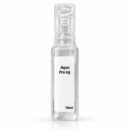
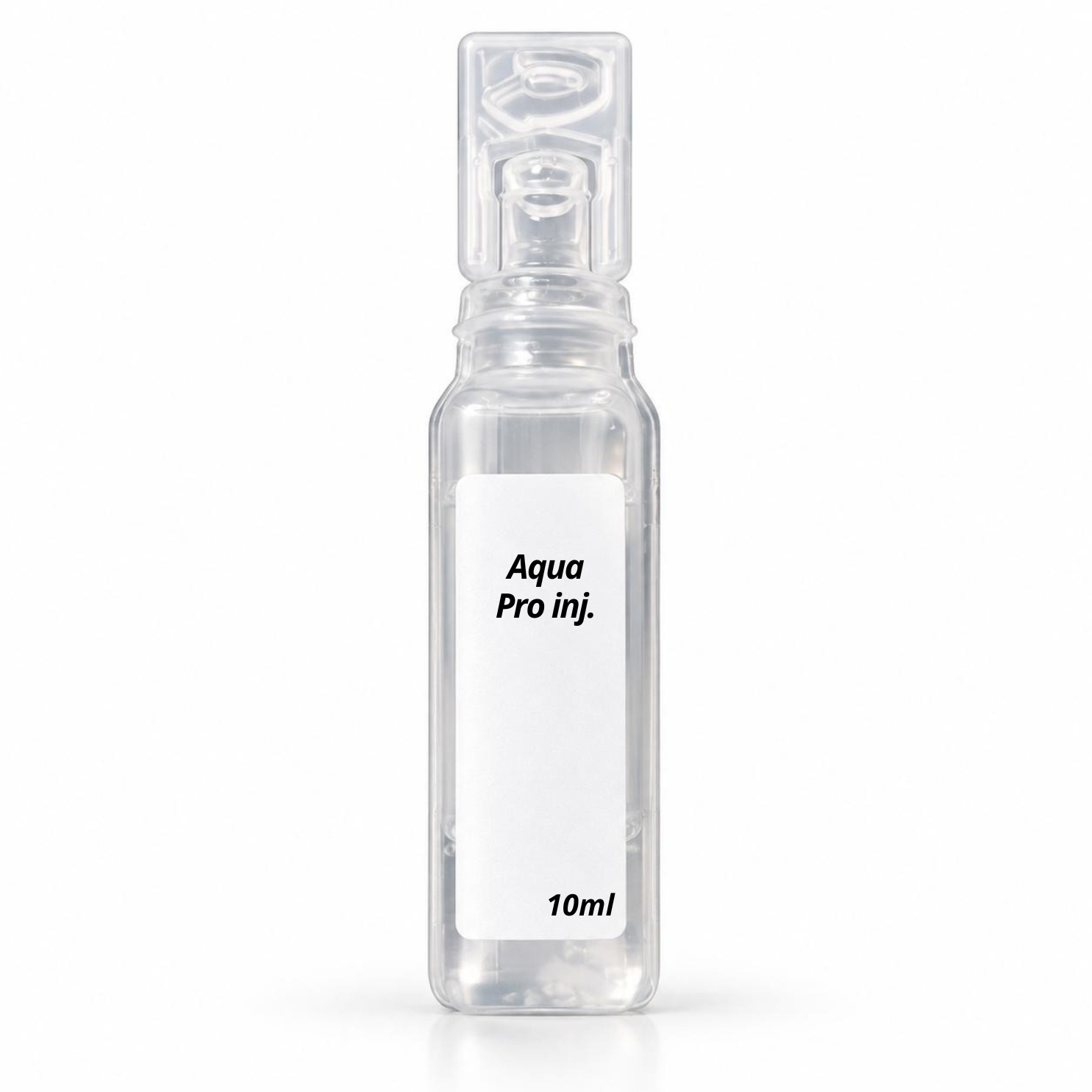
Water for injections 10ml
Water for Injection (10 ml) is sterile, apyrogenic, preservative-free water in a vial, intended for the reconstitution of lyophilized research reagents in a single session. Choose this product for reagents sensitive to benzyl alcohol or for experiments requiring an additive-free solvent. Laboratory accessory; not a medicinal product.
4,99 €
With code BLACK: 3,99 €
Lowest price in the 30 days before the discount:
4,99 €
Product unavailable
Notify me when it is back
Leave your e-mail and we will send you one message when the product is available again.
Water for injections 10 ml – sterile, pyrogen-free, preservative-free water for reconstituting lyophilisates
- Sterile, pyrogen-free water for injections, with no benzyl alcohol and no other additives.
- 10 ml vial; once the stopper is punctured, the contents are used in a single session.
- Laboratory accessory for reconstituting lyophilised research reagents.
Product status notice
Laboratory accessory: sterile, pyrogen-free water for injections (WFI) in a 10 ml vial, with no benzyl alcohol and no other additives. A solvent for reconstituting lyophilised research reagents (Research Use Only) in laboratory work. It is not sold as a medicinal product or dietary supplement. It is not intended for use in humans or animals. It does not change the status of the reagents dissolved in it – they remain RUO material. Sales are aimed at qualified research staff, scientific institutions and laboratories.
Introduction
Two 10 ml vials, each holding a clear liquid of the same purity grade. What separates them is one ingredient and what happens after the needle first goes through the stopper. Bacteriostatic water 10ml contains 0.9% benzyl alcohol, which inhibits bacterial growth and lets you draw solvent from the same vial for several weeks. Water for injections contains nothing but water. Once punctured, it serves a single work session, and you discard whatever water is left in the vial.
The lack of a preservative can be a limitation, and it can be a requirement. Benzyl alcohol can accelerate the aggregation of some proteins reconstituted from a lyophilisate, and in cell culture it is an extra substance that acts on cell membranes. When the reagent’s documentation specifies a preservative-free solvent, or the whole reconstitution fits into one session, water for injections 10 ml is the right choice.
What water for injections 10 ml is
Water for injections (WFI) is the highest purity grade of pharmaceutical water. The European Pharmacopoeia describes it in monograph 0169, “Aqua ad iniectabile”, and distinguishes two forms: water for injections in bulk, held in the production system, and sterilised water for injections, filled into sealed containers. This vial contains the second: sterile, pyrogen-free water with no additives, closed with a rubber stopper under a crimp cap.
The starting point is drinking water or purified water, either distilled or passed through reverse osmosis combined with electrodeionisation, ultrafiltration or nanofiltration. The Pharmacopoeia permits both routes and, for each, requires continuous conductivity monitoring and regular testing for total organic carbon (TOC) and microbial contamination. The water filled into containers is sealed and heat-sterilised under conditions that keep it compliant with the bacterial endotoxins test.
The United States Pharmacopeia (USP) describes the same type of product as Sterile Water for Injection: sterile, pyrogen-free water with no bacteriostatic agent, no antimicrobial agent and no buffer, supplied only in single-dose containers.
Selected European Pharmacopoeia requirements for sterilised water for injections in containers of up to 10 ml (a reference point for this grade of water, not test results for a specific batch):
| Parameter | Ph. Eur. requirement |
|---|---|
| Appearance | clear, colourless |
| Additives | no added substances of any kind |
| Sterility | complies with the test for sterility (2.6.1) |
| Bacterial endotoxins | less than 0.25 IU/ml (2.6.14) |
| Conductivity at 25°C | not more than 25 µS/cm |
| Residue on evaporation | not more than 4 mg per 100 ml |
| Sub-visible particles | complies with test 2.9.19 |
Conductivity and residue on evaporation show how many ions and solids remain in the water. The conductivity limit for water in containers is higher than for water in the production system: there the Pharmacopoeia requires not more than 1.3 µS/cm at 25°C, whereas for water filled into containers of up to 10 ml it allows 25 µS/cm.
The sterility test checks whether the water contains living microorganisms; the endotoxin assay checks whether bacterial remnants that survived sterilisation are still present. You will find the batch number and expiry date on the vial label. Record them in the experiment documentation together with the data of the reagent you are dissolving, because they are the first lead when a series gives a result that differs from the previous one.
Sterile and pyrogen-free water for injections – two different properties
Sterility means the absence of living microorganisms. Being pyrogen-free means the absence of fever-inducing substances, in practice bacterial endotoxins: lipopolysaccharides (LPS) from the outer membrane of Gram-negative bacteria.
Steam sterilisation works like a 90-degree wash: it kills bacteria but does not remove the traces they leave behind. Endotoxins are exactly that kind of trace: fragments of the bacterial outer membrane that cells release while alive and when they break down, and autoclave temperatures do not destroy them. Water can therefore be sterile and still contain endotoxins if bacteria multiplied in it before sterilisation. That is why the Pharmacopoeia requires two separate tests, and endotoxins are measured with the LAL test, which uses a reagent made from horseshoe crab blood cells that clots in the presence of LPS.
In laboratory work, endotoxins in the solvent distort measurements. Innate immune cells (macrophages, monocytes and dendritic cells) recognise LPS through the TLR4 receptor (Poltorak et al., 1998) and respond with a burst of pro-inflammatory cytokines such as TNF-α and IL-6. Human dendritic cells are activated even by the trace amounts of endotoxin left in some commercial protein preparations (Schwarz et al., 2014).
If you are studying a reagent’s effect on inflammation in cell culture, a solvent containing endotoxins can trigger a response the reagent itself did not cause. Pyrogen-free water for injections reduces this source of error to trace level: the pharmacopoeial limit is less than 0.25 IU/ml. It has no effect, however, on endotoxins brought in by the lyophilisate itself: that is a separate parameter of the reagent batch, and endotoxin testing is a test that HPLC purity cannot replace.
Water for injections or bacteriostatic water – a comparison
- Water for injections 10 ml: composition – water only, no additives; container type – single-dose; after the first puncture – one work session, then disposal; working solution – preservative-free; typical use – preservative-sensitive reagent, in vitro model, reconstitution in one session.
- Bacteriostatic water 10 ml: composition – water with 0.9% benzyl alcohol; container type – multi-dose; after the first puncture – a series of withdrawals within the window stated on its product page; working solution – the preservative passes into the solution; typical use – lyophilisate dissolved once and drawn in portions over several weeks.
The choice depends on your working rhythm and on the reagent. Do you dissolve the lyophilisate once and then draw portions over several weeks? You need a preservative, so bacteriostatic water goes in the basket. If you complete reconstitution in one session, or the reagent’s documentation rules out benzyl alcohol, choose water for injections 10 ml.
When to choose preservative-free water for injections
A reagent sensitive to benzyl alcohol. Benzyl alcohol binds to protein segments exposed on the surface of the molecule and promotes partial unfolding, and unfolded protein aggregates more readily (Zhang et al., 2004). Roy et al. (2005) described this during reconstitution of a lyophilisate: a solution containing 0.9% benzyl alcohol caused aggregation of recombinant interleukin-1 receptor antagonist, and the extent depended on the formulation.
Similar observations concern recombinant granulocyte colony-stimulating factor (Thirumangalathu et al., 2006) and interferon α-2a (Bis et al., 2015). These are results for proteins. Short peptides often lack a stable three-dimensional structure, so this mechanism need not apply to them. The documentation of the specific reagent is what counts: if it specifies a preservative-free solvent, order water for injections together with the lyophilisate.
An in vitro model in which the solvent should add nothing. Benzyl alcohol inhibits bacteria by entering the lipid bilayer of their membranes, and it acts on the membranes of cultured cells in the same way. In cell biology it is sometimes even used deliberately when membrane fluidity needs to be increased (Gordon et al., 1980; Balogh et al., 2005). In an experiment where the control and test groups differ only in the reagent, every additive in the solvent is one more variable to control. Water for injections removes that variable.
Reconstitution completed in one session. If you dissolve several vials of lyophilisate at once and immediately aliquot the finished solutions and move them to their final storage conditions, the preservative in the solvent has nothing to protect. A 10 ml vial covers such a session with room to spare.
Reconstitution with water for injections 10 ml – one vial, one session
The procedure differs from working with bacteriostatic water in one assumption: you puncture the solvent vial’s stopper within a single session and do not put the vial aside for later once the session ends. The length of the session is set by your workstation. The USP <797> standard, which governs sterile compounding in pharmacy, allows a punctured single-dose vial to be used for no more than 12 hours, and only if it was punctured in ISO Class 5 air: in a certified laminar airflow workbench, a biological safety cabinet or an isolator.
For a vial punctured on an ordinary bench, the standard provides no window at all, so there a session means one uninterrupted sitting: you draw all the portions one after another and discard the vial straight away. The example volumes and concentrations below only illustrate the logic of the calculations in laboratory work.
- Plan the session before you puncture the stopper. Work out the total solvent volume for all the vials you are reconstituting that day. Three vials of 5 mg lyophilisate, each made up to 2 mg/ml, need 3 × 2.5 ml, or 7.5 ml, so one vial of water for injections is enough. Match the number of water vials to the session plan, not to the entire study.
- Prepare the workstation. Ideally, work in ISO Class 5 air. The minimum is a disinfected bench, sterile syringes and needles, and swabs soaked in 70% isopropyl alcohol. Bring the vials to room temperature.
- Disinfect the stoppers. Remove the protective cap, wipe the rubber stoppers of the water vial and the lyophilisate vial, then wait for the alcohol to evaporate.
- Draw each portion with a new, sterile needle. Every puncture of the same stopper is a chance to introduce microorganisms, and in preservative-free water nothing will stop them afterwards.
- Run the water down the side of the vial and do not shake. Directing the stream at the vial wall rather than the cake and swirling the vial gently limit foaming, and with it the protein’s contact with the air–liquid interface, which promotes aggregation (Duerkop et al., 2018).
- Label each solution. Reagent name, concentration, date and time of reconstitution, water batch number and the note “WFI, preservative-free”: that last item changes how the solution is stored.
- End the session by discarding the vial and the remaining water. Do this even if 5 ml is left in it.
A preservative-free working solution
A dissolved reagent takes on the properties of the solvent, so a solution made with water for injections has no antibacterial protection. Each further withdrawal from its vial carries a greater risk of contamination than with a solution made with bacteriostatic water. Research peptide suppliers advise against storing solutions at all unless necessary (GenScript); the simplest approach is to dissolve only what you will use in the series. When storage is unavoidable, three rules limit the risk:
- Store the solution under the conditions in the reagent’s documentation. Without such data, a fridge (2–8°C) is enough for a short time, and portions for longer storage are frozen at −20°C.
- If a measurement series spans several days, divide the solution into sterile single-use aliquots straight after reconstitution. You draw from each aliquot only once.
- Freeze the aliquots unless the reagent’s documentation forbids it, and do not refreeze an aliquot once it has been thawed.
The chemical stability of the solution is set by the reagent, and water for injections does not shorten it. What it does not do is stop contamination that enters the vial during a withdrawal.
Storing water for injections 10 ml
- Unopened vial: room temperature, in its packaging, away from light. Do not let it freeze – ice can damage the vial or compromise the stopper seal.
- Expiry date and batch number: on the vial label. After the expiry date the vial is not fit for use.
- Check before use: the water should be clear and colourless, with no visible particles, and the cap and stopper intact. Cloudiness, sediment, a cracked vial or a damaged cap disqualify the vial.
- After puncturing: do not store the vial; the one-session rule applies.
- Keep out of the reach of children.
Water for injections 10 ml – product status
In the catalogue, water for injections 10 ml is a laboratory accessory for reconstituting research reagents (Research Use Only). It is not sold as a medicinal product or dietary supplement. The solvent does not change the status of the reagents: research peptides remain RUO material whether they were prepared with water for injections or with bacteriostatic water. You will find the reagents it is used to reconstitute in the research peptides category.
Summary
Sterile, pyrogen-free water of “for injections” grade, with no benzyl alcohol and no other additives, in a 10 ml vial. Once the stopper has been punctured, it serves a single work session. It suits preservative-sensitive reagents, in vitro models in which the solvent should add no substance, and any situation where you complete reconstitution in one sitting. Order as many vials as the reconstitution sessions you plan.
References
- European Pharmacopoeia. Water for injections (Aqua ad iniectabile), monograph 0169 (04/2017). Strasbourg: European Directorate for the Quality of Medicines & HealthCare.
- European Pharmacopoeia. 2.6.14 Bacterial endotoxins. Strasbourg: European Directorate for the Quality of Medicines & HealthCare.
- United States Pharmacopeia. Sterile Water for Injection — monograph. USP–NF.
- United States Pharmacopeia. General Chapter <797> Pharmaceutical Compounding — Sterile Preparations (2023 revision). USP–NF.
- Poltorak A, He X, Smirnova I, Liu MY, Van Huffel C, Du X, et al. Defective LPS signaling in C3H/HeJ and C57BL/10ScCr mice: mutations in Tlr4 gene. Science. 1998;282(5396):2085-2088. doi:10.1126/science.282.5396.2085. PMID: 9851930. PubMed
- Schwarz H, Schmittner M, Duschl A, Horejs-Hoeck J. Residual endotoxin contaminations in recombinant proteins are sufficient to activate human CD1c+ dendritic cells. PLoS One. 2014;9(12):e113840. doi:10.1371/journal.pone.0113840. PMID: 25478795. PubMed
- Zhang Y, Roy S, Jones LS, Krishnan S, Kerwin BA, Chang BS, et al. Mechanism for benzyl alcohol-induced aggregation of recombinant human interleukin-1 receptor antagonist in aqueous solution. Journal of Pharmaceutical Sciences. 2004;93(12):3076-3089. doi:10.1002/jps.20219. PMID: 15514986. PubMed
- Roy S, Jung R, Kerwin BA, Randolph TW, Carpenter JF. Effects of benzyl alcohol on aggregation of recombinant human interleukin-1-receptor antagonist in reconstituted lyophilized formulations. Journal of Pharmaceutical Sciences. 2005;94(2):382-396. doi:10.1002/jps.20258. PMID: 15614819. PubMed
- Thirumangalathu R, Krishnan S, Brems DN, Randolph TW, Carpenter JF. Effects of pH, temperature, and sucrose on benzyl alcohol-induced aggregation of recombinant human granulocyte colony stimulating factor. Journal of Pharmaceutical Sciences. 2006;95(7):1480-1497. doi:10.1002/jps.20619. PMID: 16729274. PubMed
- Bis RL, Singh SM, Cabello-Villegas J, Mallela KM. Role of benzyl alcohol in the unfolding and aggregation of interferon α-2a. Journal of Pharmaceutical Sciences. 2015;104(2):407-415. doi:10.1002/jps.24105. PMID: 25100180. PubMed
- Gordon LM, Sauerheber RD, Esgate JA, Dipple I, Marchmont RJ, Houslay MD. The increase in bilayer fluidity of rat liver plasma membranes achieved by the local anesthetic benzyl alcohol affects the activity of intrinsic membrane enzymes. Journal of Biological Chemistry. 1980;255(10):4519-4527. PMID: 6246076. PubMed
- Balogh G, Horváth I, Nagy E, Hoyk Z, Benkő S, Bensaude O, et al. The hyperfluidization of mammalian cell membranes acts as a signal to initiate the heat shock protein response. FEBS Journal. 2005;272(23):6077-6086. doi:10.1111/j.1742-4658.2005.04999.x. PMID: 16302971. PubMed
- Duerkop M, Berger E, Dürauer A, Jungbauer A. Impact of cavitation, high shear stress and air/liquid interfaces on protein aggregation. Biotechnology Journal. 2018;13(7):e1800062. doi:10.1002/biot.201800062. PMID: 29575605. PubMed
- GenScript. Peptide Storage and Handling Guidelines. genscript.com (accessed 07.10.2026).
FAQ
Yes, if they all take place in one session and you draw each portion with a new, sterile needle. On an ordinary bench, a session means one uninterrupted sitting: you draw the portions one after another and discard the vial straight away. In ISO Class 5 air, the USP <797> standard allows a punctured vial to be used for up to 12 hours. Without a preservative, every puncture of the stopper increases the risk of contaminating the remaining water.
Chemical stability is set out in the reagent’s documentation. A solution made with water for injections has no antibacterial protection, however, so for a measurement series spread over several days, divide it immediately into sterile single-use aliquots and store them under the conditions given for the reagent: briefly at 2–8°C, or longer as frozen aliquots at −20°C.
No. Distilled water is not sterile and is not tested for endotoxins. Reconstituting a reagent that will go into cell culture requires sterile, pyrogen-free water; otherwise microorganisms or endotoxins from the solvent become part of the experiment.
Check the expiry date on the label and hold the vial up to the light. Cloudiness, sediment, discolouration, a cracked vial, a damaged cap or signs of freezing disqualify the vial. So does having been punctured in a previous session, even if the water looks clean.
0.0
0 reviews
This product has no reviews yet.
Black Week
Black Week deals before everyone else
Sign up for the newsletter and get access to the Black Week promotion before other customers.
By signing up you agree to receive the Pro-Body newsletter with news and promotions. You can unsubscribe at any time with one click in the e-mail. Privacy policy