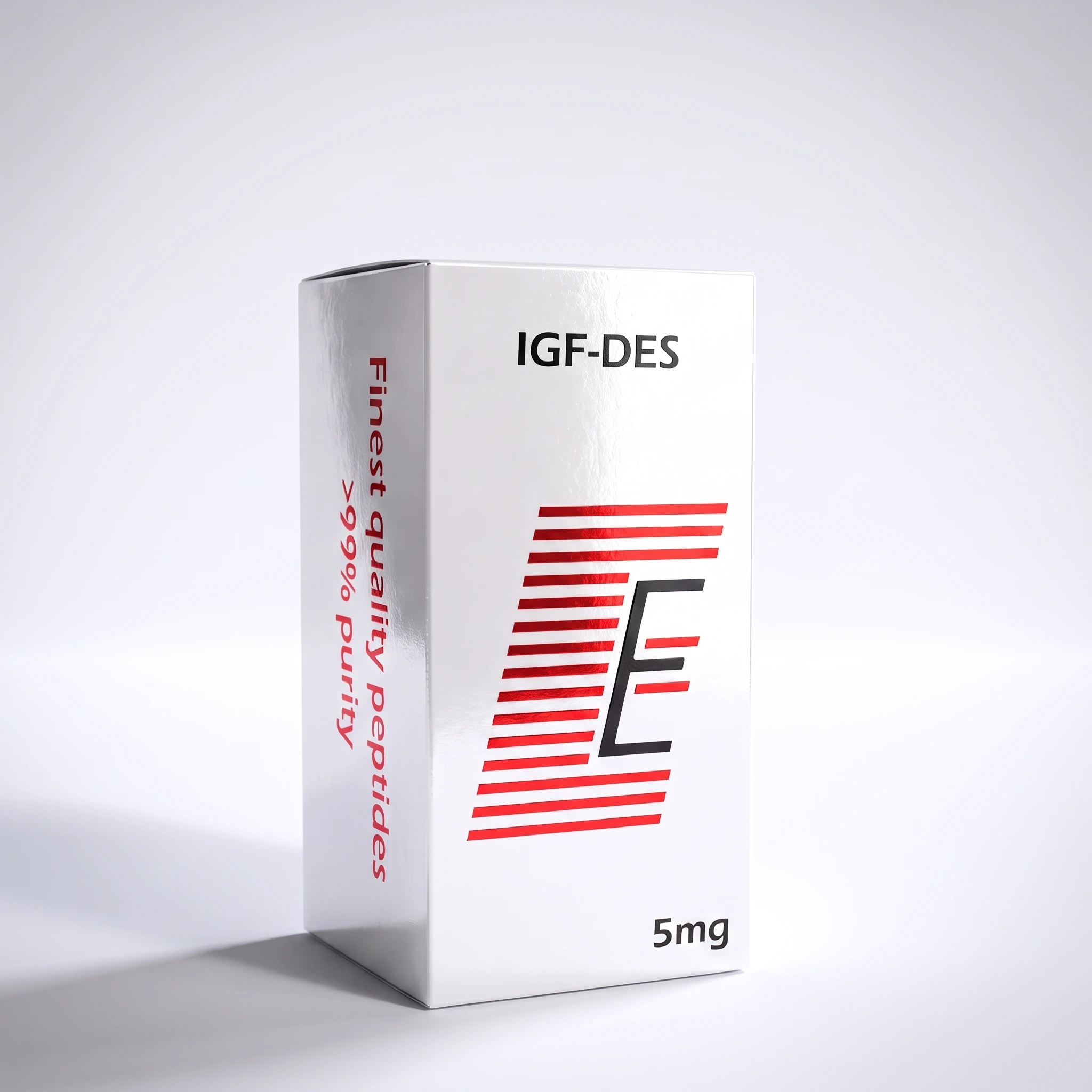
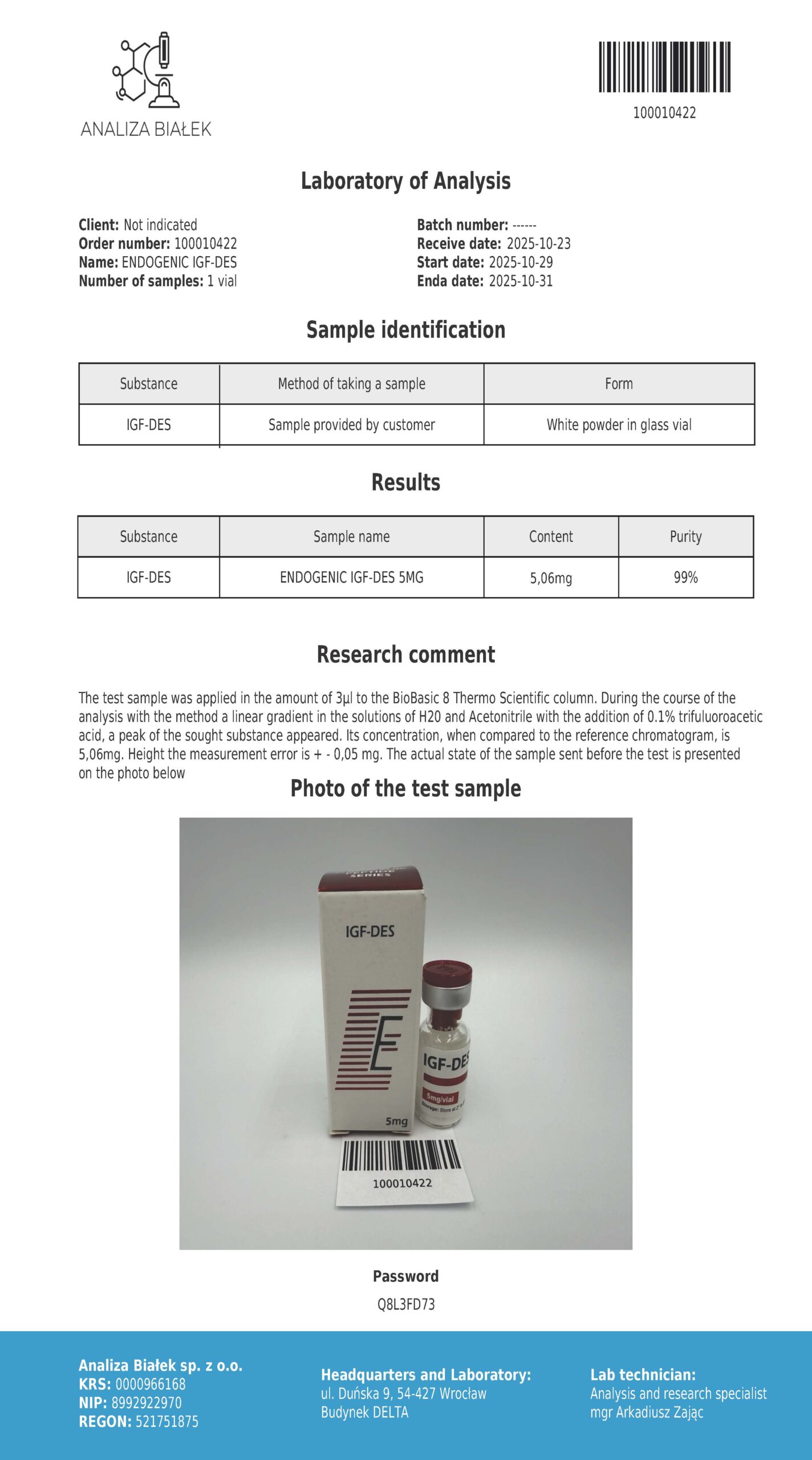
IGF-1 DES (des(1-3)IGF-1, des(1-3)IGF-I) is a shortened analogue of insulin-like growth factor type 1 in which the first three N-terminal amino acids – the Gly-Pro-Glu tripeptide – have been removed. Native human IGF-1 has 70 amino acids; the des(1-3) analogue has 67 of them, with a preserved IGF-1R receptor binding domain. This makes it a molecule with the same attachment point as native IGF-1, but with a different pharmacological profile resulting from a different interaction with transport proteins. It remains an investigational reagent with no completed clinical trials of its administration.
IGF-1 DES 5mg
IGF-1 DES — shortened IGF-1 analogue without the N-terminal tripeptide (67 aa vs. 70 aa native). The clearly reduced affinity for IGFBP-binding proteins results in high local potency and short, local action through the IGF-1R receptor. In models, it is associated with the proliferation of myoblasts, satellite cells and local tissue regeneration. It works locally – unlike the systemic IGF-1 LR3. Research Use Only reagent
47,99 €
With code BLACK: 38,39 €
Lowest price in the 30 days before the discount:
47,99 €
Fast shipping
Free delivery from 350 €
Returns policy
IGF-1 DES 5 mg - shortened IGF-1 analogue with high local potency, research reagent
- IGF-1 DES — shortened IGF-1 analogue without the N-terminal tripeptide (67 aa vs. 70 aa native).
- The clearly reduced affinity for IGFBP-binding proteins results in high local potency and short, local action through the IGF-1R receptor.
- In models, it is associated with the proliferation of myoblasts, satellite cells and local tissue regeneration.
Product status information
Chemical reagent intended exclusively for laboratory tests (Research Use Only). It is not a medicinal product, dietary supplement or food. It is not intended for use on humans or animals. Sales only to registered research units and laboratories.
Regulatory frame – growth factor, WADA category S2 (prohibited substance)
IGF-1 DES is an analogue of insulin-like growth factor type 1 (IGF-1). Growth factors and their mimetics fall into the category WADA Prohibited List S2 (peptide hormones, growth factors, related substances and mimetics) — substances prohibited in sport at all times (in- and out-of-competition). IGF-1 and its analogues appear in this category. Registered Athletes (ADAMS) and persons subject to anti-doping programs must check the current Prohibited List before making any decision. In the Pro-Body catalog, IGF-1 DES appears only as a RUO research reagent, not as an adjuvant.
IGF-1 DES from the line Endogenous is a shortened analogue of insulin-like growth factor type 1 – a molecule in which the first three amino acids of the N-terminus (Gly-Pro-Glu) have been removed. This seemingly minor modification clearly changes the pharmacological profile of the peptide: the analogue deprived of the N-terminal tripeptide binds much weaker to IGFBP transport proteins, and therefore has a stronger and more local effect than native IGF-1.
It is found in the literature under the following names des(1-3)IGF-1, des(1-3)IGF-I and abbreviation IGF-1 DES. The Endogenic line contains Pro-Body reagents focused on enzymes, pathways and signals of endogenous metabolism – hormonal axes that the body uses to regulate growth, regeneration and metabolism. IGF-1 DES fits into it as a tool for axis research growth hormone and IGF-1 (GH → liver and tissue production of IGF-1) and on local growth factor signaling in muscle tissue.
The central element of this axis are IGFBP-binding proteins — a family of six transport proteins that bind circulating IGF-1, modulating its availability to the receptor. It is the interaction with IGFBP that distinguishes IGF-1 DES from the parent molecule. This reagent is supplied as vial of lyophilisate (dry powder) 5 mg for self-reconstitution — a format that gives the researcher the freedom to select the working concentration for a specific experimental setup.
Purity verified by HPLC ≥98%, identity confirmed by Q-TOF mass spectrometry, COA available for each batch. It is a molecular tool for research on IGF-1R signaling, muscle anabolism and local tissue regeneration – exclusively in laboratory conditions.
IGF-1, GH–IGF-1 axis and IGFBP-binding proteins
Insulin-like growth factor type 1 (IGF-1) is one of the body’s main anabolic mediators. It is a peptide with a structure similar to proinsulin, produced mainly in the liver under the influence of growth hormone (GH), and also locally in many tissues, including skeletal muscles. Axis GH–IGF-1 is one of the central systems regulating tissue growth, muscle protein synthesis and regeneration – growth hormone secreted by the pituitary gland stimulates the production of IGF-1, which in turn transmits most of the anabolic signal to the cell level.
The local, tissue version of this signal in muscle is a splice variant of IGF-1 known as Mechano Growth Factor (PEG-MGF), studied alongside des(1-3) and LR3 analogues. Circulating IGF-1 is almost never found in its free form. Over 95% of the pool is related to IGFBP binding proteins (IGF binding proteins) — a family of six transport proteins (IGFBP-1 to IGFBP-6) that bind IGF-1 with high affinity.
IGFBPs act as a reservoir and regulator: they extend the half-life of the growth factor in the bloodstream, but at the same time limit its immediate availability to the receptor. Free IGF-1 – the fraction not bound to IGFBP – is the part of the pool that can actually activate the IGF-1R receptor in the tissue.
The mechanism of regulation by IGFBPs is a central point in understanding why analogues lacking affinity for these proteins behave differently. It is this mechanism that has made IGF-1 DES interesting for research. Removal of the N-terminal tripeptide (Gly-Pro-Glu) clearly reduces the affinity of the molecule for IGFBP, while the affinity for the IGF-1R receptor itself remains preserved.
In the models, this translates into a larger fraction of free peptide at the site of administration and, consequently, into a higher local potency compared to native IGF-1.
What is IGF-1 DES - a shortened analogue of des(1-3)IGF-1
Chemically, IGF-1 DES is a variant of native IGF-1 lacking the first three N-terminal amino acid residues. Native human IGF-1 has 70 amino acids; in the des(1-3) analogue, the tripeptide was removed Gly-Pro-Glu from positions 1–3, leaving a 67-amino acid chain with a preserved receptor-binding domain.
- Full name: IGF-1 DES (des(1-3)IGF-1, des(1-3)IGF-I)
- Class: truncated analogue of insulin-like growth factor type 1 (growth factor, peptide/protein)
- Modification: removal of the N-terminal tripeptide Gly-Pro-Glu (positions 1–3)
- Number of amino acids: 67 (vs 70 aa in native IGF-1)
- CAS number: 112603-35-1 — for verification in the batch COA
- Molar mass: ~7372 g/mol — for verification in the batch COA
- Molecular target/axis: IGF-1R receptor; PI3K/Akt and MAPK cascade; GH–IGF-1 axis
- Distinguishing feature: clearly reduced affinity for IGFBP-binding proteins → high local potency
- Delivered form: vial of lyophilisate (dry powder) 5 mg for reconstitution; ≥98% HPLC
Characteristics table
| Parameter | Value |
|---|---|
| Name | IGF-1 DES (des(1-3)IGF-1) |
| Line | Endogenous |
| Class | Truncated IGF-1 analog (growth factor) |
| Modification | Lack of N-terminal tripeptide Gly-Pro-Glu (positions 1–3) |
| Number of amino acids | 67 (vs 70 aa native IGF-1) |
| CAS number | 112603-35-1 (to be verified with the batch COA) |
| Molar mass | ~7372 g/mol (to be verified in the batch COA) |
| Molecular target/axis | IGF-1R receptor; PI3K/Akt and MAPK pathway |
| Affinity for IGFBP | significantly reduced (vs native IGF-1) |
| PK profile | short half-life, mainly local/tissue effects |
| Physical form | lyophilisate (dry powder) 5 mg in a vial |
| HPLC purity | ≥98% |
| Identity confirmation | Q-TOF mass spectrometry |
| Clinical status | no registration; no completed phase I-III studies for this analogue |
| WADA status | category S2 – prohibited substance (growth factors) |
Mechanism of action at the molecular level
In the literature, IGF-1 DES is described as an IGF-1R receptor agonist with a profile characterized by high local potency and short action. The literature points to five related axes observed in the models. Below, each with the name of the trail and its translation into experimental observations.
IGF-1R receptor agonism – PI3K/Akt and MAPK cascade
The main axis of the profile. IGF-1 DES binds to IGF-1R receptor — a receptor with tyrosine kinase activity — and triggers the same intracellular signaling as native IGF-1. Receptor activation leads to phosphorylation of substrate proteins and the initiation of two main cascades: PI3K/Act (anabolic and survival signal, regulation of protein synthesis by the mTOR axis) and MAPK (proliferative signal). In models, this is the molecular core of the molecule’s anabolic profile – the starting point for the observed effects on cell growth and survival.
Removal of the N-terminal tripeptide (1-3) and escape from IGFBP – high local potency
The second axis explains why the des(1-3) analog behaves differently from the parent molecule. Removal of the Gly-Pro-Glu tripeptide from the N terminus significantly reduces the affinity of the peptide for IGFBP-binding proteins, with preserved affinity for the IGF-1R receptor. In experimental practice, this means that the analogue is “captured” to a lesser extent by transport proteins, and a larger fraction remains free and available to the receptor at the site of administration.
In classical works this translated to approximately ten times higher local power compared to native IGF-1 (Ballard et al. 1987). This is a fundamental mechanistic difference: not a different receptor, but a different access to the same receptor.
Short half-life – mainly local and tissue effects
The third axis concerns pharmacokinetics. Because IGF-1 DES binds less strongly to IGFBP, it also loses the reservoir which, in the case of native IGF-1, prolongs its presence in the bloodstream. This has an effect short half-life and rapid clearance — the analogue effect remains primarily local and tissue, concentrated in the area of administration, not systemic.
This distinguishes it from the analogue in terms of profile IGF-1 LR3 (Long R3), the modification of which extends the operation time and gives it a more systemic character. In IGF-1 models, DES is therefore a tool for examining the short and local signal.
Anabolism – proliferation of myoblasts and satellite cells
The fourth axis involves the anabolic translation of the IGF-1R signal. In cellular and tissue models, IGF-1 DES has been associated with proliferation of myoblasts and satellite cells and with processes hypertrophy and hyperplasia muscle tissue. Satellite cells are muscle-resident stem cells whose activation and division underlie muscle fiber growth and repair. The IGF-1R signal through the PI3K/Akt cascade promotes protein synthesis and cell survival, which in models translated into an anabolic profile of the analogue (Tomas et al. 1991; Adams 2002).
Local tissue regeneration and growth in models
The fifth axis is a wider, tissue translation of the previous four. Due to the high local potency and short action of IGF-1, DES is sometimes considered in the literature as a testing tool local tissue regeneration and growth — where a strong, localized anabolic signal is important, not systemic exposure. This is an effect observed at the tissue level as a result of molecular mechanisms, not a separate pathway.
Reference data mainly comes from classic works on des(1-3)IGF-1 potency and anabolism (Ballard et al. 1987; Tomas et al. 1991) and reviews on IGF-1 signaling in muscle (Philippou et al. 2014; Clemmons 2018).
IMPORTANT DISTINCTION
“It has an anabolic effect” or “has high local potency” in the context of this description means: “in vitro and in vivo studies in animal models have observed the effect of IGF-1 DES on the IGF-1R receptor, the PI3K/Akt and MAPK cascade, and on the proliferation of myoblasts and satellite cells.” This is not a guarantee of effect in humans or a suggestion that the IGF-1 DES reagent may function as an anabolic, muscle building or regenerative agent in humans.
Three distinctions are necessary. IGF-1 DES (des(1-3)) acts mainly locally — high local potency, significantly reduced affinity for IGFBP, short half-life, fast clearance. IGF-1 LR3 (Long R3) works more systemically — its modification extends the duration of action and makes it dispersed in the body; it is a different pharmacokinetic profile of the same axis.
Native IGF-1 is the parent molecule, strongly bound to IGFBP, with the shortest free fraction. All three work through the same thing IGF-1R receptor, not through the growth hormone receptor (GHR) — this differs fundamentally from recombinant growth hormone (rhGH), which acts on the GHR above the IGF-1 axis. All mechanisms described refer only to observations in preclinical models.
Applications in scientific research
IGF-1 DES as an RUO reagent is used as a molecular tool in several areas of research on growth factor signaling and muscle anabolism. The 5 mg form of a lyophilized vial works well when the researcher needs complete freedom in selecting the working concentration for a specific experimental system. In the catalog classification, the analogue is adjacent to peptides for muscle mass studied in the context of hypertrophy.
- IGF-1R signaling — studies on the activation of the receptor and PI3K/Akt and MAPK cascades in cell cultures, with IGF-1 DES as an agonist with high local potency
- Muscle anabolism — models of myoblast and satellite cell proliferation, markers of hypertrophy and hyperplasia, muscle protein synthesis in cell lines
- The role of IGFBP-binding proteins — comparative studies on the difference in the affinity of the des(1-3) analogue and native IGF-1 for IGFBP and on the free peptide fraction
- Pharmacokinetics of IGF-1 analogues — comparison of local (DES) and systemic (LR3) profiles in models, studies on clearance and local effects
- Local tissue regeneration — models of tissue growth and repair in which a strong, concentrated anabolic signal is important instead of systemic exposure
Summary
IGF-1 DES (5 mg lyophilisate vial, Endogenic line) is truncated analogue of insulin-like growth factor type 1 — des(1-3)IGF-1, in which the N-terminal tripeptide Gly-Pro-Glu (positions 1–3) has been removed, giving a 67-amino acid chain (vs 70 aa in native IGF-1; CAS 112603-35-1; ~7372 g/mol – values to be confirmed in COA). The distinguishing feature is clearly reduced affinity for IGFBP-binding proteins, with preserved affinity for the IGF-1R receptor – in the models this translated into approximately ten times higher local potency and a larger fraction of free peptide at the site of administration.
The analogue acts through the IGF-1R receptor (PI3K/Akt and MAPK cascade), has a short half-life and rapid clearance, so its effects remain mainly local and tissue-specific. In IGF-1 models, DES has been associated with myoblast and satellite cell proliferation, hypertrophy and hyperplasia, and with local tissue regeneration. IGF-1 DES (des(1-3), local, short T½) differs in profile from IGF-1 LR3 (Long R3, systemic, longer T½) and from native IGF-1 — all of them act through IGF-1R, not through the growth hormone receptor (GHR), unlike rhGH.
Regulatory Status – Research Use Only; no clinical phase in humans; WADA category S2 (prohibited substance). The guide discusses the broader context of the use of growth factors and IGF-1 analogues in bodybuilding sports peptides in bodybuilding.
Bibliography
- Ballard FJ, Francis GL, Ross M, Bagley CJ, May B, Wallace JC (1987). Natural and synthetic forms of insulin-like growth factor-1 (IGF-1) and the potent derivative, destripeptide IGF-1: biological activities and receptor binding. PubMed
- Tomas, F. M., Knowles, S. E., Owens, P. C., Read, L. C., Chandler, C. S., Gargosky, S. E., Ballard, F. J. (1991). Increased weight gain, nitrogen retention and muscle protein synthesis following treatment of diabetic rats with insulin-like growth factor (IGF)-I and des(1-3)IGF-I. PubMed
- Clemmons, D. R. (2018). Role of IGF-binding proteins in regulating IGF responses to changes in metabolism. PubMed
- Philippou A, Maridaki M, Pneumaticos S, Koutsilieris M (2014). The complexity of the IGF1 gene splicing, posttranslational modification and bioactivity. PubMed
- Adams, G. R. (2002). Autocrine and/or paracrine insulin-like growth factor-I activity in skeletal muscle. PubMed
Chemical reagent Research Use Only. IGF-1 DES (des(1-3)IGF-1, 5 mg lyophilisate vial, Endogenic line) in the Pro-Body catalog is not a medicinal product, dietary supplement or food. It is not intended for administration to humans or animals outside a controlled experimental environment; The form of the lyophilized vial does not suggest preparation for administration to humans. IGF-1 DES it is not registered as a medicine in the EU or the USA (not authorized by EMA, FDA, EFSA), a
IGF-1 and its analogues are on the WADA Prohibited List in category S2 (growth factors) – substances prohibited in sport at all times. Registered Athletes (ADAMS) must check the current list before making any decision. The information in the description is educational and scientific in nature and refers to results reported in preclinical literature – it does not constitute medical advice or administration instructions.
FAQ
Circulating IGF-1 is almost entirely bound to IGFBP-binding proteins, which limit its immediate availability to the receptor. Removal of the N-terminal tripeptide Gly-Pro-Glu clearly reduces the affinity of the analogue for IGFBP, while maintaining affinity for the IGF-1R receptor. As a result, a smaller part of the molecules is “captured” by transport proteins, and a larger fraction remains free and available to the receptor at the site of administration. In classic works, this translated into approximately ten times higher local potency compared to native IGF-1. These are observations from preclinical models, not an effect confirmed in humans.
Both are IGF-1 analogues acting through the same IGF-1R receptor, but they differ in their pharmacokinetic profile. IGF-1 DES (des(1-3)) has a short half-life and rapid clearance – its effect remains primarily local and tissue-specific, concentrated at the site of administration. IGF-1 LR3 (Long R3) has a modification that extends the duration of action, which makes its profile more systemic and dispersed in the body. In short: DES is a short and local signal, LR3 is a longer and systemic signal. Both remain RUO reagents.
These are two different levels of the same hormonal axis. Growth hormone (rhGH) works by growth hormone receptor (GHR) and stimulates, among other things, the production of IGF-1 – so it acts above IGF-1 in the GH-IGF-1 axis. IGF-1 DES is an analogue of IGF-1 itself, and it works directly through the IGF-1R receptor, below the level of growth hormone, bypassing GHR. Different receptor, different axis level. A related GH axis research tool is the oral secretagogue MK-677 (Ibutamoren), stimulating endogenous secretion of growth hormone.
Yes. Growth factors and their analogues belong to category S2 of the WADA Prohibited List (peptide hormones, growth factors, related substances and mimetics) — substances prohibited in sport at all times (in- and out-of-competition). IGF-1 and its analogues appear in this category. This status is unambiguous and distinguishes IGF-1 DES from compounds whose classification remains to be verified. Registered Athletes (ADAMS) and persons covered by anti-doping programs must check the current Prohibited List themselves before making any decision. The reagent remains intended for laboratory use only.
The lyophilisate is brought to room temperature and then dissolved in bacteriostatic water, sterile water for injection, or dilute acetic acid depending on the unit’s protocol – introduced slowly down the side of the vial. Dissolution is carried out with gentle circular motion, without vigorous shaking, which causes aggregation and foaming of the protein. Once a clear solution is obtained, it is divided into working aliquots, labeled with the date and batch number, and stored according to the unit’s procedure, limiting freeze-thaw cycles. This is a laboratory procedure for a research reagent, not instructions for administration to humans.
0.0
0 reviews
This product has no reviews yet.
Related products