Both analogues bind IGFBPs weakly, but they achieve this differently. IGF-1 DES lacks the first three amino acids of the native sequence, while IGF-1 LR3 has arginine at position 3 and 13 extra amino acids at the N-terminus. They also differ in mass, which allows them to be told apart in the MS spectrum. In the catalogue, the truncated analogue is available as IGF-1 DES (1-3).
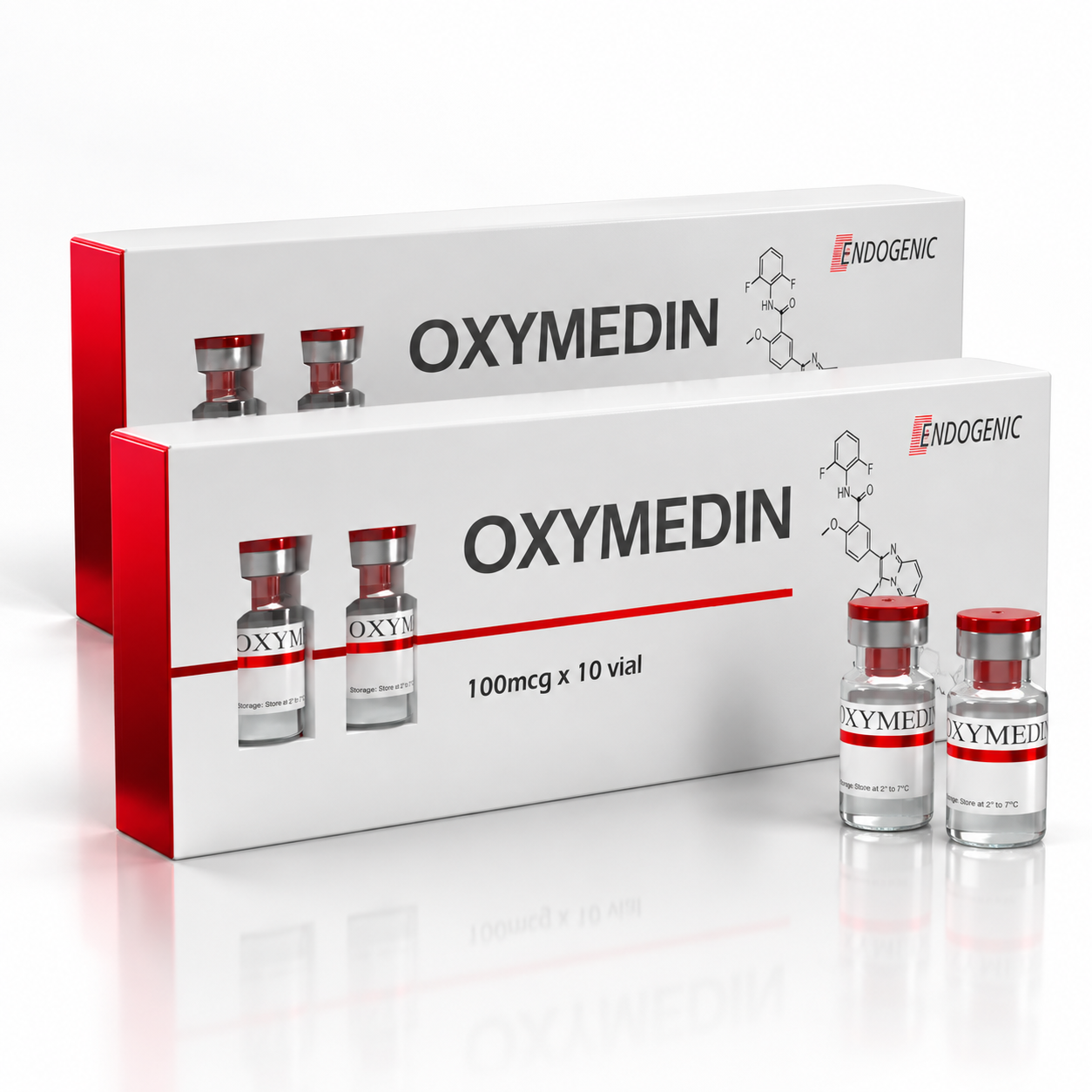
OXYMEDIN (IGF-1 LR3) 2 pieces
Oxymedin (IGF-1 LR3) is a set comprising two packs of 10 vials of lyophilized powder, with 100 mcg of IGF-1 LR3 per vial—totaling 20 vials and 2 mg. It is a reagent for research on the IGF-1 receptor in cellular models.
449,99 €
Fast shipping
Delivery options
Free delivery from 350 €
Returns policy
Oxymedin (IGF-1 LR3) 2 packs – 20 vials of 100 mcg each, RUO research reagent
- IGF-1 LR3 – an 83-amino-acid IGF-1 analogue with weak binding to IGFBPs.
- 2 packs of 10 lyophilisate vials; 100 mcg IGF-1 LR3 per vial, 20 vials and 2 mg in total.
- RUO reagent without authorisation as a medicine; WADA List 2026: class S2.3.
Product status notice
A chemical reagent intended solely for laboratory research (Research Use Only). It is not a medicinal product, dietary supplement or foodstuff. It is not intended for use in humans or animals. IGF-1 LR3 is not an authorised medicine and is not a substitute for mecasermin, the native IGF-1 used as a medicine (Increlex®). The 2026 WADA List places IGF-1 analogues in class S2.3, prohibited at all times. Sales are aimed at research institutions and laboratories.
Introduction
In cultured rat L6 myoblasts, IGF-1 LR3 stimulated protein and DNA synthesis more strongly than native IGF-1. In chick embryo fibroblasts, which do not secrete IGF-binding proteins (IGFBPs), it was weaker (Francis et al., 1992). The analogue’s advantage is therefore explained by weak binding to IGFBPs, not by stronger action at the receptor. As a result, the outcome of an experiment with IGF-1 LR3 depends on how much of these proteins the model contains.
Oxymedin is Pro-Body’s trade name for IGF-1 LR3 (Long R3 IGF-I). The set contains 2 packs of 10 lyophilisate vials, a total of 20 vials with 100 mcg IGF-1 LR3 each (2 mg in the complete set). It contains the same substance as the product Oxymedin Endogenic. Each vial is reconstituted separately, while the remaining vials can stay in dry form until needed. One pack contains 1 mg of IGF-1 LR3 in total. Identity and purity are confirmed by the batch certificate of analysis (COA).
What Oxymedin (IGF-1 LR3) is
IGF-1 LR3 is a recombinant analogue of insulin-like growth factor 1. A 13-amino-acid extension was added in front of the human IGF-1 sequence: the first 11 residues of methionyl porcine growth hormone and the dipeptide Val-Asn. The glutamic acid at position 3 was replaced with arginine, hence the “R3” in the name. The whole molecule has 83 amino acids (Francis et al., 1992).
| Parameter | Value |
|---|---|
| Name | Oxymedin (IGF-1 LR3) 2 packs |
| Other names | Long R3 IGF-I, LR3-IGF-I, [Arg3]-IGF-I with an extended N-terminus |
| Chain length | 83 amino acids |
| Modifications | arginine at position 3, 13-amino-acid N-terminal extension |
| Molecular target | IGF-1 receptor; in some models also the insulin receptor |
| Form | lyophilisate; 2 packs of 10 vials, 20 vials in total |
| Content per vial | 100 mcg IGF-1 LR3; 1 mg per pack of 10 vials, 2 mg per set of 20 vials |
| Identity check | mass of approx. 9111 Da in the MS spectrum and HPLC purity – in the batch COA |
| Legal status | RUO reagent; analogue without authorisation as a medicine |
| WADA List 2026 | S2.3 – growth factors (IGF-1 and its analogues) |
IGF-1, IGF-1 LR3 and IGF-1 DES – a comparison
- IGF-1 (native)
- chain length: 70 amino acids
- modification: none
- binding to IGFBPs: strong
- anabolic action in rats relative to IGF-1: reference
- molecular mass calculated from the sequence: approx. 7649 Da
- IGF-1 LR3
- chain length: 83 amino acids
- modification: arginine at position 3, 13 amino acids added at the N-terminus
- binding to IGFBPs: weak
- anabolic action in rats relative to IGF-1: approx. 2.5 times stronger
- molecular mass calculated from the sequence: approx. 9111 Da
- IGF-1 DES
- chain length: 67 amino acids
- modification: first three amino acids missing
- binding to IGFBPs: weak
- anabolic action in rats relative to IGF-1: approx. 2.5 times stronger
- molecular mass calculated from the sequence: approx. 7365 Da
Molecular mass is the simplest identity test. The values in the table were calculated from the human IGF-1 sequence in the UniProt database, taking account of the three disulphide bonds (UniProt, P05019), and from the modifications described when the analogue was produced (Francis et al., 1992). Compare this value with the MS spectrum in the Oxymedin batch COA: it should show a mass close to 9111 Da. A result close to 7649 Da or 7365 Da would indicate a different molecule from this family. The potency data come from a rat model of dexamethasone-induced catabolism (Tomas et al., 1992).
IGF-1 LR3 and IGF-binding proteins
Native IGF-1 circulates in the blood bound to IGFBPs, which limit its passage into tissues. IGF-1 LR3 binds them weakly, so in models rich in these proteins more of the analogue stays free and reaches the cells (Tomas et al., 1992).
In the rat model from the table, IGF-1 LR3 had the advantage even though it bound to the IGF-1 receptor three times more weakly than the native factor. In the same experiment, IGF-1 and its analogues increased gut mass by as much as 45%, and the gain in carcass mass reflected nitrogen retention, not fat gain (Tomas et al., 1992).
In cell cultures, the analogue’s advantage depends on whether the cells secrete IGFBPs. In lines that do not, native IGF-1 may turn out to be more potent (Francis et al., 1992). When planning an experiment, therefore, check whether the chosen line secretes IGFBPs into the medium. The analogue also acts through the insulin receptor: in H35 hepatoma cells, in which IGF acts via this route, it retained a similar activity relative to IGF-1 as in myoblasts (Francis et al., 1992).
20 vials of Oxymedin in 2 packs – working with the set
The set lets you dissolve the analogue in portions. Vials are reconstituted separately as needed for the current series of experiments, while the remaining vials stay in lyophilised form until use. The set comprises 2 packs of 10 vials; each vial contains 100 mcg IGF-1 LR3.
The solvent is specified in the batch documentation. For comparison, the datasheet for a recombinant R3 IGF-1 analogue recommends dissolving the lyophilisate in dilute hydrochloric acid (10 mM) to a concentration of 1 mg/ml. There, solutions diluted below 1 mg/ml require the addition of a carrier protein, e.g. bovine serum albumin (BSA) at 1–5 mg/ml, because without it the peptide adsorbs to plastic and glass. The datasheet does not recommend long-term storage of such dilutions (Abcam, datasheet ab58738).
- Before opening. Let the vial reach room temperature before you puncture the stopper.
- Dissolving. Run the solvent down the side of the vial and swirl it gently, without shaking.
- Aliquots. Divide the solution straight away into single-use aliquots labelled with the date, concentration and batch number.
- Freezing. Store the aliquots frozen and do not thaw the same aliquot more than once.
- The remaining vials. Leave them sealed until use, under the conditions given on the label. If none are given, the reference point is 4°C, which the R3 IGF-1 datasheet recommends for the lyophilisate before reconstitution.
Keep out of the reach of children.
Oxymedin (IGF-1 LR3) – safety and legal status
During treatment with native IGF-1, hypoglycaemia is monitored particularly closely. In a European registry of children treated with mecasermin (recombinant IGF-1 with the native sequence), at least one episode of hypoglycaemia occurred in 80 of 304 patients. The rate was 0.11 episodes per patient-year of treatment, and 0.01 for severe episodes (Bang et al., 2023). These data concern a medicine used under the supervision of an endocrinologist. No clinical trials of IGF-1 LR3 have been published, so its safety profile in humans remains undescribed.
Mecasermin (Increlex®) is a medicine for children with severe primary IGF-1 deficiency (Bang et al., 2023). The Oxymedin reagent is neither that medicine nor a substitute for it and does not replace medical consultation.
The 2026 WADA Prohibited List names insulin-like growth factor 1 (IGF-1, mecasermin) and its analogues in section S2.3. IGF-1 LR3 is such an analogue, so it is prohibited at all times, in and out of competition (WADA, 2026). How the class of a research compound is determined is described in the article on anti-doping status.
Summary – what the Oxymedin (IGF-1 LR3) 2 packs set contains
The set comprises 2 packs of 10 lyophilisate vials, a total of 20 vials containing 100 mcg IGF-1 LR3 each (2 mg in total). IGF-1 LR3 is an 83-amino-acid IGF-1 analogue with arginine at position 3 and an extended N-terminus. The analogue binds IGFBPs weakly, so in models rich in these proteins it acts more potently than native IGF-1, while in lines without them it can be weaker. The risk of hypoglycaemia has been described for native IGF-1, and WADA class S2.3 covers the whole group of its analogues. Read the batch analytical documentation before you prepare a solution. Other compounds on this axis are collected in the area of compounds studied in the context of muscle tissue.
References
- Francis GL, Ross M, Ballard FJ, Milner SJ, Senn C, McNeil KA, et al. Novel recombinant fusion protein analogues of insulin-like growth factor (IGF)-I indicate the relative importance of IGF-binding protein and receptor binding for enhanced biological potency. J Mol Endocrinol. 1992;8(3):213-223. doi:10.1677/jme.0.0080213. PMID: 1378742. PubMed
- Tomas FM, Knowles SE, Owens PC, Chandler CS, Francis GL, Read LC, et al. Insulin-like growth factor-I (IGF-I) and especially IGF-I variants are anabolic in dexamethasone-treated rats. Biochem J. 1992;282(Pt 1):91-97. doi:10.1042/bj2820091. PMID: 1371669. PubMed
- Bang P, Polak M, Bossowski A, Maghnie M, Argente J, Ramon-Krauel M, et al. Frequency and Predictive Factors of Hypoglycemia in Patients Treated With rhIGF-1: Data From the Eu-IGFD Registry. J Clin Endocrinol Metab. 2023;109(1):46-56. doi:10.1210/clinem/dgad479. PMID: 37579214. PubMed
- Abcam. Recombinant human R3 IGF1 protein (ab58738) — product datasheet. doc.abcam.com (accessed 08.10.2026).
- UniProt Consortium. UniProtKB P05019 — Insulin-like growth factor 1 (IGF1), Homo sapiens: mature chain sequence (residues 49–118) and disulphide bonds. uniprot.org (accessed 08.10.2026).
- World Anti-Doping Agency. Prohibited List 2026 (Polish translation: Polish Anti-Doping Agency). antydoping.pl (accessed 08.10.2026).
FAQ
No. Growth hormone acts further up the same axis and stimulates IGF-1 production, whereas Oxymedin is an analogue of IGF-1 itself. Somatropin, the full-sequence growth hormone, is contained in Oxytropin growth hormone.
In the solvent specified in the batch documentation. The R3 IGF-1 datasheet gives dilute hydrochloric acid (10 mM) and the addition of a carrier protein for solutions below 1 mg/ml. Dissolve without shaking and divide the solution into aliquots straight away.
The set contains 2 packs of 10 vials, giving 20 vials in total. Each vial contains 100 mcg IGF-1 LR3: 1 mg per pack and 2 mg in the complete set. Vials are reconstituted separately, while the remaining vials stay sealed until use.
Yes. Section S2.3 covers IGF-1 and its analogues, and the ban applies at all times. The List does not need to name IGF-1 LR3, because it covers the whole group of analogues.
0.0
0 reviews
This product has no reviews yet.
Black Week
Black Week deals before everyone else
Sign up for the newsletter and get access to the Black Week promotion before other customers.
By signing up you agree to receive the Pro-Body newsletter with news and promotions. You can unsubscribe at any time with one click in the e-mail. Privacy policy
Related products