

Epithalamin is a peptide extract of the pineal gland — a mixture of undefined, variable composition, difficult to standardize between batches. Epithalon (AEDG) is a synthesized tetrapeptide with a defined sequence of four amino acids, replicating the core of the activity attributed to epithalamin. Epithalon’s advantage in research work is chemical reproducibility and controllable purity — an important difference when material consistent across series is needed.

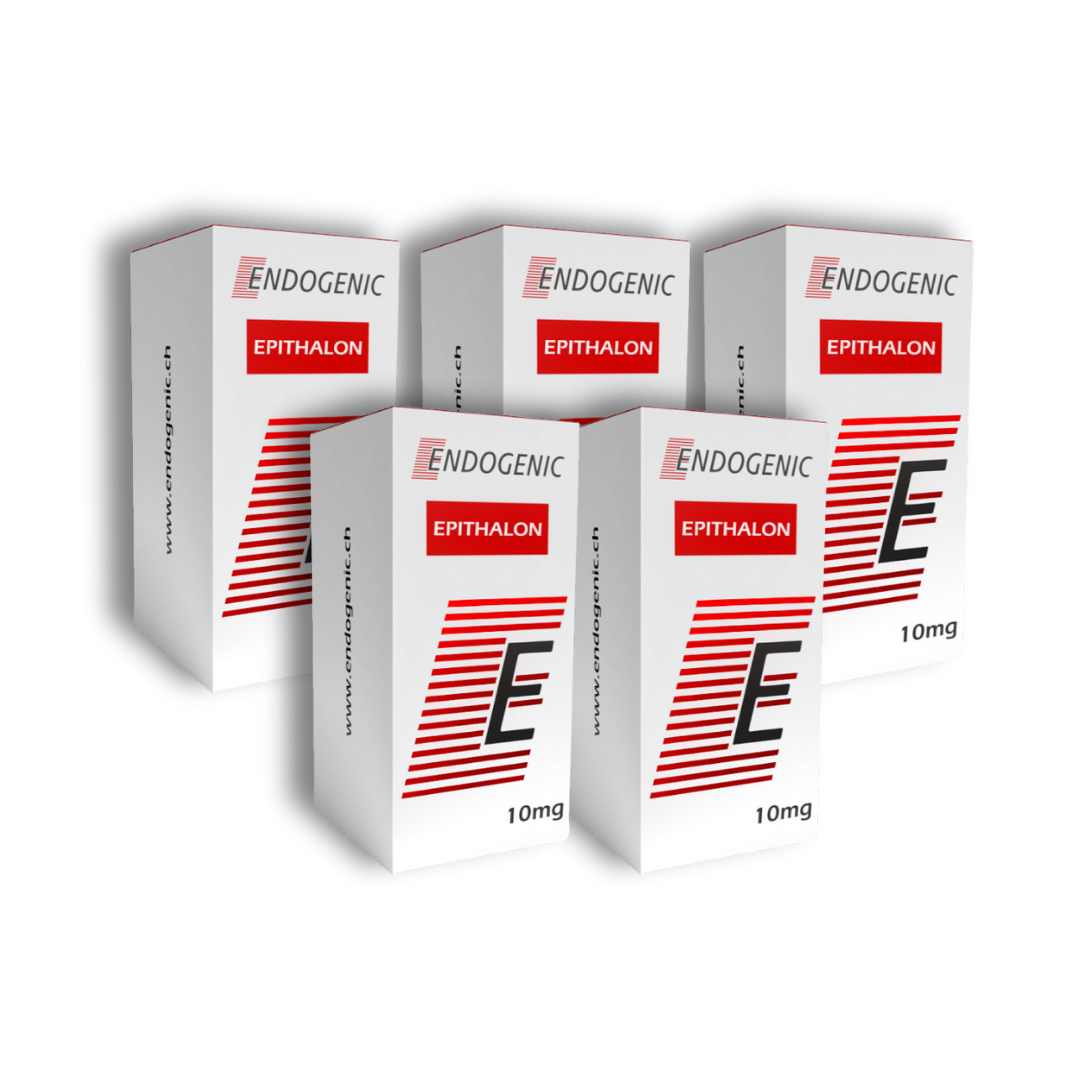
EPITHALON 10 mg 4+1 GRATIS
Epithalon 10 mg (AEDG, Ala-Glu-Asp-Gly) in a set of 5 vials (4 + 1 free) — a synthetic pineal gland tetrapeptide, an analog of epithalamine from Chawinson’s school of peptide bioregulation. Tested in vitro for telomerase (hTERT) induction and in rodent models for circadian rhythm and markers of aging. Chemical reagent intended exclusively for laboratory research — Research Use Only.
141,99 €
Fast shipping
Delivery options
Returns policy
Epithalon 10 mg (4+1 FREE set) — AEDG pineal tetrapeptide, longevity reagent RUO
- Epithalon: synthetic AEDG tetrapeptide.
- Pack of 5 vials, each containing 10 mg of lyophilisate, in a 4+1 free offer.
- Research Use Only reagent, not a medicinal product.
Epithalon – Chemical reagent intended exclusively for laboratory research (Research Use Only). It is not a medicinal product, dietary supplement, or foodstuff. It is not intended for use in humans or animals. Sale restricted exclusively to registered research entities and laboratories.
In the mid-1980s in Leningrad, Vladimir Khavinson’s team isolated a peptide extract — epithalamin — from the pineal gland of calves and observed, in rodent models, lifespan extension and normalization of the circadian rhythm. The problem was technical: the extract is a mixture of undefined composition, difficult to standardize and reproduce between batches. The answer was the synthesis of a short peptide replicating the core of the activity — Epithalon, the tetrapeptide Ala-Glu-Asp-Gly (AEDG).
Four amino acids, one reproducible sequence, controllable purity. Three decades later, Epithalon remains one of the most frequently cited compounds in the literature on the biology of aging — mainly owing to the in vitro observation in which the peptide induced telomerase activity in human somatic cells (Khavinson et al. 2003). The molecule has not, however, completed any Phase III clinical trial, is not registered as a drug, and remains a research tool.
Most of the data come from the Russian school of peptide bioregulation (Khavinson, Anisimov) and require independent replication. This reagent is supplied in the format of a lyophilizate in a vial, 10 mg of Epithalon per vial, in a set of 5 vials (4 paid + 1 free) — a configuration dedicated to research protocols with a longer time horizon, in which reproducible series require a supply of material from a single batch pool. Reconstitution with bacteriostatic water before experimental work.
General overview — pineal peptides and the Khavinson school
The pineal gland (epiphysis) is a small midbrain gland that synthesizes melatonin and participates in the regulation of the circadian rhythm and the neuroendocrine axis. In aging models, a gradual decline in its secretory activity is observed — a phenomenon that the Russian school of molecular gerontology placed at the center of the hypothesis of an “aging clock” controlled by the pineal gland.
From this hypothesis grew the concept of peptide bioregulation — the research school of the St. Petersburg Institute of Bioregulation and Gerontology (Vladimir Khavinson, Vladimir Anisimov). The premise: short regulatory peptides, replicating fragments of endogenous tissue extracts, modulate gene expression in a tissue-specific manner. Epithalamin (pineal extract) was the prototype; Epithalon (AEDG) — its synthesized, standardized analog with a defined sequence of four amino acids.
The world of pharmacology observes Epithalon for three reasons. First, as a tool for studying telomerase regulation in somatic cells — an area in which small-molecule modulators of hTERT expression are few. Second, as a model compound for chronobiology and the pineal-hypothalamus axis in rodent models. Third, as a representative of the class of “peptide geroprotectors” — short peptides studied for their effect on aging markers and lifespan in animal models.
In all three directions, the research material must be chemically reproducible — and here HPLC purity and confirmation of identity by MS matter, because short peptides are easily contaminated with products of incomplete synthesis. Epithalon is positioned in the catalog among research peptides intended for experimental work.
What is Epithalon?
Chemically, Epithalon is a linear tetrapeptide with the sequence Ala-Glu-Asp-Gly.
- Common name: Epithalon, Epitalon, Epithalone
- Full sequence name: H-Ala-Glu-Asp-Gly-OH (Alanyl-glutamyl-asparaginyl-glycine)
- Sequence abbreviation: AEDG (one-letter amino acid code)
- Synonyms: Epitalon, Epithalone, synthetic analog of epithalamin
- Class: synthetic regulatory tetrapeptide; analog of epithalamin (pineal peptide)
- CAS number: 307297-39-8
- Molecular formula: C₁₄H₂₂N₄O₉
- Molar mass: 390.35 g/mol
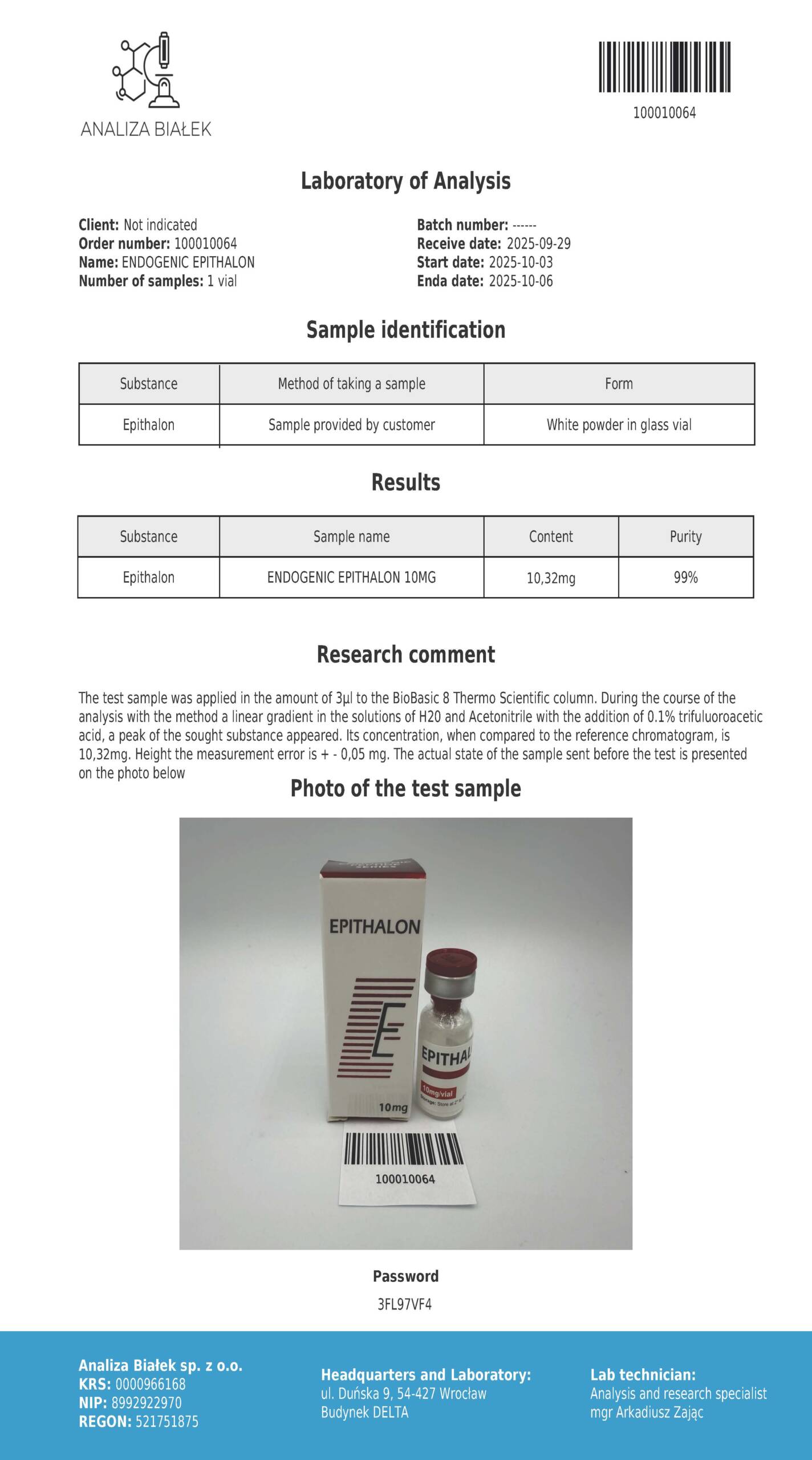
- Supplied form: lyophilizate in a vial, 10 mg of active substance per vial, set of 5 vials (4 + 1 free); reconstitution with bacteriostatic water; pharmaceutical grade ≥98% HPLC
Origin: Epithalon was developed by Vladimir Khavinson at the St. Petersburg Institute of Bioregulation and Gerontology as a synthetic analog of epithalamin — a pineal peptide extract studied since the 1970s–1980s. The aim of the synthesis: to replace the non-standardizable tissue extract with a defined, reproducible sequence of four amino acids. The main body of research was conducted by Russian teams (Khavinson, Anisimov, Korkushko) within the framework of peptide bioregulation — with an emphasis on telomerase, the circadian rhythm, and aging markers in rodent models and cell cultures.
The molecule has not been registered as a drug in any jurisdiction and has not undergone Phase III clinical trials in humans.
SCIENTIFIC PERSPECTIVE
A significant portion of the data on Epithalon comes from preclinical models (SHR mouse, rat, human fibroblasts in vitro, somatic cell cultures) and from the literature of the Russian school of peptide bioregulation. Some of the foundational works (Anisimov, Korkushko) require independent replication in laboratories outside this school — many of them were published in journals with limited indexing reach.
Observations concerning telomerase, the circadian rhythm, and lifespan require confirmation in controlled clinical trials in humans, which have not been conducted to date. Extrapolation of the in vitro profile to the biology of aging of the whole human organism requires far-reaching caution.
Mechanism of action at the molecular level
Epithalon is described in the literature through several parallel regulatory mechanisms. There is no unambiguously identified primary receptor — the Khavinson school’s model assumes direct modulation of gene expression (the “peptide bioregulation” mechanism), rather than classical signaling through a membrane receptor.
Telomerase activation in somatic cells (in vitro)
The most frequently cited observation. Telomerase is an enzyme that elongates telomeres — the terminal segments of chromosomes, which shorten with each division of a somatic cell, defining the so-called Hayflick limit (a finite number of divisions). In cultures of human fibroblasts, Epithalon induced expression of the catalytic subunit of telomerase (hTERT), which was accompanied by telomere elongation and an increase in the number of cell divisions — in the work of Khavinson et al. (2003), exceeding the Hayflick limit in vitro was described.
In experimental practice this means: cells in culture divided longer than would follow from their “replicative clock.” This is an observation at the level of cell culture — not proof of organism lifespan extension.
Circadian modulation and melatonin synthesis
As an analog of a pineal peptide, Epithalon in rodent models affected melatonin synthesis and the normalization of the circadian rhythm, especially in older animals with weakened pineal function. The mechanism is linked to the pineal-hypothalamus axis. In practice: in aging models, a shift in the melatonin secretion profile toward the nocturnal amplitude characteristic of younger animals was observed.
Antioxidant and geroprotective action (rodent models)
In mouse and rat models (including the SHR mouse), Anisimov’s work described a reduction in markers of oxidative stress and an effect on survival parameters in long-term exposure protocols. Some works reported an extension of median lifespan and modulation of the incidence of spontaneous tumors in animal cohorts — these observations come mainly from a single research school and require independent replication.
Regulation of gene expression (epigenetic mechanism)
The Khavinson school’s model assumes that short regulatory peptides exhibit activity at the level of gene expression — direct interaction with specific DNA sequences and modulation of the expression of regulatory genes were proposed. This is the core of the concept of “peptide bioregulation.” The molecular details of this interaction (affinity, sequence specificity) remain a subject of discussion and have not been fully characterized outside the original school.
Neuroendocrine modulation
In aging models, Epithalon was described as a compound normalizing the function of the hypothalamic-pituitary axis — restoring, in rodent models, a neuroendocrine signaling profile similar to that of younger animals. The mechanism is probably indirect, through the pineal-hypothalamus axis.
Applications in scientific research
Epithalon is used in research work in several areas. In in vitro models (human fibroblasts, somatic cell lines, cultures with senescence markers), its effect on hTERT expression, telomere length, and the number of cell divisions is studied. In in vivo models (SHR mouse, rat), survival parameters, markers of oxidative stress, the melatonin secretion profile, and neuroendocrine axis function are analyzed in long-term exposure protocols. Specific research directions include:
- Telomerase regulation and replicative senescence — measurement of hTERT expression (qPCR, Western blot), telomere length (TRF, telomere qPCR), the number of cell passages to reach senescence; Epithalon as a tool for studying pharmacological modulation of the Hayflick limit
- Chronobiology and the pineal-hypothalamus axis — melatonin secretion profile, expression of circadian clock genes (Bmal1, Per, Cry), models of rhythm desynchronization in aging
- Geroprotection in rodent models — survival parameters, markers of oxidative stress, the incidence of neoplastic changes in long-term cohorts (Anisimov’s line of research)
- “Peptide geroprotectors” profile — comparison of Epithalon with other short regulatory peptides of the bioregulation school in terms of their effect on aging markers
- Models of regulatory gene expression — research on the proposed epigenetic mechanism of action of short peptides
Within the same family of telomere reagents, comparisons are made with other AEDG variants — e.g. the injectable variant injectable Epithalon 10mg and the stabilized derivative N-acetyl Epithalon, in which the acetyl group affects the stability profile of the peptide under experimental conditions.
Summary
Epithalon (AEDG, Ala-Glu-Asp-Gly) is a synthetic tetrapeptide developed by Vladimir Khavinson as a standardized analog of epithalamin — a pineal extract. In the literature it is described mainly owing to the induction of telomerase activity (hTERT expression) and telomere elongation in human somatic cells in vitro (Khavinson et al. 2003), as well as the modulation of the circadian rhythm and aging markers in rodent models (Anisimov’s line of research).
The mechanism is linked to direct regulation of gene expression (“peptide bioregulation”) and to the pineal-hypothalamus axis. Most of the data come from the Russian school of bioregulation and require independent replication; there are no Phase III clinical trials in humans. Within anti-aging reagents, researchers sometimes pair it with the combination anti-aging stack Epithalon GHK-Cu, combining the telomere peptide with copper GHK-Cu.
Form: lyophilizate in a vial 10 mg, set of 5 vials (4 + 1 free), reconstitution with bacteriostatic water, HPLC purity ≥98%, COA for each batch. Regulatory status — exclusively Research Use Only; no registration as a drug; WADA status: not listed.
Bibliography
- Khavinson VKh, Bondarev IE, Butyugov AA (2003). Epithalon peptide induces telomerase activity and telomere elongation in human somatic cells. PubMed
- Khavinson VKh, Morozov VG (2003). Peptides of pineal gland and thymus prolong human life. PubMed
- Anisimov VN, Khavinson VKh, Popovich IG, et al. (2003). Effect of Epitalon on biomarkers of aging, life span and spontaneous tumor incidence in female Swiss-derived SHR mice. PubMed
- Korkushko OV, Khavinson VKh, Shatilo VB, Antonyk-Sheglova IA (2011). Peptide geroprotector from the pituitary gland inhibits rapid aging of elderly people: results of 15-year follow-up. PubMed
Research Use Only chemical reagent. Epithalon 10 mg (4+1 FREE set) in the Pro-Body catalog is not a medicinal product, dietary supplement, or foodstuff. It is not intended for administration to humans or animals outside a controlled experimental environment. The compound has not completed Phase III clinical trials in humans and is not registered as a drug in any jurisdiction.
The information in the description is educational and scientific in nature and refers to results reported in the literature (mainly in vitro and in vivo models in rodents) — it does not constitute medical advice or instructions for administration. Some sources come from a research school requiring independent replication.
FAQ
In cultures of human fibroblasts, Epithalon induced expression of the catalytic subunit of telomerase (hTERT), which was accompanied by telomere elongation and an increase in the number of cell divisions — exceeding the Hayflick limit in vitro was described (Khavinson et al. 2003). This is an observation at the level of an isolated cell culture. It is not equivalent to telomere elongation or the reversal of aging in the human organism — such clinical trials have not been conducted.
A significant part of the body of research on Epithalon comes from a single school (the Russian school of peptide bioregulation — Khavinson, Anisimov, Korkushko) and was published in journals with limited indexing reach. Some works are difficult to unambiguously verify in PubMed/DOI databases. In line with Pro-Body policy, when we cannot confirm an identifier, we mark it explicitly rather than providing an uncertain PMID. These observations require independent replication outside the original school.
Store the lyophilizate in an unopened vial protected from light and moisture — long-term −20°C is recommended, short-term 2–8°C is acceptable (details in the batch COA). Reconstitute individual vials as needed by the research protocol — this allows you to limit the exposure time of the dissolved material, which after dissolution is stored at 2–8°C typically for up to 28 days and is not subjected to freeze-thaw cycles.
Epithalon is a longevity tetrapeptide linked to telomerase regulation and the pineal axis — the category of peptide geroprotectors. Semax 50mg is a heptapeptide with a neuropeptide profile, studied in a different context (neurotrophic axis, BDNF). Different sequences, different research directions, different bodies of literature — what unites them is the status of an RUO reagent and the same Pro-Body quality regime (HPLC ≥98%, MS, COA per batch).
No. Epithalon does not currently appear on the WADA list of prohibited substances. Its status in future updates may, however, change. Registered athletes (ADAMS) should verify the current list before any decision and follow subsequent editions of the list.
5.0
2 reviews
-
Michał J
 Polski
Verified purchase
Polski
Verified purchase
Product review
Jak zwykle produkt jakościowy, polecam.
-
Jakub
Polski
Product review
Bardzo dobry produkt.