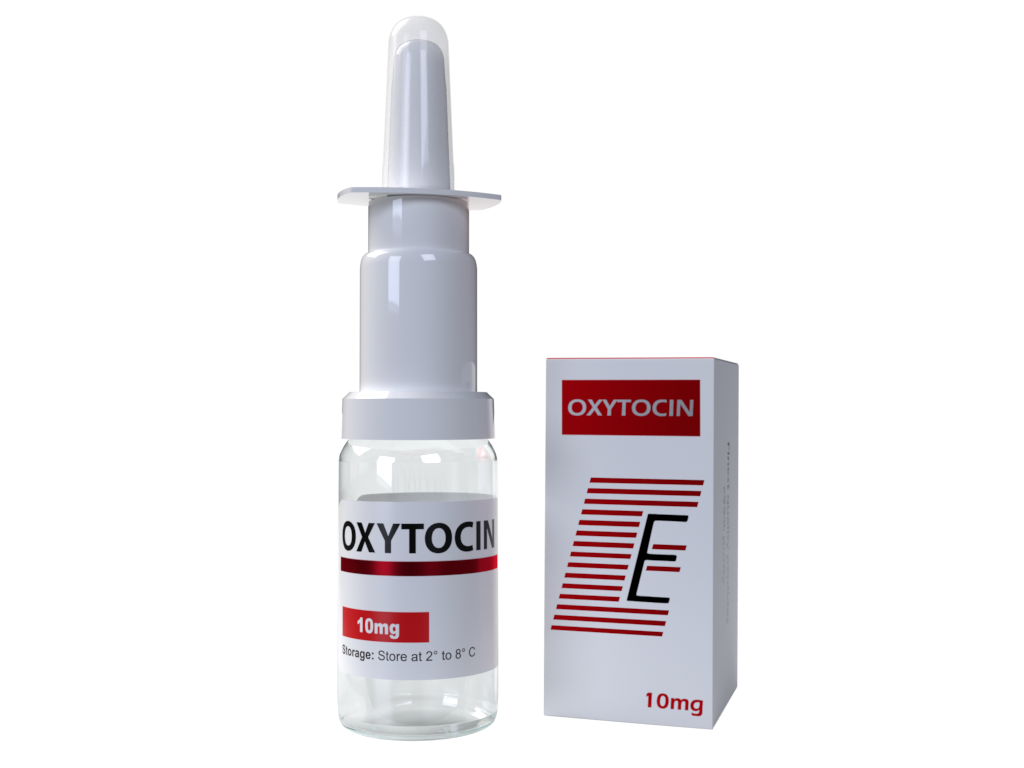
NO. This is a self-preparation kit. It consists of three elements: a vial with oxytocin lyophilisate (powder), bacteriostatic water for reconstitution and an empty glass atomizer with a dosing pump. The researcher first reconstitutes the lyophilisate with the included water, then transfers the solution to the atomizer. The concentration of the solution is not factory set – it results from the peptide content in the vial (given in the COA) and the volume of water used for reconstitution. The kit is a reagent for laboratory research; human studies were conducted with a registered medicine, not with this kit.
Oxytocin spray
Nasal oxytocin is an endogenous cyclic nonapeptide supplied as a reagent kit: a vial with lyophilisate, water for reconstitution and a glass atomizer. Intranasal oxytocin is one of the most documented nose-to-brain models in humans – hundreds of studies on social cognition, trust and connection. Research Use Only.
28,99 €
With code BLACK: 23,19 €
Lowest price in the 30 days before the discount:
28,99 €
Fast shipping
Free delivery from 350 €
Returns policy
Nasal oxytocin - research reagent
- Oxytocin: cyclic nonapeptide.
- Reagent kit: lyophilisate, water and glass atomizer.
- Research Use Only reagent, not a substitute for a registered medicine.
Product status information
Chemical reagent intended exclusively for laboratory tests (Research Use Only). It is not a medicinal product, dietary supplement or food. It is not intended for use on humans or animals. Sales only to registered research units and laboratories.
REGULATORY STATUS (critical)
Oxytocin is the active substance registered medicinal product in the EU, USA and around the world – in injection and intranasal form (including Syntocinon®, Pitocin®), used in obstetrics and lactation. Reagent RUO Pro-Body oxytocin is in a different category: Research Use Only research material, is not a replacement registered medicine nor does it replace medical consultation.
Communicating the product as a “bonding spray”, “over the counter love hormone”, “trust spray” or “intranasal oxytocin for biohackers” is contrary to the Research Use Only framework. Reagent identity and purity are solely determined by the MS sequence and mass in the batch COA.
Introduction
In the family of endogenous peptides whose activity has been most widely described in humans, oxytocin occupies a unique place – it is a nonapeptide produced in the hypothalamic nuclei, acting as both a peripheral hormone and a central neurotransmitter. Oxytocin belongs to the lineage Endogenic — reagents mapping molecules of endogenous origin or directly derived from them, provided for research on the neuroendocrinology and neuropharmacology of regulatory peptides.
In the Pro-Body catalog it is adjacent to others peptides to improve well-being studied as compounds modulating mood and stress reactivity. This reagent delivers oxytocin as a kit of three elements: a vial with oxytocin lyophilisate, bacteriostatic water for reconstitution and a glass atomizer with a dosing pump.
This is not a ready-to-use solution: the lyophilisate requires reconstitution with the included water before use in a research protocol. Oxytocin administered through the nose has become one of the most frequently studied models of nose-to-brain transport in humans, with hundreds of studies on social cognition, trust and bonding – conducted with a registered medicine (the classic Syntocinon nasal spray).
In human studies, oxytocin is given intranasally as a registered medicine; in the catalog this kit belongs to the group peptides spray – reagents supplied with water for reconstitution and an atomizer. Oxytocin has two formats in the Pro-Body catalog, which should not be confused with each other: just a vial of lyophilisate without an atomizer (Oxytocin 10 mg – lyophilized vial) and this set with water for reconstitution and an atomizer.
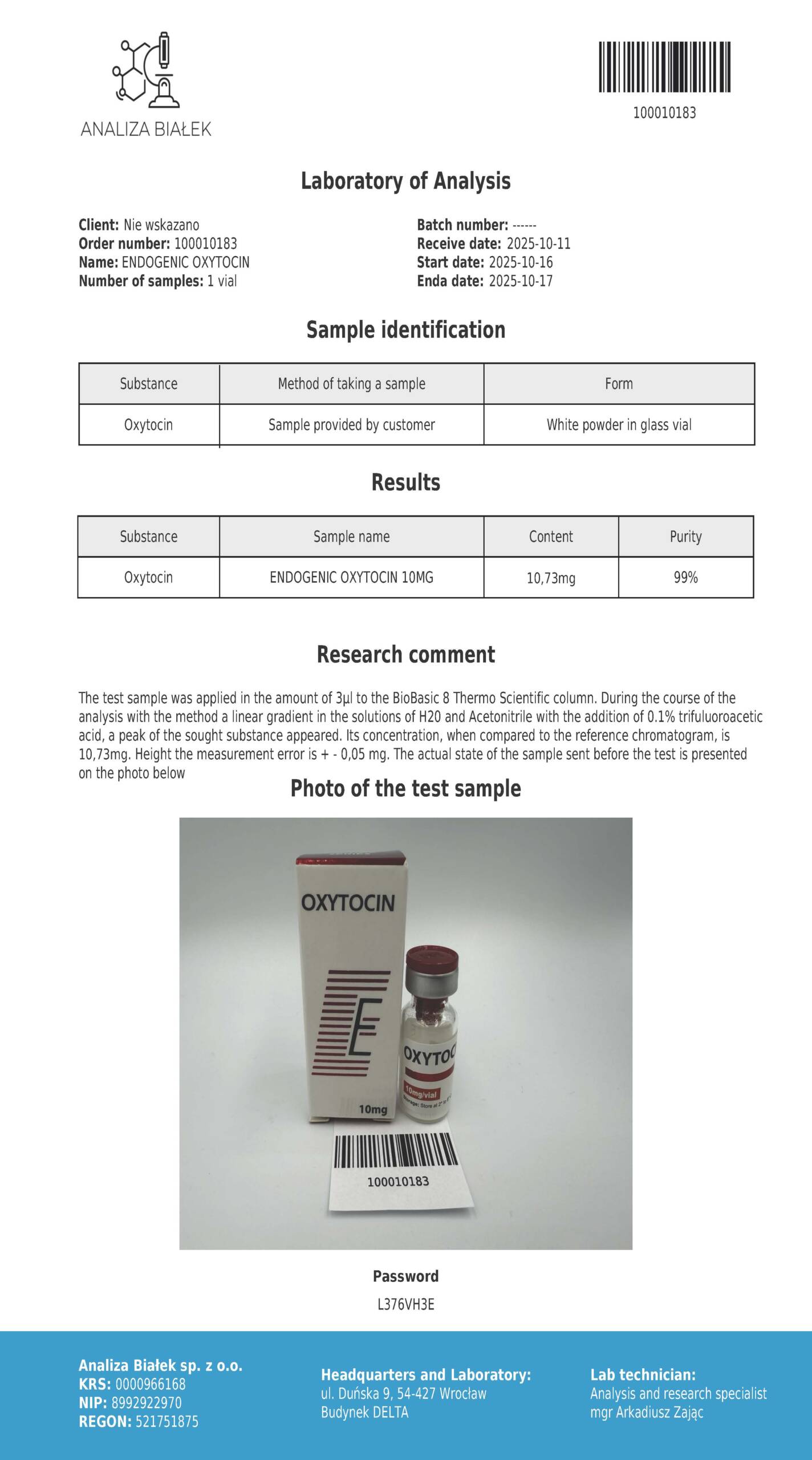
Both formats contain the same compound in the form of a lyophilized product that requires reconstitution – the difference is that this kit adds bacteriostatic water and a glass atomizer. The pharmacological profile includes oxytocin receptor (OTR) agonism, role in social cognition and attachment, modulation of the HPA axis and anxiety, peripheral effects (uterine contraction, lactation – basis for therapeutic use) and interaction with the dopaminergic reward system. Purity verified by HPLC ≥98%, identity confirmed by mass spectrometry, COA available for each batch.
General description - oxytocin as a hormone and neurotransmitter
Oxytocin was isolated and synthesized earlier than most regulatory peptides – the first chemical synthesis was performed by Vincent du Vigneaud in 1953, for which he received the Nobel Prize in Chemistry. The molecule is produced in large cell neurons of the paraventricular nuclei (PVN) and supraoptic nuclei (SON) of the hypothalamus, from where it is transported to the posterior pituitary gland and released into the circulation as a hormone.
At the same time, oxytocinergic projections reach many structures of the central nervous system (CNS) – amygdala, nucleus accumbens, hippocampus, prefrontal cortex – where oxytocin acts as a neurotransmitter and neuromodulator. This duality makes oxytocin a molecule with two separate research histories. On the one hand, it is a classic obstetric hormone: it causes uterine muscle contractions during childbirth and is responsible for the flow of milk during lactation – and this is the basis for its registration as a drug (Syntocinon®, Pitocin®).
On the other hand, since the beginning of the 21st century, oxytocin has become one of the most intensively studied neurobehavioral peptides – from Kosfeld et al.’s (2005) groundbreaking work on the effects of intranasal oxytocin on trust, through hundreds of studies on social cognition, emotion recognition, attachment, and anxiety regulation. It is this second trend – neurobehavioral, based on intranasal administration of the medicine – that is the source of most data on central effects.
What is oxytocin?
Oxytocin is an endogenous nonapeptide with a cyclic structure, closed by a disulfide bridge between cysteine residues. In this kit, it is delivered as a lyophilized product in a vial along with bacteriostatic water for reconstitution and a glass atomizer.
- Common name: oxytocin, oxytocin, OT
- Sequence: Cys-Tyr-Ile-Gln-Asn-Cys-Pro-Leu-Gly-NH₂ (nonapeptide) with a Cys1-Cys6 disulfide bridge closing the ring; C-terminus amidated (Gly-NH₂)
- Structural origin: endogenous hormone and neurotransmitter; structurally close to vasopressin (difference of two amino acid residues)
- Chemical class: cyclic nonapeptide; oxytocin receptor (OTR) agonist
- Supplied form: set – vial with oxytocin lyophilisate + bacteriostatic water for reconstitution + glass atomizer; pharmaceutical grade ≥98% HPLC
Table of physicochemical characteristics
| Parameter | Value | Notes |
|---|---|---|
| Sequence | Cys-Tyr-Ile-Gln-Asn-Cys-Pro-Leu-Gly-NH₂ | nonapeptide, S-S bridge Cys1-Cys6 |
| CAS number | 50-56-6 | for oxytocin |
| Molecular formula | C₄₃H₆₆N₁₂O₁₂S₂ | cyclic amidated form |
| Molar mass | 1007.19 g/mol | mass for verification in the batch COA |
| Structure | cyclic (6-residue ring + tripeptide tail) | a disulfide bridge closes the ring |
| Supplied form | set: lyophilisate vial + water + glass atomizer | for reconstitution of the lyophilisate by the investigator |
| Purity | ≥98% HPLC | UV detection, per batch verification |
| Plasma half-life (model) | ~3–5 min | rapid degradation by oxytocinases/peptidases |
Mechanism of action at the molecular level
Oxytocin acts through several parallel pathways – from a classic peripheral effect to complex central modulation. The following mechanisms have been documented in preclinical models and, for some, in human studies based on intranasal administration. Pharmacological profile described for oxytocin in research models:
- Oxytocin receptor (OTR) agonism — main mechanism. OTR is a G protein-coupled receptor (GPCR) that, upon binding oxytocin, triggers the Gq/PLC → IP₃/DAG → intracellular calcium mobilization cascade. The receptor occurs peripherally (uterine myometrium, mammary myoepithelial cells) and centrally (amygdala, hippocampus, nucleus accumbens, hypothalamus), which explains both the obstetric and neurobehavioral effects of the same molecule
- Role in social cognition, bonding, and trust — the most widely researched central direction. Human studies based on intranasal administration have described the effects of oxytocin on interpersonal trust (Kosfeld et al. 2005), facial emotion recognition, and attention to social stimuli (Guastella et al. 2010). Mechanistically, this involves modulation of amygdala activity and social stimulus processing circuits
- Modulation of the HPA axis and anxiety reactivity — oxytocin in animal models and some studies involving humans suppresses the response of the hypothalamic-pituitary-adrenal (HPA) axis to stress and reduces the reactivity of the amygdala to threatening stimuli. This is one of the likely mechanisms for the anxiolytic and prosocial profile observed in behavioral studies
- Peripheral action – uterine contraction and lactation — historically the first and best characterized effect: stimulation of OTR receptors in the myometrium causes contractions (basis for use in induction of labor), and in the mammary gland it contracts myoepithelial cells, causing milk flow. It is this mechanism that underlies the registration of oxytocin as a drug (Syntocinon®, Pitocin®).
- Interaction with the dopaminergic system and reward circuits — Oxytocinergic projections to the nucleus accumbens and the ventral tegmental area (VTA) modulate dopaminergic signaling. In animal models (including the prairie vole), this pathway is associated with the formation of attachment and the rewarding nature of social interactions – which makes oxytocin a bridge molecule between the peptide system and the classical reward system.
Nose-to-brain mechanism - the best documented model of intranasal administration in humans
Intranasal administration is the route on which, in the case of oxytocin, one of the most extensive bodies of data on human nose-to-brain transport has been built – in studies with a registered medicine. This distinguishes oxytocin from most regulatory peptides, where the intranasal route remains mainly an animal model or logical analogy. Most peptides do not cross the blood-brain barrier (BBB) well when administered peripherally – they are too large and too polar.
Intranasal administration offers an alternative delivery route to the CNS, partially bypassing the BBB. Two parallel pathways have been described in the literature on the transport of peptides through the nose (Born et al. 2002):
- Olfactory pathway (olfactory) — a peptide applied to the olfactory epithelium in the upper part of the nasal cavity can be transported along the olfactory nerves to the olfactory bulb and further to the structures of the forebrain, bypassing the systemic circulation
- Trigeminal nerve pathway — the endings of the trigeminal nerve innervating the nasal mucosa constitute a second route of transport to the brain stem and further structures of the CNS
For oxytocin, this pathway is of particular importance. The classic work of Born et al. (2002) showed that neuropeptides administered intranasally reach the cerebrospinal fluid in humans – which became the methodological basis for the entire trend of intranasal oxytocin research on social cognition, emotion regulation and the context of autism (exploratory studies). Hundreds of behavioral studies were based on intranasal Syntocinon nasal spray.
SCIENTIFIC PERSPECTIVE
Intranasal oxytocin as a medicine has a very extensive literature of human studies — it is one of the most widely used nose-to-brain models in social neuroscience, with hundreds of published trials. Scientific honesty, however, requires two caveats. Firstly, the sheer size of the corpus of behavioral data does not close the debate on the actual central bioavailability: some authors indicate that the fraction of oxytocin reaching the CNS after intranasal administration may be small, and the observed effects may be partially mediated peripherally or by non-receptor mechanisms (MacDonald 2011, Quintana 2018).
Secondly – these studies were conducted with a registered medicinal product (Syntocinon®), while the RUO Pro-Body form is a research reagent — not a registered drug and not its substitute. Human studies concern the medicine and do not authorize the use of the reagent in humans.
Applications in scientific research
The oxytocin in this kit is prepared for the route of administration on which the most extensive body of data on its central action is based. It is used in research areas:
- Research on social cognition — experimental paradigms of trust (trust game economic games), facial emotion recognition, attention to social stimuli and cognitive empathy; oxytocin as a modulating compound in human protocols based on intranasal administration
- Nose-to-brain transport studies — comparative pharmacokinetics of intranasal versus systemic administration; oxytocin as a model peptide molecule in the characterization of transport through the olfactory epithelium and trigeminal nerve
- Models of anxiety regulation and the HPA axis — assessment of the impact on amygdala reactivity and cortisol response to stress in animal models and protocols involving humans
- Models of attachment and social bond — research on animal models with a strong social phenotype (prairie vole), on the role of oxytocin in pair formation and parental care
- Oxytocin receptor (OTR) research — characterization of the pharmacology of OTR agonism, Gq/PLC signaling and interactions with the vasopressin system in vitro
- Exploratory neurodevelopmental models — research on the role of oxytocinergic signaling in the context of autism spectrum disorders (research context only, without therapeutic implications)
In studies on central peptides, oxytocin is sometimes compared with other native regulatory peptides – the reference point for an anxiolytic peptide is, for example, N-acetyl Selank spray, and for a nootropic peptide with a pro-cognitive profile N-acetyl Semax spray. In the context of modulation of social behavior and the intimate sphere, oxytocin is sometimes considered together with a melanocortin agonist PT-141 spray.
REGULATORY STATUS
Oxytocin is the active substance of a drug registered (Syntocinon®, Pitocin®) in the EU, USA and worldwide – for obstetric and lactation applications. The Oxytocin RUO Pro-Body reagent remains outside this category: it is a Research Use Only research material, not a substitute for a medicinal product. Oxytocin not listed currently on the WADA Prohibited Substances List as a separately listed substance; however, the status should be verified against the current list before any decision by the Registered Athlete (ADAMS) as regulatory peptides are sometimes covered by general clauses.
Storage conditions
- Lyophilisate (unopened vial): −20°C for long-term storage; permissible 2-8°C in the shorter term; protect from light and moisture, in the original, unopened vial
- Bacteriostatic water: Store according to label (typically room or refrigerated temperature), in original, closed packaging
- Reconstituted solution (in atomizer): refrigerator 2–8°C, protected from light; the peptide in the aqueous phase degrades faster than the lyophilized product, and the oxytocin disulfide bridge is additionally sensitive to oxidation – prepare portions corresponding to the current needs of the protocol, monitor by HPLC for longer storage
- Freezing: do not freeze the finished solution in the atomizer (freezing-thawing destabilizes the peptide and the buffer system); for longer storage, aliquot the mother liquor and freeze it at −20°C, avoiding multiple freezing and thawing cycles
- Glass atomizer: clean and dry before filling and after emptying; store dry, closed, protected against mechanical damage
Summary
Nasal oxytocin is an endogenous cyclic nonapeptide Cys-Tyr-Ile-Gln-Asn-Cys-Pro-Leu-Gly-NH₂ (disulfide bridge Cys1-Cys6, CAS 50-56-6, 1007.19 g/mol), supplied as a reagent kit – vial with lyophilisate, bacteriostatic water for reconstitution and glass atomizer. It is a molecule with two research histories: a classic obstetric hormone (uterine contraction, lactation – the basis for registration as a drug) and one of the most intensively studied neurobehavioral peptides, modulating social cognition, trust, bonding and anxiety regulation.
The pharmacological profile includes oxytocin receptor (OTR, Gq/PLC-coupled GPCR) agonism, a role in social cognition (Kosfeld 2005, Guastella 2010), modulation of the HPA axis and amygdala, peripheral effects and interaction with the dopaminergic reward system. Intranasal oxytocin – as a registered medicine – is one of the best documented nose-to-brain models in humans, with hundreds of behavioral trials based on Syntocinon nasal spray (Born 2002), although actual central bioavailability remains a matter of debate (MacDonald 2011, Quintana 2018).
The short plasma half-life (~3–5 min) narrows the window of systemic exposure. HPLC purity ≥98%, MS confirmation (Q-TOF), COA for each batch. The main distinction: oxytocin is the active substance of a registered drug, but Pro-Body is a Research Use Only reagent – not a drug and not a drug substitute.
Bibliography
- Kosfeld M, Heinrichs M, Zak PJ, Fischbacher U, Fehr E (2005). Oxytocin increases trust in humans. PubMed
- Born J, Lange T, Kern W, McGregor GP, Bickel U, Fehm HL (2002). Sniffing neuropeptides: a transnasal approach to the human brain. PubMed
- Guastella AJ, Einfeld SL, Gray KM, Rinehart NJ, Tonge BJ, Lambert TJ, Hickie IB (2010). Intranasal oxytocin improves emotion recognition for youth with autism spectrum disorders. PubMed
- MacDonald E, Dadds MR, Brennan JL, Williams K, Levy F, Cauchi AJ (2011). A review of safety, side-effects and subjective reactions to intranasal oxytocin in human research. PubMed
- Quintana DS, Smerud KT, Andreassen OA, Djupesland PG (2018). Evidence for intranasal oxytocin delivery to the brain: recent advances and future perspectives. PubMed
FAQ
It is the same molecule in the form of a lyophilisate – the difference is in the contents of the kit. This product is vial with lyophilisate + bacteriostatic water + glass atomizer, i.e. a reagent kit; the lyophilisate requires reconstitution. Oxytocin 10 mg – lyophilized vial is the peptide itself without water and an atomizer, giving greater freedom in the choice of concentration and solvent. In both cases, the peptide requires reconstitution and the working concentration is selected by the researcher.
Both – depending on the product category. Oxytocin as an active substance is a component of registered medicines (Syntocinon®, Pitocin®) used in obstetrics and lactation, only under medical supervision. This Pro-Body kit, on the other hand, is Research Use Only reagent — material for laboratory tests, which is not a medicinal product, is not a substitute for a drug and does not replace a medical consultation. This distinction is fundamental to the regulatory status of the product.
The intranasal route has become the standard method of delivering oxytocin for studies of its central effects because the peptide poorly crosses the blood-brain barrier after peripheral administration. Human studies based on intranasal Syntocinon nasal spray have reported the effects of oxytocin on interpersonal trust (Kosfeld et al. 2005), facial emotion recognition, and attention to social stimuli (Guastella et al. 2010) – an area called “social cognition.” The classic work of Born et al. (2002) showed that neuropeptides administered through the nose reach the cerebrospinal fluid, which provided the methodological basis for the entire trend.
This is the subject of active scientific debate. On the one hand, there are hundreds of behavioral studies showing the effects of intranasal oxytocin on social behavior, on the other – some authors (MacDonald 2011, Quintana 2018) indicate that the actual fraction of the peptide reaching the CNS after intranasal administration may be small, and some of the observed effects may be mediated peripherally or by non-receptor mechanisms. In other words: the corpus of behavioral data is enormous, but the mechanism of central transport has not been clearly resolved. This is an important caveat when interpreting the results.
The half-life of oxytocin in plasma is only ~3–5 minutes because it is quickly degraded by plasma and tissue peptidases (including oxytocinases). Implication for research: the systemic exposure window after administration is narrow, which further motivates the choice of the intranasal route, which is intended to deliver the peptide closer to central targets while bypassing part of the peripheral metabolism. The short half-life is also important for the stability of the working solution – it is worth monitoring it by HPLC during longer storage.
Oxytocin is not currently listed as a separately listed prohibited substance on the WADA list. However, please remember that regulatory peptides are covered by general clauses and the status of the substance may change in subsequent updates. Registered athletes (ADAMS) must check the current list of prohibited substances before making any decision.
0.0
0 reviews
This product has no reviews yet.