

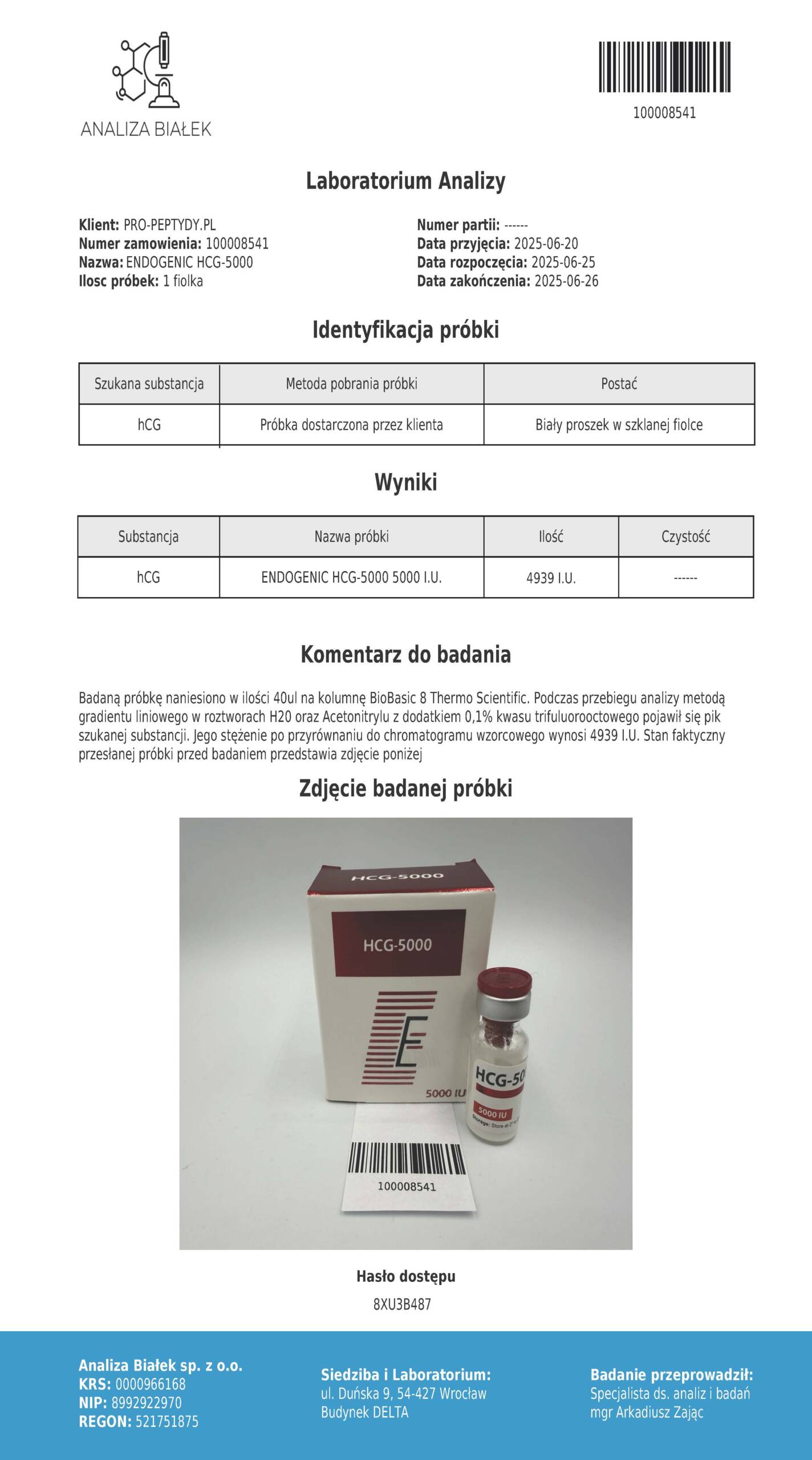
hCG (human chorionic gonadotropin, chorionic gonadotropin) is a dimeric glycoprotein with a mass of ~36.7 kDa, composed of a common alpha subunit and a specific, strongly glycosylated beta subunit. Physiologically, it is a signal of early pregnancy. In reagent circulation, it serves as a reference, stable analogue of luteinizing hormone (LH) for research on the HPG axis and gonadal function. In the Pro-Body catalog it is a RUO reagent – a molecular tool for laboratory work, not a medicinal product.
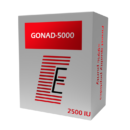
HCG 5000 IU
hCG 5000 IU — dimeric gonadotropic glycoprotein in a larger vial of lyophilisate, for laboratory tests. Reference LH analog acting through the LHCGR receptor; models of the HPG axis, Leydig cells and steroidogenesis. RUO reagent with bacteriostatic water for reconstitution.
28,99 €
Fast shipping
Delivery options
Returns policy
hCG 5000 IU (chorionic gonadotropin) - RUO research reagent
- hCG 5000 IU — dimeric gonadotropic glycoprotein in a larger vial of lyophilisate, for laboratory tests.
- Reference LH analog acting through the LHCGR receptor; models of the HPG axis, Leydig cells and steroidogenesis.
- RUO reagent with bacteriostatic water for reconstitution.
Product status information
Chemical reagent intended exclusively for laboratory tests (Research Use Only). It is not a medicinal product, dietary supplement or food. It is not intended for use on humans or animals. Sales only to registered research units and laboratories.
Regulatory status
Human chorionic gonadotropin (hCG) is active substance of registered medicinal products – including Pregnyl®, Ovitrelle® (choriogonadotropin alfa) and Choragon®. In commercial forms, hCG is available only on prescription and requires medical supervision (reproductive context, ovulation induction, assessment of gonadal function). The hCG 5000 IU RUO reagent from the Pro-Body catalog is NOT a medicinal product, it is not a substitute for Pregnyl®/Ovitrelle®/Choragon® and does not replace a medical consultation.
Additionally: hCG is on the prohibited list WADA in category S2 — substance prohibited in men (in- and out-of-competition). Registered Athletes (ADAMS) must verify the current list before making any decision.
Introduction
hCG 5000 IU from the Endogenic line is the same dimeric glycoprotein that human physiology knows as a signal of early pregnancy – chorionic gonadotropin produced by the trophoblast, supporting the corpus luteum in the first weeks of embryo development. However, in reagent circulation it has a different function: this reference luteinizing hormone (LH) analogue, a molecular tool for research on the hypothalamic-pituitary-gonadal (HPG) axis and the function of Leydig cells.
The Endogenic line collects molecules that act on the body’s physiological regulatory loops – and hCG, which mimics the pituitary’s own hormone, is a textbook example of this approach. The 5000 IU format differs from the 2500 IU variant by one decision – higher unit content per vial. It is the same lyophilisate of the same glycoprotein, but a larger dose of international units of biological activity in one vial.
For laboratory work, this means longer test protocols from one vial, lower unit cost of activity and a larger working volume of the solution after reconstitution – while maintaining the entire characteristics of the molecule. Smaller format delivers HCG 2500 IU — the same glycoprotein in a half-unit vial. hCG remains a molecule with a double regulatory identity that cannot be passed over in silence: on the one hand, it is the active substance of drugs registered for decades, and on the other, it is a research reagent outside the pharmaceutical trade.
These two paths are not interchangeable. The hCG 5000 IU RUO reagent functions only as molecular tool for HPG axis research, supplied as a lyophilized vial with an activity of 5000 IU with separate bacteriostatic water for reconstitution.
General description - hCG as a glycoprotein analogue of LH
Human chorionic gonadotropin (hCG) is dimeric glycoprotein composed of two non-covalently linked subunits. Subunit alpha is common to the entire family of pituitary and thyroid gonadotropins – it is divided by luteinizing hormone (LH), follicle-stimulating hormone (FSH) and thyroid-stimulating hormone (TSH). Identity and specificity are determined by the subunit beta — strongly glycosylated in hCG, with a characteristic C-terminal extension rich in sialic acid residues.
It is this glycosylation that distinguishes hCG from other gonadotropins and gives the molecule its most important pharmacological feature. In the literature, hCG is described primarily as LH/CG common receptor agonist (LHCGR) — binds the same receptor as luteinizing hormone and triggers an analogous intracellular signal. Therefore, in research models it functions as durable and easily standardized LH analogue: where endogenous LH has a short half-life and a pulsatile nature of secretion, hCG provides a long, stable stimulus to the receptor.
This makes it a particularly convenient tool for working on the HPG axis and the response of the gonads to gonadotropin stimulation. In the Pro-Body catalog hCG 5000 IU belongs to the group of reagents for research hypothalamic-pituitary-gonadal axis. The 5000 IU format is of a technical nature: a larger dose of activity units per vial streamlines work with longer protocols and lowers the unit cost compared to the smaller 2500 IU variant.
The choice of format (5000 vs 2500 IU) is a decision about the scale of the research protocol, not the nature of the molecule – this remains identical in both vials.
What is hCG 5000 IU - larger vial of lyophilisate
hCG 5000 IU is vial of glycoprotein lyophilisate with a biological activity of 5,000 international units (IU), with separate bacteriostatic water for reconstitution. The molecule is a dimeric glycoprotein with a mass of approx 36.7 kDa, issue CAS 9002-61-3, composed of a common alpha subunit (92 amino acids) and a specific, highly glycosylated beta subunit (145 amino acids). hCG activity is expressed in international units (IU) referring to biological gonadotropic activity, rather than simple mass – this is a standard convention for gonadotropin preparations, where what matters is the strength of the signal at the receptor, not the mass of the protein itself.
The difference between the 5000 IU and 2500 IU format comes down to content of activity units per vial. When reconstituted it gives this larger volume of working solution (or higher concentration with the same volume of solvent), which translates into longer research protocols from one vial and lower unit cost of activity. The choice between 5000 IU and 2500 IU depends on the scale of laboratory work – the smaller 2500 IU vial works well for short protocols and limiting losses when used infrequently, the larger 5000 IU for intensive work with a large number of working concentrations.
Strong glycosylation of the beta subunit and the abundance of sialic acid residues are responsible for prolonged half-life hCG compared to LH. Sial residues slow down the renal clearance of the glycoprotein, thanks to which the signal to the LHCGR receptor persists much longer than after endogenous, pulsed LH. This is a molecular explanation why hCG is sometimes preferred over recombinant LH in research models as a lasting stimulus to gonadal cells.
Chemical characteristics – 5000 IU vial
| Parameter | Value |
|---|---|
| Name | hCG 5000 IU (human chorionic gonadotropin, chorionic gonadotropin) |
| Line | Endogenous |
| Class | Dimeric gonadotropic glycoprotein (LH analogue) |
| Construction | Alpha subunit (shared with LH/FSH/TSH) + beta subunit (specific, highly glycosylated) |
| Target receptor | LHCGR (LH/CG common receptor) |
| Molecular weight | ~36.7 kDa |
| CAS number | 9002-61-3 |
| Activity/vial | 5000 IU (international units) |
| Format vs. 2500 IU variant | Larger vial – double the amount of activity units |
| Physical form | Lyophilisate (powder for reconstitution) |
| Solvent | Bacteriostatic water (supplied separately) |
| Cleanliness | HPLC; glycoprotein identity confirmed analytically |
Mechanism of action at the molecular level
In the literature, hCG is described as a glycoprotein acting through one central receptor but with several distinct physiological contexts. Below are five mechanistic axes with the name of the pathway and the ratio observed in research models on the HPG axis.
LHCGR receptor agonism – LH mimicry
Basic axis. hCG binds common LH/CG receptor (LHCGR) — the same one that activates endogenous luteinizing hormone. The LHCGR receptor belongs to the G protein-coupled receptor family; its activation triggers the cAMP/PKA cascade, leading to the expression of steroidogenic enzymes. Casarini et al. (2018) described subtle differences in intracellular signaling between hCG and LH despite a common receptor – hCG and LH are not fully identical in the profile of activated pathways, which makes hCG a separate molecular tool worth investigating, rather than a simple substitute for LH.
Stimulation of Leydig cells in men – intratesticular testosterone
In models of male gonadal function, LHCGR agonism on Leydig cells testis leads to steroidogenesis – the production of testosterone, including high concentrations of intratesticular testosterone. Liu and Handelsman (2003) discussed hCG in the context of hormonal support of testicular function and gonadal steroidogenesis within the HPG axis. In research models, hCG functions as a reference gonadotropic stimulus to assess Leydig cell reserve and response – the classic “hCG stimulation test” in the endocrine literature. This is the context of research on gonadal function, not a suggestion for use in humans.
Support of the corpus luteum and induction of ovulation in women – the context of reproduction
Physiologically, hCG is a signal of early pregnancy: produced by the trophoblast, it maintains corpus luteum, which secretes progesterone necessary for the maintenance of the embryo. The same agonist activity on LHCGR in the ovary, at the appropriate moment of the cycle, induces ovulation – it mimics the pre-ovulatory LH surge. Cole (2010) described in detail the biology of hCG and its function in reproduction. This is historically the first and best characterized area of molecule physiology – and the context in which hCG is the active ingredient of registered reproductive drugs.
Prolonged half-life relative to LH – glycosylation and sialic acid
Pharmacokinetic axis. A highly glycosylated beta subunit with a C-terminal extension rich in sialic acid residues gives hCG a much longer half-life than endogenous LH. Reszty sialowe spowalniają klirens nerkowy glikoproteiny — Choi i Smitz (2014) porównali LH i hCG jako bodźce na wspólny receptor, wskazując na różnice w farmakokinetyce i profilu aktywacji. Trwały sygnał czyni hCG wygodnym narzędziem standaryzacji w modelach stymulacji gonadotropinowej, gdzie pulsacyjny LH jest trudny do kontroli.
Research on the HPG axis and gonadal function
Integration axis. The hypothalamic-pituitary-gonadal axis is a regulatory loop in which the hypothalamus (GnRH) controls the pituitary gland (LH/FSH), which controls the gonads. hCG, by mimicking LH, allows you to examine the gonadal response regardless of the parent axis — directly at the level of the LHCGR receptor. This makes it a tool for studies of Leydig function, ovarian reserve, and steroidogenic response in models where it is desirable to bypass pituitary signal variability.
Komplementarnym narzędziem do stymulacji osi powyżej przysadki jest Kisspeptin-10, działający na poziomie podwzgórzowej regulacji wyrzutu GnRH. Reference data comes from, among others: z prac Cole (2010), Casarini i wsp. (2018), Liu i Handelsman (2003) oraz Choi i Smitz (2014).
IMPORTANT DISTINCTION
“Stimulates Leydig cells” or “supports the corpus luteum” in the context of this description means: “LHCGR receptor agonism and stimulation of gonadal steroidogenesis have been observed in HPG axis research models.” This is not a guarantee of effect in humans or a suggestion that hCG 5000 IU reagent may function as an agent for fertility, testosterone or testicular function. All described mechanisms refer to physiology and research models – the reagent remains a molecular tool for laboratory tests, not a replacement for registered hCG drugs.
Important distinction – format, hormones and status
IMPORTANT DISTINCTION
The “hCG” designation requires distinction on several levels – format, hormonal family and legal status. The party’s identity is always confirmed analysis recorded in COA, not the trade name itself.
5000 IU vs 2500 IU format. Both variants are the same glycoprotein in the form of lyophilisate – they are different content of activity units per vial. The larger 5000 IU vial delivers twice the number of international units: longer protocols per vial, lower cost per unit of activity, larger working volume after reconstitution. Smaller chorionic gonadotropin 2500 IU works well for shorter protocols and reducing waste when used infrequently. The choice of format is a decision about the scale of the work, not the nature of the particle.
hCG (LH analogue) vs FSH vs HMG. hCG mimics luteinizing hormone (LH) — acts on the LHCGR receptor and controls gonadal steroidogenesis. This is a different signal than FSH (follicle-stimulating hormone), which acts on its own receptor and is responsible for follicle maturation/spermatogenesis. HMG (human menopausal gonadotropin) is, in turn, a mixture of LH and FSH activity isolated from the urine of postmenopausal women. These three reagents are not interchangeable – compare HMG 75 IU as a separate tool with the LH+FSH profile.
RUO reagent vs Pregnyl®/Ovitrelle®/Choragon® (drugs). hCG is the active substance of registered medicinal products – Pregnyl® and Choragon® (hCG from urine), Ovitrelle® (recombinant choriogonadotropin alfa). These preparations are available only on prescription and intended for clinical use under medical supervision. hCG reagent 5000 IU RUO is not a replacement none of these drugs and does not reproduce their pharmaceutical status – it is a tool for laboratory tests, outside the marketing of medicinal products.
A glycoprotein, not a steroid or SARM. hCG is dimeric glycoprotein with a mass of ~36.7 kDa – a protein molecule acting through the LHCGR membrane receptor. It does not belong to the class of steroid compounds or selective androgen receptor modulators (SARMs). Although it stimulates gonadal steroidogenesis in research models, it is not itself a steroid molecule or a small-molecule nuclear receptor ligand – it is a protein agonist of the gonadotropic receptor.
Applications in scientific research
hCG 5000 IU as an RUO reagent is used in several research directions on the HPG axis. The 5000 IU format is particularly useful where the researcher needs longer protocols or more working concentrations from one vial without multiple reconstitution.
Studies on the function of Leydig cells. Models for assessing the steroidogenic reserve and response of Leydig cells – a classic gonadotropin stimulation test. Endpoints: testosterone production (including intratesticular), expression of steroidogenic enzymes, LHCGR receptor response. hCG functions as a reference, persistent stimulus to the LH/CG receptor.
Models of the HPG axis and gonadal steroidogenesis. Studies of the hypothalamic-pituitary-gonadal loop, in which hCG allows to stimulate the gonads bypassing the variable pituitary signal. Endpoints: sex steroid profile, gonadal response dynamics, axis feedback. Reagents that act higher in the loop – a GnRH agonist at the pituitary level such as GnRH analogue Alarelin, and a separate hypothalamic-pituitary-adrenal axis, for which the reference point is ACTH 1-39.
Reproductive context – corpus luteum and ovulation. Models of research on the maintenance of the corpus luteum and the induction of ovulation in which hCG mimics the pre-ovulatory LH surge. Endpoints: progesterone secretion, ovulatory dynamics, ovarian response.
Comparative studies of LH vs. hCG. The 5000 IU format as a stable LH analogue is a tool for research on the differences in intracellular signaling between hCG and LH despite a common receptor (Casarini et al. 2018) and on the pharmacokinetics of glycosylated glycoprotein relative to recombinant LH.
SCIENTIFIC PERSPECTIVE
The mentioned research directions concern: reproductive physiology and models over the HPG axis. Endpoints (steroidogenesis, sex hormone profile, ovulatory dynamics) are the subject of scientific research and are not expected to occur in people outside a controlled environment. The hCG 5000 IU reagent is a tool for laboratory work and does not reproduce the clinical applications of registered hCG preparations.
REGULATORY STATUS
hCG is the active substance registered medicines (Pregnyl®, Ovitrelle®, Choragon®) available only on prescription – RUO reagent is not a substitute. On the prohibited list WADA hCG is listed in category S2 (peptide hormones, growth factors and related substances) – as a PROHIBITED substance in men, in- and out-of-competition. Registered Athletes (ADAMS) must verify the current list of prohibited substances before any decision regarding use.
Summary
hCG 5000 IU is a dimeric gonadotropic glycoprotein (~36.7 kDa, CAS 9002-61-3) composed of a common alpha subunit and a specific, highly glycosylated beta subunit, supplied as a lyophilisate vial with an activity of 5,000 international units with separate bacteriostatic water for reconstitution. In the literature, it is described as a reference analogue of luteinizing hormone (LH) – an agonist of the common LHCGR receptor, which in men stimulates Leydig cells to steroidogenesis, in women it supports the corpus luteum and induces ovulation, and thanks to glycosylation and sialic acid residues, it maintains a much longer signal to the receptor than endogenous LH.
The 5000 IU format differs from the 2500 IU variant only in the content of activity units per vial – a larger dose means longer research protocols from one vial, a lower unit cost of activity and a larger working volume after reconstitution, while maintaining the entire characteristics of the molecule. The regulatory profile remains critical and clear: hCG is the active substance of registered prescription drugs (Pregnyl®, Ovitrelle®, Choragon®) and the RUO reagent is not a substitute for them; on the WADA list, hCG is listed in category S2 as a prohibited substance in men.
Bibliography
- Choi J, Smitz J (2014). Luteinizing hormone and human chorionic gonadotropin: origins of difference. PubMed
- Cole L.A. (2010). Biological functions of hCG and hCG-related molecules. PubMed
- Casarini L, Santi D, Brigante G, Simoni M (2018). Two hormones for one receptor: evolution, biochemistry, actions, and pathophysiology of LH and hCG. PubMed
- Liu, P. Y., Handelsman, D. J. (2003). The present and future state of hormonal treatment for male infertility. PubMed
- Stenman UH, Tiitinen A, Alfthan H, Valmu L (2006). The classification, functions and clinical use of different isoforms of HCG. PubMed
DISCLAIMER – Research reagent (Research Use Only)
Product hCG 5000 IU (chorionic gonadotropin) is sold exclusively as chemical reagent for laboratory tests in vitro and on animal models. It is not a medicine, is not a dietary supplement and is not a product intended for human consumption. It is not intended to diagnose, treat, cure, mitigate or prevent any disease. hCG is the active substance of registered medicinal products (Pregnyl®, Ovitrelle®, Choragon®) available only on prescription – the RUO reagent is not a substitute for a medicinal product and does not replace a medical consultation. hCG is on the WADA prohibited list in category S2 as a prohibited substance in men; athletes covered by anti-doping programs must verify current WADA guidelines on their own. Sales addressed to qualified research personnel, scientific units and pharmacological laboratories.
FAQ
hCG binds the common LH/CG receptor (LHCGR) – the same receptor that activates endogenous LH – and triggers the cAMP/PKA cascade leading to steroidogenesis. In men, LHCGR agonism on testicular Leydig cells stimulates testosterone production in research models, including high intratesticular concentrations. This makes hCG the reference stimulus in the classic gonadotropin stimulation test, examining the reserve and response of Leydig cells. These are observations from models above the HPG axis, not an effect confirmed for human use outside the clinical setting of prescription drugs.
Content of biological activity units per vial. The larger 5000 IU vial delivers twice the international units on the same glycoprotein – longer study protocols per vial, lower cost per unit of activity, and larger working volume after reconstitution. Smaller vial HCG 2500 IU works well for shorter protocols and reducing waste when used infrequently. The molecule is identical in both variants; the only difference is the scale.
hCG mimics luteinizing hormone (LH) – it acts on the LHCGR receptor and controls gonadal steroidogenesis. FSH (follicle-stimulating hormone) acts on its own receptor and is responsible for follicle maturation and spermatogenesis – this is a different signal. HMG (human menopausal gonadotropin) is a mixture of LH and FSH activity isolated from the urine of postmenopausal women. These three reagents are not interchangeable and correspond to different gonadal regulatory loops. Compare: menotropin HMG.
hCG is on the WADA prohibited list in category S2 (peptide hormones, growth factors and related substances) as a substance prohibited in men, in- and out-of-competition. Reason: stimulation of Leydig cells stimulates endogenous testosterone production, which is a form of support. The ban applies to men and remains in force at all times. The RUO reagent form does not change this status. Registered Athletes (ADAMS) must check the current list before making any decision.
Bring the vial of lyophilisate and bacteriostatic water to room temperature, disinfect the caps, withdraw the selected volume of water (selected to the target working concentration) and introduce it slowly along the wall of the vial, without directing the stream at the glycoprotein sediment. Do not shake – rotate the vial gently until the lyophilisate dissolves so as not to damage the protein structure. Once reconstituted, label the vial and keep cool. The larger 5000 IU vial gives a larger working volume or higher concentration than the 2500 IU variant.
5.0
0 reviews
-
przemek.k
 Polski
Verified purchase
Polski
Verified purchase
Product review
Tylko endogenic szybka wysyłka najlepsza jakość mały gratis polecam
-
Bartek
Polski
Verified purchase
Product review
Najlepsze hcg na rynku, serio, nie ma co szukać po piwnicach jeżeli pod nosem ma się najlepszy produkt. O samej obsłudze zamówienia też wiele można powiedzieć, szybka wysyłka, dobry kontakt, oby tak dalej, macie stałego klienta + sprzedawca docenia stałych klientów, mówię z autopsji ;)
-
Christoph98
Polski
Verified purchase
Product review
Zamawiałem 2x HCG 5000 oraz MK-677. Wysyłka zrealizowana bardzo szybko – w poniedziałek rano odebrana przez kuriera, a dziś (wtorek) koło południa już była paczka. Polecam serdecznie!
-
Mykyta A.
Polski
Verified purchase
Product review
Dostała w 2 dni
-
rabe
Polski
Verified purchase
Product review
Szybka wysyłka
-
Kamil
Polski
Verified purchase
Product review
Zdecydownie najlepsze hcg na rynku…
-
Paweł
Polski
Verified purchase
Product review
Jest tak, jak powinno być :)
-
Mario
Polski
Verified purchase
Product review
Najlepsze ze wszystkich firm, a trochę testowałem.
-
Sko
Polski
Verified purchase
Product review
Dotarła na paczkomat za pobraniem w 2 dni.
-
Marcin
Polski
Verified purchase
Product review
Mega szybka dostawa na paczkomat. Polecam firmę.
-
Michał
Polski
Product review
Najlepsze hcg na rynku. Używam regularnie już od dłuższego czasu i mogę śmiało stwierdzić, że lepszego nie znajdziecie!
-
wiedzmin9999
Polski
Verified purchase
Product review
HCG z tej firmy to dobra sprawa, polecam.
Related products