Methylene blue has no single receptor. Its profile is the resultant of the redox-active chemistry of a molecule capable of reversibly accepting and donating electrons — and it is precisely this feature that underlies most of the observed effects.
Alternative electron carrier — bypass of complexes I and III
At the heart of methylene blue’s action is the alternating transition between its oxidized form (MB⁺, blue) and reduced form (leuco-MB, colorless). In the mitochondrion MB⁺ accepts electrons from NADH and from NADPH dehydrogenase, and then donates them directly to cytochrome c — bypassing complex I and complex III of the respiratory chain. In practice: when these complexes are damaged (by toxins, hypoxia, neurodegeneration), methylene blue acts like a makeshift “detour” for electrons, sustaining flow through the chain and ATP production (Oz et al. 2011; Tucker et al. 2018).
This is the mechanism that explains why the compound arouses interest wherever the problem is an energy deficit of the cell — and the direct supply to complex IV (cytochrome c oxidase) translates in models into an increase in oxygen consumption and ATP synthesis.
Hormetic dose dependence — the inverted-U-shaped curve
Here the central pharmacological feature of methylene blue appears: hormesis. At low concentrations (in rodent models on the order of 0.5–4 mg/kg) the molecule supports energy metabolism and acts as an antioxidant; above this threshold it begins to act pro-oxidatively and inhibits mitochondrial respiration. The dependence has the shape of an inverted U: the benefit grows with dose only up to a certain point, after which the effect reverses (Rojas et al. 2012; Oz et al. 2011).
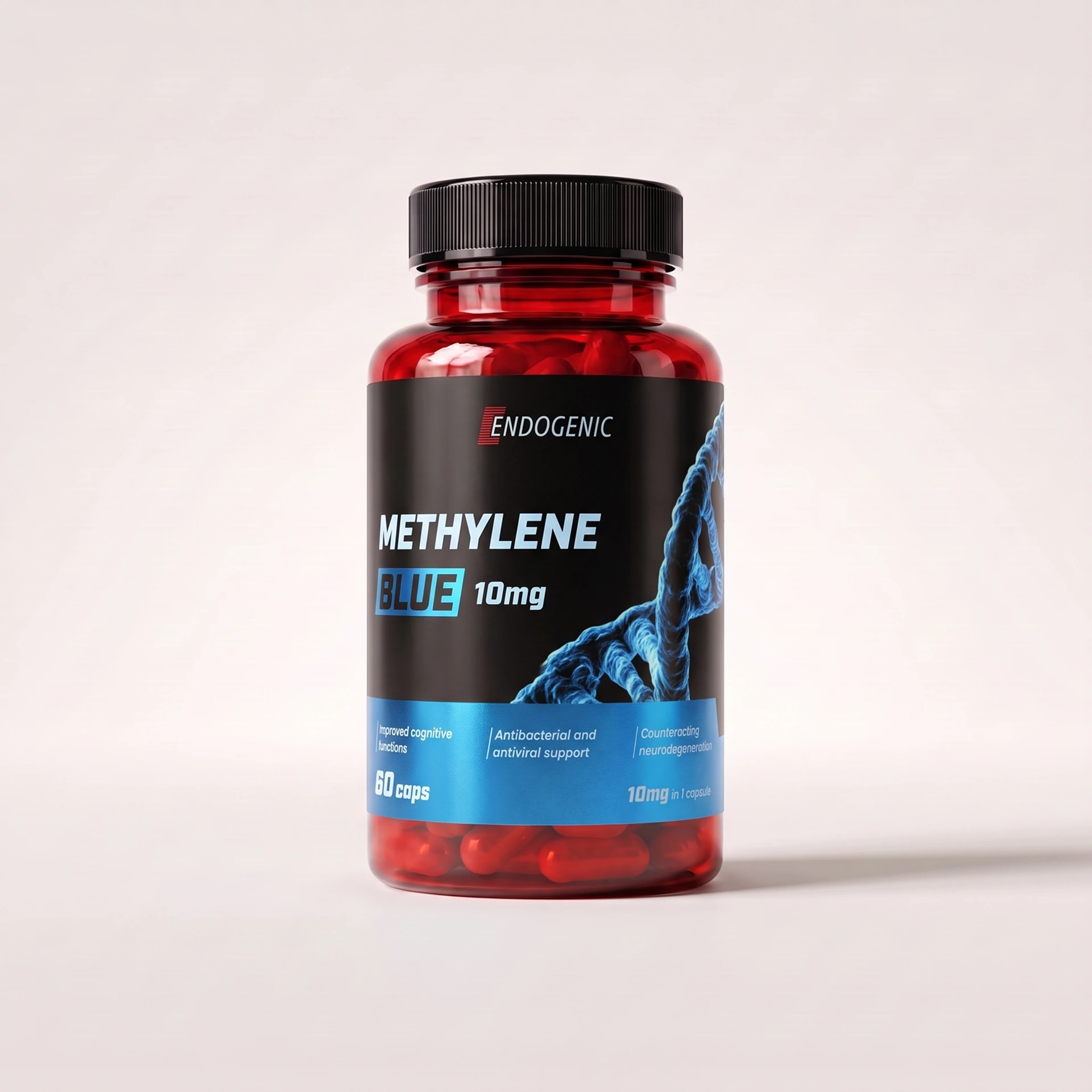
This is the biochemical justification for the rule “little, not much” — escalation not only fails to help, but turns the compound’s profile against the mitochondrion. A fixed, low dose of 10 mg has structural significance in this context: it keeps the preparation in the ascending phase of the curve.
Reversible MAO inhibition — the source of the most dangerous interaction
At higher doses methylene blue inhibits monoamine oxidase — the enzyme that breaks down serotonin, noradrenaline and dopamine. Ramsay et al. (2007) demonstrated that it is a potent MAO-A inhibitor with an affinity close to that of classical MAOIs, which makes the interaction with serotonergic drugs a real, not theoretical, threat. The mechanism is simple and brutal: if MAO is blocked while a serotonergic drug simultaneously increases the concentration of serotonin in the synapse, serotonin has no way to be broken down — and accumulates to a toxic level.
This is the biochemical basis of serotonin syndrome and the reason the FDA in 2011 warned against combining methylthioninium with serotonergic drugs.
Neuroprotection in models — tau aggregation, memory, cerebral blood flow
In vitro, methylene blue inhibits the aggregation of tau protein and β-amyloid — two markers of neuropathology. It is precisely this direction that led to the development of the derivative LMTM / hydromethylthionine (leuco-methylthioninium), which advanced to clinical trials in Alzheimer’s disease (the TauRx line; Gauthier et al. 2016). It is worth being precise: it was the derivative, not methylene blue itself in chloride form, that was the subject of large clinical trials, and the results of those trials remain a matter of methodological debate.
Regardless of this, in preclinical models of Parkinson’s and Alzheimer’s, methylene blue itself showed neuroprotective action — it limited neuron loss and markers of oxidative stress and improved memory parameters in rodents (Tucker et al. 2018). In humans, a single imaging study (Rodriguez et al. 2016, multimodal fMRI) reported an effect of a low dose on the activity of areas associated with working memory and consolidation.
With its neurotrophic and neuroprotective profile, methylene blue fits into the broader shelf of compounds studied for cognitive function — mechanistically distinct, but considered in a similar context, such as DIHEXA with its synaptogenic profile (the HGF/c-Met axis) or 9-MBC as a dopaminergic neuroprotectant from preclinical studies of Parkinson’s disease.