The core sequence is identical – Ala-Glu-Asp-Gly (AEDG). The difference is the acetyl group attached to the N-terminal alanine (Ac-Ala-Glu-Asp-Gly). Acetylation “closes” the free amino group that aminopeptidases recognize, so the acetylated variant is designed to be more proteolytically stable and potentially better at penetrating membranes. In research work, this means a tool for systems where the native peptide is too unstable. Methodological caveat: direct comparative data on the stability and activity of both forms remain limited.
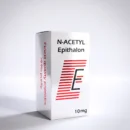
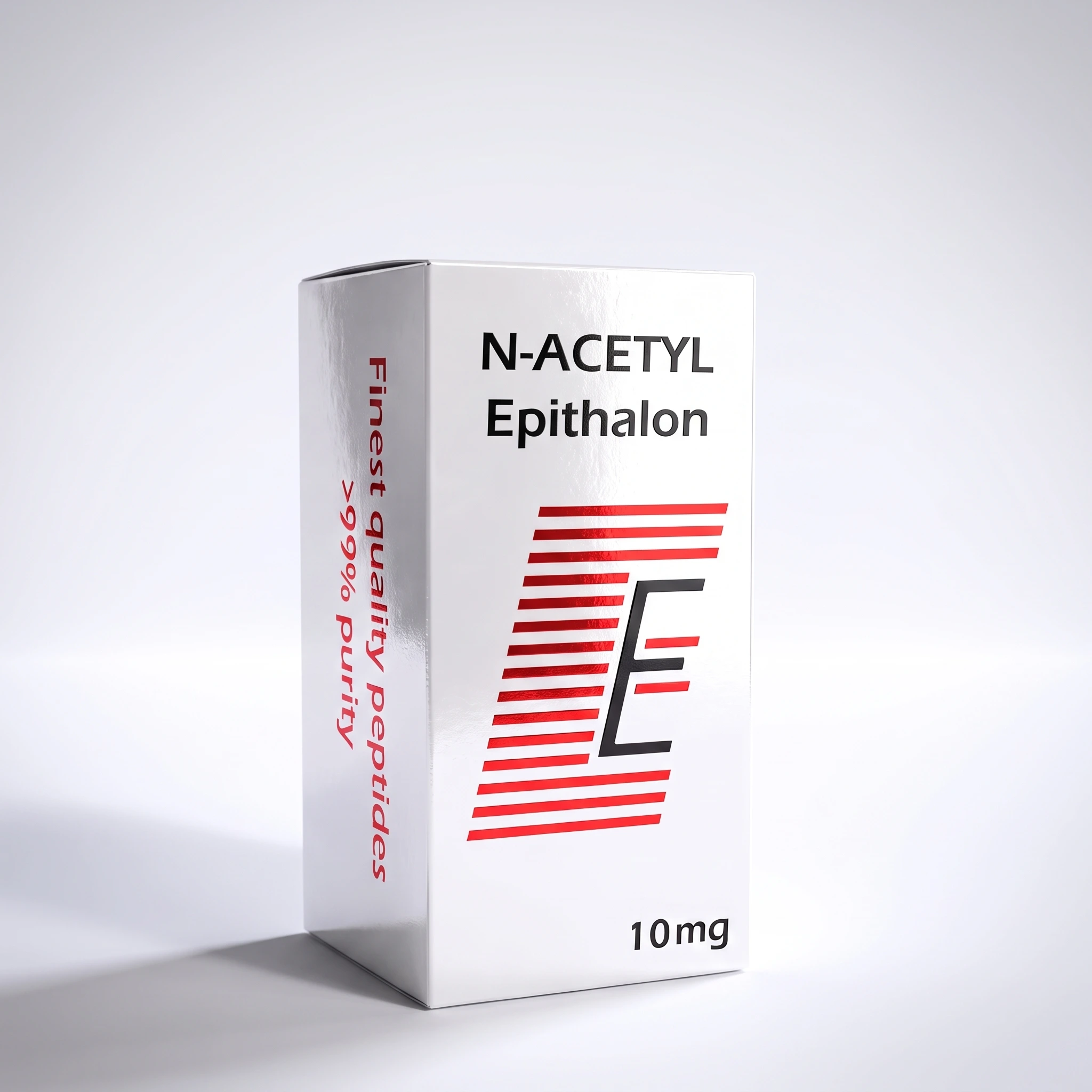
N-Acetyl Epithalon 10 mg
N-Acetyl Epithalon (Ac-Ala-Glu-Asp-Gly) — an acetylated variant of the pineal tetrapeptide AEDG from the Chawinson school of peptide bioregulation, with an acetyl group stabilizing the N-terminus against aminopeptidases. Core examined in vitro on telomerase induction (hTERT) and in rodent models on circadian rhythm and aging markers. Chemical reagent intended exclusively for laboratory research – Research Use Only.
37,99 €
With code BLACK: 30,39 €
Lowest price in the 30 days before the discount:
37,99 €
Fast shipping
Free delivery from 350 €
Returns policy
N-Acetyl Epithalon - acetylated pineal tetrapeptide AEDG, longevity reagent RUO
- N-Acetyl Epithalon: acetylated variant of the AEDG tetrapeptide.
- Vial of lyophilisate with a nominal content of 10 mg, for reconstitution.
- Research Use Only reagent, not for use in humans or animals.
Chemical reagent intended exclusively for laboratory tests (Research Use Only). It is not a medicinal product, dietary supplement or food. It is not intended for use on humans or animals. Sales only to registered research units and laboratories.
Tetrapeptide Epithalon (Ala-Glu-Asp-Gly, AEDG) has one technical problem, known to anyone who works with short acidic peptides: the free N-terminus is susceptible to cleavage by aminopeptidases, and the four amino acids degrade rapidly in the biological environment. Peptide chemistry’s response to this fragility is chain end modification. N-Acetyl Epithalon is a native AEDG tetrapeptide with an acetyl group attached to the N-terminal alanine residue – a modification that masks the free amino group and is expected to increase the molecule’s resistance to proteolysis and, potentially, its membrane penetration.
N-terminal acetylation is one of the best described stabilizing treatments in peptide chemistry. The logic is simple: aminopeptidases recognize the free N-end, and its “closure” with an acetyl group deprives the enzyme of a point of attachment. This is why acetylated variants of short regulatory peptides emerge as research tools where the native sequence proves too unstable for a given experimental system.
The core of the activity remains the same as in native Epithalon — the AEDG sequence and the entire body of observations around it: telomerase induction in vitro, circadian modulation, geroprotective profile in rodent models. N-Acetyl Epithalon inherits this literature context, but adds its own methodological caveat, to which we will return: head-to-head comparative data between the acetylated and native variant are limited, and the stability advantage remains largely a chemical premise, not a clinically proven benefit. This reagent is supplied in a lyophilisate in a vial, to be reconstituted with bacteriostatic water before experimental work.
Epithalon - pineal peptides and the Chawinson school
The pineal gland (epiphysis) is a small gland in the midbrain that synthesizes melatonin and participates in the regulation of the circadian rhythm and the neuroendocrine axis. In models of aging, a gradual decline in its secretory activity is observed – a phenomenon that the Russian school of molecular gerontology has put at the center of the hypothesis of an “aging clock” controlled by the pineal gland.
From this hypothesis arose the concept peptide bioregulation — St. research school Petersburg Institute of Bioregulation and Gerontology (Vladimir Khavinson, Vladimir Anisimov). Assumption: short regulatory peptides, representing fragments of endogenous tissue extracts, modulate gene expression in a tissue-specific manner. Ephthalamine (pineal gland extract) was the prototype; Epithalon (AEDG) – its synthesized, standardized analogue with a defined sequence of four amino acids.
N-Acetyl Epithalon is another engineering step in the same line: the same sequential core, additionally chemically stabilized at the N-terminus. The world of pharmacology is watching the AEDG core for three reasons. First, as a research tool telomerase regulation in somatic cells – an area where there are few small-molecule modulators of hTERT expression. Secondly, as a model compound for chronobiology and the pineal-hypothalamic axis in rodent models.
Third, as a representative of the class of “peptide geroprotectors” – short peptides studied for their effects on aging markers and lifespan in animal models; in the catalog they correspond to a wider shelf research peptides with a regulatory profile. The acetylated variant introduces a fourth, purely methodological thread to this puzzle: the question of whether stabilization of the N-terminus translates into a measurably different pharmacokinetic profile and activity in a given system.
In all these directions, the research material must be chemically repeatable – and here HPLC purity and MS identity confirmation are important, because short peptides are easily contaminated with products of incomplete synthesis, and the acetylation itself requires confirmation by molecular weight.
What is N-Acetyl Epithalon?
Chemically, N-Acetyl Epithalon is a linear AEDG tetrapeptide with an acetyl group at the N-terminus – Ac-Ala-Glu-Asp-Gly.
- Common name: N-Acetyl Epithalon, N-Acetyl Epitalon, Acetylated Epithalon
- Full sequence name: Ac-Ala-Glu-Asp-Gly (N-acetyl-alanyl-glutamyl-asparaginyl-glycine)
- Sequence abbreviation: AEDG (single letter core amino acid code), with N-acetyl modification
- Synonyms: N-Acetyl Epitalon, acetylated epithalamine analogue, stabilized variant of Epithalon
- Class: synthetic regulatory tetrapeptide with N-terminal modification; derivative of native Epithalon (pineal epithalamine analogue)
- CAS number (Epithalon core): 307297-39-8; CAS identifier for the acetylated variant – for verification in the batch COA
- Molar mass (approximate): ~432 g/mol (AEDG core 390.35 g/mol + acetyl group, +42 g/mol relative to native) – value to be confirmed by mass spectrometry in COA
- Supplied form: lyophilisate in a vial; reconstitution with bacteriostatic water; pharmaceutical grade ≥98% HPLC
The native form remains a natural reference point for the acetylated variant – in parallel research protocols it is compared with the classic Epithalon 10mg as a sequential core without N-terminal modification.
Mechanism of action at the molecular level
The AEDG core is described in the literature by several parallel regulatory mechanisms. There is no clearly identified primary receptor – the Chawinson school model assumes direct modulation of gene expression (the “peptide bioregulation” mechanism), and not classic signaling through a membrane receptor. The N-acetyl modification does not change the core sequence, so the proposed mechanisms refer to the same base molecule – provided that the mechanistic data were collected on the native form.
Telomerase activation in somatic cells (in vitro)
The most frequently cited observation for the AEDG core. Telomerase is an enzyme that lengthens telomeres – the end sections of chromosomes that shorten with each somatic cell division, determining the so-called Hayflick limit (finite number of divisions). In human fibroblast cultures, Epithalon induced the expression of the telomerase catalytic subunit (hTERT), which was accompanied by an extension of telomeres and an increase in the number of cell divisions – in the work of Chawinson et al. (2003), the Hayflick limit was described in vitro.
In experimental practice, this means: cells in culture were dividing longer than their “replication clock” would indicate. This is an observation at the cell culture level – not evidence of an organism’s lifespan extension, and comes from research on the native form.
Circadian modulation and melatonin synthesis
As a pineal peptide analogue, the AEDG core in rodent models influenced melatonin synthesis and normalization of the circadian rhythm, especially in older animals with weakened pineal gland function. The mechanism is associated with the pineal-hypothalamic axis. In practice: in aging models, a shift in the melatonin secretion profile towards the nocturnal amplitude characteristic of younger animals was observed.
Proteolytic stabilization as a target of acetyl modification
This is a thread specific to this variant. The free N-end of the short peptide is a place recognized by aminopeptidases – enzymes that cut off subsequent amino acids from the end of the amino chain. N-acetylation attaches an acetyl group to the N-terminal alanine, “closing” the free amino group and depriving the aminopeptidases of a foothold.
The expected result is an extension of the lifetime of the molecule in the biological environment and, potentially, an increase in the lipophilicity of the N-terminus, which is sometimes associated with better membrane penetration. These premises are based on general peptide chemistry; direct comparative data on the stability and bioavailability of N-Acetyl Epithalon relative to the native form remain limited and require separate experimental verification in a specific system.
Antioxidant and geroprotective effects (rodent models)
In mouse and rat models (including the SHR mouse), Anisimow’s work described the reduction of oxidative stress markers and the impact on survival parameters in long-term exposure protocols. Some studies reported an extension of the median lifespan and modulation of the incidence of spontaneous cancers in animal cohorts – these observations come mainly from one research stream, concern the native peptide and require independent replication.
Regulation of gene expression (epigenetic mechanism)
The Chawinson school model assumes that short regulatory peptides have activity at the level of gene expression – direct interaction with specific DNA sequences and modulation of the expression of regulatory genes were proposed. This is the core concept of “peptide bioregulation”. The molecular details of this interaction (affinity, sequence specificity) remain a matter of debate and have not been fully characterized outside the original mainstream. It remains an open question whether the presence of the acetyl group influences this proposed interaction with DNA.
IMPORTANT DISTINCTION
Here two separate objections meet, which must not be combined.
The first – telomerase: “telomerase activation” in the context of this description refers only to the observation of the induction of hTERT expression and elongation of telomeres in in vitro human cell cultures (Chawinson et al. 2003). This is not the same as “extending human lifespan”, “reversing aging”, or “lengthening telomeres in a person using the reagent”.
Telomerase activity in isolated cell culture and the effect on the aging process of the entire organism are two separate levels of observation – the first does not prove the second. There are no human clinical trials (RCTs) assessing the effects on in vivo telomere length, aging biomarkers, or survival.
The second one is variant: the quoted observations come from research on native Epithalon, not over the acetylated form. N-acetylation is a theoretical stability improvement; direct comparative studies have not demonstrated that the acetylated variant reproduces the full core activity profile or that its bioavailability is significantly higher in any organism. Communication such as “peptide for longevity”, “cellular rejuvenation” or “telomere lengthening” is contrary to the Research Use Only framework and goes beyond what has been demonstrated in the literature.
Applications in scientific research
N-Acetyl Epithalon is used in research as a stabilized variant of the AEDG core – especially in systems where the native peptide turns out to be too unstable, or where the goal is to compare the profile of both forms. In models in vitro (human fibroblasts, somatic cell lines, cultures with senescence markers) the effect on hTERT expression, telomere length and the number of cell divisions is examined.
In models in vivo (SHR mouse, rat) survival parameters, oxidative stress markers, melatonin secretion profile and the function of the neuroendocrine axis are analyzed in long-term exposure protocols. An intranasal variant is also available: N-acetyl Epithalon spray. Specific research directions include:
- Comparison of the acetylated variant with the native one — measurement of proteolytic stability (incubation with aminopeptidases, plasma, membrane fractions), degradation kinetics by HPLC and comparative activity in the same cellular system; N-Acetyl Epithalon as a tool to test whether N-terminal stabilization translates into a measurable profile difference
- Telomerase regulation and replicative senescence — measurement of hTERT expression (qPCR, Western blot), telomere length (TRF, telomere qPCR), number of cell passages until senescence; AEDG core as a tool to study pharmacological modulation of the Hayflick limit
- Chronobiology and the pineal-hypothalamic axis — melatonin secretion profile, expression of circadian clock genes (Bmal1, Per, Cry), models of rhythm desynchronization in aging
- Geroprotection in rodent models — survival parameters, oxidative stress markers, incidence of cancer in long-term cohorts (Anisimov’s line of research)
- Profile “peptide geroprotectors” — comparison with other short regulatory peptides of the bioregulation school in terms of their impact on aging markers
Summary
N-Acetyl Epithalon (Ac-Ala-Glu-Asp-Gly) is an acetylated variant of the native tetrapeptide Epithalon (AEDG) – a core sequence developed by Vladimir Chawinson as a standardized analog of pineal epithalamine, additionally stabilized by an acetyl group at the N-terminus. The purpose of the modification is to increase resistance to aminopeptidases and, potentially, membrane penetration; this advantage is based on overall peptide chemistry, and direct comparative data to the native form remains limited.
AEDG core observation corpus – telomerase induction (hTERT) and telomere lengthening in vitro (Chawinson et al. 2003), modulation of circadian rhythm and aging markers in rodent models (Anisimov’s line of research) – derived from a native peptide and requires independent replication; no phase III clinical trials in humans for either form. Form: lyophilisate in a vial, reconstitution with bacteriostatic water, HPLC purity ≥98%, MS Q-TOF with confirmation of the acetyl group, COA for each batch.
Regulatory Status – Research Use Only; lack of registration as a medicine; WADA status: class S0 (non-approved substances), prohibited at all times. In research on skin geroprotection, the telomere core is sometimes combined with a copper peptide with a regenerative profile – the catalog corresponds to a ready-made set Epithalon + GHK-Cu, combining the sequential AEDG core with GHK-Cu in one anti-aging protocol.
Bibliography
- Khavinson VK, Bondarev IE, Butyugov AA (2003). Epithalon peptide induces telomerase activity and telomere elongation in human somatic cells. PubMed
- Khavinson VK, Morozov VG (2003). Peptides of pineal gland and thymus prolong human life. PubMed
- Anisimov VN, Khavinson VK, Popovich IG, Zabezhinski MA, et al. (2003). Effect of Epitalon on biomarkers of aging, life span and spontaneous tumor incidence in female Swiss-derived SHR mice. PubMed
- Korkushko OV, Khavinson VK, Shatilo VB, Antonyuk-Shcheglova IA (2006). Geroprotective effect of epithalamine (pineal gland peptide preparation) in elderly subjects with accelerated aging. PubMed
FAQ
This is an open question. Observation of hTERT induction and telomere lengthening in vitro comes from studies of native Epithalon (Chawinson et al. 2003), not the acetylated form. The assumption that N-acetylation preserves the full activity profile of the AEDG core and merely improves stability is a chemical hypothesis – it has not been confirmed by direct comparative studies. Therefore, N-Acetyl Epithalon is sometimes used as a tool for such comparison in a controlled system.
Neither native Epithalon nor its acetylated variant has completed clinical phase III in humans. The data corpus is preclinical models – cell cultures in vitro and rodent models in vivo — coming mainly from the Russian school of peptide bioregulation (Chawinson, Anisimow, Korkuszko). Telomerase activity in isolated cell culture and the effect on aging in the whole organism are two separate levels of observation; the first does not prove the second. The “peptide for longevity” communication is contrary to the Research Use Only framework.
Yes. The List does not name N-acetyl Epithalon, but as a compound with no marketing authorisation in any country it falls under class S0 (non-approved substances) and is prohibited at all times, in and out of competition. Registered athletes (ADAMS) should verify the current list before making any decision and follow subsequent editions of the list. H
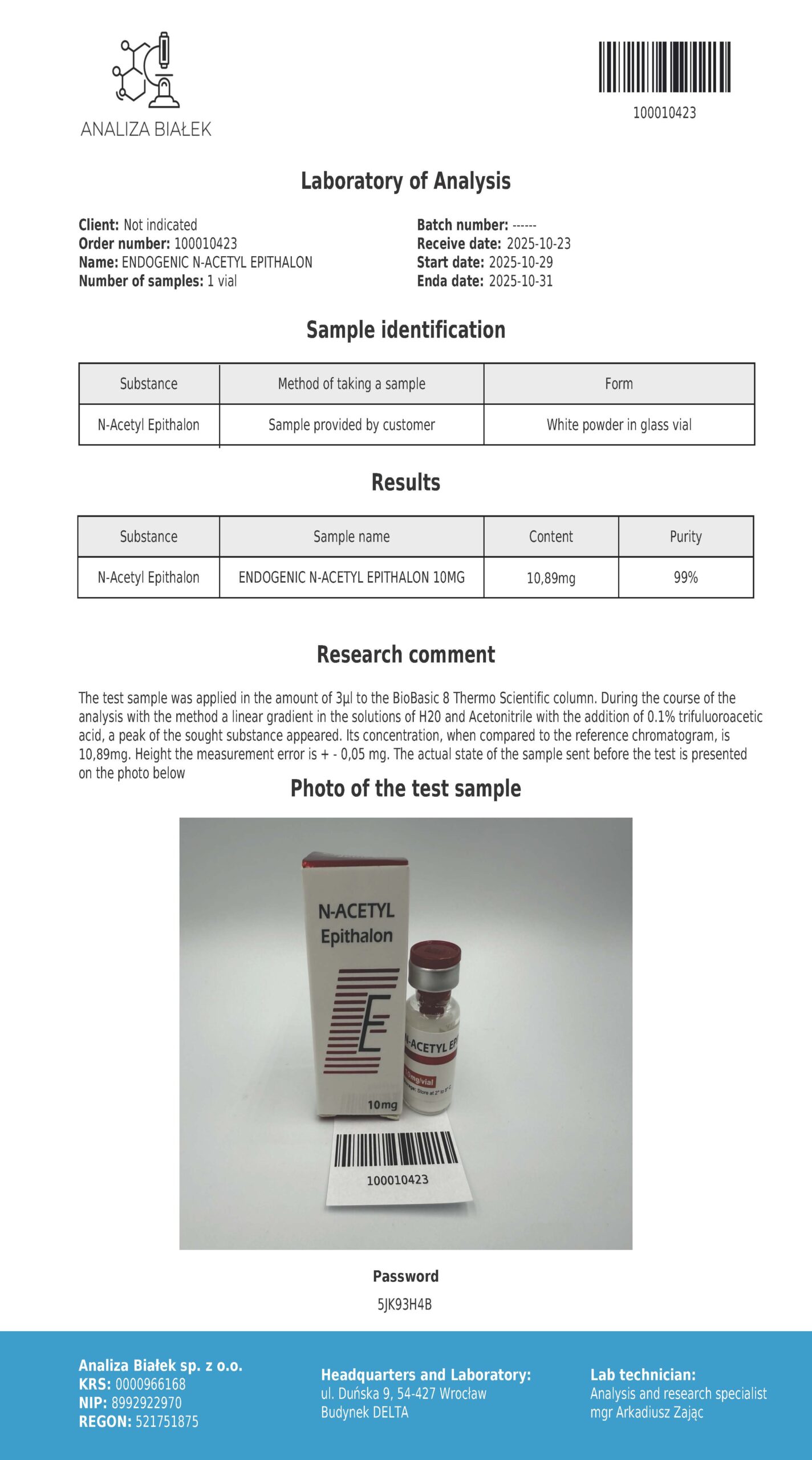
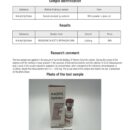
The binding signal is mass spectrometry. The acetyl group adds ~42 g/mol relative to the native core (390.35 g/mol → ~432 g/mol), so Q-TOF MS confirms the presence of modification and distinguishes the product from the non-acetylated form. HPLC additionally detects a possible admixture of the non-acetylated form as a related impurity. The Pro-Body batch COA reports theoretical and measured weights as well as the HPLC result – these are documents that determine the identity of the material.
Store the lyophilisate in the unopened vial protected from light and moisture – long-term recommended -20°C, short-term acceptable 2-8°C (details in the batch COA). After reconstitution with bacteriostatic water, the material is stored at 2–8°C, typically for up to 28 days, and is not subjected to freeze-thaw cycles. In the case of the acetylated variant in longer protocols, it is worth monitoring the stability by HPLC, including for possible deacetylation.
0.0
0 reviews
This product has no reviews yet.
Related products