Skip to content
Black Week: 20% off everything, code BLACK

Search

What are you looking for?

Type at least 2 characters to see suggestions.

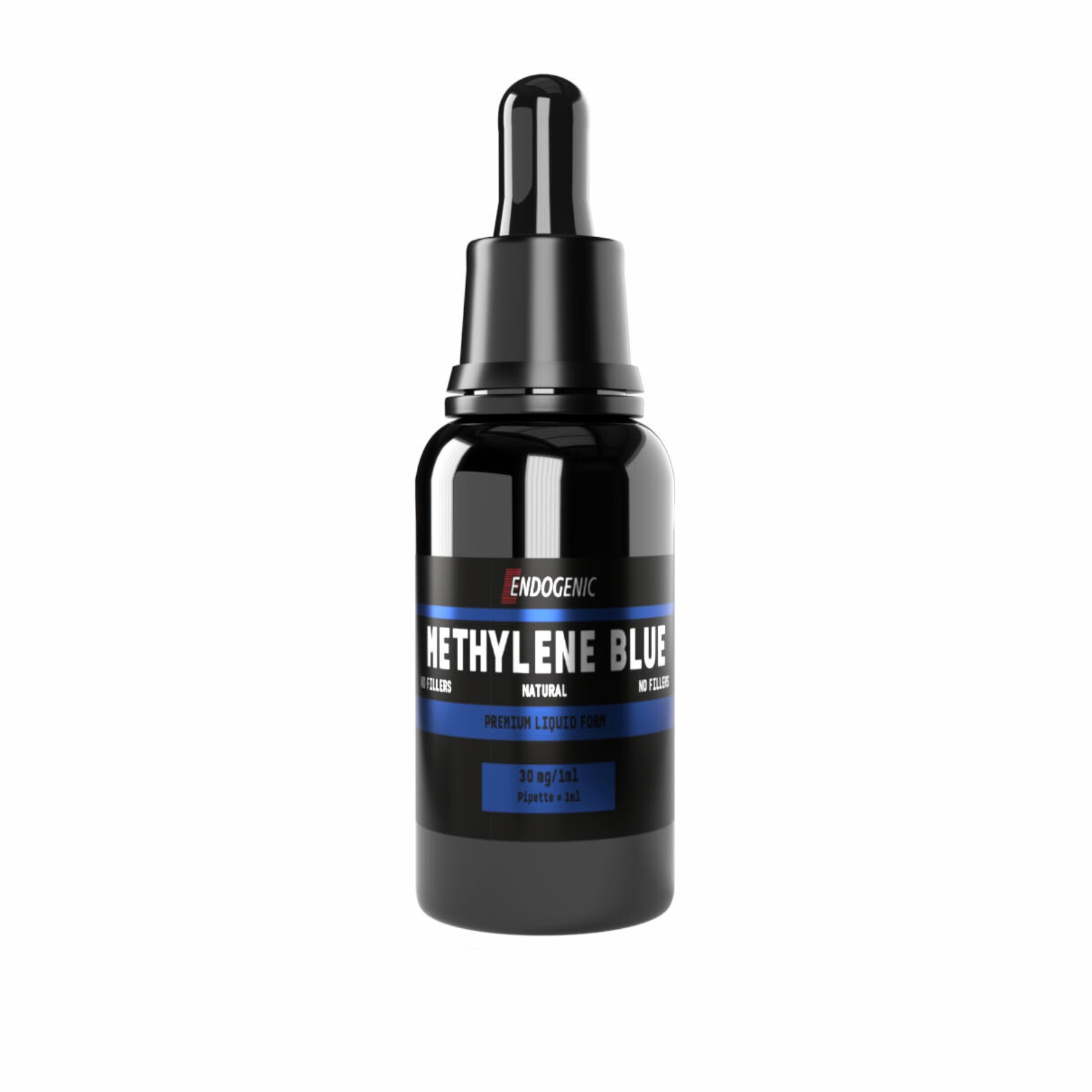
METHYLENE BLUE 30mg/1ml

METHYLENE BLUE 30mg/1ml

Methylene Blue (methylthioninium chloride) 30 mg/ml – oral/sublingual solution in a dropper bottle. A phenothiazine thiazine dye with a mitochondrial profile: at low doses, it acts as an alternative electron carrier supporting ATP production. A specialized nootropic-mitochondrial preparation for adults (21+).

40,99 €
With code BLACK: 32,79 € Lowest price in the 30 days before the discount: 40,99 €

Product unavailable

Notify me when it is back

Leave your e-mail and we will send you one message when the product is available again.

Methylene Blue 30 mg/1 ml — methylene blue, oral solution, nootropic-mitochondrial preparation

  • Methylene blue, methylthioninium chloride.
  • Solution concentration: 30 mg/ml.
  • Not a substitute for the medicine Provayblue/Proveblue.

Product status information

A specialized nootropic-mitochondrial preparation intended solely for adults (21+), for independent risk assessment. It is not a medicinal product or a dietary supplement within the Polish or EU legal meaning. It is not a substitute for the drug Provayblue®/Proveblue® (methylthioninium chloride for intravenous administration, approved for methemoglobinemia). Before making any decision, review the “Legal status” section and the absolute contraindications at the end of the description.

Methylene blue has 130 years of medical history behind it. Paul Ehrlich used it to stain neurons in 1886, in 1891 it became the first fully synthetic drug administered to a human (against malaria), and today — under the names Provayblue® and Proveblue® — it remains an approved intravenous drug for methemoglobinemia. Over the last two decades the same molecule came under the microscope of neuropharmacology for an entirely different reason: at low doses it behaves like an alternative electron carrier in the mitochondrial respiratory chain, bypassing damaged complexes I and III and restoring ATP production where energy metabolism is failing.

This makes methylene blue a compound with two faces. On one hand — a tool studied in models of Alzheimer’s disease, Parkinson’s disease, brain injury and memory deficits, where the central problem is mitochondrial dysfunction. On the other — a substance with a narrow therapeutic window, a hormetic curve (more does not mean better) and one truly dangerous interaction that must not be taken lightly. Coach Marek would put it bluntly: this is not a compound you take “on a trial basis” alongside an antidepressant.

This preparation is a 30 mg/ml (3%) solution in a dropper bottle, of pharmaceutical quality, purity ≥98% HPLC, identity confirmed by mass spectrometry, COA available for every batch. The liquid form with a drop dispenser allows precise measurement of low doses on the order of 5–30 mg — which, with methylene blue, where the difference between a metabolism-supporting dose and a pro-oxidant dose is a matter of a few milligrams per kilogram, is critically important. The product belongs to the broader family of peptides and compounds for brain function offered in the Pro-Body catalog.

Mechanism of action at the molecular level

Methylene blue does not have a single receptor. Its profile is the resultant of the redox-active chemistry of a molecule capable of reversibly accepting and donating electrons — and it is precisely this feature that underlies most of the observed effects.

Alternative electron carrier — bypass of complexes I and III

At the heart of methylene blue’s action is the alternating transition between the oxidized form (MB⁺, blue) and the reduced form (leuco-MB, colorless). In the mitochondrion MB⁺ accepts electrons from NADH and from NADPH dehydrogenase, and then donates them directly to cytochrome c — bypassing complex I and complex III of the respiratory chain. In practice: when these complexes are damaged (by toxins, hypoxia, neurodegeneration), methylene blue acts as a makeshift “detour” for electrons, sustaining flow through the chain and ATP production (Rojas et al. 2012). This is the mechanism that explains why the compound attracts interest wherever the problem is a cellular energy deficit.

Increased complex IV (cytochrome c oxidase) activity — and the hormetic curve

At low concentrations methylene blue raises the activity of complex IV (cytochrome c oxidase) — the terminal enzyme of the respiratory chain — increasing oxygen consumption and ATP synthesis in neurons (Tucker et al. 2018). Here the central pharmacological feature appears: an inverted-U-shaped hormetic relationship. Low doses (in rodent models on the order of 0.5–4 mg/kg) support energy metabolism; above this threshold (about 4 mg/kg) the molecule begins to act pro-oxidatively and inhibits mitochondrial respiration.

This is the biochemical justification for the “little, not a lot” rule — escalating the dose not only fails to help, it reverses the effect.

Antioxidant activity

Paradoxically, the same redox activity within an appropriate concentration range allows methylene blue to scavenge reactive oxygen species (ROS) and nitrogen species (RNS) and to reduce excess nitric oxide. The molecule captures electrons from free-radical reactions, limiting oxidative stress in nervous tissue (Schirmer et al. 2011). Together with the bypass of the respiratory chain, this yields a “dual mitochondrial protection” profile: more ATP, less oxidative damage — within a narrow dosing window.

Weak inhibition of MAO-A and MAO-B — the source of the most dangerous interaction

At higher doses methylene blue inhibits monoamine oxidase — the enzyme that breaks down serotonin, noradrenaline and dopamine. Ramsay et al. (2007) demonstrated that it is a potent MAO-A inhibitor with an affinity close to that of classic MAOIs, which makes the interaction with serotonergic drugs a real, not a theoretical, threat. The mechanism is simple and brutal: if MAO is blocked, and at the same time a serotonergic drug increases the concentration of serotonin in the synapse, the serotonin has no way to be broken down — and it accumulates to a toxic level.

This is the biochemical basis of serotonin syndrome and the reason why in 2011 the FDA warned against combining methylthioninium with serotonergic drugs.

IMPORTANT DISTINCTION

“Weak MAO inhibition” does not mean “safe MAO inhibition.” The term “weak” refers to the dose threshold at which the effect becomes significant — not to the strength of the block itself. At the doses used in a nootropic context, the risk of a serotonergic interaction is real. If you are taking any drug that affects serotonin, this single property disqualifies methylene blue from your protocol — regardless of the potential mitochondrial benefits.

Inhibition of tau and β-amyloid aggregation

Methylene blue in vitro inhibits the aggregation of tau protein and of β-amyloid — two markers of the neuropathology of Alzheimer’s disease (Atamna and Kumar 2010). It is precisely this direction that led to the development of the derivative LMTX/hydromethylthionine (leuco-methylthionine), which advanced to phase III clinical trials in Alzheimer’s disease (Wischik et al. 2015). It is worth keeping precise: it was the derivative, not methylene blue itself in the chloride form, that was the subject of large clinical trials — and the results of those trials remain the subject of methodological debate.

Neuroprotection in models of Parkinson’s and Alzheimer’s disease

Tying together the pathways above, in preclinical models of Parkinson’s and Alzheimer’s disease methylene blue showed neuroprotective action: it limited neuronal loss, improved memory parameters in rodents and reduced markers of oxidative stress (Tucker et al. 2018). The mechanism is the sum of effects — mitochondrial energetics plus antioxidant protection plus an effect on the aggregation of pathological proteins. A related neuroprotective profile — though through a different, dopaminergic mechanism — is shown in preclinical studies of Parkinson’s disease by 9-MBC (9-methyl-β-carboline), a β-carboline compound with a BDNF/GDNF neurotrophic profile.

Protocol for advanced users (21+)

The protocol below describes the way methylene blue is sometimes used in a nootropic-mitochondrial context by adults assessing the risk independently. It is not a medical recommendation. The overriding principle with this compound is: less means better — the hormetic curve punishes dose escalation.

  • Starting dose (tolerance assessment): 5–10 mg once daily. The first attempt is always in the lower range — the goal is to check the individual reaction, not the effect. The low molar mass and the precise dropper allow such a small dose to be measured accurately.
  • Standard dose: 15–30 mg once daily. This is the range in which the profile supporting mitochondrial metabolism dominates (the ascending phase of the hormetic curve).
  • Caution threshold: doses calculated per body mass above ~2 mg/kg approach the area in which the mitochondrial effect begins to reverse (pro-oxidatively). “Forced” escalation is biochemically counterproductive.
  • Route of administration — sublingual vs oral: sublingual administration (a few drops under the tongue, held for 30–60 seconds before swallowing) partially bypasses the first-pass effect through the liver, raising the availability of the active fraction. Oral administration (diluted in water) is simpler, but subjects a larger part of the dose to hepatic metabolism.
  • Dilution: the intensely colored 3% solution is worth dissolving in a glass of water — this makes dosing easier and limits staining of the oral mucosa. A straw reduces tooth staining.
  • Cycle length: typically 4–8 weeks of cyclical use, followed by a break. The long half-life (10–18 h) means the compound accumulates — a break allows the baseline effect to be assessed without the substance.

SCIENTIFIC PERSPECTIVE

Most data on low-dose methylene blue in the context of cognitive and mitochondrial function come from preclinical models (rodents, cell cultures) and individual, small human studies concerning memory and cerebral blood flow. There are no large, multicenter clinical trials confirming a “nootropic” profile of methylene blue in healthy adults. The optimism of the mechanistic data is worth balancing with realism about the strength of the clinical evidence.

Summary

Methylene blue (methylthioninium chloride, CAS 61-73-4) is a thiazine phenothiazine dye with a unique redox profile: at low doses it acts as an alternative electron carrier in the mitochondrial respiratory chain, bypassing damaged complexes I and III and raising the activity of complex IV — which translates into support for ATP production and antioxidant protection in models of neurodegeneration (Rojas et al. 2012, Tucker et al. 2018).

The profile, however, has two limitations of critical importance: the hormetic curve (above ~4 mg/kg the effect reverses) and MAO inhibition, which makes it dangerous in combination with serotonergic drugs (Ramsay et al. 2007). The derivative LMTX/hydromethylthionine advanced to phase III trials in Alzheimer’s disease (Wischik et al. 2015). This preparation is a 30 mg/ml solution, purity ≥98% HPLC, MS confirmation, COA per batch — a specialized nootropic-mitochondrial preparation for adults (21+), not a drug and not a substitute for Provayblue®.

Bibliography

  1. Rojas JC, Bruchey AK, Gonzalez-Lima F (2012). Neurometabolic mechanisms for memory enhancement and neuroprotection of methylene blue. PubMed
  2. Tucker D, Lu Y, Zhang Q (2018). From mitochondrial function to neuroprotection — an emerging role for methylene blue. PubMed
  3. Atamna H, Kumar R (2010). Protective role of methylene blue in Alzheimer’s disease via mitochondria and cytochrome c oxidase. PubMed
  4. Wischik CM, Staff RT, Wischik DJ, Bentham P, Murray AD, Storey JM, et al. (2015). Tau aggregation inhibitor therapy: an exploratory phase 2 study in mild or moderate Alzheimer’s disease. PubMed
  5. Schirmer RH, Adler H, Pickhardt M, Mandelkow E (2011). Lest we forget you — methylene blue…. PubMed
  6. Ramsay RR, Dunford C, Gillman PK (2007). Methylene blue and serotonin toxicity: inhibition of monoamine oxidase A (MAO A) confirms a theoretical prediction. PubMed