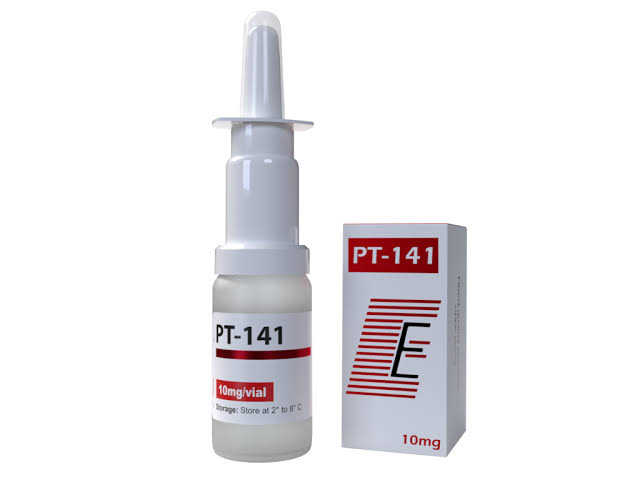
NO. This is a self-preparation kit. It consists of three elements: a vial with lyophilized PT-141 (powder), bacteriostatic water for reconstitution and an empty glass atomizer with a dosing pump. The researcher first reconstitutes the lyophilisate with the included water, then transfers the solution to the atomizer. The concentration of the solution is not factory set – it results from the peptide content in the vial (given in the COA) and the volume of water used for reconstitution. This format reflects the original intranasal route of administration in the history of bremelanotide.
PT-141 Spray
PT-141 nasal (Endogenic line) is bremelanotide — cyclic heptapeptide, metabolite and analogue of Melanotan II with a free acid at the C-terminus, melanocortin agonist with preference for MC4R — supplied as a kit for self-preparation of a nasal spray: vial with lyophilisate, bacteriostatic water for reconstitution and glass atomizer. Research Use Only reagent
40,99 €
With code BLACK: 32,79 €
Lowest price in the 30 days before the discount:
40,99 €
Fast shipping
Delivery options
Free delivery from 350 €
Returns policy
PT-141 Nasal (Bremelanotide) - Nasal Spray Preparation Kit, RUO Reagent
- PT-141 (bremelanotide): a cyclic heptapeptide.
- Kit: lyophilisate, bacteriostatic water and a glass atomizer.
- Research Use Only reagent, not a substitute for Vyleesi.
Product status information
Chemical reagent intended exclusively for laboratory tests (Research Use Only). It is not a medicinal product, dietary supplement or food. It is not intended for use on humans or animals. Sales only to registered research units and laboratories.
Regulatory status (critical)
Bremelanotide is the active substance of a registered medicine — preparation Vyleesi® (subcutaneous injection), approved by the FDA in 2019 for the treatment of hypoactive sexual desire disorder (HSDD) in premenopausal women. Vyleesi® is available only by prescription and requires medical supervision. The PT-141 RUO Pro-Body reagent is not a substitute for the medicinal product, it is not its generic form and does not replace a medical consultation.
A registered drug has a different form of administration (injection), a different approval jurisdiction and a different legal status than a research reagent for intranasal administration. Marketing the product as “Vyleesi without a prescription”, “libido peptide”, “erection enhancer” or “desire remedy” is contrary to the Research Use Only framework.
Bremelanotide (PT-141) began its career not as an injectable drug, but as an intranasal drug candidate. Palatin Technologies, the company that developed this molecule from the Melanotan II metabolite, conducted the original clinical program based on nasal spray — this was the first development pathway for bremelanotide, explored in early phases I and II. Intranasal bremelanotide underwent a series of studies on sexual dysfunction before the program of this form of administration was suspended due to a safety signal: a transient increase in blood pressure in some subjects.
Only after this did Palatin redesign the development to subcutaneous injection, which ultimately led to the registration of Vyleesi®. This reagent from the line Endogenic precisely reproduces the original route of administration from the history of the compound – it is supplied as a kit for self-preparation of nasal spray: vial with bremelanotide lyophilisate, bacteriostatic water for reconstitution and a glass atomizer with a dosing pump.
This is not a ready-to-use solution: the researcher first reconstitutes the lyophilized product with the included water and then fills the atomizer, preparing the solution for intranasal administration. This format refers to the intranasal administration of regulatory peptides – a route in which the peptide is absorbed through the nasal mucosa into the systemic circulation, with partial nose-to-brain transport along the olfactory and trigeminal nerves.
In the Pro-Body catalog it is adjacent to other peptides for libido studied as reference compounds on central and peripheral pathways of sexual function. Unlike the pan-agonist Melanotan 2 PT-141 is an agonist with a preference for the MC4R receptor — a central nervous system receptor associated with central sexual arousal pathways. Purity verified by HPLC ≥98%, identity confirmed by mass spectrometry, COA available for each batch.
REGULATORY STATUS
Bremelanotide is the active substance of Vyleesi® (FDA 2019, HSDD in premenopausal women, subcutaneous injection form). Bremelanotide for intranasal administration is not registered as a drug in the EU or the USA – Palatin’s original intranasal program was discontinued due to a transient increase in blood pressure. The PT-141 RUO reagent is a research material, not a registered drug and not its substitute. Bremelanotide is currently not on the WADA Prohibited Substances List (as of 2024) – registered athletes (ADAMS) should verify the current list.
Melanocortin system, MC4R and central arousal
The melanocortin system is one of the most extensively branched signaling pathways in mammals: one family of peptides (melanocortins) and five receptors (MC1R–MC5R) controlling processes as diverse as skin pigmentation, appetite, inflammation, libido, and sebaceous gland secretion. All melanocortins (α-MSH, β-MSH, γ-MSH and ACTH) are formed from one protein precursor – proopiomelanocortin (POMC) — through enzymatic post-translational cleavage.
Melanocortin receptors belong to the class A of G protein-coupled receptors (GPCRs); their activation increases the intracellular cAMP concentration through adenylate cyclase and triggers the PKA pathway. From a bremelanotide perspective, the primary receptor is MC4R — located primarily in the central nervous system, including the hypothalamus. MC4R participates in the regulation of energy balance (appetite suppression) and, what is important for the PT-141 profile, in central modulation of sexual functions.
This excitation pathway is central: it works at the level of transmission in the brain, and not through the peripheral vascular mechanism characteristic of PDE5 inhibitors (sildenafil, tadalafil). This distinction is the basis of an entire line of research on melanocortins in the context of sexual function – bremelanotide models central pathway activation, not vasodilation.
Bremelanotide is directly derived from Melanotan II. Chemically, it is its metabolite and analogue: it differs in the C-terminal end of the cyclic peptide core – bremelanotide has a free carboxyl group (–COOH) where Melanotan II has an amide group (–NH₂). This seemingly minor difference shifts the selectivity profile: from a pan-agonist of the entire system (MT-II) towards an agonist with a preference for MC4R with weaker activity on MC1R, and therefore with lower pigmentation potential.
What is PT-141 (Bremelanotide)?
Chemically, PT-141 is a cyclic heptapeptide, an α-MSH analogue with a modified and stiffened core sequence, closely related to Melanotan II.
- Common name: PT-141, Bremelanotide, Bremelanotide
- Chemical name: cyclic analog [Nle⁴,D-Phe⁷]-α-MSH; Melanotan II metabolite/analog with a free acid at the C-terminus
- Synonyms: PT 141, bremelanotide, bremelanotide
- Sequence: Ac-Nle-cyclo[Asp-His-D-Phe-Arg-Trp-Lys]-OH
- CAS number: 189691-06-3
- Molecular formula: C₅₀H₆₈N₁₄O₁₀
- Molar mass: 1025.16 g/mol
- Chemical class: cyclic heptapeptide, melanocortin analogue; melanocortin receptor agonist with preference for MC4R
- Medicinal equivalent: Vyleesi® (bremelanotide, subcutaneous injection; FDA 2019)
- Delivered form: set – vial with lyophilized PT-141 + bacteriostatic water for reconstitution + glass nasal atomizer (for self-preparation of the solution); pharmaceutical grade ≥98% HPLC
- Line: Endogenic
Table of physicochemical characteristics
| Parameter | Value | Notes |
|---|---|---|
| Sequence | Ac-Nle-cyclo[Asp-His-D-Phe-Arg-Trp-Lys]-OH | cyclic heptapeptide, free acid at the C-terminus |
| CAS number | 189691-06-3 | bremelanotide |
| Molecular formula | C₅₀H₆₈N₁₄O₁₀ | free acid (–COOH) |
| Molar mass | 1025.16 g/mol | mass for verification in the batch COA |
| Difference from MT-II | C-terminus: –COOH (PT-141) vs –NH₂ (MT-II) | shifts selectivity towards MC4R |
| Supplied form | set: lyophilisate vial + water + glass atomizer | for reconstitution and preparation of the nasal solution by the investigator |
| Purity | ≥98% HPLC | UV detection, per batch verification |
| Development | Palatin Technologies | primary intranasal program phase I/II |
Mechanism of action at the molecular level
PT-141 acts as an agonist of melanocortin receptors with a preference for MC4R. This fundamentally distinguishes it from the parent Melanotan II, which is a full pan-agonist of the entire MC1R–MC5R family. The profile of bremelanotide has been described in research models and clinical literature on the approved drug. Mechanistic profile (observed in research models and clinical literature):
- MC4R-preferred agonism (vs MT-II pan-agonism). Bremelanotide activates melanocortin receptors with a clear preference for MC4R and MC1R, but its functional profile is narrower than that of the MT-II pan-agonist (Molinoff et al. 2003). Changing the C-terminus from an amide to a free acid shifts selectivity toward central receptors, making PT-141 a tool for testing central component of melanocortin signaling, as opposed to the systemic-pigmentation profile of MT-II.
- MC4R in the CNS – central sexual arousal pathways. MC4R in the hypothalamus and related CNS regions is involved in the central modulation of sexual function. Activation of this receptor by bremelanotide in models and clinical studies is associated with stimulation of central — activated at the level of transmission in the brain, and not at the level of the peripheral vascular effect. This is the main pathway on which the development of a registered drug was based.
- Hypothalamic pathway. MC4R signaling in the hypothalamus integrates inputs related to energy balance and sexual function. By reaching these centers, bremelanotide models the activation of the hypothalamic pathway – an element that distinguishes the melanocortin mechanism from mechanisms operating outside the CNS.
- Weaker MC1R activity – less pigmentation than MT-II. Unlike Melanotan II, which strongly activates MC1R on melanocytes (hence its pronounced pigmentation effect), bremelanotide has weaker functional activity on this receptor. In research practice, this means a smaller melanogenic component – PT-141 is a tool targeting the central pathway, not skin pigmentation.
- No vascular mechanism. Bremelanotide does not work by inhibiting phosphodiesterase type 5 (PDE5) or by direct vasodilation. Its mechanism is central, melanocortin — this is the main point that distinguishes this class of molecules from PDE5 inhibitors (sildenafil, tadalafil), which act peripherally at the vascular level. In comparative research on sexual function, this distinction of mechanism is fundamental.
Nose-to-brain mechanism - peptide transport by intranasal administration
The intranasal administration format for which this kit is prepared reflects primary route of administration of bremelanotide in the history of compound. This is a rare situation: for most peptides, the intranasal route is a logistical choice, but for bremelanotide it was Palatin’s first consciously chosen development path – the Phase I/II clinical program for the nasal spray preceded the injectable form.
In the Pro-Body catalog this corresponds to a broader group peptides spray tested by intranasal administration. Most regulatory peptides cross the blood-brain barrier poorly when administered peripherally. Intranasal administration offers an alternative delivery route to the central nervous system (CNS), partially bypassing this barrier. For a peptide with a central profile, such as bremelanotide, this is particularly justified – the main pathway (MC4R in the CNS) is a central target. Two parallel nose-to-brain transport pathways have been described in research models:
- Olfactory pathway (olfactory) — a peptide applied to the olfactory epithelium in the upper part of the nasal cavity can be transported along the olfactory nerves to the olfactory bulb and further to the structures of the forebrain, partially bypassing the systemic circulation.
- Trigeminal nerve pathway — the endings of the trigeminal nerve innervating the nasal mucosa constitute a second route of transport to the brain stem and further structures of the CNS.
In parallel, the peptide is absorbed through the richly vascularized nasal mucosa into the general circulation, from which it can also reach MC4R receptors in the CNS.
Important distinction - PT-141 vs Melanotan II, reagent vs Vyleesi, pressure profile
Three points require clear separation.
First of all, PT-141 is not the same as Melanotan II. Both molecules share a cyclic heptapeptide core, but differ in their C-terminus: PT-141 has a free carboxyl group (–COOH), Melanotan II – group amide (–NH₂). The pharmacological consequence is fundamental. Melanotan II is full MC1R–MC5R pan-agonist — activates the entire melanocortin system, including strongly MC1R (hence its pronounced pigmentation effect).
PT-141 is agonist with preference for MC4R with weaker MC1R activity – a tool targeting the central melanocortin pathway with a smaller pigmentation component. In a research protocol, these are two different tools for two different questions. The pan-agonist is also available in a vial format Melanotan 2 10mg (lyophilisate for reconstitution, freedom to select working concentrations).
Secondly, the PT-141 RUO reagent is not the same as Vyleesi®. Bremelanotide is the active substance of the registered drug Vyleesi® (FDA 2019, HSDD in premenopausal women), but RUO reagent and drug are two separate categories. Vyleesi® is an approved injectable medicinal product, available by prescription, subject to regulatory oversight and summary of product characteristics.
The PT-141 Pro-Body reagent is a Research Use Only material – not a substitute for the drug, not a generic form, not a product for human use. They differ in the form of administration (prepared nasal spray vs subcutaneous injection), legal status and purpose. The same compound in a reconstitution format is available as PT-141 10mg (lyophilisate in a vial).
Third, the pressure profile is a strong safety signal. The transient increase in blood pressure following bremelanotide administration is a documented class effect that led to the discontinuation of the original Palatin intranasal program and is reflected in the warnings of the approved drug characteristics. In the context of RUO reagent, this cardiovascular risk profile is an additional argument for strictly maintaining the Research Use Only framework and against any consumer communication.
Applications in scientific research
PT-141 prepared for intranasal administration is a testing tool central melanocortin signaling component – MC4R-preferred agonist, in a format reflecting the original route of administration from the compound’s history. The kit format adds the dimension of examining the intranasal route for a centrally profiled peptide. Research directions include:
- MC4R receptor pharmacology — receptor affinity, functional selectivity and kinetics of cAMP activation in systems expressing recombinant melanocortin receptors (HEK293 lines transfected with MCR); bremelanotide as a MC4R-targeting ligand
- Comparative studies of receptor selectivity — PT-141 (MC4R preference, free acid) vs. Melanotan II (MC1R–MC5R pan-agonist, amide) vs. selective MC1R ligands; mapping of functional profiles within the family
- Central pathways of sexual arousal — in vivo models of central modulation of sexual functions by MC4R in the CNS, as opposed to vascular mechanisms (PDE5)
- Hypothalamic MC4R signaling — integration of energetic and sexual stimuli in the hypothalamus; bremelanotide as a tool for studying the central pathway
- Characterization of intranasal administration — comparative pharmacokinetics of absorption through the nasal mucosa versus parenteral administration; assessment of the systemic fraction and nose-to-brain components for melanocortin peptide with a central profile
- Studies on the cardiovascular profile of melanocortins — influence of activation of the melanocortin pathway on blood pressure (transient increase in blood pressure as a documented class effect)
In studies on peptides with activity in the sphere of sexual functions and bonds, PT-141 is sometimes combined with other native regulatory peptides in intranasal form – the reference point for intranasal administration of a peptide with a social-sexual profile is, for example, Oxytocin spray, studied in models of social bonds and behavior.
Set: vial + water + atomizer - preparation of nasal spray
Unlike the factory supplied solution, this product is a kit for preparing your own nasal solution: vial with bremelanotide lyophilisate, bacteriostatic water for reconstitution and a glass atomizer with a dosing pump. The solution is prepared by the researcher – first he reconstitutes the lyophilisate with water, then transfers the solution to the atomizer. Composition and characteristics of the set:
- Lyophilisate vial: PT-141 peptide in dry form (lyophilized powder); peptide content declared in the batch COA; requires reconstitution before use
- Bacteriostatic water: included solvent for reconstitution of the lyophilisate; a bacteriostat (typically benzyl alcohol) limits the growth of microorganisms in the multiple-take solution
- Glass atomizer: nasal applicator with a dosing pump, refillable; glass protects the solution against light degradation and is chemically neutral towards the peptide; the atomizer is delivered empty – it is filled by the researcher after reconstitution
- Single spray volume: ~100 µl per pump press (approximate value for this type of atomizer – to be confirmed for a given unit)
- Preparation of the solution: after reconstituting the lyophilisate with bacteriostatic water, the researcher transfers the solution to the atomizer; the working concentration results from the peptide content in the vial and the volume of water used for reconstitution – the selection of parameters is up to the researcher
SCIENTIFIC PERSPECTIVE
Because this is a self-preparation kit, the working concentration is not factory set – it results from the volume of bacteriostatic water that the researcher selects during reconstitution and the peptide content given in the COA. Working concentrations should be selected in accordance with the methodology of a given experiment, not analogous to doses of a registered drug or to human administration – the RUO excludes use in humans. The fraction of the peptide absorbed intranasally is not 1:1 comparable to the concentrations from the injection form.
Summary
PT-141 (Bremelanotide) is a cyclic heptapeptide Ac-Nle-cyclo[Asp-His-D-Phe-Arg-Trp-Lys]-OH, a metabolite and analogue of Melanotan II with a free acid at the C-terminus instead of the amide, developed by Palatin Technologies. Unlike the pan-agonist MT-II, it is an agonist with a preference for MC4R — a CNS receptor related to central sexual arousal pathways, with a central mechanism rather than a vascular one (as with PDE5 inhibitors), and with weaker MC1R activity, and therefore a smaller pigmentation component.
Form: kit for self-preparation of nasal spray – vial with lyophilisate, bacteriostatic water for reconstitution and glass atomizer, Endogenic line; the researcher reconstitutes the lyophilized product and fills the atomizer. The format refers directly to the history of the compound – intranasal bremelanotide was the original Palatin development path (phase I/II trials), stopped due to a transient increase in blood pressure, and then development was redirected to an injection that produced the registered drug Vyleesi® (FDA 2019, HSDD in premenopausal women).
The cardiovascular profile – a transient increase in blood pressure – is a real safety signal and a documented class effect. HPLC purity ≥98%, MS confirmation (Q-TOF), COA for each batch. Regulatory status of intranasal administration – Research Use Only; the reagent is not a substitute for the registered drug Vyleesi®; WADA status: not listed (as of 2024).
Bibliography
- Diamond LE, Earle DC, Rosen RC, Willett MS, Molinoff PB (2004). Double-blind, placebo-controlled evaluation of the safety, pharmacokinetic properties and pharmacodynamic effects of intranasal PT-141, a melanocortin receptor agonist, in healthy males and patients with mild-to-moderate erectile dysfunction. PubMed
- Molinoff PB, Shadiack AM, Earle D, Diamond LE, Quon CY (2003). PT-141: a melanocortin agonist for the treatment of sexual dysfunction. PubMed
- Clayton AH, Althof SE, Kingsberg S, DeRogatis LR, Kroll R, Goldstein I, et al. (2016). Bremelanotide for female sexual dysfunctions in premenopausal women: a randomized, placebo-controlled dose-finding trial. PubMed
- Kingsberg SA, Clayton AH, Portman D, Williams LA, Krop J, Jordan R, et al. (2019). Bremelanotide for the treatment of hypoactive sexual desire disorder: two randomized phase 3 trials. PubMed
- Rosen RC, Diamond LE, Earle DC, Shadiack AM, Molinoff PB (2004). Evaluation of the safety, pharmacokinetics and pharmacodynamic effects of subcutaneously administered PT-141, a melanocortin receptor agonist, in healthy male subjects and in patients with an inadequate response to Viagra. PubMed
FAQ
It is the same compound (bremelanotide) in a different route of administration. This kit is prepared for intranasal administration – mirror format primary development path bremelanotide, on which Palatin based early phase I/II trials. The subcutaneous injection form is the route through which Vyleesi® was ultimately approved after the initial intranasal program was halted due to a transient increase in blood pressure.
The pharmacokinetics of both forms are not 1:1 – the fraction absorbed by the nasal mucosa depends on the formulation and the condition of the nasal mucosa. Pro-Body reagent is a Research Use Only material, not a registered drug.
Both molecules share a cyclic heptapeptide core, but differ in their C-terminus: PT-141 has a free carboxyl group (–COOH), Melanotan II has an amide group (–NH₂). Pharmacologically, the difference is fundamental. Melanotan II is full MC1R–MC5R pan-agonist (activates the entire system, including strongly MC1R, hence the clear pigmentation). PT-141 is agonist with preference for MC4R with weaker MC1R activity – a tool targeting the central melanocortin pathway with a smaller pigmentation component. In a research protocol, these are two different tools.
MC4R is located primarily in the central nervous system, including the hypothalamus – a region integrating stimuli related to energy balance and sexual functions. Activation of MC4R by bremelanotide in models and clinical studies is associated with stimulation of central: activated at the level of transmission in the brain, and not by a peripheral vascular mechanism. This fundamentally distinguishes melanocortins from PDE5 inhibitors (sildenafil, tadalafil), which act peripherally at the vascular level. It was the central MC4R pathway that became the basis for the development of bremelanotide.
Bremelanotide is the active ingredient in Vyleesi®, but the RUO reagent and the drug are two separate categories. Vyleesi® is an FDA (2019) approved subcutaneous injection drug product for the treatment of HSDD in premenopausal women, available by prescription only and subject to regulatory oversight and summary of product characteristics. PT-141 Pro-Body reagent is a Research Use Only research material for the preparation of an intranasal solution – not a substitute for the drug, not its generic form, not a product for human use. They differ in the form of application, legal status and purpose. The reagent does not replace medical consultation.
A transient increase in blood pressure is a documented class effect of bremelanotide—and the reason why the original Palatin intranasal program was discontinued (Diamond et al. 2004). In an approved injectable drug (Vyleesi®), this profile is reflected in the limitations of the product characteristics for patients with uncontrolled hypertension and cardiovascular disease. In the context of the RUO reagent, this means that intranasal bremelanotide is an investigational material with a real cardiovascular risk profile – a factor further justifying strict maintenance of the Research Use Only framework.
NO. Bremelanotide is currently not on the WADA Prohibited Substances List (as of 2024). However, registered athletes (ADAMS) should verify the current list before making any decision – the melanocortin activity status of the compound may change in future updates.
0.0
0 reviews
This product has no reviews yet.
Black Week
Black Week deals before everyone else
Sign up for the newsletter and get access to the Black Week promotion before other customers.
By signing up you agree to receive the Pro-Body newsletter with news and promotions. You can unsubscribe at any time with one click in the e-mail. Privacy policy
Related products
GHRP-2 10mg
GHRP-2 10mg
19,99 €